
Disclosure: this article contains affiliate links. If you buy through them, Bright Technology may earn a small commission at no extra cost to you. As an Amazon Associate, we earn from qualifying purchases.
The best action cameras of 2026 shoot better in low light and last longer on a charge than ever, but each one shines in a different job. In this comparison we cover the six most interesting models right now from DJI, GoPro and Insta360, with their official specs and a clear recommendation based on your sport or the kind of video you want to shoot.
- Action cameras compared
- 1. DJI Osmo Action 6: best all-rounder
- 2. GoPro HERO13 Black: the biggest ecosystem
- 3. Insta360 Ace Pro 2: highest resolution
- 4. Insta360 X5: best 360° camera
- 5. DJI Osmo Nano: smallest for hands-free filming
- 6. GoPro HERO: the budget option
- How to choose an action camera
- Common mistakes when buying an action camera
- Which action camera should you choose?
- Frequently asked questions
- Keep reading
Quick answer: the DJI Osmo Action 6 is the best all-round action camera thanks to its large sensor with variable aperture, 20 m waterproofing and long battery life. The GoPro HERO13 Black is the pick for the biggest accessory ecosystem, the Insta360 Ace Pro 2 for 8K recording and the Insta360 X5 if you want 360° video.
Action cameras compared
This table brings together the manufacturers’ figures. Battery life is the maximum claimed and depends heavily on resolution and temperature.
| Model | Sensor | Max video | Waterproof (no case) | Max runtime | Weight | Best for |
|---|---|---|---|---|---|---|
| DJI Osmo Action 6 | 1/1.1-inch, f/2.0-f/4.0 | 4K at 120 fps | 20 m (65 ft) | Up to 4 h | 149 g | All-round and low light |
| GoPro HERO13 Black | 1/1.9-inch | 5.3K at 60 fps | 10 m (33 ft) | 1.5 h at 5.3K | 154 g | Mounts and accessories |
| Insta360 Ace Pro 2 | 1/1.3-inch | 8K at 30 fps | 12 m (39 ft) | About 180 min | 177 g | Highest resolution |
| Insta360 X5 | Dual 1/1.28-inch | 8K 360° at 30 fps | 15 m (49 ft) | Up to 208 min | 200 g | 360° video and travel |
| DJI Osmo Nano | 1/1.3-inch | 4K at 60 fps (120 fps slow-mo) | 10 m (33 ft) | 90 min (200 with dock) | 52 g | Hands-free filming |
| GoPro HERO | No data | 4K | 5 m (16 ft) | No data | 86 g | Tight budgets |
Two figures matter more than they seem: sensor size, which decides quality as the light drops, and depth without a case, which tells you whether you can take it into the sea without extras.
1. DJI Osmo Action 6: best all-rounder
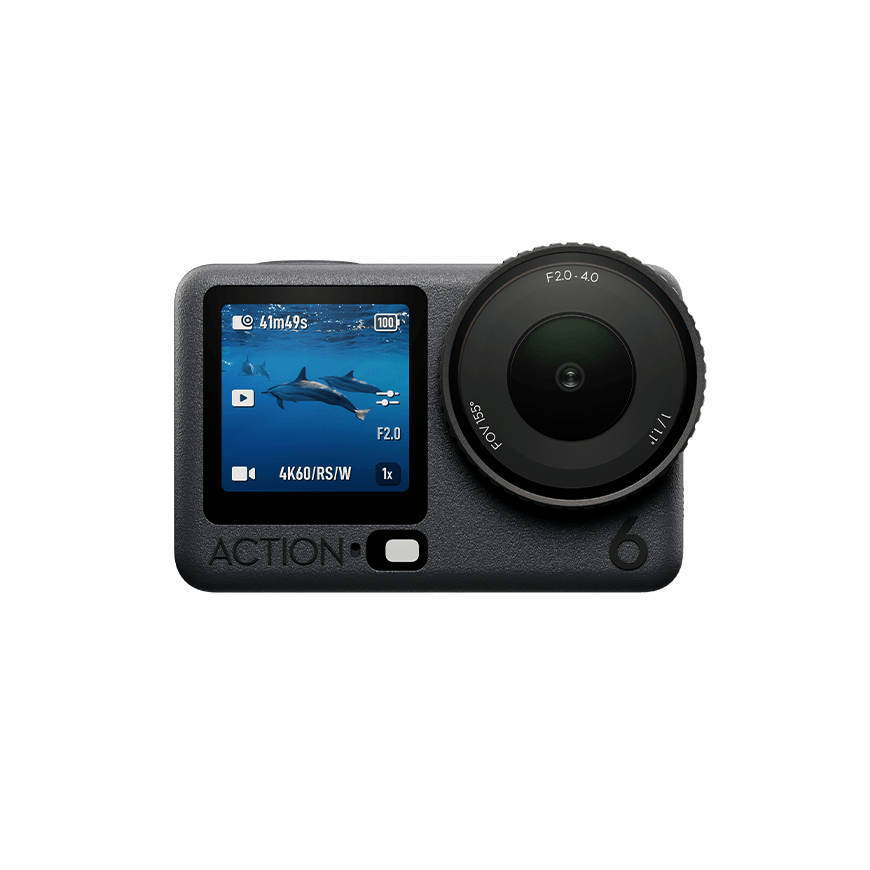
- Sensor: 1/1.1-inch, 38 MP
- Aperture: variable f/2.0-f/4.0
- Video: 4K at 120 fps
- Waterproof: 20 m without a case
- Runtime: up to 4 h
- Internal storage: 50 GB
The Osmo Action 6 is the most complete action camera of 2026. Its square 1/1.1-inch sensor is the largest of the traditional cameras on this list, and a variable f/2.0 to f/4.0 aperture is a rarity in this category.
That combination makes it the best in low light: sunrises, indoors or dense forest. It also goes 20 m underwater without a case, records for up to four hours at 1080p and has 50 GB of internal storage in case you forget your card. It has not launched officially in the US. Curious about what comes next? Read our piece on the DJI Osmo Action 7 release date.
- 1/1.1-inch sensor with variable aperture
- Best in low light
- Waterproof to 20 m
- 50 GB of internal storage
- Fewer third-party accessories than GoPro
- Tops out at 4K
- No official US release
2. GoPro HERO13 Black: the biggest ecosystem
The HERO13 Black is still the reference camera thanks to its ecosystem: there are mounts, housings and accessories for every sport. It shoots 5.3K at 60 fps with a 1/1.9-inch sensor and is waterproof to 10 m.
It added interchangeable HB-series lenses, ND filters, magnetic mounting and a higher-capacity battery than earlier generations. In low light it trails the Osmo Action 6, but in daylight its image and stabilisation are excellent.
- Huge range of mounts and accessories
- 5.3K at 60 fps
- Interchangeable lenses
- Excellent stabilisation
- Smaller sensor, weaker in low light
- Only 10 m without a case
3. Insta360 Ace Pro 2: highest resolution
The Ace Pro 2 is the only traditional camera here that records 8K at 30 fps, with a 1/1.3-inch sensor and 13.5 stops of dynamic range. It also shoots 4K at 60 fps and has a 2.5-inch flip screen, very handy for filming yourself.
It is waterproof to 12 m without a case and its 1,800 mAh battery is rated for about 180 minutes. It is a bit heavier than its rivals at 177 g, but it is the best if you want to crop in the edit without losing quality.
- 8K video for cropping in the edit
- Flip screen for vlogging
- Good dynamic range
- Heaviest of the traditional cameras
- 8K files take up lots of space
4. Insta360 X5: best 360° camera
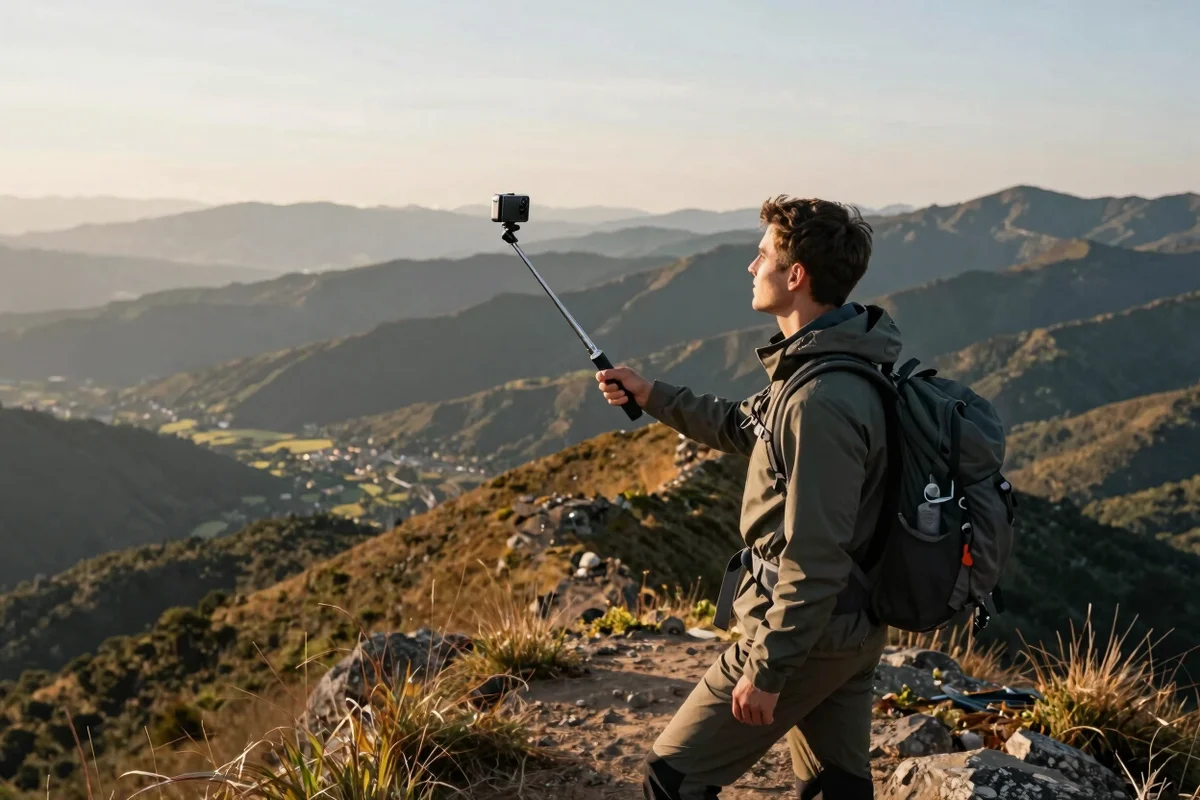
The X5 records everything around it with two 1/1.28-inch sensors in 8K at 30 fps. Later, in the app, you choose the framing: follow a friend, spin the view or create the drone-like third-person shot with the invisible selfie stick.
It is waterproof to 15 m and claims up to 208 minutes in its endurance mode. It is the favourite for travel and sports where you do not know where to point the camera, though it needs more editing time.
- Records in 360° so you frame later
- Invisible selfie stick effect
- Waterproof to 15 m
- Needs more editing
- Exposed lenses can scratch
- Costs more than a traditional camera
5. DJI Osmo Nano: smallest for hands-free filming
The Osmo Nano weighs just 52 g and attaches magnetically to clothing, a cap or any metal surface. It records 4K at 60 fps, with 4K at 120 fps slow motion, and offers D-Log M and 10-bit colour.
Its Vision Dock with a screen works as a viewfinder and extends runtime from 90 to about 200 minutes. It is waterproof to 10 m and ideal for first-person or everyday footage where you do not want the camera to stand out.
- Only 52 g
- Very quick magnetic mounting
- D-Log M and 10-bit
- Short runtime without the dock
- Smaller sensor than the Action 6
6. GoPro HERO: the budget option
The GoPro HERO is the simplest model in the range: it weighs 86 g, records 4K and is waterproof to 5 m. It lacks a front screen and the advanced features of the HERO13 Black, but it works with most of the brand’s mounts.
It makes a good first action camera or a second camera for a helmet or a dog harness. If you want low-light quality or advanced stabilisation, step up a model.
- Very light and compact
- Works with GoPro mounts
- Most affordable on the list
- Only 5 m without a case
- Basic features
How to choose an action camera
- Sensor size: the larger it is, the better at sunset, indoors or underwater.
- Waterproofing without a case: 10 m covers pools and snorkelling; for diving you will need a housing.
- Real battery life: claimed figures are usually at low resolution; expect far less at 4K.
- Stabilisation: every camera here stabilises well; differences show in extreme conditions.
- Mounts: check they exist for your sport before buying.
- Front screen: essential if you vlog or film yourself.
Common mistakes when buying an action camera
- Looking only at resolution: 8K in poor light can look worse than good 4K.
- Forgetting fast memory cards: high-frame-rate 4K needs V30 cards or better.
- Skipping spare batteries: runtime drops a lot in the cold.
- Buying a 360° camera with no time to edit: its big advantage lives in the app.
Which action camera should you choose?
- You want the best for almost everything: DJI Osmo Action 6.
- Your sport needs specific mounts: GoPro HERO13 Black.
- You vlog and like to crop in the edit: Insta360 Ace Pro 2.
- You travel or the action is all around you: Insta360 X5.
- You want to film without being noticed: DJI Osmo Nano.
- Tight budget: GoPro HERO.
Looking for a present? See our list of cool tech gadgets. And if aerial shots are what you are after, the alternative is a drone: our guide to the best camera drones has you covered.
Frequently asked questions
The DJI Osmo Action 6, for its balance of low-light quality, waterproofing and battery life. If accessories matter most, the GoPro HERO13 Black.
DJI wins in low light and battery life with the Osmo Action 6. GoPro wins on the range of mounts and accessories. The choice depends on your sport.
The Osmo Action 6 reaches 20 m without a case. For deeper dives, any of them needs its dive housing.
Yes, if you travel or do sports where the action is all around you and you do not mind editing. To shoot and post quickly, a traditional camera is simpler.
It has not been released officially in the US. It is sold in the UK and Europe.