
- Drone, UAV and UAS: what's the difference?
- How does a drone fly?
- Main parts of a drone
- How a drone works, step by step
- What sensors does a drone use?
- How drone GPS works
- How the remote talks to the drone
- Safety systems and failsafes
- Automation, autonomous flight and AI
- Bottom line
- How drones work: FAQ
- Keep reading
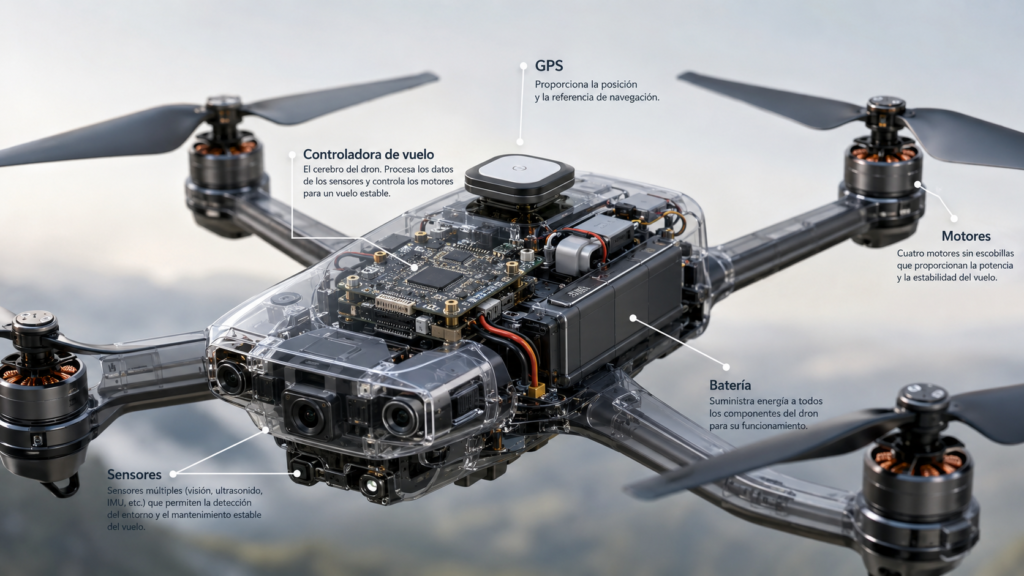
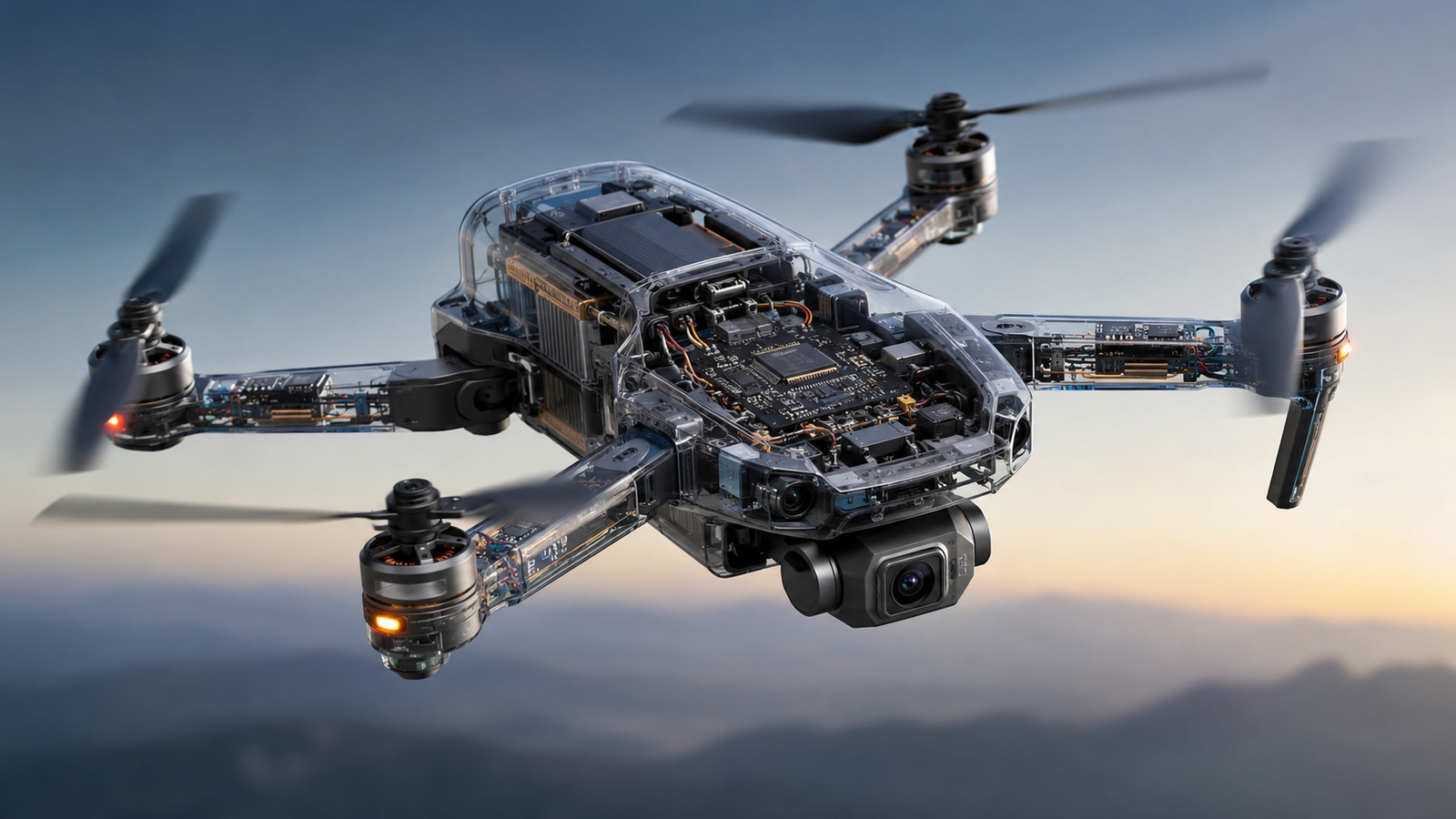
What is a drone? A drone is an aircraft that flies without a pilot on board, either controlled remotely, flying assisted maneuvers or following programmed instructions. But it’s much more than a camera with propellers: to stay in the air it coordinates motors, sensors, positioning systems, wireless links and software that makes hundreds of tiny corrections every second.
When you move a stick on the remote, the command travels to the drone, the flight controller works out the response and the motors change speed. At the same time, sensors check tilt, altitude, heading and position to keep the flight stable. This guide explains each part and how they work together.
Quick answer: a drone flies because its propellers push air down and generate thrust. A flight controller reads data from the IMU, barometer, compass, GPS and vision sensors, compares it with your commands and constantly adjusts each motor’s speed through its ESC. That closed loop is what keeps a modern drone steady.
Drone, UAV and UAS: what’s the difference?
- Drone: the everyday word for an unmanned aircraft.
- UAV (unmanned aerial vehicle): the aircraft itself.
- UAS (unmanned aircraft system): the full system: aircraft, remote or ground station, communication links and everything else needed to operate it.
Not every drone has four propellers. There are multirotors, fixed-wing drones and hybrids. This guide focuses on multirotors, the most common type for consumers.
How does a drone fly?
A multirotor flies on the thrust produced by its propellers. The motors spin the props at high speed, pushing air downward; the reaction force pushes the drone up.
Thrust and weight
To take off, total thrust must exceed the drone’s weight. When thrust equals weight, it hovers; more thrust makes it climb, less makes it descend. On a quadcopter, two propellers spin clockwise and two counterclockwise, which cancels out rotational torque and lets the drone control its heading.
The four controls: throttle, pitch, roll and yaw
- Throttle: overall thrust, to climb or descend.
- Pitch: tilts the drone forward or backward.
- Roll: tilts it left or right.
- Yaw: rotates it around its vertical axis.
To fly forward, for example, the flight controller slightly slows some motors and speeds up others. The drone tilts, and part of the thrust starts pushing it horizontally. Stability depends on these changes being fast, coordinated and proportional to your inputs.
Main parts of a drone
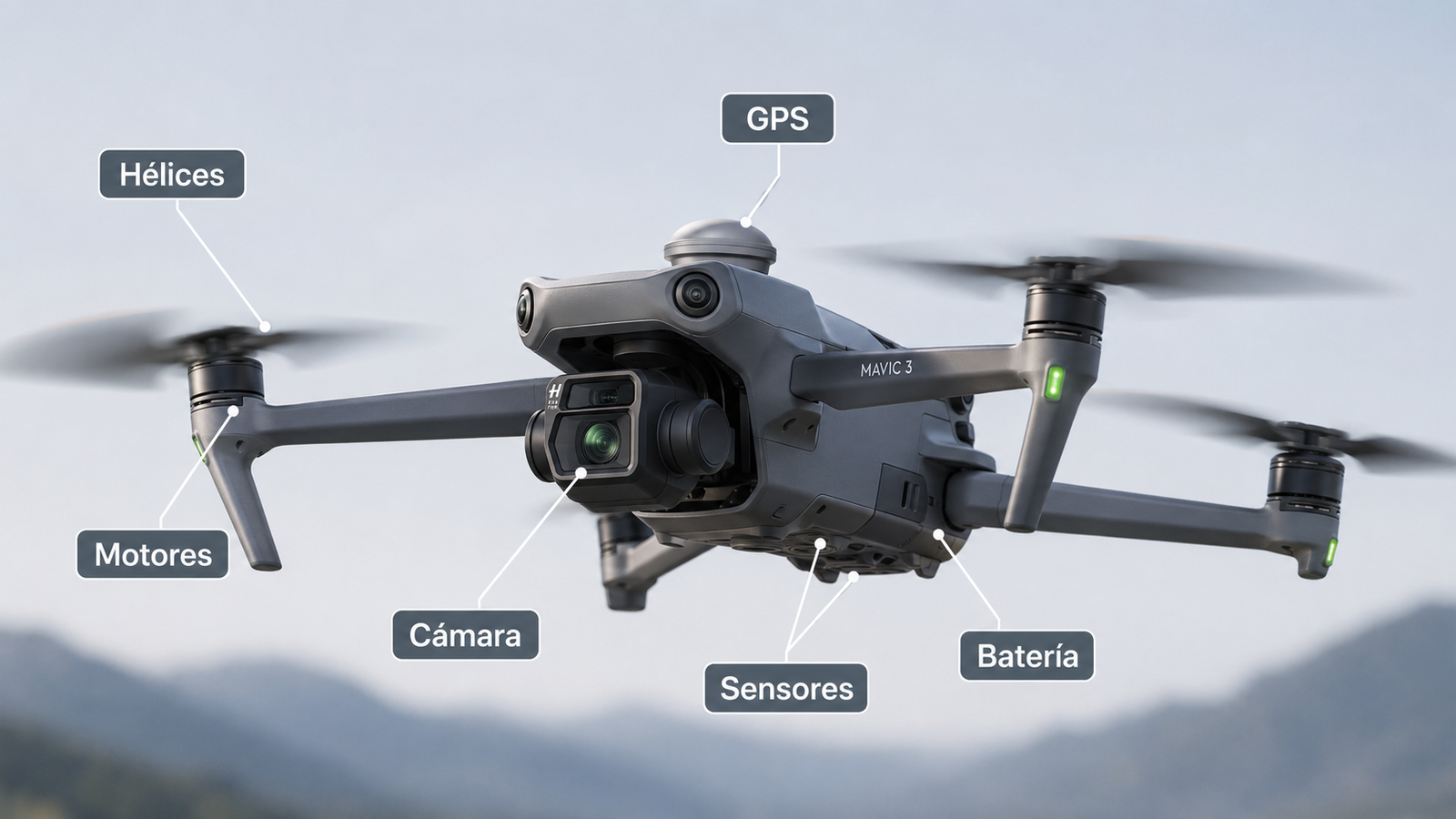
| Component | Main function |
|---|---|
| Frame | Holds and protects the components |
| Motors | Turn electrical energy into rotation |
| Propellers | Generate the thrust needed to fly |
| ESCs | Control each motor’s speed |
| Battery | Powers the motors and electronics |
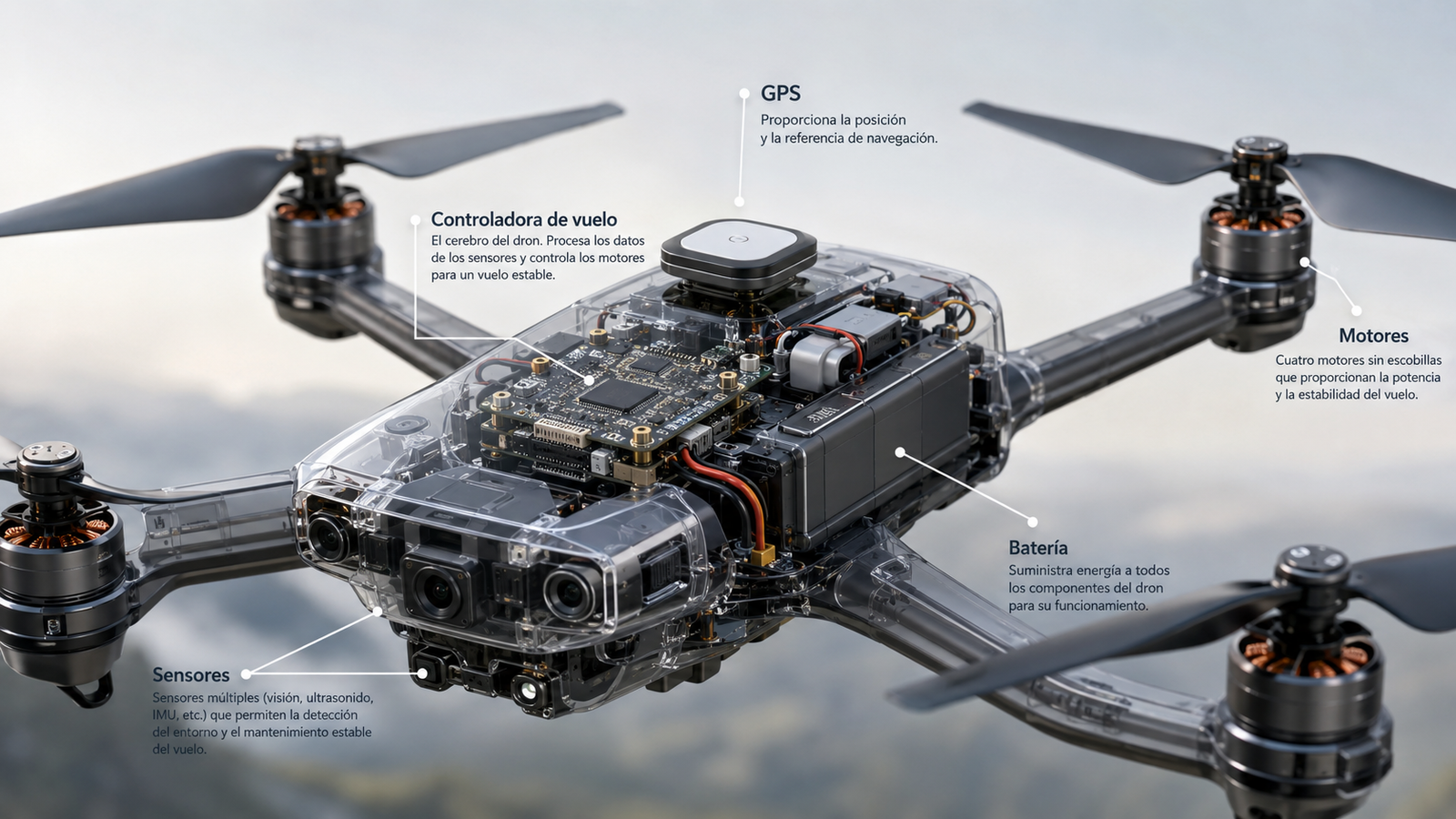
| Flight controller | Processes commands and stabilizes the aircraft |
| IMU | Measures acceleration and rotation |
| Barometer | Helps estimate and hold altitude |
| Magnetometer (compass) | Provides a heading reference |
| GPS / GNSS | Calculates position |
| Receiver and antennas | Receive commands from the remote |
| Video/telemetry link | Sends live video and flight data to the pilot |
| Camera and gimbal | Capture and stabilize photos and video |
| Firmware | Runs the electronics and flight logic |
Frame
The frame carries the motors, battery and electronics. It must be stiff enough to keep its geometry and light enough not to waste energy.
Motors and propellers
Brushless motors turn electricity into rotation; propellers turn rotation into thrust. Their size, shape and pitch affect efficiency, noise, speed and payload.
ESCs (electronic speed controllers)
ESCs regulate the power sent to each motor. Without independent control of every motor, a drone couldn’t stabilize itself or change direction precisely.
Battery
Most drones use lithium batteries (LiPo or Li-ion). Real flight time depends on capacity, weight, speed, temperature, wind, maneuvers, accessories and battery age, so expect less than the advertised figure.
Flight controller
The flight controller is the brain. It receives your commands, reads the sensors, calculates the response and decides how much power each ESC should send. It also manages stabilization, flight modes, positioning, Return to Home, altitude and distance limits, battery warnings and what happens if the signal is lost.
How a drone works, step by step
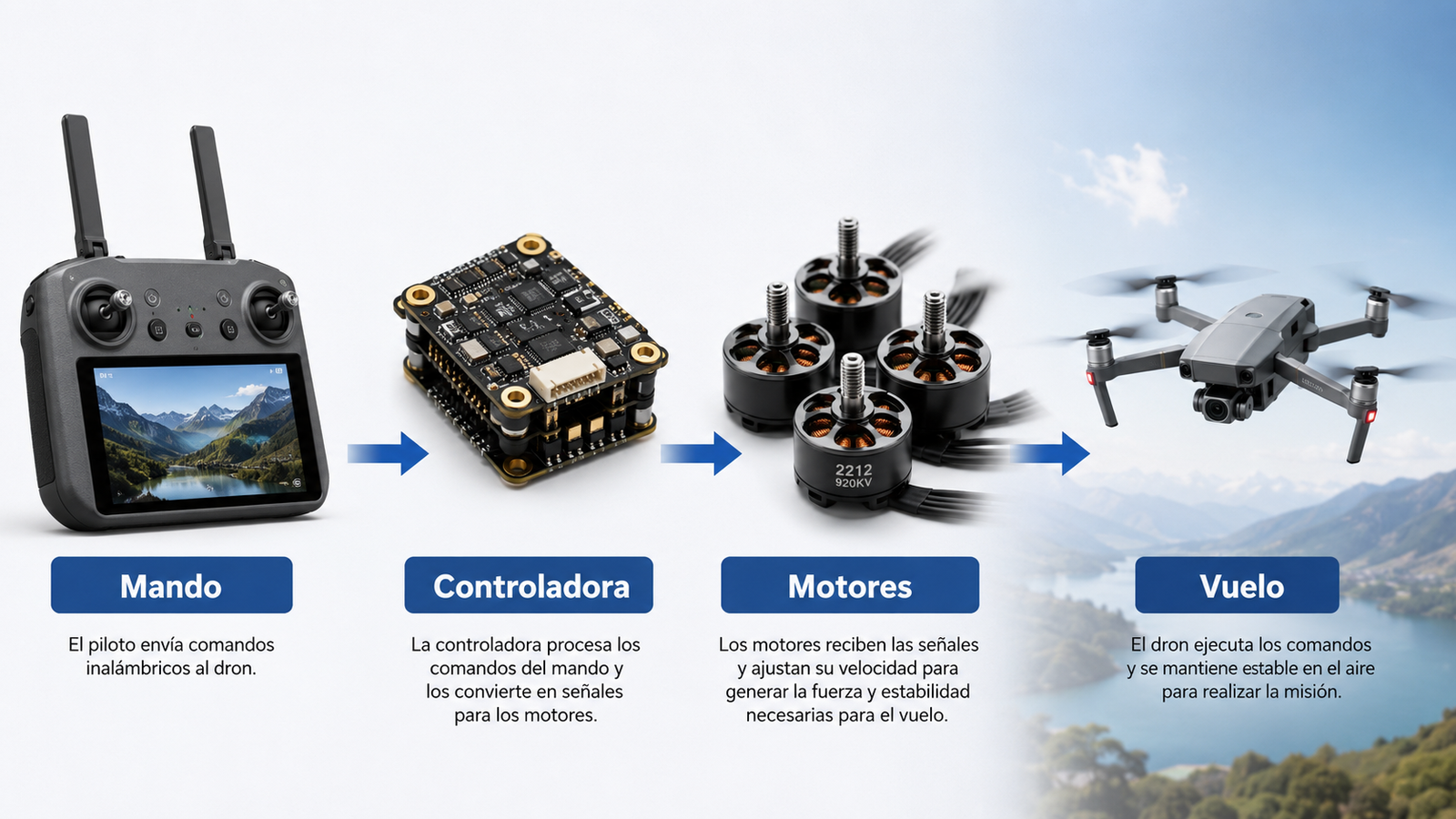
- Startup: the controller checks the battery, sensors, motors, radio link and positioning, and records the home point. Don’t take off until the app confirms everything is ready.
- Command: you move a stick, press a button or choose an automatic mode; the remote converts it into a digital signal and transmits it.
- Processing: the flight controller compares the command with the drone’s current tilt, rotation, altitude, heading, position, speed and battery state.
- Motor control: it sends new instructions to each ESC; differences in motor speed make the drone climb, descend, tilt or turn.
- Sensor correction: sensors check whether the movement matches the request and the controller corrects any deviation, over and over. This closed loop keeps the drone level and in position despite small gusts.
- Telemetry and video: the drone sends battery level, altitude, distance, speed, signal quality, satellite count, warnings and, if it has a camera, live video.
What sensors does a drone use?
IMU: gyroscope and accelerometer
The inertial measurement unit combines a gyroscope, which measures rotation speed on each axis, and an accelerometer, which detects acceleration and helps estimate orientation. The controller fuses both to detect tilt and correct it instantly.
Barometer
Measures changes in air pressure to estimate altitude changes. It helps hold height, though weather can affect its readings.
Magnetometer (compass)
Gives a heading reference from Earth’s magnetic field. Metal structures, cars, power lines, speakers and magnets can disturb it, so avoid taking off from metal surfaces and never ignore compass warnings.
GPS and other GNSS
The GNSS receiver uses satellite signals (GPS, Galileo, GLONASS, BeiDou) to estimate position, enabling position hold, route logging and automatic functions.
Vision and obstacle sensors
Cameras, infrared, ultrasonic and time-of-flight sensors help hold position near the ground, judge distance, detect and brake for obstacles and assist landing. They work worse in low light, over uniform or reflective surfaces, around thin branches, wires, glass and water, and at high speed. Obstacle sensing is an aid, not a guarantee.
How drone GPS works
Many drones use a multi-constellation GNSS receiver. The flight controller combines its position estimate with the IMU, barometer, compass and vision sensors, a process called sensor fusion. This lets the drone hold position, measure distance from home, log routes, fly programmed missions and return home.
Accuracy drops near tall buildings, metal structures, mountains, interference or poor sky visibility. A drone can fly without GPS, but it may drift horizontally, depending on its flight mode and other sensors.
How the remote talks to the drone
- Control link: carries your commands for throttle, direction, heading, camera moves and functions. Range and stability depend on the system, antennas, distance, obstacles and interference.
- Telemetry: sends flight data back to you so you can monitor the aircraft and receive warnings.
- Video link: streams live images to the remote, phone or goggles. Low latency is critical for immersive FPV flying.
Safety systems and failsafes
Safety systems reduce risk but don’t remove the pilot’s responsibility or guarantee recovery from every problem.
- Return to Home (RTH): flies back to a saved point when you trigger it, when the signal is lost for a while or at a set battery level. It needs a valid position, enough battery and a sensible RTH altitude; a drone without forward sensors could hit an obstacle on the way back.
- Signal loss: depending on the model and settings, the drone returns, hovers or lands. Check this before you fly.
- Low battery: warnings, limited functions, a suggested return or an automatic landing. Waiting until the battery is nearly empty is risky in wind or at distance.
- Obstacle avoidance: helps brake or reroute, within limits of range, angle, speed and light. Some modes reduce or disable it.
- GPS loss or interference: the drone falls back on the IMU, barometer and vision sensors and may start drifting with the wind.
Technology never replaces following the rules where you fly. In the US, check FAA guidance for recreational and commercial pilots before your first flight.
Automation, autonomous flight and AI
Not every automatic feature uses artificial intelligence. Holding altitude, flying waypoints or returning home rely on sensors, rules and conventional algorithms. Typical automatic functions include assisted takeoff and landing, position hold, waypoint routes, RTH, orbits and path following.
AI and computer vision handle more complex tasks: recognizing people or objects, following a subject, interpreting images, choosing a path and analyzing mission data. The level of autonomy varies a lot between models; never assume a drone can make safe decisions on its own in every environment.
Bottom line
A drone stays in the air thanks to the coordination of its motors, propellers, ESCs, flight controller and sensors. The controller takes your commands, calculates each motor’s response and uses the IMU, barometer, compass, GNSS and vision sensors to correct the movement. Understanding this chain helps you read app warnings, use automatic features properly and react better to changes in signal, battery or positioning.
How drones work: FAQ
An aircraft without a pilot on board that is flown remotely or follows programmed instructions, using motors, propellers, sensors and a flight controller to stay stable.
Drone is the common term. UAV refers to the aircraft itself; UAS covers the whole system: aircraft, controls, communications and everything needed to operate it.
Its flight controller uses data from the IMU and other sensors to detect any deviation and constantly adjust the speed of each motor.
Yes, but it may not hold its horizontal position automatically. Behavior depends on the flight mode and the other sensors available.
Opposite rotation cancels the torque produced by the motors and lets the drone control its rotation around its vertical axis.
No. Some have no obstacle sensors, and others only detect obstacles in certain directions or conditions.