
There is no single list of the types of artificial intelligence. AI can be classified by its capability (ANI, AGI and ASI), by the technology it uses, by how it learns, by what it produces and by how autonomously it acts. This guide explains each classification, the real difference between ANI vs AGI vs ASI, and which types of AI actually exist today.
- How artificial intelligence is classified
- Types of AI by capability: ANI, AGI and ASI
- ANI vs AGI vs ASI: comparison table
- Types of AI by technical approach
- Types of AI by how they learn
- Types of AI by what they produce
- Types of AI by autonomy: assistants, agents and agentic AI
- Reactive machines, limited memory, theory of mind and self-aware AI
- One AI system can belong to several types
- Which types of AI exist today?
- Types of AI FAQ
- Keep reading
Quick answer: every AI system in use today is ANI (artificial narrow intelligence), even very capable assistants like ChatGPT, Gemini or Claude. AGI (artificial general intelligence) is a research goal with no agreed test, and ASI (artificial superintelligence) is a hypothetical scenario. Beyond that scale, the same system can be generative, multimodal, conversational and agentic at once.
For the big picture on how AI works, its uses, benefits and risks, see our complete guide to artificial intelligence.
How artificial intelligence is classified
No single classification describes every AI system. You can group them by how broad their abilities are, the technology used, how they learn, the output they produce, the data format they process, their autonomy and the function they were built for. One system can fit several categories at once.
| Criterion | Main categories | What it describes |
|---|---|---|
| Capability | ANI, AGI and ASI | How broad and general its abilities are |
| Technical approach | Rules, machine learning, deep learning | The technology used |
| Learning | Supervised, unsupervised, reinforcement, self-supervised | How it learns from data |
| Output | Predictive, generative, classifier | What it produces |
| Modality | Text, image, audio, video or multimodal | What information it processes |
| Autonomy | Assistants, agents, agentic systems | How independently it acts |
Types of AI by capability: ANI, AGI and ASI
The ANI, AGI and ASI scheme compares the breadth of an AI’s abilities with the flexibility of human intelligence. Its boundaries have no universally accepted tests.
What is ANI? Artificial narrow intelligence
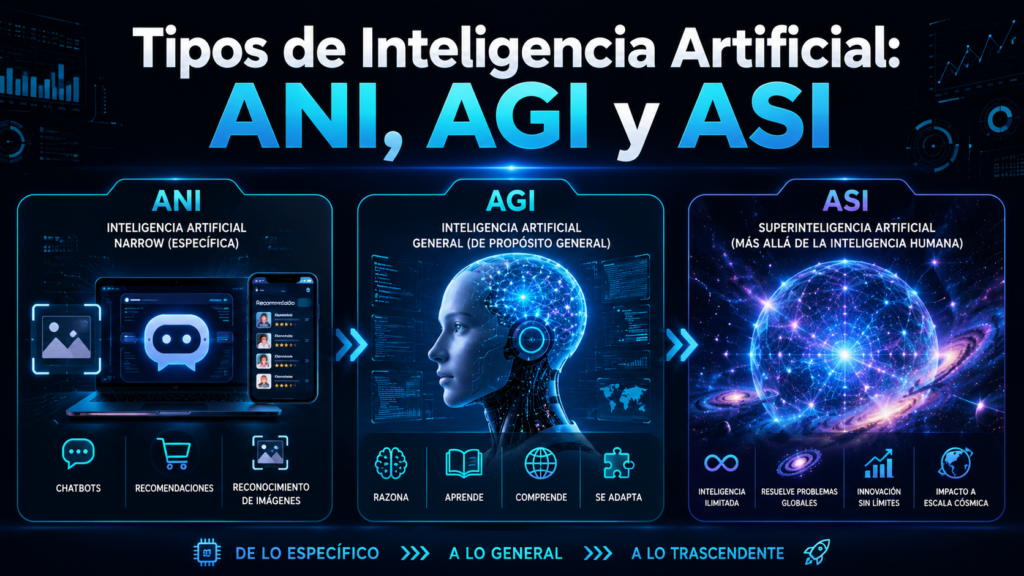
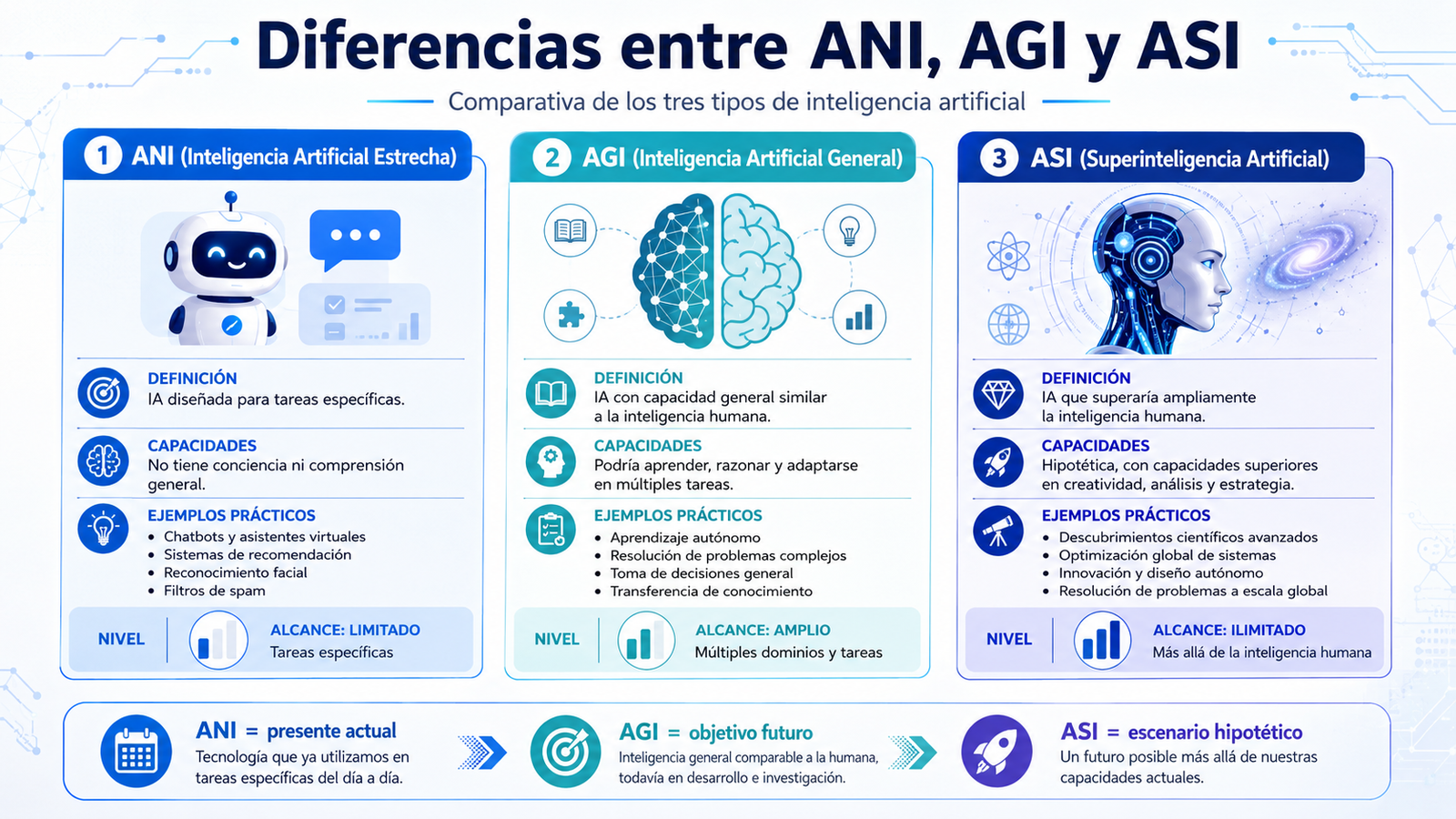
ANI stands for Artificial Narrow Intelligence, also called narrow, weak or specialized AI. It covers systems designed for specific tasks in specific contexts, such as classifying images, recommending products, translating text, recognizing speech, predicting demand or generating content.
“Narrow” doesn’t mean a system can do only one thing. A multimodal model can work with text, images, documents, audio, code and tools, yet it still depends on a defined architecture, data, instructions and environment.
- Designed or trained for particular goals
- Performance varies by task
- Can outperform specialists in specific activities
- Doesn’t generalize without limit to any situation
- Needs evaluation and oversight
- All AI deployed today is usually classed here, even the most versatile systems
What is AGI? Artificial general intelligence
AGI stands for Artificial General Intelligence. The term describes a system able to learn, reason and apply knowledge across a wide variety of tasks and domains, including new situations. A possible AGI would learn new tasks from little information, transfer knowledge between domains and adapt to the unknown.
There is no universal definition or test to certify AGI, so researchers, companies and organizations use the term differently.
AGI doesn’t necessarily mean consciousness. General capability and subjective experience are different things. A system could solve a huge range of tasks without that showing it has emotions or awareness.
Does AGI exist today? There is no widely accepted consensus that any system has reached AGI. Current models have very broad abilities but uneven profiles: they excel at some tasks and fail at others a person would find simple.
What is ASI? Artificial superintelligence
ASI stands for Artificial Superintelligence. It describes a hypothetical scenario in which a system would far surpass human abilities across many disciplines, such as scientific research, engineering and strategy. It is not an available technology, and nobody knows how it would be developed or whether it would emerge from AGI. It is discussed mainly in debates about safety, control, goal alignment and governance, which should be kept separate from the real risks of systems in use today.
ANI vs AGI vs ASI: comparison table
| Feature | ANI | AGI | ASI |
|---|---|---|---|
| Meaning | Narrow, specialized AI | General AI | Superintelligence |
| Status | Real systems in use | Research concept with no universal test | Hypothetical scenario |
| Scope | Defined tasks and contexts | A wide variety of domains | Would far exceed human abilities |
| Transfer between tasks | Limited or variable | Broad | Theoretically superior |
| Adapting to new situations | Depends on the system | Should be high | Hypothetically very high |
| Verified examples | Today’s AI systems, such as ChatGPT, spam filters and recommenders | None universally accepted | None |
| Implies consciousness | No | Not necessarily | Not necessarily |
Don’t read this as an automatic ladder every system must climb. ANI, AGI and ASI are conceptual categories based on breadth of capability. In short: ANI is what exists, AGI is a contested goal and ASI is a scenario.
Types of AI by technical approach
- Rule-based and knowledge-based AI: follows rules, logic or knowledge entered by specialists (“if conditions A and B are met, recommend C”). Traceable and controllable, but thousands of rules are hard to maintain when a problem changes.
- Machine learning: builds models that learn relationships from data instead of hand-written rules.
- Deep learning: a subfield of machine learning based on multi-layer neural networks, common in language, image, audio, video and multimodal tasks. A simpler technique is sometimes faster and more interpretable.
The relationship between these concepts is explained in how artificial intelligence works.
Types of AI by how they learn
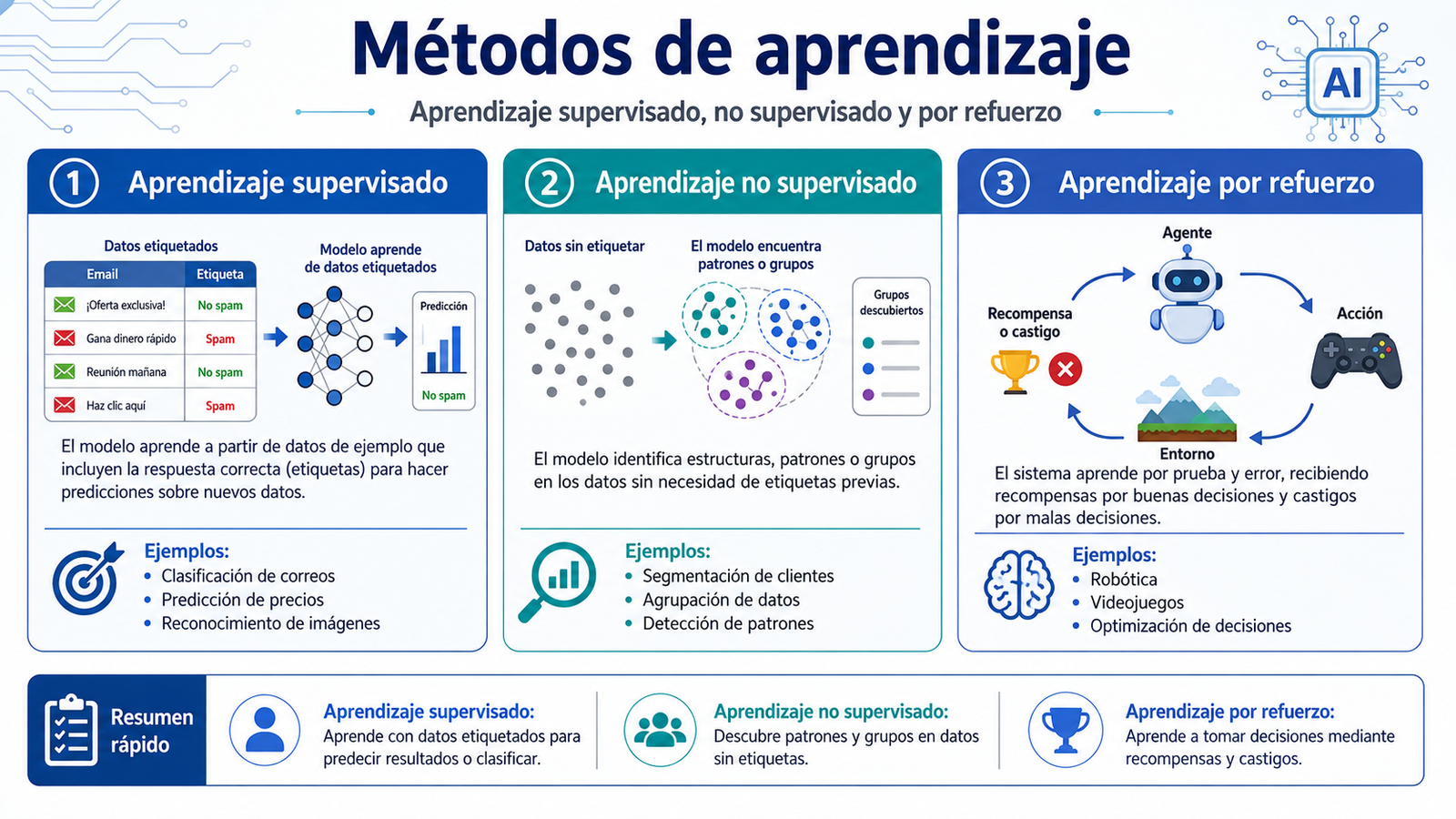
- Supervised learning: learns from examples with a correct answer or label, such as emails marked spam or legitimate. Used for classification and prediction.
- Unsupervised learning: receives unlabeled data and looks for structure or groups, for example to segment customers. A person must interpret what the groups mean.
- Reinforcement learning: an agent learns by interacting with an environment, where actions bring rewards or penalties and the goal is to maximize cumulative reward. Used in robotics and games.
- Self-supervised learning: creates training signals from the data itself without manual labels, for example by predicting a hidden part of a text or reconstructing an incomplete image. It has been important in developing large language models and foundation models.
Types of AI by what they produce
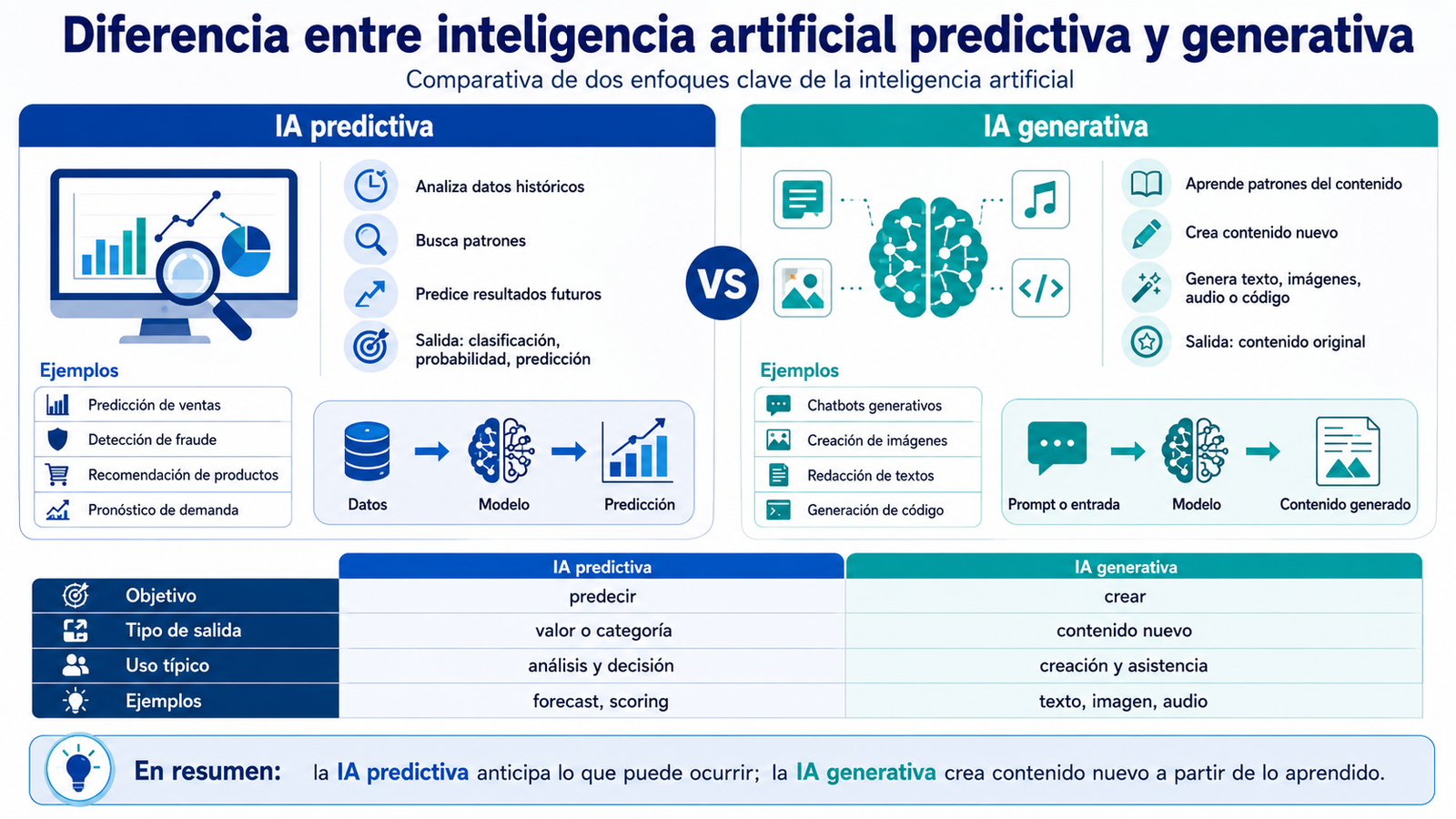
- Predictive AI: estimates a probability, value, forecast or risk, such as sales, default risk or equipment failures.
- Generative AI: produces new content from an input, including text, images, audio, music, video, code, presentations and 3D models. It shouldn’t be confused with AGI, since a generative system can work in many formats and still be narrow AI. Read our guide to generative AI for its models, workings and limits.
- Discriminative or classifier AI: separates examples, assigns categories or estimates the link between input and result, as in filtering email or detecting disease in images.
- Recommendation systems: rank options likely to be relevant in e-commerce, streaming, social media and news.
- Conversational AI: processes language for text or voice interaction, from chatbots to voice interfaces. Not all of it is generative, since some systems follow predefined flows and intents.
- Computer vision: analyzes images and video, for example object detection and quality inspection.
- Robotics and autonomous systems: combine perception, planning and action in the physical world.
See applications of artificial intelligence for the sectors where each category is used.
Types of AI by autonomy: assistants, agents and agentic AI
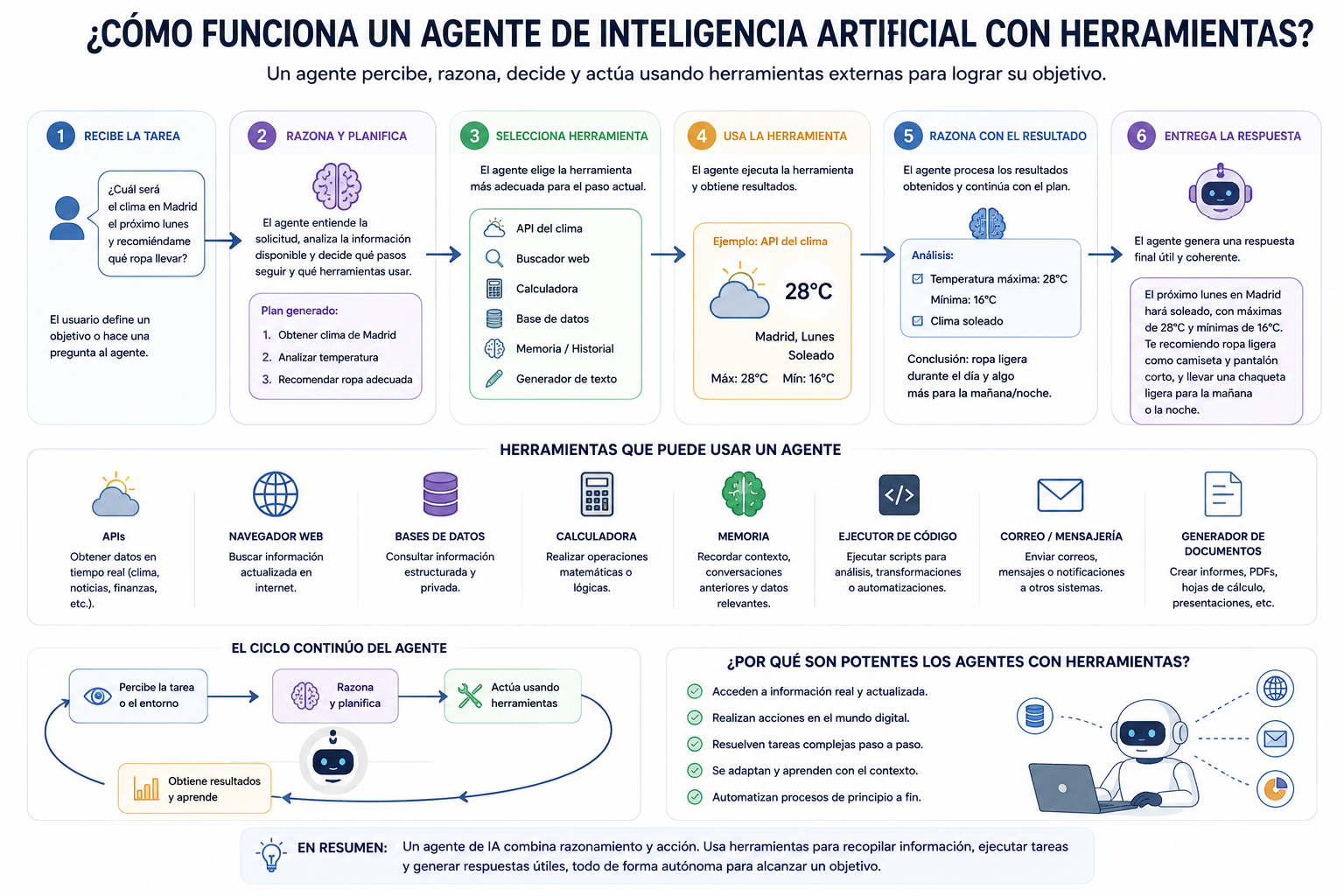
Autonomy describes how far a system can choose and carry out actions without a person confirming each step.
- Assistants and copilots: help a person complete a task while the user keeps main control. The person reviews and decides.
- AI agents: receive a goal, plan several steps, use tools and act on a digital or physical environment, for example running code or querying a database. That doesn’t mean they have a will of their own, because permissions and controls bound them.
- Agentic AI systems: coordinate several agents or processes to meet broader goals over longer periods, splitting tasks and adapting the plan, with human checkpoints.
The more autonomy a system has, the more important permissions, oversight, activity logs and a way to stop it become. These systems appear in AI automation workflows.
Reactive machines, limited memory, theory of mind and self-aware AI
Another popular classification, common in introductory courses, describes four functional levels. Treat it as a conceptual framework, not a universal technical taxonomy.
- Reactive machines: respond to a specific situation without building persistent memory of earlier experience, like classic chess engines.
- Limited memory: uses recent information, context or stored data to respond. Many modern systems fit partly, though the label is too broad to explain their technical differences.
- Theory of mind: the hypothetical ability to interpret others’ emotions, beliefs and intentions.
- Self-aware AI: a system with consciousness or its own subjective experience. There is no accepted evidence that current systems are self-aware, and being able to chat or speak in the first person is not the same thing.
One AI system can belong to several types
These classifications aren’t mutually exclusive. A modern assistant can be described as narrow AI by capability, deep learning by architecture, partly self-supervised by training, generative by output, conversational by interface, multimodal by format, and an agent if it can use tools and carry out actions. So the better question isn’t “what type of AI is this?” but “by which criterion do we want to classify it?”
Which types of AI exist today?
Real systems exist today for rule-based AI, machine learning, deep learning, predictive and generative AI, computer vision, language processing, recommendation, robotics, AI agents and specialized multimodal systems. Under the ANI, AGI and ASI framework they are generally classed as narrow AI. No universally accepted test certifies AGI, and ASI remains hypothetical. This distinction helps avoid two mistakes: downplaying what AI can really do, and attributing general intelligence, consciousness or autonomy that hasn’t been shown.
Types of AI FAQ
There is no single number. AI can be classified by capability, technology, learning method, function, modality and autonomy.
ANI is artificial narrow intelligence (specialized AI), AGI is artificial general intelligence with human-comparable capability across many domains, and ASI is a hypothetical artificial superintelligence far above humans.
AGI would match human-level ability across many tasks, while ASI would far exceed the best humans in practically every field. Neither exists today.
ANI means artificial narrow intelligence: systems built for specific tasks, such as spam filters, recommenders, translation or language models.
Under the ANI, AGI and ASI scale it is generally considered narrow AI. It can perform many tasks, but there is no consensus or universal test that certifies it as AGI.
Predictive AI estimates an outcome, value or probability. Generative AI produces content such as text, images, audio, video or code.
No. A model can generate content in many formats and still be specialized, narrow AI.
Machine learning learns relationships from data. Deep learning is a part of machine learning based on deep neural networks.
An agent can take a goal, plan actions, use tools and act with some autonomy. Agentic AI refers to systems that coordinate agents or processes and carry out tasks over longer periods with less direct human involvement.
No. General capability and consciousness are different concepts. An AGI definition can focus on learning and adaptation without showing subjective experience.
No. Artificial superintelligence remains a hypothetical scenario.