

AI for marketing is changing how businesses attract customers, create content and run their digital campaigns. A few years ago, tasks like writing articles, designing ad creatives, segmenting audiences or analyzing large amounts of data required whole teams of specialists. Today, many of them can be done in minutes.
That is why more companies are adding AI tools to digital marketing, online advertising, email marketing, SEO and social media. The point is not to replace marketers but to boost their productivity and free them for more strategic work. This guide explains how AI marketing works, which tools are worth using and which applications are delivering the best results.
Quick answer: start with a general assistant like ChatGPT for content and strategy, add Canva AI for visuals, use Gemini or Claude for research and analysis, and connect everything with an automation tool such as Zapier, Make or n8n. AI works best for targeting, personalization and removing repetitive work, while people keep ownership of strategy and creative judgment.
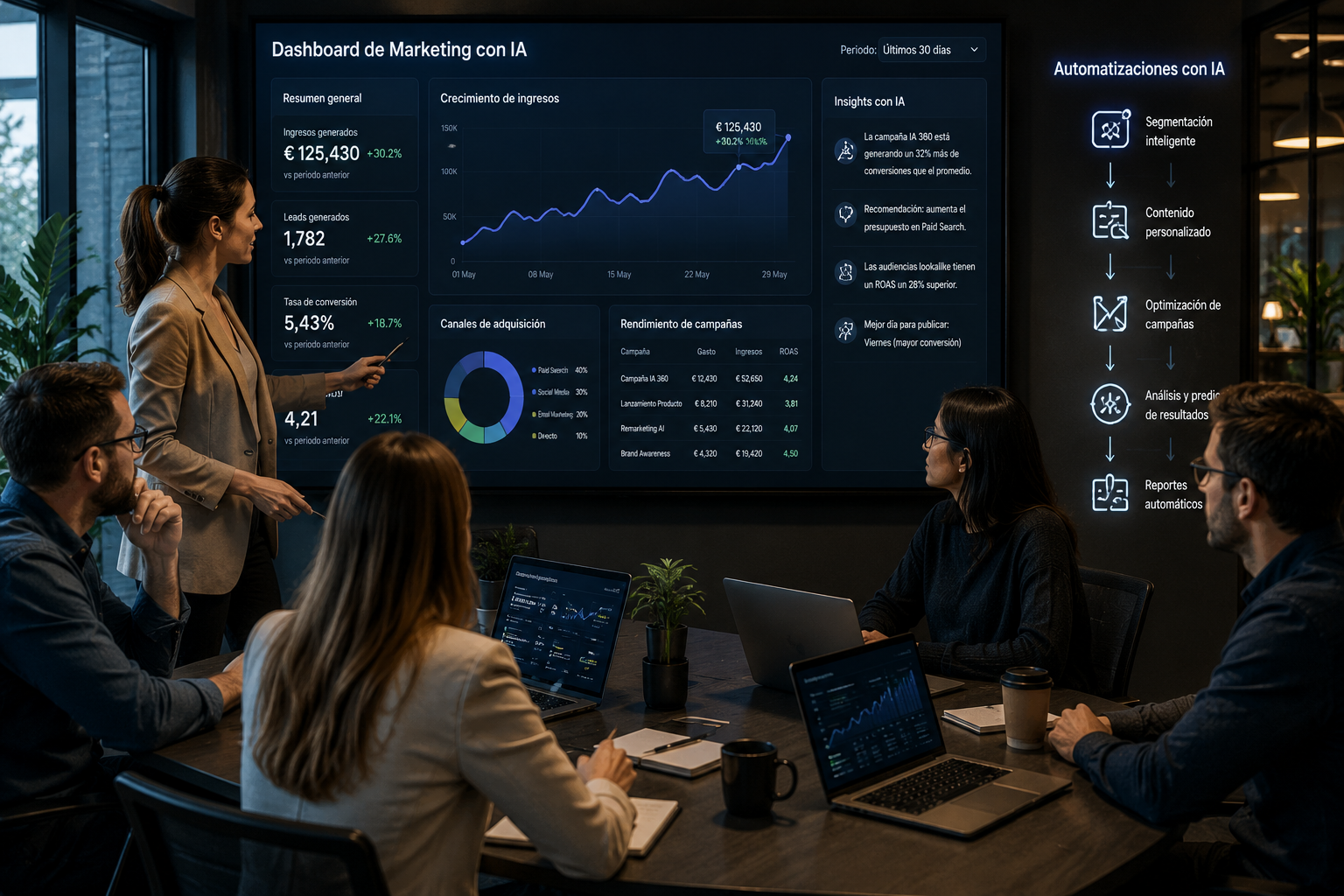
What is AI for marketing?
AI for marketing means using systems that can analyze data, generate content and automate processes to improve the performance of marketing activities. Unlike traditional tools, AI can learn patterns, identify opportunities and produce personalized results. For example, it can:
- Create ads automatically
- Write social media posts
- Analyze user behavior
- Personalize email campaigns
- Generate ad images
All of it happens at a speed that is impossible to reach manually, which is why AI has become one of the most important technologies in modern marketing.
Benefits of AI in digital marketing
Companies that build AI into their marketing strategy usually see clear advantages:
- Higher productivity: automate repetitive work such as content drafts, keyword research, campaign setup and data analysis.
- Advanced personalization: consumers expect tailored experiences, and AI can analyze large amounts of data to adapt messages and offers to each user, which usually improves conversion rates.
- Better decisions: smart tools detect patterns and trends that are hard to spot manually, helping you optimize campaigns and reduce errors.
- Lower costs: automation lets you do more with fewer resources, which is especially useful for freelancers, small businesses, startups and lean marketing teams.
How marketers use AI today
AI is already present in practically every area of digital marketing.
Content marketing
AI can help generate ideas, draft articles and emails, design posts and optimize copy. Tools like ChatGPT have become everyday assistants for content creators.
Social media
Brands use AI to create posts, generate images, analyze audiences, schedule content and optimize campaigns. That keeps a steady presence without adding to the workload.
Paid advertising and AI targeted marketing
Ad platforms such as Google Ads, Meta Ads, LinkedIn Ads and TikTok Ads rely heavily on machine learning for audience targeting, bidding and budget allocation. That is the core of AI targeted marketing: the system decides who sees which message. Your job shifts to feeding it strong creative, clean conversion data and clear goals.
Email marketing
Smart systems can write emails, personalize messages, automate sequences and analyze results, improving both productivity and conversions.
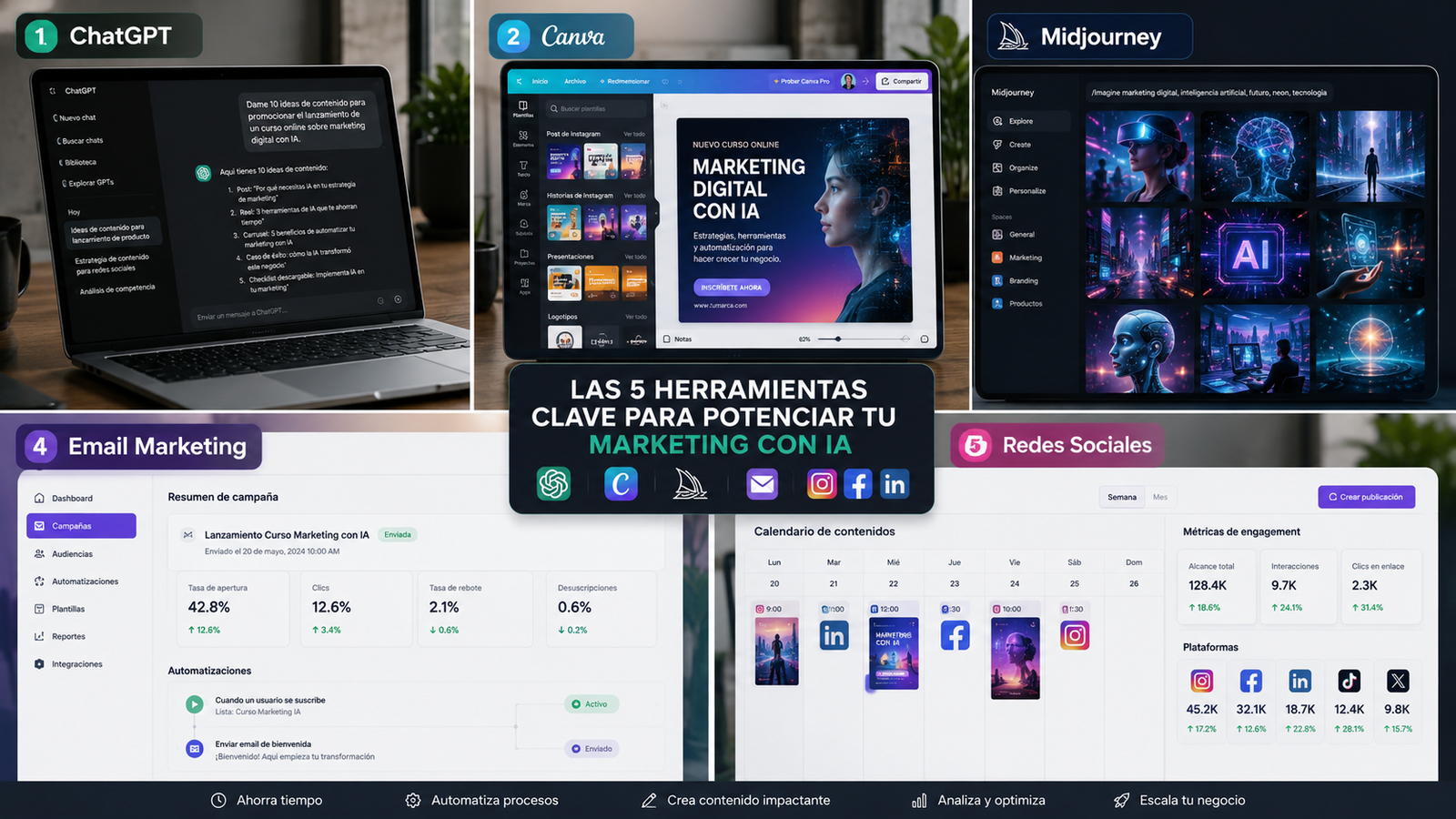
The best AI tools for marketing
Choosing the right tools can make an enormous difference to any AI marketing strategy. There are specialized solutions for nearly every area of digital marketing, from content creation to campaign automation and ad imagery. For a broader comparison, see our list of the best AI tools.
ChatGPT for marketing
When people talk about AI for digital marketing, ChatGPT is usually one of the first tools that comes up. Its versatility lets you use it at almost any stage of the process. You can use it to:
- Write blog posts
- Draft ads
- Design content strategies
- Build email marketing sequences
- Generate social media ideas
- Analyze audiences
- Create editorial calendars
Example prompt: Act as a digital marketing director. Design a customer acquisition strategy for a tech website. Include SEO, social media, email marketing and automation. A prompt like this can produce a useful action plan in seconds. Need a head start? Browse our best ChatGPT prompts.
Canva AI
Canva AI has become a favorite of small businesses and content creators. It lets you make banners, social posts, presentations, ads and promotional material without advanced graphic design skills. Its strengths are that it is very easy to use, has professional templates, offers AI image generation and allows quick editing. For many businesses it is a simple way to produce quality visual content.
Midjourney for advertising and branding
Although it is usually associated with digital art, Midjourney also has interesting marketing uses, such as advertising concepts, campaign creatives, moodboards and visual brand design. Companies increasingly use AI to generate visual ideas before starting a creative project. See our guide to AI image generators for more options.
Gemini and Claude for market research
Research is one of the areas where AI adds the most value. Gemini and Claude can analyze trends, study competitors, summarize reports and surface opportunities, which supports more informed decisions before you launch campaigns. Our comparison of ChatGPT vs Claude vs Gemini shows how they differ.
Marketing automation tools
Automation is one of the most profitable applications of AI. You can automate lead capture, email sending, customer follow-up, content publishing and form handling. The most widely used platforms are:
- Zapier: perfect for beginners.
- Make: an excellent balance of power and ease of use.
- n8n: ideal for advanced automations.
To go deeper, read our guide to AI automation.
| Tool | Best for |
|---|---|
| ChatGPT | Content creation and strategy |
| Canva AI | Graphic design and social media visuals |
| Midjourney | Visual creativity and ad concepts |
| Gemini | Market research |
| Claude | Document analysis |
| Zapier / Make / n8n | Automation, from beginner to advanced |
How to use AI to create marketing content
Content creation is one of the areas where AI delivers the biggest return on investment. It can help you produce:
- SEO articles: keyword research, outlines, drafts and semantic optimization.
- Social media posts: content ideas, editorial calendars, copy and calls to action.
- Email marketing: automated sequences, sales emails, newsletters and loyalty campaigns.
- Video and scripts: scripts for YouTube, Reels, Shorts and podcasts.
Always add a human edit for brand voice, accuracy and real examples. That is what separates content that converts from generic AI text. For search-focused work, see our guide to AI for SEO.
How AI helps you win more customers
One of the most common questions is whether AI can help you get more customers. The answer is yes, in several ways:
- Better targeting: AI analyzes data to identify more relevant audiences.
- Personalization: messages adapt to each user.
- Sales automation: less time on admin tasks and follow-ups.
- Continuous optimization: smart tools detect which campaigns work best and suggest improvements.
Real-world examples of AI in marketing
| Business | How it uses AI | Result |
|---|---|---|
| E-commerce store | Product descriptions, product images, automated emails, product recommendations | Higher productivity and better conversion |
| Marketing agency | ChatGPT for content, competitor analysis and strategy | Faster production times |
| B2B company | AI automation for lead capture, sales follow-up and lead nurturing | More sales opportunities with less manual work |
Running a company rather than a campaign? Our overview of AI for business covers the wider picture.
The future of AI in marketing
Everything points to AI playing a bigger role in digital marketing. In the coming years, expect:
- More personalized campaigns
- Advanced automation
- Multimodal content generation (text, image, video and audio together)
- Predictive optimization
- Tighter integration between tools
Companies that learn to use these technologies well will have an important competitive advantage. And many of these tools are already available today to any business, whatever its size.
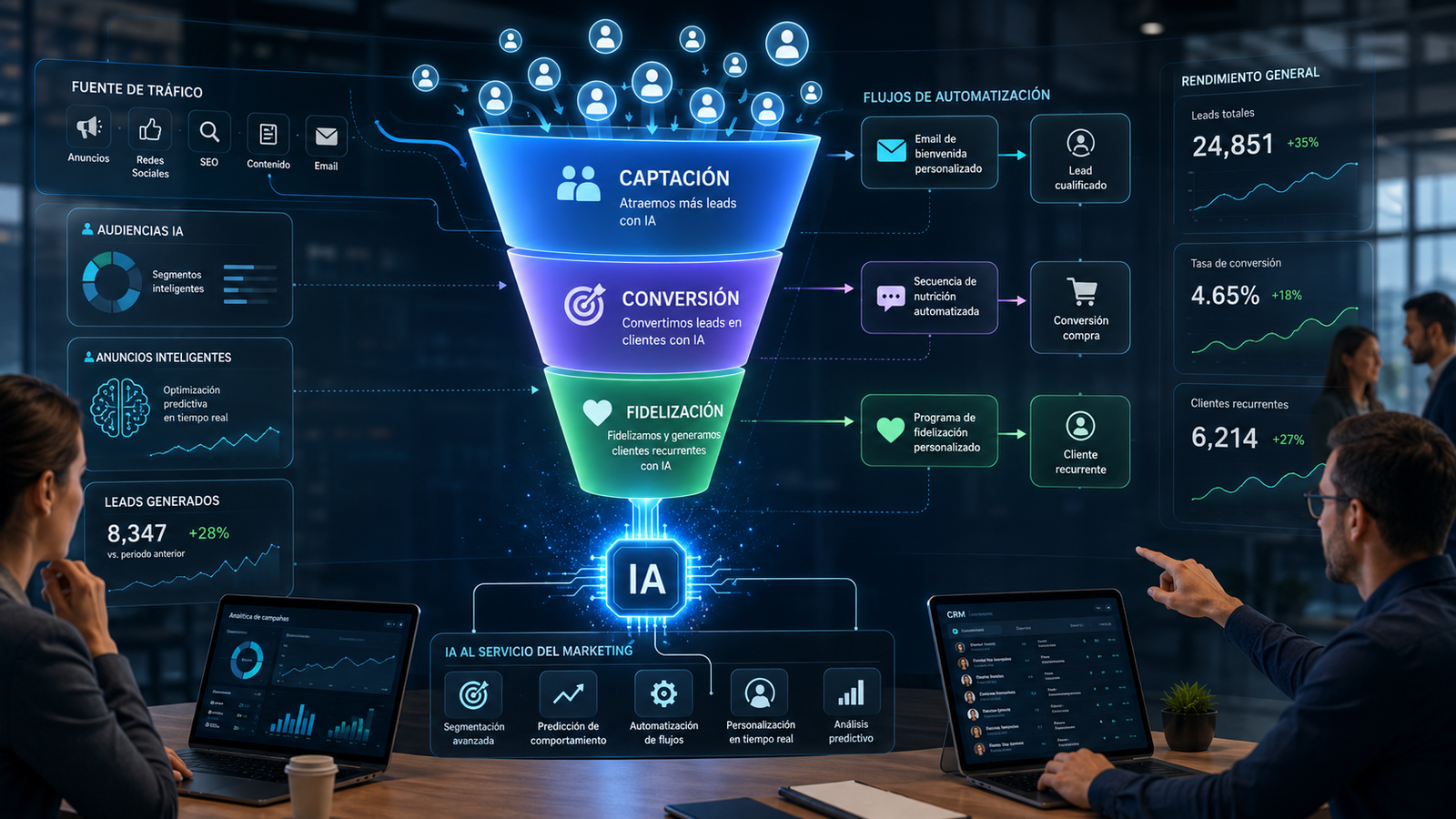
Bottom line
AI for marketing is no longer an emerging trend. It is already transforming how companies attract customers, create content and optimize campaigns. ChatGPT, Canva AI, Midjourney, Claude, Gemini and automation platforms like n8n handle work that used to require whole teams of specialists.
The real potential of AI is not replacing marketers. It is removing repetitive work, speeding up processes and freeing time for strategy. Businesses that combine human creativity with smart automation will gain a growing advantage.
AI marketing FAQ
Using artificial intelligence tools to automate tasks, analyze data, create content and optimize campaigns in order to attract customers and improve results. It is used in SEO, social media, advertising, email marketing, automation and analytics.
AI can create content faster, automate repetitive tasks, analyze large amounts of data, improve audience segmentation, personalize campaigns and optimize conversions. That makes it a core tool for businesses of every size.
It depends on the goal: ChatGPT for content and strategy, Canva AI for design, Midjourney for visual concepts, Gemini for research, Claude for document analysis and n8n, Make or Zapier for automation. Combining several usually works best.
Using machine learning to decide who sees which message: finding high-value audiences, predicting who is likely to convert and adjusting bids and creative automatically. Most ad platforms now do this by default.
Yes. ChatGPT is one of the most used tools in digital marketing. It can write articles and ads, design strategies, generate ideas, build email sequences and create content calendars.
Yes. Many companies use AI to research keywords, build SEO outlines, draft content, optimize articles and spot content opportunities. The best results come from combining AI with human review.
Yes. Modern tools can create posts, design images, write copy, schedule content and analyze results, which cuts the time needed to manage social media.
No. AI increases productivity and efficiency, but strategy, creativity, market understanding and decision-making still depend largely on people.
Practically any organization. Freelancers and small businesses through large corporations can all benefit.
Expect more personalized campaigns, advanced automation, tighter integration between platforms, multimodal content generation and predictive, data-driven optimization.