
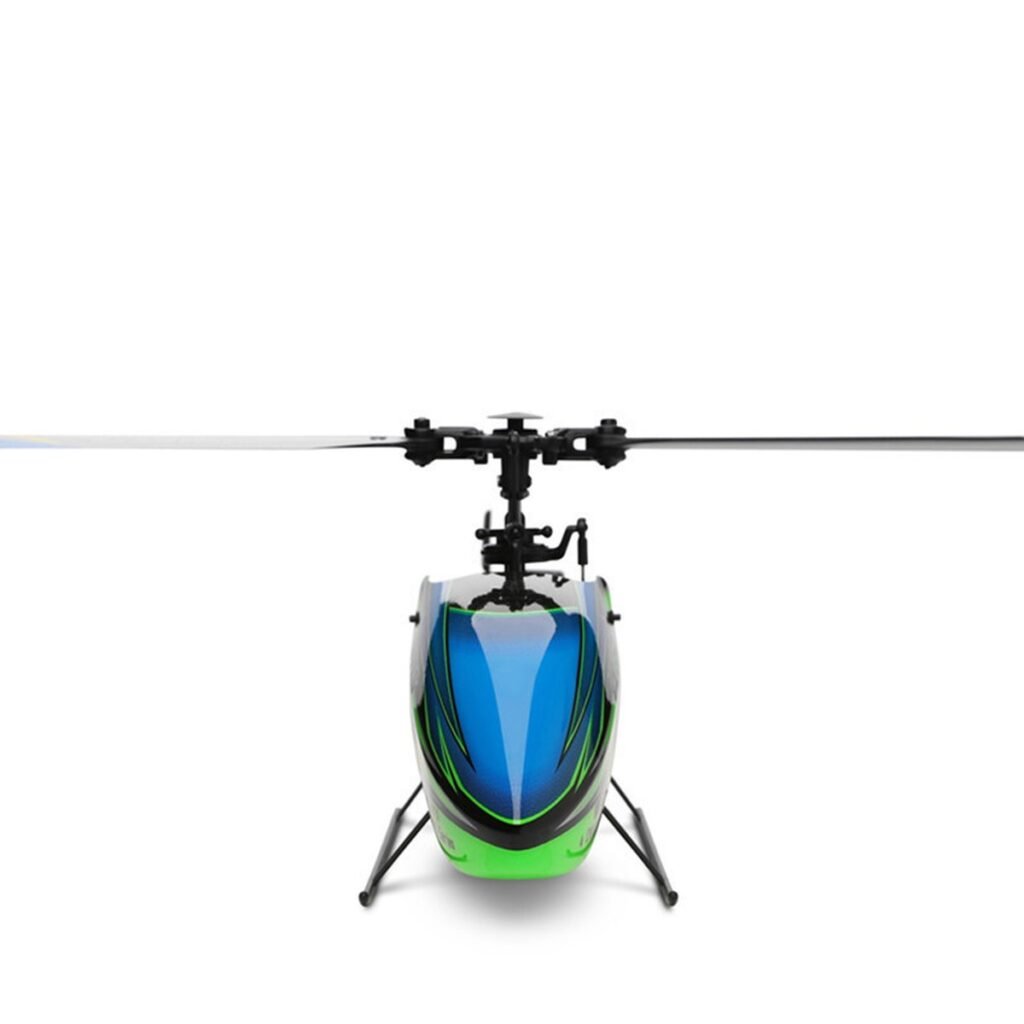
A 4 channel RC helicopter is the point where a toy becomes a real flying machine: you control climb, yaw, forward and backward flight and sideways movement, just like a full-size helicopter. This guide covers a 42-gram model with a single flybarless rotor, a 6-axis gyro and a 2.4 GHz transmitter, and explains how it flies, where to fly it and who it suits.
- Specs at a glance
- What "4 channel" really means
- Single rotor and flybarless: why it matters
- The 6-axis gyro: your safety net
- Battery, charging and flight time
- Range: what 80-100 m means in practice
- Where to fly it
- How to learn: a simple practice plan
- Care, crashes and spare blades
- What's in the box
- 4 channel helicopter vs. a beginner drone
- Who it is for, and who should skip it
- Shipping to the US and the EU
- FAQ
- Keep reading
- Official sources
Quick answer: this is a light, single-rotor 4 channel RC helicopter with a 245 mm main rotor, 6-7 minutes of flight per charge and 80-100 m of radio range. It is a good way to learn real helicopter flying indoors or outside on calm days, from age 14. If you want a heli that holds its height by itself at the push of a button, an altitude-hold model is easier.
Specs at a glance
| Feature | Spec |
|---|---|
| Channels | 4 |
| Rotor | Single main rotor, flybarless |
| Stabilization | 6-axis gyro |
| Main rotor diameter | 245 mm (9.6 in) |
| Length and height | 245 mm long, 77 mm high (9.6 x 3 in) |
| Weight | 42 g (1.5 oz) |
| Materials | Nylon (PA) and plastic |
| Flight time | About 6-7 minutes |
| Charging time | 35-40 minutes |
| Transmitter | 2.4 GHz |
| Range | 80-100 m (260-330 ft) |
| Recommended age | 14+ |
Tracked shipping to the US and the EU · checkout in Spanish. US orders: €28.95 shipping, import duties included.
What “4 channel” really means
Each channel is one thing you can control. On this helicopter, the four channels are:
- Throttle: climb and descend.
- Yaw (rudder): spin the nose left or right.
- Pitch (elevator): fly forward and backward.
- Roll (aileron): slide sideways, left or right.
Cheap toy helicopters usually have 2 or 3 channels and cannot move sideways. That makes them easier at first, but you hit a ceiling fast. With 4 channels you can hover in place, fly circuits around a room and line up precise landings, which is what makes the hobby rewarding.
Single rotor and flybarless: why it matters
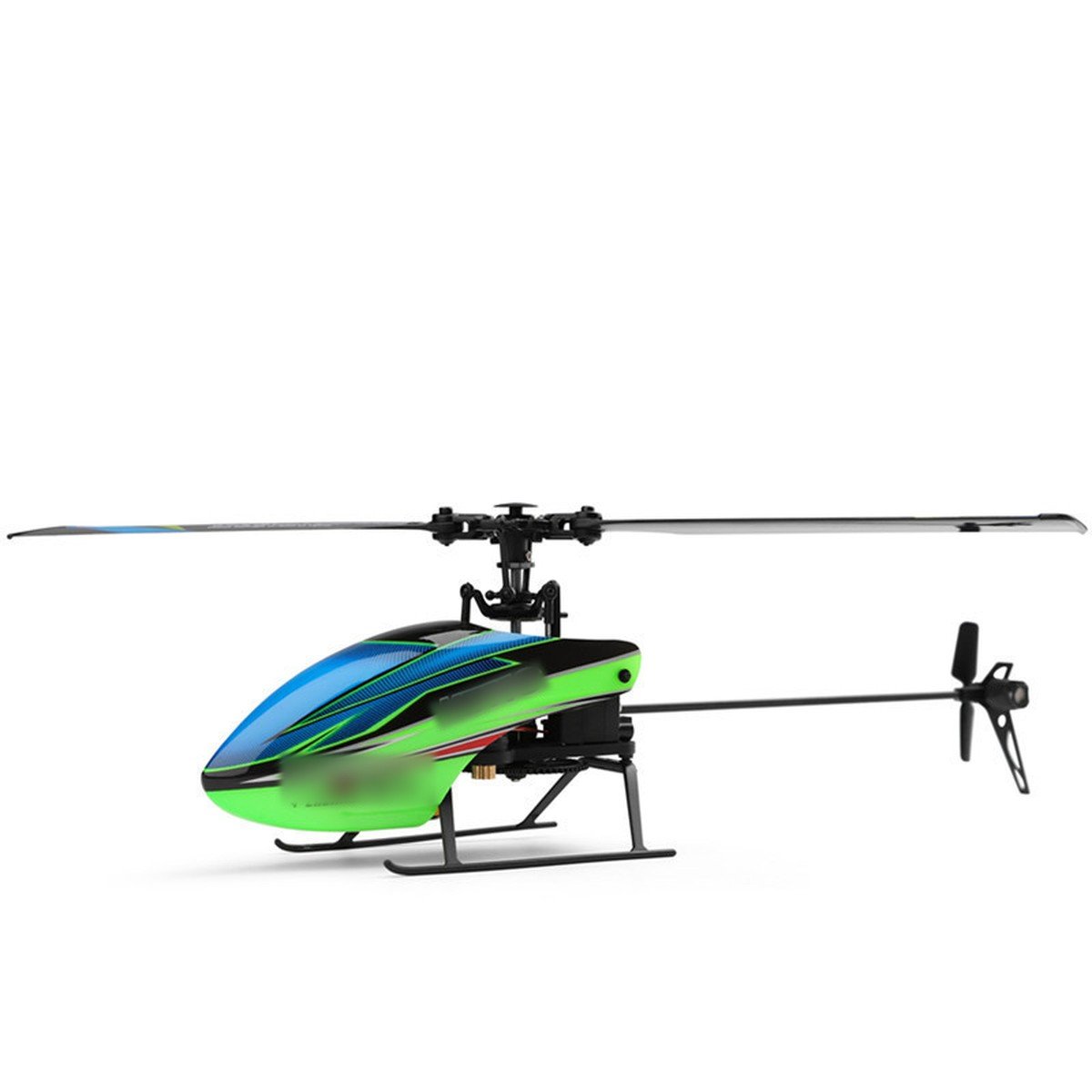
Most beginner helicopters use two stacked rotors (coaxial) that are very stable but slow and limited. This model uses a single main rotor plus a small tail rotor, the same layout as a real helicopter. It feels more alive and responds more directly to the sticks.
“Flybarless” means there is no mechanical stabilizer bar above the rotor. Instead, the electronic gyro does the stabilizing, which gives a cleaner look and a crisper response.
The 6-axis gyro: your safety net
A 6-axis gyro measures rotation and acceleration on three axes and corrects small wobbles many times per second. When you let go of the sticks, it helps the helicopter stop drifting and stay level instead of sliding off to one side.
It does not fly the helicopter for you, and there is no altitude hold: you still manage the throttle yourself. But it makes learning to hover far less frustrating than on a heli without stabilization.
Battery, charging and flight time
Each charge gives about 6 to 7 minutes of flight, and the battery recharges in 35 to 40 minutes with the included USB charger. That sounds short, but small helicopters are intense to fly: a few short flights with breaks in between is the best way to learn, and the pauses also let the motor cool down.
Battery tips
- Use only the included charger and cable.
- Do not leave the battery charging unattended.
- Let the battery cool after a flight before you recharge it.
- Stop using a battery that looks swollen or damaged.
Range: what 80-100 m means in practice
The 2.4 GHz radio reaches 80 to 100 meters (260 to 330 feet). In practice, a 42-gram helicopter is tiny: beyond 20 or 30 meters it becomes hard to tell which way the nose is pointing. Keep it close, especially while you learn orientation.
The 2.4 GHz band also means you can fly alongside friends with other 2.4 GHz models without the radios interfering with each other.
Where to fly it
- Indoors: the best place to start. A large living room, garage or gym with no fans running and fragile items moved out of the way.
- Outdoors: only in calm air. At 42 grams, a light gust can push it around easily.
- Away from people and pets: rotor blades spin fast and can hurt.
- Away from roads and airports: even small models should stay clear.
In the US, small recreational models under 250 g (0.55 lb) do not need FAA registration, but you should still follow local rules and park regulations when flying outside. See the FAA drone page for the latest guidance.
How to learn: a simple practice plan
- Charge the battery and the transmitter fully.
- Place the helicopter on the floor with the tail pointing toward you.
- Raise the throttle slowly until it lifts off, then hover low, around knee height.
- Practice holding it still for 30 seconds at a time, with the tail always toward you.
- Add gentle yaw turns, then short forward and backward hops.
- Only then try sideways movement and slow circuits around the room.
- Land before the battery gets weak, while you still have full control.
Common beginner mistakes
- Too much throttle at once: it shoots up to the ceiling. Small, smooth moves.
- Flying nose-in too early: when the helicopter faces you, left and right are reversed. Keep the tail toward you until you are confident.
- Starting in a small room: give yourself space to make mistakes.
- Flying in wind: outdoors only on truly calm days.
Care, crashes and spare blades
Every helicopter pilot crashes while learning, so it helps to know what to check afterwards. Most knocks indoors only bend or chip a rotor blade. The box includes two spare blades, so a damaged one can be swapped in a couple of minutes.
- After a crash: cut the throttle right away to protect the motor and gears.
- Check the blades: look for cracks or bends; a damaged blade causes vibration and wobbly flight.
- Check the tail rotor: if the nose spins on its own, the tail rotor may be blocked by hair or dust.
- Store it safely: keep it in its box or on a shelf, away from heat and direct sun.
A soft landing area, such as a rug or carpet, also saves a lot of blades in the first weeks.
What’s in the box
- 4 channel RC helicopter.
- 2.4 GHz transmitter.
- Lithium battery.
- USB charger.
- Two spare blades.
- User manual.
4 channel helicopter vs. a beginner drone
A quadcopter drone is easier to fly, since four rotors and electronics keep it level, and many drones also have a camera. A single-rotor helicopter is harder, but that is the point: it teaches real stick skills and is great fun once it clicks.
If you mainly want aerial photos or an easy first flight, start with one of the best drones for beginners. If you want the challenge of a real helicopter, this is a good, inexpensive way in.
Who it is for, and who should skip it
A good fit if you are 14 or older and want to learn real helicopter flying, you have flown drones and want a new challenge, or you are looking for a gift for an RC fan.
Skip it if it is for a young child, or for someone who wants to take off and have the helicopter hold its height by itself. An altitude-hold helicopter, like our RC helicopter for kids, is easier.
Shipping to the US and the EU
The helicopter ships from our store with tracking. Orders to the contiguous US cost €28.95 for shipping, import duties are included and delivery takes about 5-10 business days. EU orders cost €2.95 for shipping and take about 8-13 business days. We do not ship to Alaska, Hawaii or US territories. Checkout is in Spanish, and prices are in euros.
The €97.00 price includes Spanish VAT. For US addresses, VAT is removed at checkout, so the product total is lower than the price on the page.
Tracked shipping to the US and the EU · checkout in Spanish. US orders: €28.95 shipping, import duties included.
FAQ
It is harder than a 2 or 3 channel toy helicopter, because there is no altitude hold. The 6-axis gyro helps a lot, but plan to practice hovering indoors first.
About 6-7 minutes per charge. The battery recharges in 35-40 minutes with the included USB charger.
The manufacturer recommends it for ages 14 and up. Younger pilots should fly with adult supervision.
Yes, but only in calm air. It weighs 42 grams, so wind pushes it around easily. A large indoor room is ideal.
Yes. Shipping to the contiguous US costs €28.95, includes import duties and takes about 5-10 business days.