
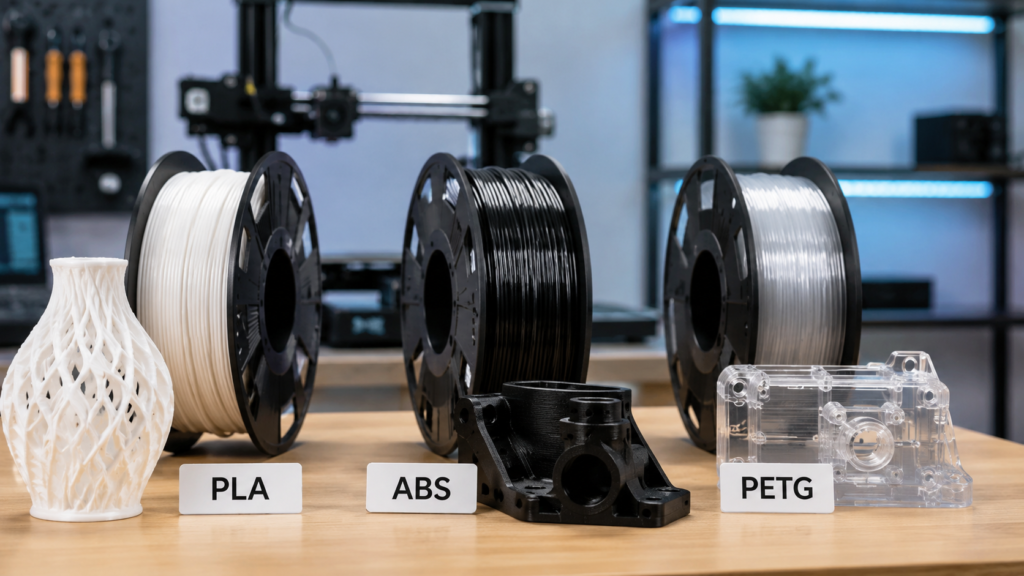
PLA vs ABS vs PETG is the first material decision most 3D printing beginners face. These three thermoplastics are by far the most popular FDM filaments, and each has very different strengths. There is no perfect filament for every job: the right one depends on how strong the part must be, whether it will see heat or sunlight, your experience and your printer.
- PLA vs PETG vs ABS at a glance
- PLA: the best filament for beginners
- PETG: the perfect balance of strength and ease
- ABS: the industry classic
- Which filament is strongest: PLA, PETG or ABS?
- Which is easiest to print?
- Price: which filament is cheapest?
- Which filament should you choose?
- Common mistakes when choosing PLA, PETG or ABS
- The best learning order for beginners
- Bottom line
- PLA vs ABS vs PETG FAQ
- Keep reading
Quick answer: PLA is the easiest to print and best for beginners, decorative pieces and visual prototypes. PETG is the best all-rounder for functional, durable and outdoor parts. ABS handles the most heat and suits engineering parts, but it warps easily and needs an enclosure and ventilation. If you can only buy one spool, buy PETG.
Looking for a machine to run them on? See our best beginner 3D printers and the wider guide to 3D printing materials.
PLA vs PETG vs ABS at a glance
All three are thermoplastic filaments sold on spools. The printer’s hotend melts them and deposits them layer by layer on the bed. The process is similar, but their physical properties are very different, so choosing the right one is key to good results.
| Property | PLA | PETG | ABS |
|---|---|---|---|
| Ease of printing | Easiest | Moderate | Hardest |
| Impact strength | Low (brittle) | High | High |
| Heat resistance (approx. deflection) | 55–65 °C (131–149 °F) | 75–85 °C (167–185 °F) | 95–105 °C (203–221 °F) |
| Outdoor use | Poor | Good | Fair (ASA is better) |
| Warping | Very low | Low | High |
| Fumes/odor | Minimal | Low | Noticeable; ventilate |
| Nozzle temperature | 190–220 °C (374–428 °F) | 220–250 °C (428–482 °F) | 230–260 °C (446–500 °F) |
| Bed temperature | Up to 60 °C (140 °F) | 70–90 °C (158–194 °F) | 90–110 °C (194–230 °F) |
| Enclosure needed | No | No | Recommended |
| Best for | Beginners, decor, models | Functional, everyday parts | Heat-resistant engineering parts |
PLA: the best filament for beginners
PLA (polylactic acid) is the most widely used filament in the world. Most people start with it because it is extremely forgiving even on inexpensive printers, and practically any FDM printer handles it without trouble.
- Very easy to print: barely warps, shrinks or lifts off the bed, which makes learning much easier.
- Excellent finish: fine detail, clean surfaces and attractive results.
- Huge variety: silk, matte, wood, marble, metallic and rainbow finishes.
- Inexpensive: usually the cheapest spool on the shelf.
Downsides: low heat resistance (a PLA part can deform if it stays somewhere hot), lower mechanical strength for functional parts and poor durability outdoors in rain and continuous sun.
Choose PLA for: learning, decorations, scale models, figures, visual prototypes, home organizers and education.
PETG: the perfect balance of strength and ease
Many makers consider PETG the best general-purpose filament today, and they have a point. It keeps much of PLA’s ease of use while being considerably tougher, which is why it’s a favorite for functional parts.
- Strong and tough: handles impacts, vibration and sustained loads.
- Better heat resistance than PLA.
- Chemical and moisture resistance: works well in damp environments.
- Ideal for functional parts: brackets, enclosures, mechanical parts, robotics and electronics.
Downsides: slightly trickier than PLA, small strings (stringing) if retraction isn’t tuned, and a finish that’s a little less crisp. The difference from PLA is much smaller than it was a few years ago, because modern printers have simplified PETG a lot.
Choose PETG for: functional and everyday parts, engineering projects, electronics enclosures and parts under mechanical stress.
ABS: the industry classic
ABS was the reference material for professional 3D printing for years and is still widely used in industry thanks to its mechanical properties. Many everyday objects are made of it: housings, tools, automotive components and appliances.
- High mechanical strength for demanding uses.
- Excellent heat resistance, well above PLA and PETG.
- Proven material with decades of industrial use.
- Engineering-friendly: automotive, robotics, manufacturing and functional prototyping.
Downsides: one of the materials most prone to warping, open printers struggle with it, and it gives off fumes that require good ventilation.
Choose ABS for: industrial applications, parts exposed to heat, mechanical components and professional environments.
Which filament is strongest: PLA, PETG or ABS?
It depends on the kind of strength you need, since taking a hit is not the same as handling heat, vibration or sustained load.
| Type of strength | 1st | 2nd | 3rd |
|---|---|---|---|
| Mechanical strength | PETG | ABS | PLA |
| Impact resistance | PETG | ABS | PLA |
| Wear resistance | ABS | PETG | PLA |
| Heat resistance | ABS | PETG | PLA |
PETG balances hardness and flexibility, absorbing impacts better than PLA, which is why it is the favorite of home users who want durable parts. ABS is excellent under demanding conditions. PLA is stiff and brittle: past its limit it snaps instead of bending. For very demanding moving parts, nylon is usually the better choice.
Heat resistance: PLA vs PETG vs ABS
Many people print a perfect PLA part and then find it deformed after a summer day in a car. PLA starts to lose stability at roughly 55-65 °C and shouldn’t be used in intense sun, vehicles or near heat sources. PETG improves on that at roughly 75-85 °C, and ABS is the clear winner at roughly 95-105 °C. If a part will see heat, ABS is still an excellent option.
Which is easiest to print?
A slightly weaker part that prints reliably is often more useful than a very strong material that causes constant problems.
- PLA (easiest): very little warping, excellent adhesion, simple settings and compatibility with practically any printer.
- PETG (in the middle): more sensitive to retraction, stringing and temperature, but still straightforward.
- ABS (most demanding): needs a heated bed, good ventilation and ideally an enclosure, with a strong tendency to warp.
Whichever you choose, good slicer settings help: see our guide to 3D printing software and how to calibrate a 3D printer.
Price: which filament is cheapest?
Prices change constantly by brand and quality, but the pattern holds: PLA is usually the cheapest, with PETG and ABS slightly higher. The gap is relatively small, so choose by properties rather than saving a few dollars on a spool.
Which filament should you choose?
| Need | Best filament |
|---|---|
| Beginners | PLA |
| Best value all-rounder | PETG |
| Outdoor parts | PETG (ASA for maximum UV resistance) |
| Functional parts | PETG |
| Engineering and heat | ABS |
| Decoration | PLA |
| Home printers | PLA and PETG |
If you could only buy one filament: PETG. If you’re just starting: PLA. For demanding technical parts: ABS. This strategy covers almost any need.
Common mistakes when choosing PLA, PETG or ABS
- Starting with ABS because it’s “stronger.” It’s the hardest of the three to print and needs a heated bed, an enclosure, ventilation and experience.
- Using PLA for hot environments. Car mounts, outdoor parts and anything near heat will deform; PETG, ABS or ASA work better.
- Thinking PETG is difficult. Modern printers handle it without much trouble, and it’s now a favorite for functional projects.
- Choosing on price alone. The difference per spool is small; the right material matters more.
- Ignoring end use. Ask whether the part will be outdoors, carry weight, get hot, need flexibility or just look good.
The best learning order for beginners
- PLA first: learn leveling, settings, adhesion, supports and slicing without extra problems.
- PETG second: stronger parts while printing stays relatively easy.
- ABS third: once you understand your printer, explore technical materials.
You can run all three on a good FDM machine; see our picks of the best FDM 3D printers.
Bottom line
There is no single winner in PLA vs ABS vs PETG, because each material shines in different situations. PLA for learning and looks, PETG for everyday functional parts, ABS for heat-resistant technical work. With those three, you can cover almost any 3D printing project.
PLA vs ABS vs PETG FAQ
PLA is the easiest to print and has the best finish, PETG is tougher and more heat-resistant than PLA, and ABS handles the most heat but is the hardest to print.
It depends on the use. PLA is easier to print and looks better; PETG is tougher, more durable and more heat-resistant.
Both are strong. PETG usually handles impacts better, while ABS stands out for heat resistance.
PLA. It’s still the easiest material for learning 3D printing.
PETG among these three. For maximum UV resistance, choose ASA.
ABS, clearly ahead of PETG and PLA.
Yes, but the difference is much smaller than it used to be.
Yes, it gives off fumes, so print it in a well-ventilated space.
In many projects, yes, which is why PETG has become one of the most popular materials.
PETG. It’s probably the most balanced material available today.