
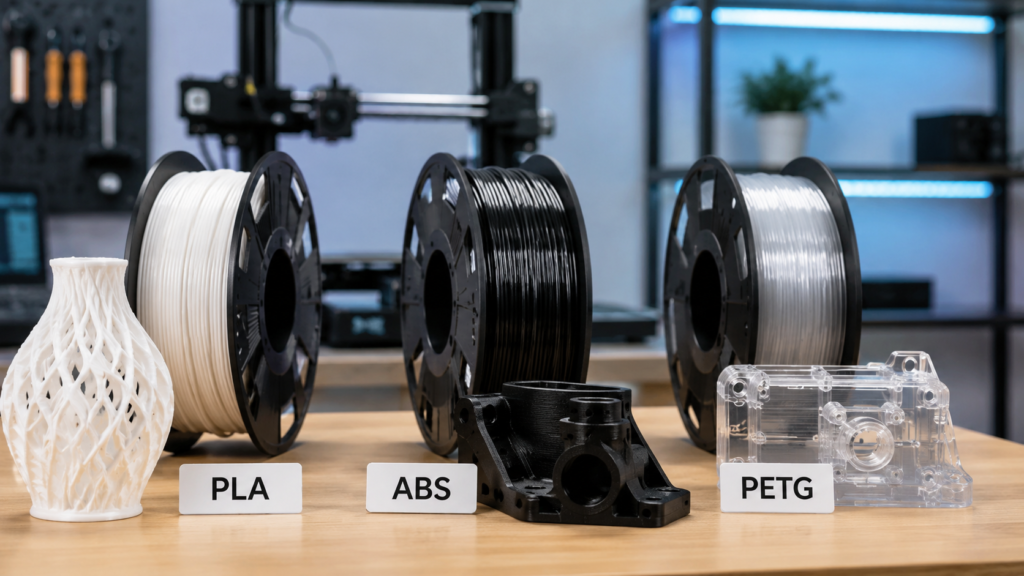
- PLA vs ABS vs PETG
- PLA vs ABS vs PETG: Comparativa rápida
- ¿Qué son PLA, PETG y ABS?
- PLA: El mejor filamento para principiantes
- PETG: El equilibrio perfecto entre resistencia y facilidad de uso
- ¿Cuándo elegir PETG?
- ABS: El clásico de la industria
- ¿Cuándo elegir ABS?
- Comparativa de resistencia: ¿Qué filamento es más resistente?
- Ganador en resistencia térmica
- Comparativa de facilidad de impresión
- Clasificación final
- Comparativa de precio
- ¿Qué filamento elegir según cada necesidad?
- Errores comunes al elegir entre PLA, PETG y ABS
- PLA vs ABS vs PETG para principiantes
- Conclusión
- Sigue aprendiendo sobre impresión 3D
- Preguntas frecuentes sobre PLA, PETG y ABS
PLA vs ABS vs PETG
Si acabas de comprar una impresora 3D o estás empezando a investigar sobre los distintos materiales disponibles, es muy probable que te hayas encontrado constantemente con tres nombres:
- PLA
- PETG
- ABS
Estos tres materiales son, con diferencia, los filamentos más populares dentro del mundo de la impresión 3D FDM, y cada uno presenta ventajas, inconvenientes y aplicaciones muy diferentes.
De hecho, una de las preguntas más habituales entre principiantes y usuarios avanzados es:
¿Qué es mejor, PLA, PETG o ABS?
La respuesta no es tan sencilla como parece.
No existe un único filamento perfecto para todos los proyectos.
El mejor material dependerá de factores como:
- El tipo de pieza que vas a imprimir.
- La resistencia necesaria.
- La exposición al calor.
- El uso interior o exterior.
- Tu nivel de experiencia.
- Las características de tu impresora 3D.
Mientras que el PLA destaca por su facilidad de uso, el PETG ofrece un excelente equilibrio entre resistencia y facilidad de impresión. Por otro lado, el ABS sigue siendo uno de los materiales favoritos para aplicaciones industriales y piezas sometidas a condiciones exigentes.
En esta guía compararemos en profundidad estos tres materiales para ayudarte a elegir el más adecuado para cada situación.
PLA vs ABS vs PETG: Comparativa rápida
| Característica | PLA | PETG | ABS |
|---|---|---|---|
| Facilidad de impresión | ⭐⭐⭐⭐⭐ | ⭐⭐⭐⭐ | ⭐⭐⭐ |
| Resistencia mecánica | ⭐⭐⭐ | ⭐⭐⭐⭐ | ⭐⭐⭐⭐ |
| Resistencia térmica | ⭐⭐ | ⭐⭐⭐ | ⭐⭐⭐⭐ |
| Resistencia exterior | ⭐⭐ | ⭐⭐⭐⭐ | ⭐⭐⭐ |
| Flexibilidad | ⭐⭐ | ⭐⭐⭐ | ⭐⭐ |
| Warping | Muy bajo | Bajo | Alto |
| Olores al imprimir | Muy bajos | Bajos | Altos |
| Recomendado para principiantes | ✅ | ✅ | ❌ |
| Precio | € | €€ | €€ |
| Uso profesional | ⭐⭐ | ⭐⭐⭐⭐ | ⭐⭐⭐⭐ |
¿Qué son PLA, PETG y ABS?
Los tres son filamentos termoplásticos utilizados por las impresoras 3D FDM.
Esto significa que se presentan en forma de bobina y se funden mediante el hotend de la impresora para depositarse capa a capa sobre la cama de impresión.
Aunque el proceso de fabricación es similar, sus propiedades físicas son muy diferentes.
Por ello elegir el material adecuado es fundamental para obtener buenos resultados.
PLA: El mejor filamento para principiantes
El PLA (Ácido Poliláctico) es el filamento más utilizado del mundo.
La mayoría de usuarios comienzan con PLA porque ofrece una experiencia extremadamente sencilla incluso en impresoras económicas.
Su popularidad se debe a tres factores principales:
- Fácil impresión.
- Excelente acabado visual.
- Precio económico.
Actualmente prácticamente cualquier impresora FDM es capaz de imprimir PLA sin problemas.
Ventajas del PLA
Muy fácil de imprimir
El PLA apenas presenta problemas de:
- Warping.
- Contracción.
- Desprendimiento de la cama.
Esto facilita enormemente el aprendizaje.
Excelente calidad visual
Permite obtener piezas con:
- Buen nivel de detalle.
- Superficies limpias.
- Acabados muy atractivos.
Gran variedad de colores y acabados
Existen versiones:
- Seda.
- Mate.
- Madera.
- Mármol.
- Metalizadas.
- Arcoíris.
Económico
Suele ser uno de los filamentos más baratos del mercado.
Inconvenientes del PLA
Baja resistencia térmica
Es su principal limitación.
Una pieza impresa en PLA puede deformarse si permanece expuesta a temperaturas relativamente elevadas.
Menor resistencia mecánica
Para aplicaciones funcionales existen materiales más adecuados.
Menor resistencia a exteriores
No suele ser la mejor opción para piezas sometidas a lluvia o exposición solar continua.
¿Cuándo elegir PLA?
El PLA es perfecto para:
- Principiantes.
- Decoración.
- Maquetas.
- Figuras.
- Prototipos visuales.
- Organización doméstica.
- Educación.
Temperaturas recomendadas PLA
- Hotend: 190°C – 220°C
- Cama caliente: 0°C – 60°C
PETG: El equilibrio perfecto entre resistencia y facilidad de uso
Muchos usuarios consideran que el PETG es actualmente el mejor material generalista para impresión 3D.
Y no les falta razón.
Combina muchas de las ventajas del PLA con una resistencia considerablemente superior.
Por este motivo se ha convertido en uno de los materiales favoritos para fabricar piezas funcionales.
Ventajas del PETG
Excelente resistencia mecánica
Soporta mejor:
- Golpes.
- Vibraciones.
- Esfuerzos continuados.
Buena resistencia térmica
Tolera temperaturas superiores al PLA.
Resistencia química
Funciona muy bien en ambientes húmedos o expuestos a determinados productos químicos.
Ideal para piezas funcionales
Es uno de los materiales más utilizados para:
- Soportes.
- Carcasas.
- Piezas mecánicas.
- Robótica.
- Electrónica.
Inconvenientes del PETG
Más difícil de imprimir que PLA
Aunque sigue siendo relativamente sencillo, requiere algo más de experiencia.
Stringing
Puede generar pequeños hilos de material si la configuración no está optimizada.
Acabado ligeramente menos limpio
Normalmente no alcanza el acabado visual tan refinado del PLA.
¿Cuándo elegir PETG?
El PETG es una excelente opción para:
- Piezas funcionales.
- Uso diario.
- Proyectos de ingeniería.
- Componentes electrónicos.
- Piezas sometidas a esfuerzos mecánicos.
Temperaturas recomendadas PETG
- Hotend: 220°C – 250°C
- Cama caliente: 70°C – 90°C
ABS: El clásico de la industria
Durante años el ABS fue el material de referencia dentro de la impresión 3D profesional.
Todavía hoy sigue utilizándose ampliamente en sectores industriales gracias a sus excelentes propiedades mecánicas.
Muchos objetos cotidianos están fabricados con ABS:
- Carcasas.
- Herramientas.
- Componentes de automoción.
- Electrodomésticos.
Ventajas del ABS
Alta resistencia mecánica
Muy adecuado para aplicaciones exigentes.
Excelente resistencia térmica
Soporta temperaturas significativamente más elevadas que PLA o PETG.
Material ampliamente probado
Décadas de uso industrial avalan su rendimiento.
Ideal para ingeniería
Es habitual encontrar ABS en:
- Automoción.
- Robótica.
- Fabricación industrial.
- Prototipado funcional.
Inconvenientes del ABS
Warping
Es uno de los materiales más propensos a deformaciones durante la impresión.
Necesita cámara cerrada
Las impresoras abiertas suelen tener más dificultades para imprimir ABS correctamente.
Olores durante la impresión
Produce vapores que requieren una ventilación adecuada.
¿Cuándo elegir ABS?
El ABS es recomendable para:
- Aplicaciones industriales.
- Piezas sometidas a calor.
- Componentes mecánicos.
- Entornos profesionales.
Temperaturas recomendadas ABS
- Hotend: 230°C – 260°C
- Cama caliente: 90°C – 110°C
Comparativa de resistencia: ¿Qué filamento es más resistente?
Una de las preguntas más habituales entre los usuarios de impresión 3D es:
¿Qué material es más resistente, PLA, PETG o ABS?
La respuesta depende del tipo de resistencia que necesitemos.
No es lo mismo soportar golpes que soportar calor, vibraciones o esfuerzos continuados.
Sin embargo, si hablamos de uso general, podemos establecer una clasificación bastante clara.
Resistencia mecánica
🥇 PETG
El PETG ofrece un excelente equilibrio entre dureza y flexibilidad.
Absorbe mejor los impactos que el PLA y presenta menos tendencia a fracturarse.
Por ello es uno de los materiales más utilizados para:
- Soportes.
- Piezas funcionales.
- Carcasas.
- Robótica.
- Componentes mecánicos.
🥈 ABS
El ABS también presenta una excelente resistencia mecánica.
De hecho, durante muchos años fue el material de referencia para aplicaciones industriales.
Es especialmente recomendable cuando las piezas van a trabajar bajo condiciones exigentes.
🥉 PLA
El PLA es suficientemente resistente para multitud de aplicaciones.
Sin embargo, suele ser más rígido y frágil.
Cuando se supera su límite de resistencia, normalmente se rompe en lugar de deformarse.
Resistencia a impactos
Si la pieza puede sufrir golpes o vibraciones:
🥇 PETG
🥈 ABS
🥉 PLA
Por este motivo PETG suele ser la opción favorita para usuarios domésticos que buscan piezas duraderas.
Resistencia al desgaste
Cuando existen piezas móviles o rozamientos continuos:
🥇 ABS
🥈 PETG
🥉 PLA
Aunque para aplicaciones muy exigentes normalmente recomendamos materiales como Nylon.
Comparativa de resistencia térmica
La temperatura es uno de los factores más importantes al elegir un material.
Muchos usuarios imprimen piezas perfectas en PLA y después descubren que se deforman al dejarlas dentro de un coche durante el verano.
Por ello es importante entender las limitaciones de cada material.
PLA
El PLA comienza a perder estabilidad relativamente pronto.
No suele recomendarse para:
- Exposición solar intensa.
- Vehículos.
- Componentes cercanos a fuentes de calor.
Temperatura aproximada de deformación:
👉 55°C – 65°C
PETG
El PETG mejora considerablemente este aspecto.
Puede soportar temperaturas más elevadas sin deformarse.
Temperatura aproximada de deformación:
👉 75°C – 85°C
ABS
Aquí es donde el ABS destaca claramente.
Su resistencia térmica sigue siendo una de sus principales ventajas.
Temperatura aproximada de deformación:
👉 95°C – 105°C
Ganador en resistencia térmica
🥇 ABS
🥈 PETG
🥉 PLA
Si vas a fabricar piezas sometidas al calor, ABS sigue siendo una excelente opción.
Comparativa de facilidad de impresión
No todo es resistencia.
De hecho, para muchos usuarios la facilidad de impresión es incluso más importante.
Una pieza ligeramente menos resistente pero fácil de fabricar suele ser mucho más útil que un material extremadamente potente que genera problemas constantemente.
PLA: El rey de los principiantes
El PLA sigue siendo el filamento más fácil de imprimir.
Ventajas:
- Muy poco warping.
- Excelente adhesión.
- Configuración sencilla.
- Compatible con prácticamente cualquier impresora.
Por ello es la opción recomendada para cualquier usuario que empieza.
🥇 PLA
PETG: El punto intermedio
PETG requiere algunos ajustes adicionales.
Es más sensible a:
- Retracción.
- Stringing.
- Temperatura.
Sin embargo, sigue siendo bastante sencillo de utilizar.
🥈 PETG
ABS: El más exigente
ABS requiere:
- Cama caliente.
- Buena ventilación.
- Preferiblemente cámara cerrada.
Además presenta una tendencia importante al warping.
🥉 ABS
Clasificación final
Facilidad de impresión
🥇 PLA
🥈 PETG
🥉 ABS
Comparativa de precio
Los precios cambian constantemente según fabricante y calidad.
Sin embargo, normalmente encontramos las siguientes tendencias.
| Material | Precio aproximado |
|---|---|
| PLA | 15€ – 25€ |
| PETG | 18€ – 30€ |
| ABS | 18€ – 30€ |
La diferencia económica suele ser relativamente pequeña.
Por ello recomendamos elegir el material por sus propiedades y no únicamente por el precio.
¿Qué filamento elegir según cada necesidad?
Después de analizar todas las características, podemos extraer conclusiones bastante claras.
Mejor filamento para principiantes
🥇 PLA
Su facilidad de uso lo convierte en la mejor puerta de entrada al mundo de la impresión 3D.
Ideal para:
- Aprender.
- Decoración.
- Maquetas.
- Figuras.
- Prototipos visuales.
Mejor filamento calidad-precio
🥇 PETG
Probablemente el material más equilibrado actualmente.
Combina:
- Resistencia.
- Facilidad de impresión.
- Durabilidad.
Por ello muchos usuarios terminan utilizándolo como material principal.
Mejor filamento para exteriores
🥇 PETG
Entre estos tres materiales es la opción más recomendable para aplicaciones exteriores.
Aunque para máxima resistencia UV suele ser preferible ASA.
Mejor filamento para piezas funcionales
🥇 PETG
Excelente equilibrio entre resistencia y facilidad de impresión.
Mejor filamento para ingeniería
🥇 ABS
Su resistencia térmica y mecánica continúa siendo muy valorada en aplicaciones profesionales.
Mejor filamento para decoración
🥇 PLA
Gracias a su facilidad de impresión y gran variedad de acabados.
Mejor filamento para impresoras 3D domésticas
🥇 PLA
🥈 PETG
La combinación perfecta para la mayoría de usuarios.
Nuestra recomendación
Si sólo pudieras comprar un único filamento:
👉 PETG.
Si estás empezando:
👉 PLA.
Si buscas aplicaciones técnicas exigentes:
👉 ABS.
Esta estrategia suele cubrir prácticamente cualquier necesidad dentro del mundo de la impresión 3D.
Errores comunes al elegir entre PLA, PETG y ABS
Uno de los mayores errores que cometen muchos usuarios cuando empiezan en el mundo de la impresión 3D es pensar que existe un único material perfecto para cualquier proyecto.
La realidad es muy diferente.
Cada filamento ha sido diseñado para cubrir necesidades específicas.
Por ello es importante conocer los errores más habituales antes de comprar una bobina.
Elegir ABS siendo principiante
Este es probablemente el error más frecuente.
Muchos usuarios leen que el ABS es más resistente y automáticamente piensan que es la mejor opción.
Sin embargo, olvidan que también es el material más complejo de imprimir de los tres.
El ABS suele requerir:
- Cama caliente.
- Cámara cerrada.
- Buena ventilación.
- Mayor experiencia.
Si estás empezando, normalmente PLA será una elección mucho más inteligente.
Utilizar PLA para piezas sometidas al calor
El PLA es fantástico para aprender.
Pero no para todo.
Muchas personas fabrican soportes para coches, piezas para exteriores o componentes cercanos a fuentes de calor y descubren que terminan deformándose.
En esos casos materiales como:
- PETG.
- ABS.
- ASA.
ofrecen mejores resultados.
Pensar que PETG es complicado
Hace años esto podía ser cierto.
Sin embargo, las impresoras modernas han simplificado enormemente su uso.
Actualmente la mayoría de usuarios pueden imprimir PETG sin demasiadas dificultades.
Por ello se ha convertido en uno de los materiales favoritos para proyectos funcionales.
Elegir el filamento únicamente por el precio
La diferencia económica entre PLA, PETG y ABS suele ser relativamente pequeña.
Por ello es mucho más importante elegir el material correcto que ahorrar unos pocos euros en la compra de una bobina.
Ignorar las condiciones de uso finales
Antes de elegir cualquier material conviene preguntarse:
- ¿Va a estar en exteriores?
- ¿Soportará peso?
- ¿Estará sometido a calor?
- ¿Necesita flexibilidad?
- ¿Es una pieza decorativa?
La respuesta a estas preguntas suele determinar rápidamente cuál es el mejor material.
PLA vs ABS vs PETG para principiantes
Si acabas de comprar tu primera impresora 3D, probablemente te preguntes cuál de estos materiales deberías utilizar primero.
Nuestra recomendación es muy clara.
Primer filamento: PLA
Aprenderás:
- Nivelación.
- Configuración.
- Adhesión.
- Soportes.
- Laminado.
sin complicarte con problemas adicionales.
Segundo filamento: PETG
Cuando ya domines PLA, PETG será el siguiente paso natural.
Te permitirá fabricar piezas mucho más resistentes manteniendo una experiencia de impresión relativamente sencilla.
Tercer filamento: ABS
Una vez entiendas correctamente el funcionamiento de tu impresora, podrás explorar materiales más técnicos como ABS.
Este orden de aprendizaje suele ofrecer los mejores resultados para la mayoría de usuarios.
Conclusión
La comparativa entre PLA vs ABS vs PETG no tiene un único ganador absoluto.
Cada material destaca en situaciones diferentes.
Si eres principiante y buscas facilidad de uso, el PLA sigue siendo la mejor elección.
Si necesitas piezas funcionales resistentes y versátiles, el PETG ofrece probablemente el mejor equilibrio entre rendimiento y facilidad de impresión.
Por otro lado, si trabajas en proyectos técnicos exigentes o necesitas una elevada resistencia térmica, el ABS continúa siendo una excelente alternativa.
Nuestra recomendación general para la mayoría de usuarios es sencilla:
🥇 PLA para aprender.
🥇 PETG para uso diario.
🥇 ABS para aplicaciones técnicas.
Con esta estrategia podrás cubrir prácticamente cualquier necesidad dentro del mundo de la impresión 3D.
Sigue aprendiendo sobre impresión 3D
También te recomendamos visitar nuestras guías relacionadas:
👉 Todo lo que necesitas saber sobre impresión 3D
👉 Impresoras 3D para principiantes
👉 Mejores impresoras 3D profesionales
👉 PLA vs ABS vs PETG
👉 Software para impresión 3D
👉 Cómo calibrar una impresora 3D
Preguntas frecuentes sobre PLA, PETG y ABS
Depende del uso.
PLA es más fácil de imprimir.
PETG es más resistente y duradero.
En términos generales ambos son muy resistentes.
PETG suele soportar mejor impactos.
ABS destaca por su resistencia térmica.
PLA.
Sigue siendo el material más sencillo para aprender impresión 3D.
PETG.
Aunque para máxima resistencia UV recomendamos ASA.
ABS.
Es claramente superior a PLA y PETG en este apartado.
Principalmente:
PLA.
PETG.
ABS.
TPU.
Normalmente PLA.
Especialmente en variantes seda o mate.
Sí.
Pero la diferencia es mucho menor que hace algunos años.
Sí.
Por ello se recomienda imprimirlo en espacios ventilados.
PETG y ABS suelen ser las opciones más recomendadas.
Generalmente PLA.
Aunque la diferencia económica suele ser pequeña.
En muchos proyectos sí.
Por eso se ha convertido en uno de los materiales más populares actualmente.
PLA.
Especialmente si buscas facilidad de impresión y buen acabado visual.
PETG.
Es probablemente el material más equilibrado del mercado actual.