
- Para qué se utiliza la inteligencia artificial
- Ejemplos de IA en la vida cotidiana
- Beneficios de aplicar inteligencia artificial
- Riesgos y limitaciones según la aplicación
- Cuándo no conviene utilizar inteligencia artificial
- Conclusión
- Preguntas frecuentes sobre las aplicaciones de la inteligencia artificial
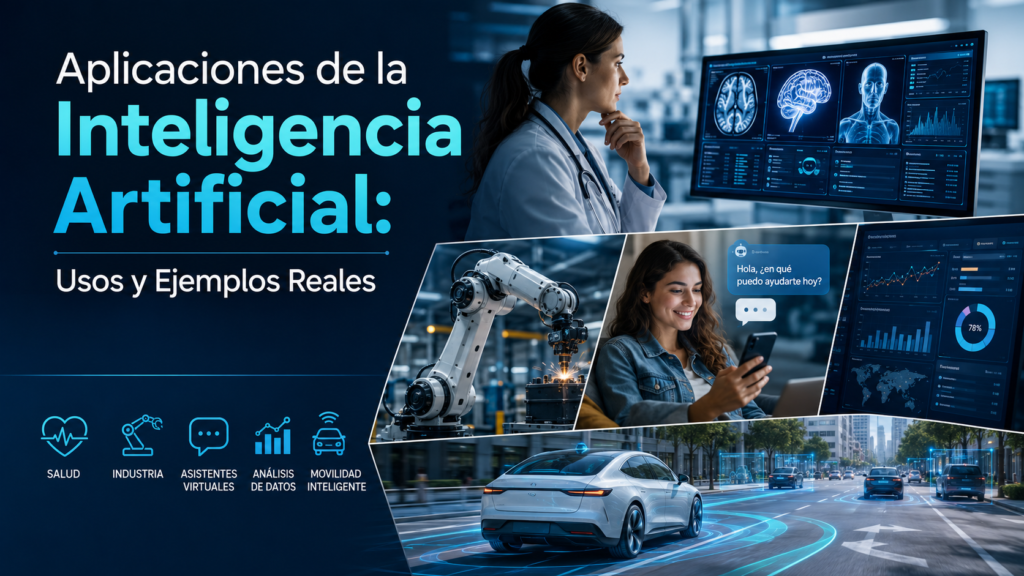
La inteligencia artificial se utiliza para analizar información, realizar predicciones, recomendar opciones, detectar anomalías, generar contenido y automatizar partes de un proceso.
Estas capacidades pueden aplicarse en educación, salud, empresas, marketing, comercio electrónico, programación, industria, transporte, agricultura y ciberseguridad. Sin embargo, utilizar IA no garantiza automáticamente mejores resultados.
Una aplicación útil debe partir de un problema concreto, disponer de datos adecuados, integrarse en el proceso real y mantener el nivel de supervisión necesario.
En esta guía conocerás las principales aplicaciones de la inteligencia artificial, ejemplos prácticos por sectores, sus beneficios y limitaciones y los criterios que debes valorar antes de incorporarla.
Para comprender previamente sus fundamentos, tipos y riesgos generales, consulta nuestra guía completa de inteligencia artificial.
Para qué se utiliza la inteligencia artificial
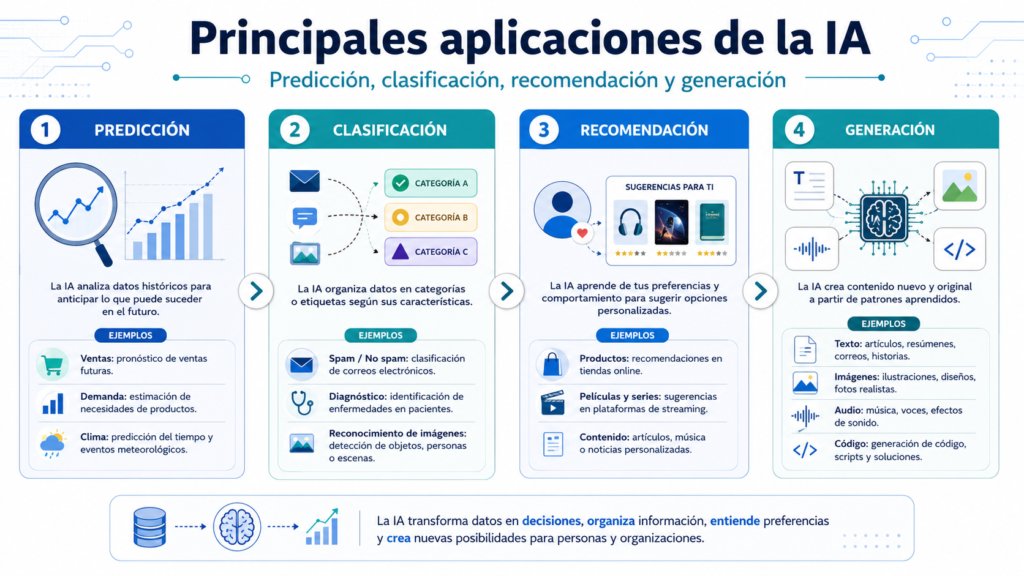
La inteligencia artificial se utiliza cuando un sistema necesita procesar información y generar un resultado relacionado con un objetivo.
Ese resultado puede consistir en:
- Una predicción.
- Una clasificación.
- Una recomendación.
- Una respuesta.
- Una alerta.
- Un contenido nuevo.
- Una acción automatizada.
- Una ayuda para tomar una decisión.
No todas las aplicaciones utilizan la misma tecnología.
Un filtro de correo no deseado puede utilizar un modelo clasificador, una tienda online puede emplear sistemas de recomendación y un asistente puede combinar modelos de lenguaje, búsqueda, documentos y herramientas externas.
Las aplicaciones también pueden agruparse según la función que realizan:
| Necesidad | Aplicación de IA | Ejemplo de resultado | Precaución |
|---|---|---|---|
| Anticipar un resultado | Predicción | Previsión de demanda | Datos históricos poco representativos |
| Ordenar información | Clasificación | Categoría de un documento | Errores de clasificación |
| Detectar algo inusual | Anomalías | Alerta de posible fraude | Falsos positivos |
| Adaptar una experiencia | Recomendación | Contenido personalizado | Perfilado y privacidad |
| Comprender lenguaje | Procesamiento de texto | Resumen o extracción | Pérdida de contexto |
| Crear contenido | IA generativa | Texto, imagen o código | Errores y derechos de uso |
| Analizar imágenes | Visión artificial | Detección de objetos | Condiciones diferentes a las de entrenamiento |
| Ejecutar varios pasos | Agente de IA | Proceso automatizado | Permisos y falta de supervisión |
Para comprender las diferencias entre modelos predictivos, generativos, conversacionales y agentes, puedes consultar los tipos de inteligencia artificial.
Principales aplicaciones de la IA según la tarea
Antes de dividir las aplicaciones por sectores, conviene entender las tareas fundamentales que puede realizar un sistema.
Análisis y predicción
Los modelos predictivos utilizan datos para estimar qué podría ocurrir.
Pueden aplicarse a:
- Previsión de ventas.
- Estimación de demanda.
- Riesgo de avería.
- Tiempo de entrega.
- Abandono de clientes.
- Consumo energético.
- Evolución de determinados indicadores.
Una predicción no es una certeza. Su utilidad depende de la calidad de los datos, de la estabilidad del entorno y de cómo se interprete el resultado.
Clasificación y detección de anomalías
La clasificación asigna información a categorías.
Puede utilizarse para:
- Filtrar correos.
- Organizar documentos.
- Identificar objetos.
- Clasificar consultas.
- Priorizar incidencias.
- Detectar contenido inapropiado.
La detección de anomalías busca casos que se alejan de un comportamiento esperado.
Puede ayudar a identificar:
- Operaciones financieras inusuales.
- Fallos en una máquina.
- Comportamientos anómalos en una red.
- Errores de calidad.
- Cambios inesperados en un proceso.
Una anomalía no demuestra por sí sola que exista fraude, ataque o avería. Normalmente indica que el caso debe revisarse.
Recomendación y personalización
Los sistemas de recomendación ordenan productos, contenidos u opciones según su posible relevancia.
Se utilizan en:
- Comercio electrónico.
- Plataformas audiovisuales.
- Música.
- Noticias.
- Publicidad.
- Formación.
- Redes sociales.
Pueden tener en cuenta:
- Historial.
- Preferencias.
- Productos similares.
- Comportamiento de usuarios parecidos.
- Contexto.
- Popularidad.
- Disponibilidad.
La personalización puede mejorar la experiencia, pero también requiere transparencia y una gestión responsable de los datos.
Procesamiento del lenguaje y conversación
La IA puede analizar y generar lenguaje.
Entre sus aplicaciones encontramos:
- Clasificación de mensajes.
- Traducción.
- Transcripción.
- Extracción de información.
- Resumen.
- Búsqueda semántica.
- Respuesta a preguntas.
- Asistentes conversacionales.
- Análisis de opiniones.
Un chatbot puede responder consultas frecuentes, pero debe permitir el acceso a una persona cuando la situación sea compleja, sensible o no pueda resolverse correctamente.
Generación de contenido
Los modelos generativos pueden producir:
- Texto.
- Imágenes.
- Audio.
- Vídeo.
- Código.
- Presentaciones.
- Borradores.
- Diseños iniciales.
Estas herramientas resultan útiles para ideación, prototipado y preparación de primeras versiones.
Sin embargo, el resultado necesita revisión para comprobar datos, calidad, originalidad, coherencia, privacidad y derechos de utilización.
La guía sobre aplicaciones de la IA generativa explica cómo se producen estos contenidos y qué limitaciones presentan.
Visión artificial
La visión artificial permite analizar imágenes y vídeos.
Puede utilizarse para:
- Detectar objetos.
- Leer documentos.
- Identificar defectos.
- Analizar imágenes médicas.
- Supervisar cultivos.
- Contar productos.
- Interpretar señales.
- Segmentar escenas.
Su rendimiento puede cambiar por la iluminación, el ángulo, la calidad de la imagen, el entorno o las diferencias respecto a los datos de entrenamiento.
Automatización y agentes
La IA puede integrarse en automatizaciones para:
- Leer un correo.
- Extraer información.
- Clasificar una solicitud.
- Consultar una base de datos.
- Generar una respuesta.
- Actualizar un sistema.
- Crear una tarea.
- Avisar a una persona.
Los agentes pueden encadenar varios pasos y utilizar herramientas, pero deben disponer únicamente de los permisos necesarios.
Una automatización fiable requiere:
- Reglas de control.
- Registros de actividad.
- Gestión de errores.
- Límites de actuación.
- Revisión humana.
- Procedimientos para detenerla.
Puedes ampliar este apartado en nuestra guía sobre automatización con inteligencia artificial.
Aplicaciones de la inteligencia artificial por sectores
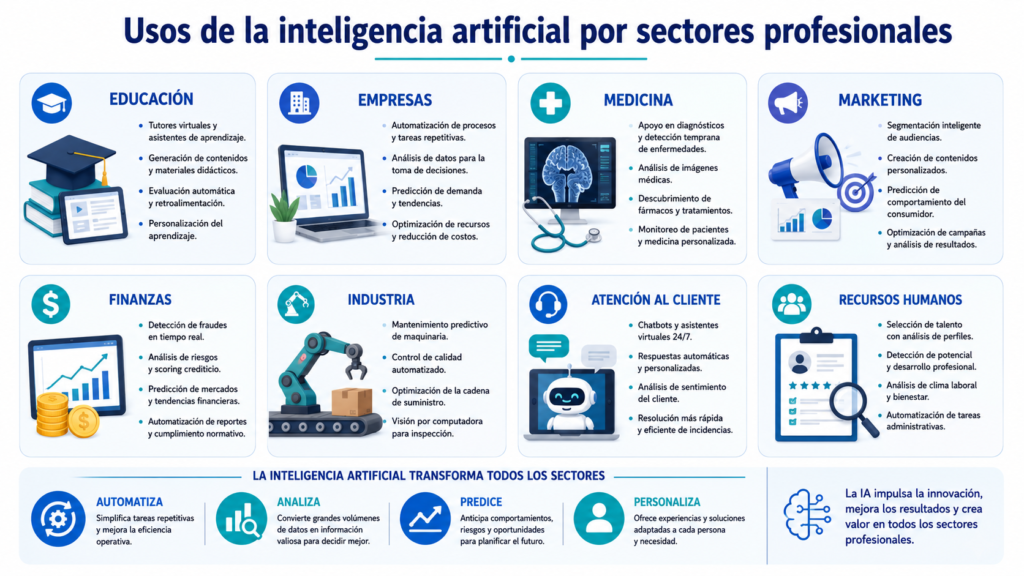
Las mismas capacidades pueden combinarse de forma diferente según el sector y el problema que se quiere resolver.
Inteligencia artificial en educación
La IA puede apoyar tanto al alumnado como al profesorado.
Entre sus aplicaciones encontramos:
- Explicaciones adaptadas.
- Tutores conversacionales.
- Generación de ejercicios.
- Evaluación formativa.
- Preparación de materiales.
- Traducción.
- Transcripción.
- Accesibilidad.
- Organización de contenidos.
- Simulaciones.
- Aprendizaje de idiomas.
Un estudiante puede utilizar un asistente para pedir una explicación adaptada a su nivel o generar preguntas de práctica.
Un docente puede emplearlo para preparar una primera versión de una actividad, adaptar un texto o crear ejemplos, manteniendo la revisión final.
La IA no debe utilizarse para sustituir el aprendizaje, entregar trabajos sin autoría ni aceptar como correcta cualquier respuesta generada.
UNESCO recomienda que su integración educativa mantenga un enfoque centrado en las personas, la inclusión, la autonomía, el pensamiento crítico y la protección de los derechos del alumnado.
Consulta nuestra guía sobre inteligencia artificial para estudiantes para conocer herramientas y métodos de uso responsable.
Inteligencia artificial en salud y medicina
La IA puede utilizarse como herramienta de apoyo para profesionales, investigadores y gestores sanitarios.
Entre sus posibles aplicaciones encontramos:
- Análisis de imágenes médicas.
- Priorización de casos.
- Apoyo a decisiones clínicas.
- Predicción de riesgos.
- Monitorización de pacientes.
- Descubrimiento de medicamentos.
- Investigación.
- Planificación de recursos.
- Gestión documental.
- Vigilancia de enfermedades.
- Automatización administrativa.
En una imagen médica, por ejemplo, un modelo puede señalar zonas que merecen revisión. El resultado debe interpretarse dentro del contexto clínico y por profesionales cualificados.
La OMS reconoce aplicaciones en diagnóstico, atención, desarrollo de medicamentos, vigilancia y gestión sanitaria, pero insiste en que la implementación debe ser segura, ética, equitativa, regulada y centrada en las personas.
En salud no debe utilizarse una herramienta generalista como sustituto de un diagnóstico o tratamiento profesional.
Inteligencia artificial en empresas y administración
Las empresas pueden aplicar IA para reducir trabajo manual, organizar información y apoyar decisiones.
Ejemplos:
- Clasificación de documentos.
- Extracción de datos de facturas.
- Gestión de correos.
- Elaboración de borradores.
- Búsqueda interna de información.
- Atención al cliente.
- Análisis de datos.
- Predicción de demanda.
- Gestión de incidencias.
- Automatización de informes.
- Apoyo comercial.
La mejor aplicación suele encontrarse en procesos:
- Repetitivos.
- Bien definidos.
- Medibles.
- Con suficiente volumen.
- Con datos disponibles.
- Que permiten supervisión.
En recursos humanos puede ayudar a redactar ofertas, organizar información o preparar preguntas, pero las decisiones sobre contratación, evaluación y promoción necesitan controles reforzados para evitar discriminación y pérdida de contexto.
La adopción empresarial no consiste únicamente en comprar una herramienta. También requiere rediseñar procesos, formar a las personas y evaluar los resultados. La OCDE señala que muchas organizaciones tienen dificultades para relacionar la IA con problemas reales de trabajo y subestiman los cambios organizativos necesarios.
La guía sobre inteligencia artificial para empresas desarrolla cómo seleccionar procesos y calcular su utilidad.
Inteligencia artificial en marketing y ventas
En marketing, la IA puede utilizarse para:
- Analizar audiencias.
- Segmentar usuarios.
- Generar borradores.
- Personalizar mensajes.
- Clasificar oportunidades.
- Predecir abandono.
- Analizar opiniones.
- Optimizar campañas.
- Recomendar contenidos.
- Preparar informes.
También puede ayudar a adaptar un mensaje a diferentes canales o reutilizar una pieza de contenido.
Sin embargo, generar más publicaciones no significa obtener mejores resultados.
El contenido debe mantener:
- Intención clara.
- Información correcta.
- Voz de marca.
- Diferenciación.
- Revisión humana.
- Utilidad para el usuario.
En publicidad, la automatización puede ajustar pujas, audiencias o distribución, pero las plataformas no garantizan rentabilidad. Es necesario medir coste, conversión, margen y calidad de los clientes obtenidos.
Puedes consultar nuestras guías de inteligencia artificial aplicada al marketing y uso de IA en SEO.
Inteligencia artificial en comercio electrónico
Las tiendas online pueden utilizar IA en diferentes fases del proceso de compra.
Aplicaciones habituales:
- Búsqueda semántica.
- Recomendación de productos.
- Personalización.
- Atención al cliente.
- Clasificación de consultas.
- Predicción de demanda.
- Gestión de inventario.
- Análisis de devoluciones.
- Generación inicial de fichas.
- Detección de operaciones anómalas.
Una recomendación útil debe equilibrar relevancia, disponibilidad, margen y necesidades reales del cliente.
La generación de fichas puede ahorrar tiempo, pero es necesario revisar:
- Especificaciones.
- Compatibilidades.
- Garantías.
- Traducciones.
- Alegaciones comerciales.
- Duplicación.
- Información legal.
También debe evitarse crear cientos de páginas prácticamente iguales que no aporten valor diferencial.
Inteligencia artificial en programación
Los asistentes de programación pueden ayudar a:
- Generar fragmentos de código.
- Explicar una función.
- Crear pruebas.
- Detectar errores.
- Preparar documentación.
- Traducir entre lenguajes.
- Proponer refactorizaciones.
- Explorar una base de código.
Son especialmente útiles como apoyo, pero no garantizan que el código sea:
- Correcto.
- Seguro.
- Eficiente.
- Compatible.
- Mantenible.
- Libre de dependencias problemáticas.
El desarrollador debe revisar, probar y comprender el resultado antes de integrarlo.
En sistemas críticos o que procesen información sensible, la revisión de seguridad resulta imprescindible.
Inteligencia artificial en finanzas
Las aplicaciones financieras pueden incluir:
- Detección de fraude.
- Análisis de anomalías.
- Evaluación de riesgos.
- Previsión de liquidez.
- Clasificación documental.
- Atención al cliente.
- Cumplimiento normativo.
- Automatización de informes.
Estas aplicaciones pueden tener consecuencias importantes para personas y empresas.
Un resultado algorítmico no debe aceptarse automáticamente cuando afecte a:
- Crédito.
- Seguros.
- Inversiones.
- Acceso a servicios.
- Detección de fraude.
- Bloqueo de operaciones.
Es necesario controlar explicabilidad, falsos positivos, protección de datos, sesgos y procedimientos de revisión.
Esta página no proporciona recomendaciones de inversión ni debe utilizarse para tomar decisiones financieras personales.
Inteligencia artificial en industria y fabricación
En industria, la IA puede combinar datos procedentes de sensores, cámaras, sistemas de producción y mantenimiento.
Entre sus aplicaciones encontramos:
- Mantenimiento predictivo.
- Detección de defectos.
- Control de calidad.
- Optimización de procesos.
- Previsión de demanda.
- Planificación de producción.
- Gestión energética.
- Robótica.
- Seguridad laboral.
- Simulación.
Un sistema de visión puede identificar defectos visuales y un modelo predictivo puede detectar cambios que indiquen desgaste.
La Comisión Europea contempla la IA aplicada al mantenimiento predictivo, la optimización de sistemas productivos y la gestión energética como ejemplos de transformación industrial, aunque su implementación requiere datos fiables e integración con la infraestructura.
Inteligencia artificial en transporte y logística
La IA puede ayudar a gestionar rutas, vehículos, almacenes y entregas.
Aplicaciones:
- Optimización de rutas.
- Predicción de demanda.
- Estimación de tiempos.
- Planificación de cargas.
- Gestión de flotas.
- Mantenimiento predictivo.
- Organización de almacenes.
- Detección de incidencias.
- Asignación de recursos.
- Sistemas de asistencia a la conducción.
Una ruta optimizada no depende solo de la distancia. Puede tener en cuenta tráfico, horarios, restricciones, consumo, capacidad y prioridades.
En vehículos con funciones automatizadas, la capacidad del sistema debe diferenciarse claramente de la conducción completamente autónoma. El conductor sigue siendo responsable cuando así lo determine el nivel de automatización y la normativa aplicable.
Inteligencia artificial en agricultura
La agricultura puede utilizar IA junto con sensores, satélites, drones, estaciones meteorológicas y maquinaria.
Entre sus aplicaciones encontramos:
- Seguimiento de cultivos.
- Detección de enfermedades.
- Predicción de rendimiento.
- Optimización del riego.
- Análisis del suelo.
- Identificación de malas hierbas.
- Planificación de cosechas.
- Gestión de recursos.
- Recomendaciones agronómicas.
- Clasificación de productos.
Un sistema puede analizar imágenes para señalar zonas con cambios de color o crecimiento, pero un especialista deberá interpretar las posibles causas.
La FAO está impulsando aplicaciones de IA y datos para agricultura inteligente, resiliencia climática, eficiencia de recursos y sistemas agroalimentarios, subrayando también la necesidad de una gobernanza inclusiva y responsable.
Inteligencia artificial en ciberseguridad
La IA puede ayudar a analizar grandes cantidades de eventos y detectar patrones difíciles de revisar manualmente.
Posibles aplicaciones:
- Detección de anomalías.
- Clasificación de alertas.
- Identificación de malware.
- Análisis de comportamiento.
- Priorización de incidentes.
- Detección de phishing.
- Respuesta asistida.
- Análisis de vulnerabilidades.
Sin embargo, la relación entre IA y ciberseguridad tiene dos direcciones:
- Utilizar IA para proteger sistemas.
- Proteger los propios sistemas de IA.
Los atacantes también pueden utilizar modelos para automatizar engaños, generar contenido malicioso o buscar vulnerabilidades.
ENISA estudia tanto el uso de IA para ciberseguridad como los riesgos de seguridad que afectan a modelos, datos e infraestructuras de IA.
Inteligencia artificial en investigación científica
La IA puede ayudar a:
- Analizar literatura.
- Encontrar relaciones.
- Procesar imágenes.
- Simular escenarios.
- Diseñar experimentos.
- Analizar grandes conjuntos de datos.
- Proponer hipótesis.
- Identificar candidatos para investigación.
- Automatizar tareas de laboratorio.
El sistema puede acelerar partes del proceso, pero no sustituye la necesidad de:
- Métodos reproducibles.
- Datos verificables.
- Evaluación.
- Experimentos.
- Revisión por especialistas.
- Transparencia.
Una hipótesis generada por IA continúa necesitando validación científica.
Ejemplos de IA en la vida cotidiana
Probablemente ya utilizas sistemas de IA en tareas como:
- Ordenar resultados de búsqueda.
- Filtrar correo no deseado.
- Recomendar música o vídeos.
- Traducir textos.
- Mejorar fotografías.
- Transcribir audio.
- Calcular rutas.
- Detectar fraude.
- Desbloquear un teléfono mediante reconocimiento facial.
- Recibir respuestas de un asistente.
- Corregir texto.
- Organizar fotografías.
No siempre existe una etiqueta visible que indique “esta función utiliza IA”.
En muchos productos, la inteligencia artificial forma parte de un sistema más amplio que también incluye reglas, bases de datos, software tradicional y decisiones humanas.
Beneficios de aplicar inteligencia artificial
Cuando la aplicación está bien seleccionada, la IA puede:
- Reducir trabajo manual.
- Procesar más información.
- Detectar patrones.
- Adaptar servicios.
- Mejorar tiempos de respuesta.
- Aumentar la accesibilidad.
- Apoyar decisiones.
- Crear borradores.
- Automatizar partes de un flujo.
- Ayudar a probar alternativas.
Estos beneficios deben medirse.
No basta con afirmar que una herramienta “aumenta la productividad”. Debe comprobarse:
- Tiempo ahorrado.
- Calidad.
- Número de errores.
- Coste.
- Satisfacción.
- Impacto en trabajadores y clientes.
- Necesidad de correcciones.
- Riesgos generados.
Riesgos y limitaciones según la aplicación
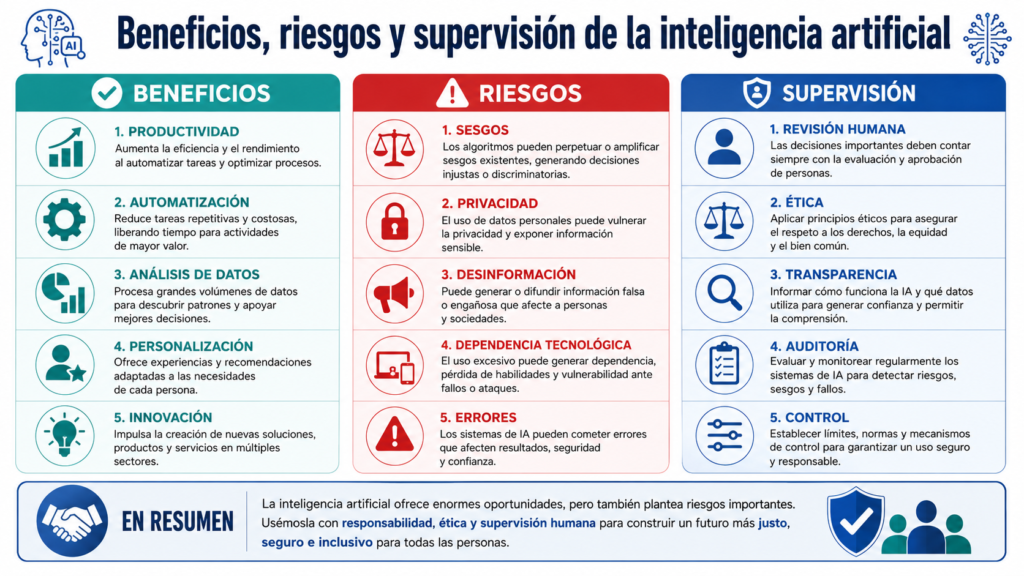
Los riesgos cambian según el contexto.
| Aplicación | Riesgo principal | Control recomendable |
|---|---|---|
| Generación de texto | Información inventada | Verificación de datos y fuentes |
| Recomendación | Perfiles invasivos o burbujas | Transparencia y control del usuario |
| Selección laboral | Discriminación | Auditoría y decisión humana |
| Salud | Daño por error | Validación clínica y supervisión profesional |
| Finanzas | Decisiones injustas | Explicabilidad y procedimiento de revisión |
| Automatización | Acción incorrecta | Permisos limitados y registro |
| Educación | Dependencia o pérdida de autoría | Uso guiado y evaluación del aprendizaje |
| Visión artificial | Errores fuera del entorno | Pruebas con condiciones reales |
| Ciberseguridad | Falsos positivos o evasión | Analistas humanos y varias capas de defensa |
NIST recomienda gestionar los riesgos durante todo el ciclo de vida de la IA, considerando fiabilidad, seguridad, resiliencia, transparencia, privacidad, responsabilidad y sesgos.
Cómo identificar una buena aplicación de IA
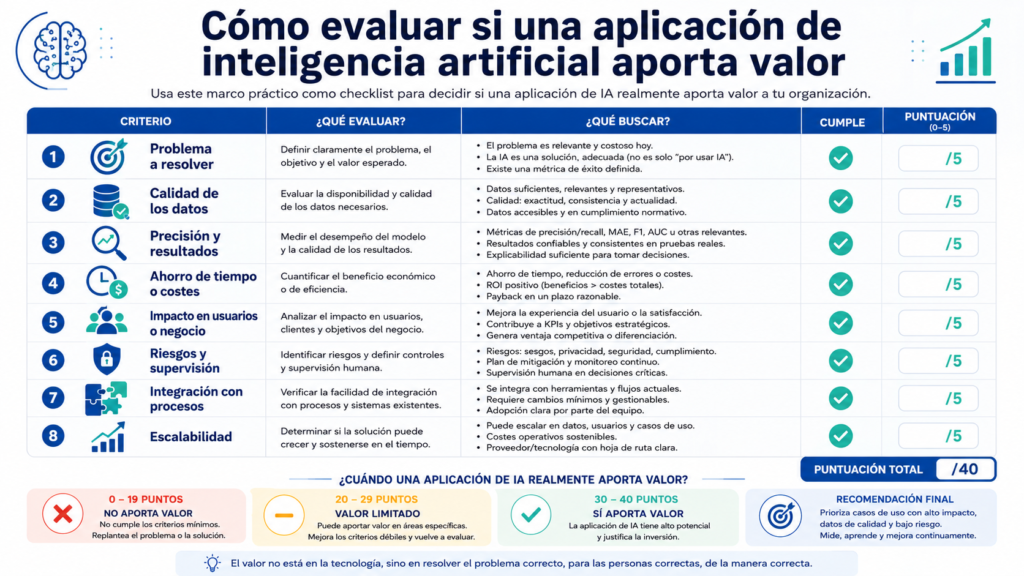
La mejor aplicación no suele ser la más llamativa, sino la que resuelve un problema concreto con un nivel de riesgo controlable.
Define el problema
Describe la tarea antes de elegir la herramienta.
Por ejemplo:
Clasificar solicitudes recibidas y dirigirlas al departamento correcto.
Es más útil que:
Queremos poner inteligencia artificial en la empresa.
Comprueba los datos disponibles
Pregúntate:
- ¿Existen datos?
- ¿Son fiables?
- ¿Tenemos permiso para utilizarlos?
- ¿Representan el proceso real?
- ¿Contienen información sensible?
- ¿Están actualizados?
- ¿Pueden evaluarse los resultados?
Sin datos adecuados, algunas aplicaciones no son viables.
Calcula el valor esperado
Compara:
- Coste de implantación.
- Tiempo ahorrado.
- Errores evitados.
- Trabajo de supervisión.
- Formación.
- Mantenimiento.
- Riesgo.
- Alternativas más sencillas.
A veces una regla, una plantilla o una mejora del proceso resulta mejor que un modelo de IA.
Evalúa el riesgo
Cuanto mayor sea el impacto sobre personas, dinero, salud, derechos o seguridad, mayor debe ser el control.
No necesita el mismo nivel de supervisión:
- Un generador de ideas.
- Un filtro de solicitudes.
- Un sistema médico.
- Un modelo de crédito.
- Una automatización que realiza pagos.
Mantén supervisión humana
Define quién:
- Revisa.
- Aprueba.
- Corrige.
- Recibe alertas.
- Gestiona errores.
- Atiende reclamaciones.
- Puede detener el sistema.
La supervisión debe ser real y no una simple formalidad.
Mide los resultados
Establece indicadores antes de implantar:
- Precisión.
- Tiempo.
- Coste.
- Satisfacción.
- Errores.
- Incidencias.
- Casos que requieren revisión.
- Diferencias entre grupos.
- Impactos inesperados.
Revisa periódicamente si la aplicación continúa aportando valor.
Cuándo no conviene utilizar inteligencia artificial
No siempre es necesario utilizar IA.
Puede ser preferible una solución tradicional cuando:
- El proceso puede resolverse con reglas simples.
- No existen datos suficientes.
- El volumen de trabajo es muy bajo.
- El coste supera el beneficio.
- No puede comprobarse el resultado.
- El error tendría consecuencias graves.
- No existe una persona responsable.
- La herramienta no ofrece garantías de privacidad.
- El sistema introduce más complejidad de la que elimina.
- El usuario necesita una explicación determinista y verificable.
La inteligencia artificial debe ser una herramienta para resolver problemas, no un objetivo por sí misma.
Conclusión
Las aplicaciones de la inteligencia artificial pueden agruparse en predicción, clasificación, recomendación, procesamiento del lenguaje, generación de contenido, visión artificial y automatización.
Estas capacidades se utilizan en educación, salud, empresas, marketing, ecommerce, programación, industria, logística, agricultura, ciberseguridad e investigación.
La utilidad no depende únicamente de la potencia del modelo.
Una buena aplicación necesita:
- Un problema concreto.
- Datos adecuados.
- Un proceso bien diseñado.
- Métricas.
- Gestión de riesgos.
- Supervisión.
- Revisión continua.
Preguntas frecuentes sobre las aplicaciones de la inteligencia artificial
Las principales aplicaciones de la Inteligencia Artificial están en educación, medicina, empresas, marketing digital, programación, ecommerce, finanzas, transporte, logística, creación de contenido y ciberseguridad.
Se utiliza en educación, salud, empresas, marketing, comercio electrónico, programación, finanzas, industria, transporte, agricultura, ciberseguridad e investigación.
En recomendaciones, búsquedas, filtros de correo, traducción, mapas, fotografías, asistentes, detección de fraude y reconocimiento de voz o imagen.
Puede apoyar explicaciones, práctica, preparación de materiales, accesibilidad, idiomas y evaluación formativa. Debe utilizarse con revisión y criterios de autoría.
Puede organizar documentos, analizar datos, automatizar tareas, apoyar la atención al cliente, preparar borradores y predecir determinadas variables.
Puede apoyar el análisis de imágenes, la monitorización, la investigación, la priorización, el desarrollo de medicamentos y la gestión de recursos. No sustituye al profesional sanitario.
Para análisis de audiencias, personalización, generación de borradores, clasificación de oportunidades, análisis de opiniones y optimización de campañas.
En búsqueda, recomendaciones, personalización, atención al cliente, inventario, previsión de demanda y preparación inicial de fichas.
Puede explicar código, proponer fragmentos, crear pruebas, detectar errores y preparar documentación. Todo resultado debe revisarse y probarse.
Sí. Puede ayudar a detectar anomalías, analizar alertas, identificar amenazas y apoyar respuestas. También debe protegerse la propia infraestructura de IA.
No. Puede aumentar el trabajo de revisión, generar errores o introducir costes adicionales. Su impacto debe medirse en el proceso real.
Debe resolver un problema concreto, disponer de datos adecuados, ofrecer un beneficio medible y permitir controlar los riesgos.
Técnicamente algunos sistemas pueden ejecutar acciones, pero el nivel de autonomía adecuado depende del riesgo. Las decisiones de alto impacto requieren controles y supervisión reforzados.
No. En algunos casos una regla, plantilla, buscador o automatización tradicional resuelve el problema de forma más barata y predecible.