
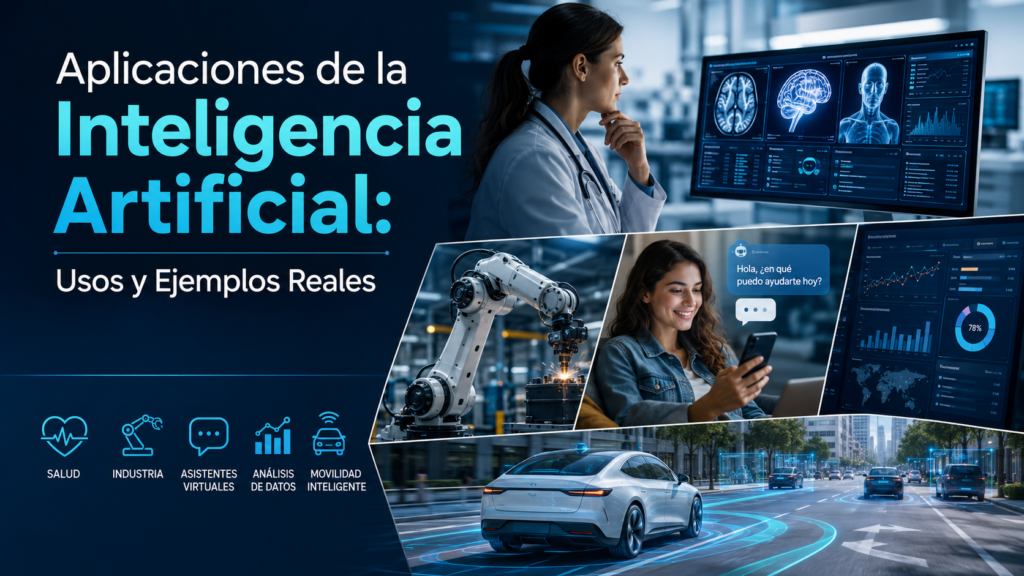
The applications of artificial intelligence reach almost every part of daily life and work: education, medicine, business, marketing, ecommerce, programming, finance, industry, transportation, agriculture, cybersecurity and science. This guide explains what AI is used for by task and by industry, with real examples, benefits, risks and how to tell whether an AI application is actually worth it.
- What artificial intelligence is used for
- Main AI applications by task
- AI applications by industry
- Everyday examples of AI
- Benefits of applying artificial intelligence
- Risks and limitations by application
- How to tell if an AI application is worth it
- When not to use artificial intelligence
- Bottom line
- AI applications FAQ
- Keep reading
Quick answer: AI is most useful for predicting, classifying, detecting anomalies, recommending, understanding language, generating content, recognizing images and automating tasks. A good AI application solves a specific problem, has suitable data, delivers a measurable benefit and keeps a person in control of high-impact decisions.
What artificial intelligence is used for
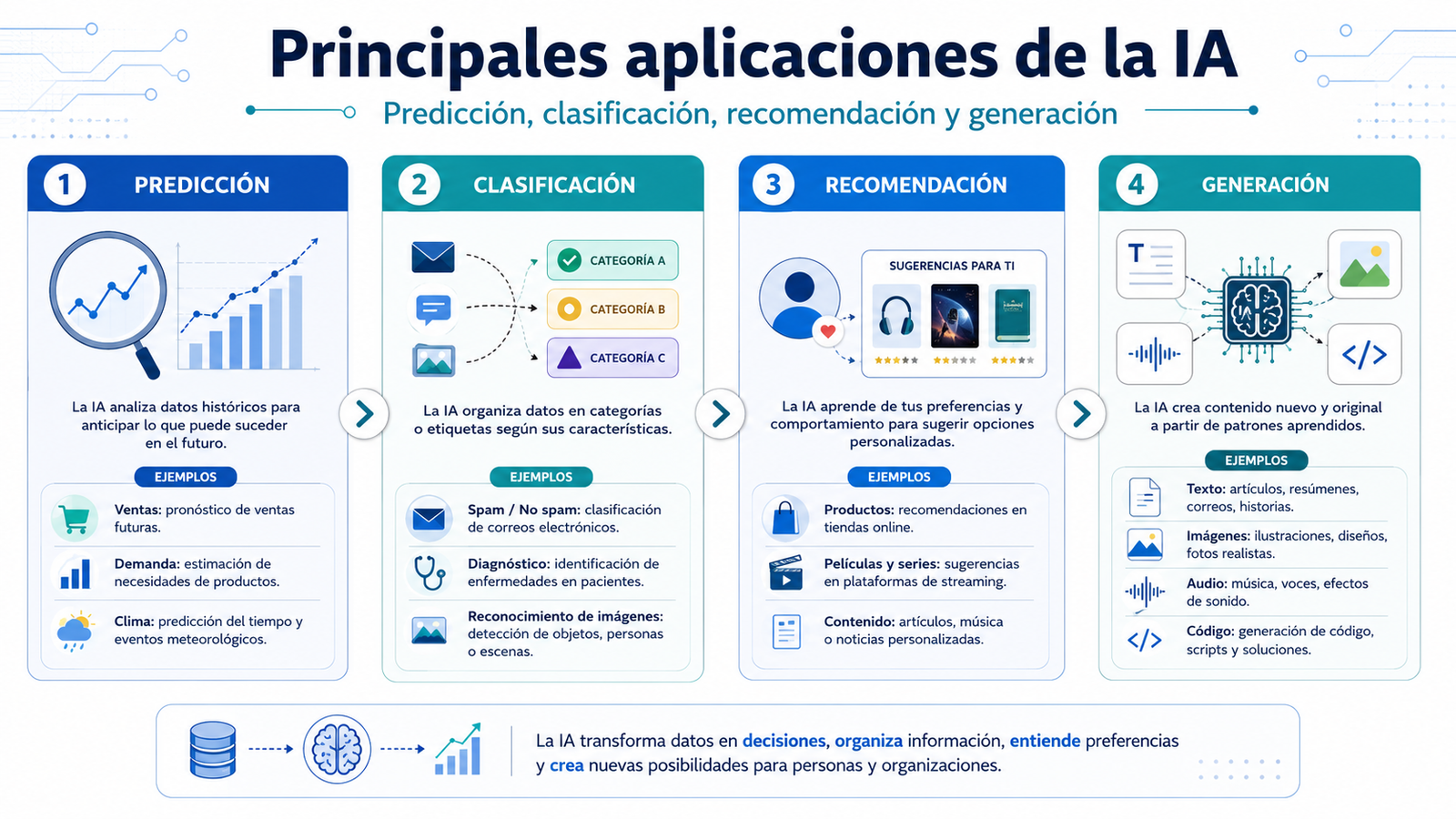
| Need | AI application | Example result | Watch out for |
|---|---|---|---|
| Anticipate an outcome | Prediction | Demand forecasting | Unrepresentative historical data |
| Sort information | Classification | A document’s category | Misclassification |
| Spot something unusual | Anomaly detection | Fraud alerts | False positives |
| Suggest options | Recommendation | Products or videos you may like | Filter bubbles and invasive profiling |
| Understand or answer language | Language processing | Chatbots, translation, summaries | Invented or outdated information |
| Create content | Generation | Text, images, code | Errors and rights issues |
| Interpret images | Computer vision | Defect detection | Lighting and data bias |
| Execute tasks | Automation and agents | Processing forms or tickets | Unsupervised actions |
Main AI applications by task
- Analysis and prediction: forecasting sales, demand, maintenance needs or risk.
- Classification and anomaly detection: sorting documents and emails, flagging fraud or unusual network activity.
- Recommendation and personalization: suggesting products, content or learning paths.
- Language processing and conversation: chatbots, translation, transcription, summaries and search.
- Content generation: drafts, images, audio, video and code.
- Computer vision: recognizing objects, faces, defects or medical findings in images.
- Automation and agents: completing multi-step tasks across apps with some autonomy.
AI applications by industry
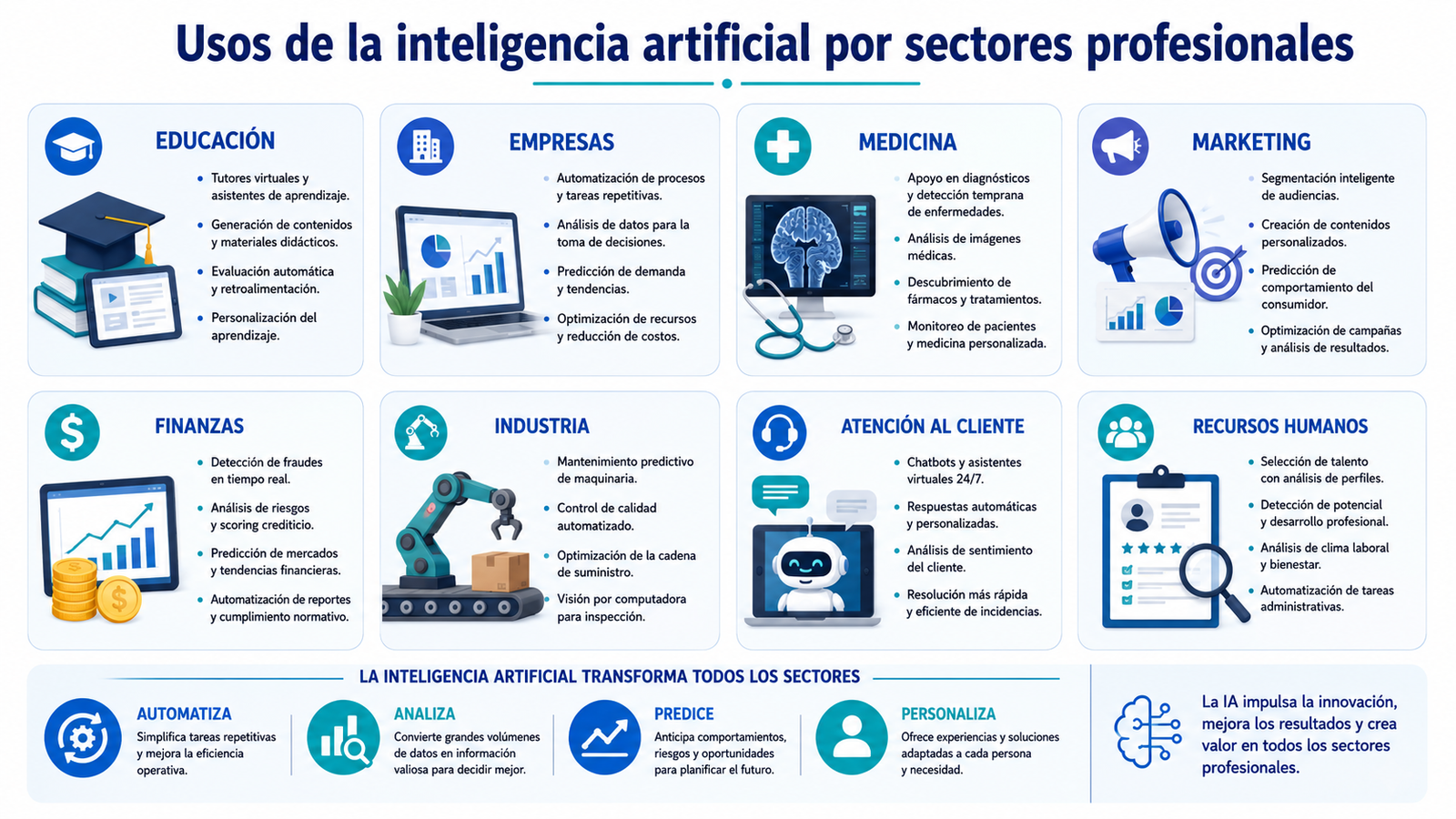
- Education: personalized explanations, practice, accessibility, language learning and teaching materials, with review and clear authorship rules.
- Health and medicine: support for imaging analysis, patient monitoring, research, triage and drug discovery. It assists professionals but doesn’t replace them.
- Business and administration: organizing documents, analyzing data, automating tasks, drafting documents and supporting customer service.
- Marketing and sales: audience analysis, personalization, content drafts, lead scoring, sentiment analysis and campaign optimization.
- Ecommerce: search, recommendations, customer service, inventory, demand forecasting and first drafts of product listings.
- Programming: explaining code, suggesting snippets, writing tests, finding bugs and documenting. Everything must be reviewed and tested.
- Finance: fraud detection, risk assessment, document processing and customer support.
- Industry and manufacturing: predictive maintenance, quality control and process optimization.
- Transportation and logistics: route optimization, demand planning, driver assistance and warehouse automation.
- Agriculture: crop monitoring with drones and satellites, precision irrigation and yield prediction.
- Cybersecurity: detecting anomalies, analyzing alerts and supporting incident response, while protecting the AI systems themselves.
- Scientific research: analyzing large datasets, predicting protein structures and speeding up simulations.
Everyday examples of AI
You probably use AI many times a day: streaming and shopping recommendations, search results, spam filters, translation apps, navigation and traffic predictions, phone camera processing, voice assistants, face unlock and bank fraud alerts.
Benefits of applying artificial intelligence
- Saves time on repetitive work
- Finds patterns in large volumes of data
- Personalizes services and learning
- Supports better-informed decisions
- Improves accessibility
- Operates at scale and around the clock
Risks and limitations by application
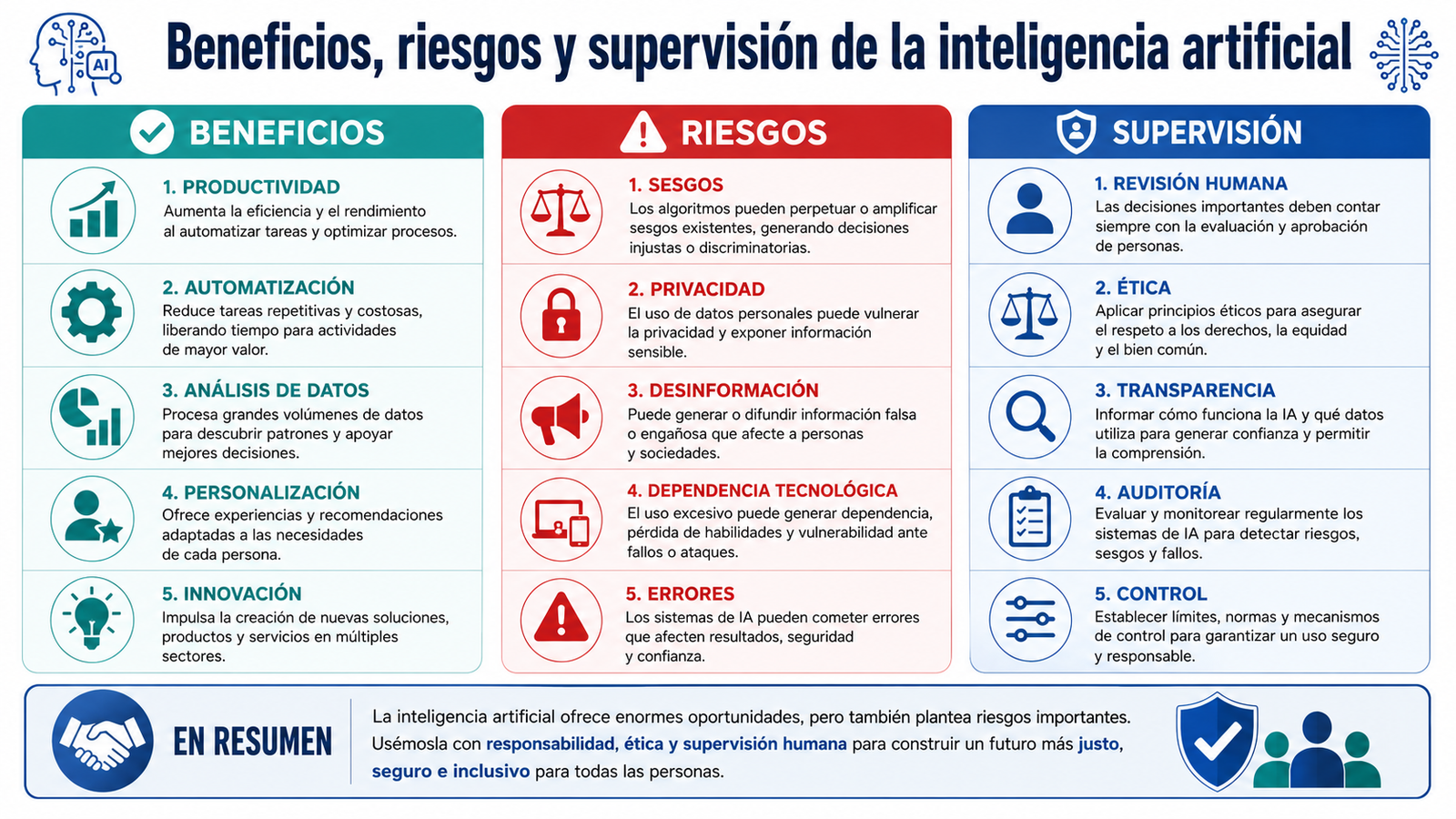
| Application | Main risk | Recommended control |
|---|---|---|
| Text generation | Invented information | Verify facts and sources |
| Recommendation | Invasive profiling or filter bubbles | Transparency and user control |
| Hiring and selection | Discrimination | Audits and human decisions |
| Medical support | Errors with serious consequences | Professional validation |
| Facial recognition | Privacy and bias | Legal limits and strict oversight |
| Autonomous agents | Unwanted actions | Permissions, logs and human approval |
How to tell if an AI application is worth it
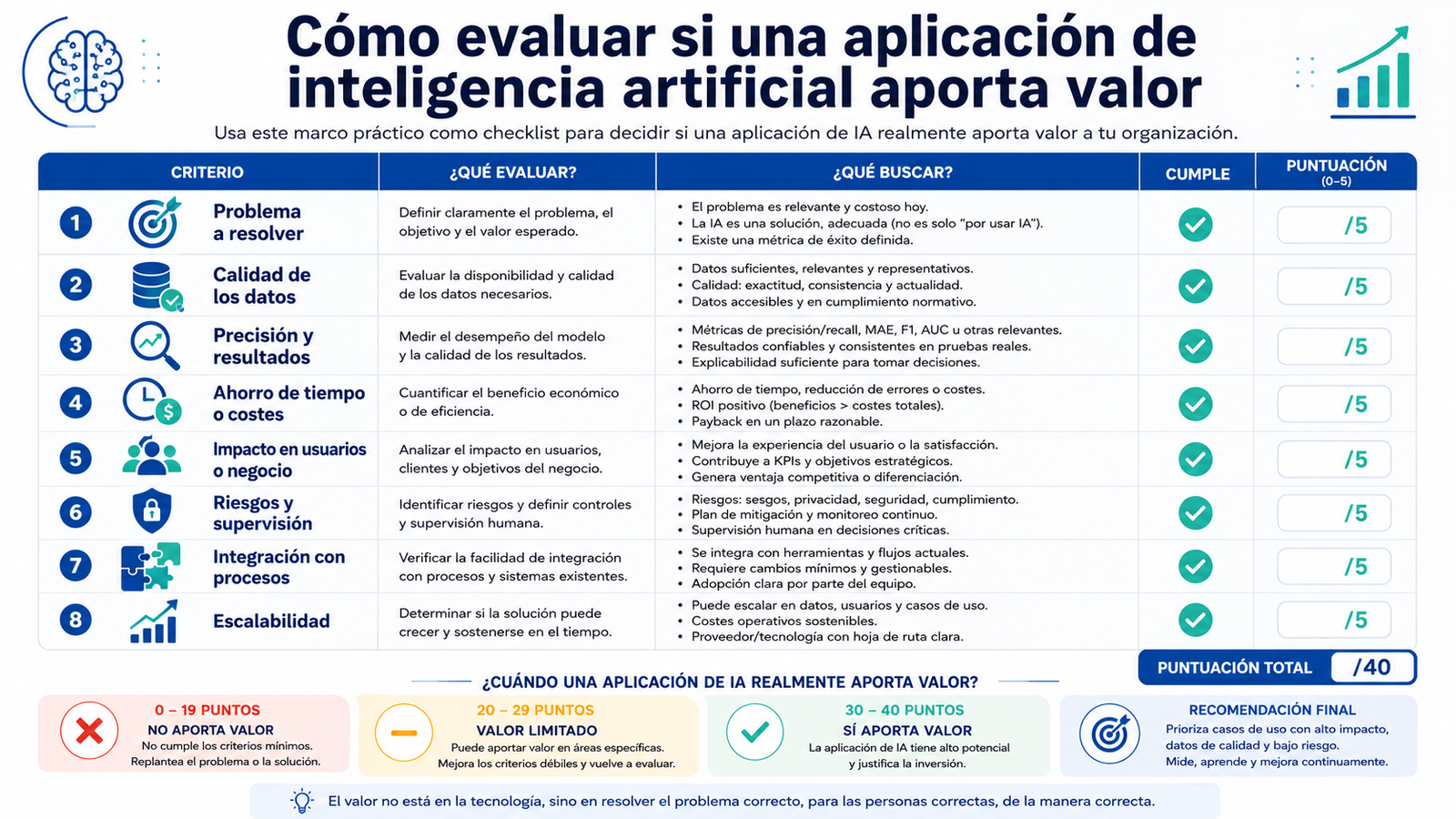
- Define the problem precisely: what should improve and for whom.
- Check the available data: quality, quantity, permissions and representativeness.
- Estimate the expected value: time saved, fewer errors, more revenue.
- Assess the risk: what happens if the AI gets it wrong.
- Keep human oversight, especially for high-impact decisions.
- Measure results in the real process, not just in a demo.
When not to use artificial intelligence
AI isn’t always the answer. When a simple rule, template, search or traditional automation solves the problem more cheaply and predictably, use that. Avoid AI too when errors would be unacceptable and can’t be checked, when you lack suitable data or when the extra review work outweighs the time saved.
Bottom line
Artificial intelligence already has real, valuable applications in almost every industry. The key isn’t using AI everywhere, but applying it where it solves a specific problem, with good data, measurable benefits and the right level of human oversight.
AI applications FAQ
Education, medicine, business, digital marketing, programming, ecommerce, finance, transportation, logistics, content creation and cybersecurity, among others.
In recommendations, search, email filters, translation, maps, photography, voice assistants, fraud detection and voice or image recognition.
To organize documents, analyze data, automate tasks, support customer service, prepare drafts and forecast certain variables.
Supporting image analysis, monitoring, research, triage, drug development and resource management. It doesn’t replace healthcare professionals.
For audience analysis, personalization, content drafts, lead scoring, sentiment analysis and campaign optimization.
No. It can add review work, introduce errors or extra costs. Its impact should be measured in the real process.
Some systems can technically act on their own, but the right level of autonomy depends on the risk. High-impact decisions need strong controls and human oversight.
No. Sometimes a rule, template, search or traditional automation solves the problem more cheaply and predictably.