
Disclosure: this article contains affiliate links. If you buy through them, Bright Technology may earn a small commission at no extra cost to you. As an Amazon Associate, we earn from qualifying purchases.
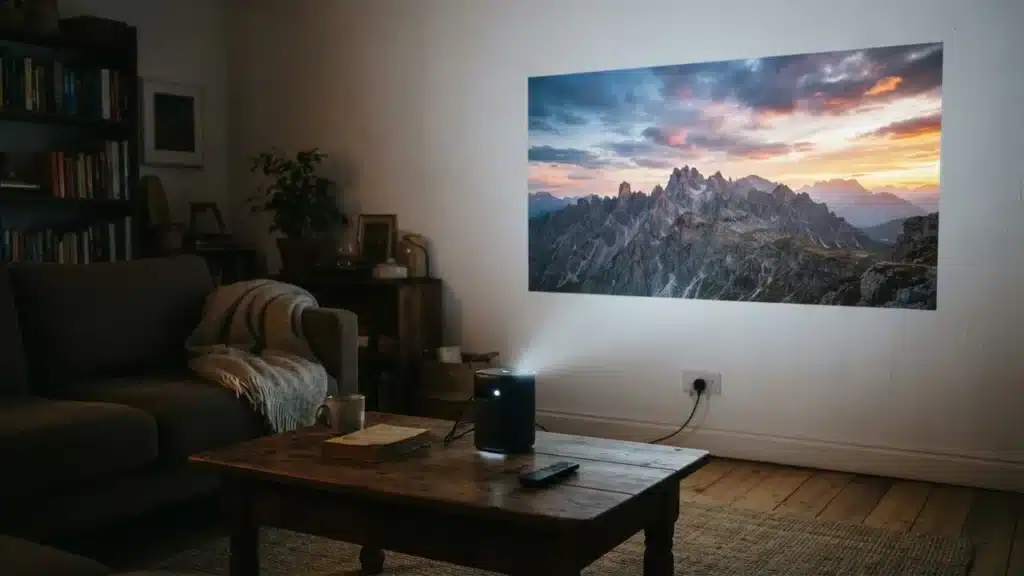
A mini portable projector turns any wall into an 80- or 100-inch screen and then goes back into a drawer or backpack. The problem is that brightness and resolution figures on product pages are often inflated. This guide compares six of the best portable projectors using manufacturer data and what really matters: real ANSI or ISO lumens, native resolution, battery and apps, so you know what to look for before you buy.
- Mini portable projectors compared
- How to choose a mini portable projector
- 1. XGIMI MoGo 4: the best mini portable projector overall
- 2. Nebula Capsule 3 GTV: 1080p in a soda-can size
- 3. Samsung The Freestyle 2nd Gen: the most flexible to position
- 4. Yaber T2 Plus: the brightest battery model for outdoors
- 5. Nebula Capsule Air: the smallest mini projector
- 6. HY320 mini projector: the budget option for home
- Which one to choose
- Mini portable projector FAQ
- Keep reading
Quick answer: the XGIMI MoGo 4 is the most balanced mini portable projector: 450 ISO lumens, native 1080p, Google TV and a built-in battery. If you want something pocket-sized, the Nebula Capsule 3 GTV delivers 1080p and official Netflix in 850 g. For outdoor movie nights, the Yaber T2 Plus adds JBL sound and 450 ANSI lumens. On a tight budget for home use, the HY320 from our store has native 720p and Android, but it needs a power outlet.
Mini portable projectors compared
| Model | Official brightness | Native resolution | Battery | System | Image size | Weight |
|---|---|---|---|---|---|---|
| XGIMI MoGo 4 | 450 ISO lumens | 1920 × 1080 | Up to 2.5 h (Eco mode) | Google TV | 40–200″ | 1.31 kg |
| Nebula Capsule 3 GTV | 200 ANSI lumens | 1920 × 1080 | Up to 2.5 h | Google TV | Up to 120″ | 850 g |
| Samsung The Freestyle 2nd Gen | 230 ANSI lumens | 1920 × 1080 | No (external USB-C battery) | Tizen | Up to 100″ | 830 g |
| Yaber T2 Plus | 450 ANSI lumens | 1920 × 1080 | Up to 2.5 h | Google TV (dongle) | 40–120″ | 2.4 kg |
| Nebula Capsule Air | 150 ANSI lumens | 1280 × 720 | About 2 h | Google TV | Up to 120″ | 650 g |
| HY320 (our store) | 200 ANSI lumens (supplier-declared) | 1280 × 720 | No (plug-in only) | Android | Not stated | Not stated |
Brightness is shown as each brand publishes it; below we explain why those figures are not always comparable.
How to choose a mini portable projector
Before looking at models, it helps to understand five specs. They separate a good projector from one that disappoints on the first night.
ANSI or ISO lumens vs “marketing” lumens
Only trust ANSI or ISO lumens. Both are measured on the projected image, averaging several points across the screen, and give similar figures. “LED” or “light source” lumens are measured before the optics or use different methods, and are usually 1.3 to 2.4 times higher than ANSI, because they rely on the Helmholtz-Kohlrausch effect (saturated colors look brighter). That’s why the same projector can appear as 230 ANSI lumens or 550 LED lumens.
As a practical guide: with 150–250 ANSI lumens you need a dark room; from about 400 ANSI or ISO lumens you can watch with some ambient light or project larger images. If a $60 mini projector promises 9,000 or 15,000 lumens, the number isn’t comparable, so be wary.
Native vs supported resolution
What counts is native resolution, the resolution of the chip that forms the image. Many mini projectors advertise “4K” or “1080p supported”, which only means they accept that signal and downscale it. For images over 80 inches, native 1080p makes a visible difference in text and detail. The HY320 is an honest example: its spec sheet says it decodes some 4K content but projects at 1280 × 720.
Is there a 4K mini projector?
Hardly. In a mini, battery-powered format, native 1080p is still the norm in 2026. Compact 4K projectors such as the Nebula Cosmos 4K SE (1,800 ANSI lumens and Google TV) are portable with a handle, but they don’t have a built-in battery and are no longer pocket-sized. If you see a “4K mini projector” for under $100, it is almost certainly a 720p or 1080p model that accepts a 4K signal.
Battery life: built-in, external or plug-in
To watch a whole movie away from home you need at least 2 real hours. The battery models here offer around 2–2.5 hours of video, usually in an eco mode with lower brightness. Some, like the Freestyle or the MoGo 3 Pro, have no battery and depend on a compatible USB-C power bank, and others, like the HY320, only work plugged in.
Operating system and apps
Google TV with official Netflix is the most convenient option. Many cheap projectors use generic Android where Netflix or Disney+ aren’t certified or work with limitations. The Nebula models and XGIMI MoGo 4 include Google TV; the Freestyle uses Tizen, the system on Samsung TVs. If a projector has no reliable system, you can always plug a streaming stick into the HDMI port.
Image size and distance
The maximum advertised size isn’t the recommended one. XGIMI allows up to 200 inches on the MoGo 4 but recommends 60 to 120 inches for a good experience. The bigger the image, the dimmer it looks. With a mini projector of 150–250 ANSI lumens, stay between 60 and 90 inches.
1. XGIMI MoGo 4: the best mini portable projector overall
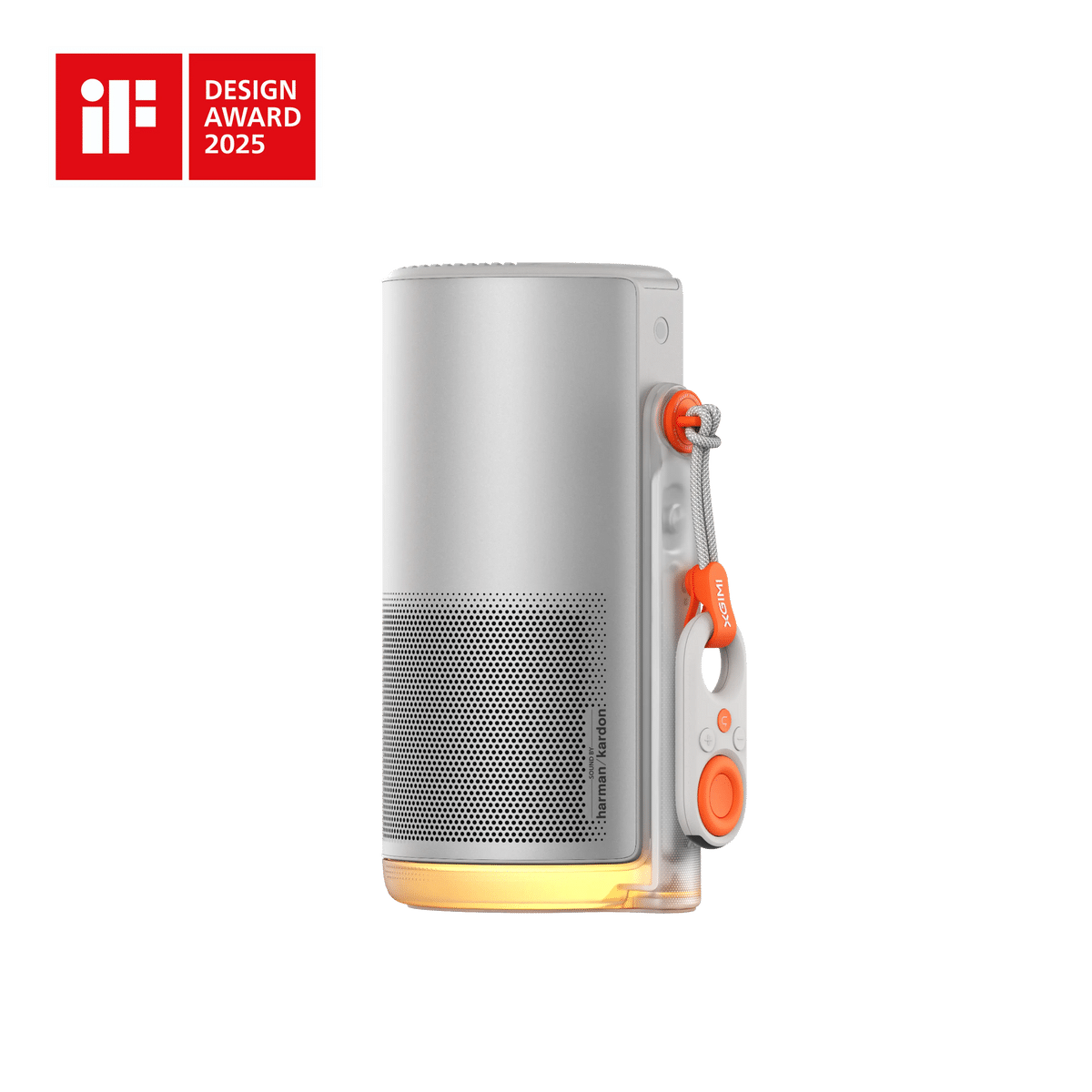
The most complete model here. It combines 450 ISO lumens, native 1080p, Google TV and a built-in battery in a 1.31 kg body. According to XGIMI, the battery lasts up to 2.5 hours of video in Eco mode and up to 6 hours as a speaker; with the optional PowerBase it reaches about 5 hours of video.
It projects images from 40 to 200 inches, although XGIMI recommends 60 to 120.
Ideal for: anyone who wants one projector for the living room, bedroom and outdoor trips.
- 450 ISO lumens, the brightest battery model here
- Native 1080p and Google TV
- Up to 2.5 h of video (5 h with PowerBase)
- Heavier than pocket models
- Maximum battery life requires Eco mode
- Pricier than basic options
2. Nebula Capsule 3 GTV: 1080p in a soda-can size
The best choice if size is your priority but you don’t want to drop to 720p. The Google TV version of Anker Nebula’s Capsule 3 offers 200 ANSI lumens, 1920 × 1080 resolution, officially licensed Netflix and up to 2.5 hours of video.
Watch the name: there’s also the Capsule 3 Laser, with a laser light source and 300 ANSI lumens. Check the exact version before you buy.
Ideal for: travel, vacation rentals and bedroom movie nights.
- Very compact: 850 g
- Native 1080p and Google TV with official Netflix
- Up to 2.5 h of video or 8 h of music
- 200 ANSI lumens: needs darkness
- Several versions with similar names
- Large images only in dark rooms
3. Samsung The Freestyle 2nd Gen: the most flexible to position
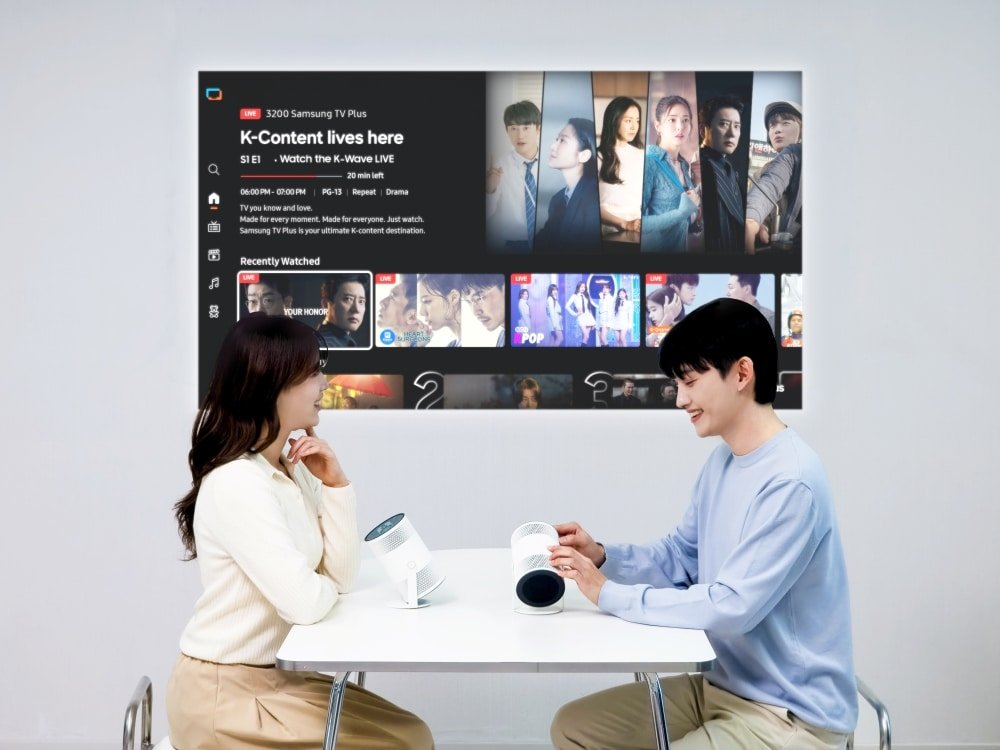
Its standout feature is the 180-degree rotating design, which lets you project onto a wall or the ceiling without a tripod. It has native 1080p, 230 ANSI lumens (550 LED lumens by the marketing measure), Tizen with streaming apps and automatic keystone and focus.
There’s no built-in battery: it runs plugged in or from an external USB-C power bank, which Samsung says gives up to about three hours. In January 2026 Samsung announced its successor, The Freestyle+, with 430 ISO lumens and AI-powered automatic adjustments, and it’s already on sale in the US.
Ideal for: projecting onto the bedroom ceiling and Samsung TV owners.
- 180° rotating base for walls or ceilings
- Native 1080p and Tizen apps
- Automatic keystone and focus
- No built-in battery
- 230 ANSI lumens: modest brightness for the price
- Its brighter successor is now available
4. Yaber T2 Plus: the brightest battery model for outdoors
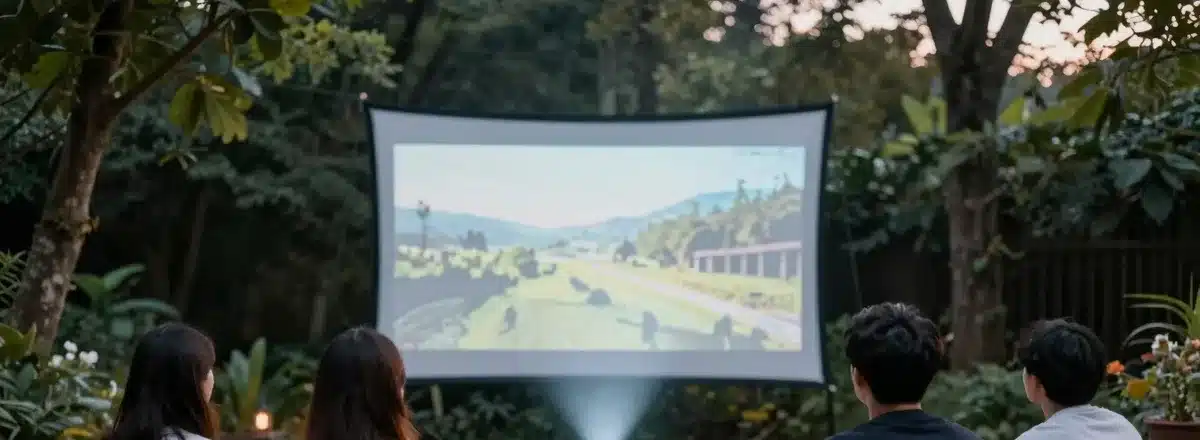
This is the backyard and camping projector, with JBL sound, 450 ANSI lumens and an 8,000 mAh battery. Yaber quotes up to 2.5 hours of video and up to 18 hours in speaker mode. The Plus version adds a Google TV dongle for official apps.
In exchange it weighs 2.4 kg: portable, but not a pocket projector. It projects 40 to 120 inches with automatic focus and keystone correction.
Ideal for: summer outdoor movies and gatherings where sound matters.
- 450 ANSI lumens and native 1080p
- JBL sound and 8,000 mAh battery
- Google TV via included dongle
- 2.4 kg, the heaviest here
- Apps depend on an external dongle
- No removable battery or charging base
5. Nebula Capsule Air: the smallest mini projector
It weighs just 650 g and fits in a large pocket. Anker introduced it as the smallest Google TV projector in its lineup. It offers 150 ANSI lumens, 720p resolution, official Netflix and about 2 hours of battery (around 4 with the optional battery tripod).
Its brightness and resolution limit it to moderate image sizes in dark rooms. It’s a fun travel projector, not a TV replacement.
Ideal for: travelers, kids’ rooms and projecting on the ceiling before bed.
- 650 g, the lightest here
- Google TV with official Netflix
- Battery can be extended with an optional tripod
- Only native 720p
- 150 ANSI lumens
- Not suited to large images
6. HY320 mini projector: the budget option for home
The HY320 is the affordable portable projector in this selection, designed to be used plugged in and moved between rooms. We sell it in our store, which ships internationally with the plug adapted to each country.
According to the supplier’s spec sheet, it offers native 1280 × 720 resolution, Android, dual-band WiFi 6, Bluetooth 5.0, screen mirroring, automatic keystone correction and an adjustable built-in stand. Declared brightness is 200 ANSI lumens and power consumption is 40 W.
It has clear limits. There is no battery, it projects at 720p even though it accepts some 4K content, and it performs best in a dark room on a plain, light-colored wall. Availability of some streaming apps may depend on system updates, so keep an HDMI streaming stick in mind.
Ideal for: bedrooms, kids’ rooms, students and second homes on a small budget.

- Very affordable
- Native 720p with no inflated resolution claims
- WiFi 6, Bluetooth 5.0 and an adjustable stand
- No battery: always plugged in
- Generic Android: some apps may be unavailable
- Brightness suited to dark rooms
Which one to choose
- One projector for everything: XGIMI MoGo 4, the best balance of brightness, resolution and battery.
- Smallest with good image quality: Nebula Capsule 3 GTV, with 1080p in 850 g.
- Ceiling projection: Samsung The Freestyle, thanks to its rotating base (or the brighter Freestyle+).
- Backyard cinema: Yaber T2 Plus, for its brightness, battery and JBL sound.
- Ultra-light travel: Nebula Capsule Air.
- Small budget and home use: the HY320 mini projector.
- Real 4K: look for a home 4K projector rather than a mini, and accept that it won’t have a battery.
If you like gadgets like these, browse more ideas in the curious gadgets category of our store.
Mini portable projector FAQ
For dark rooms and 60- to 90-inch images, 150–250 ANSI lumens is enough. For some ambient light or bigger screens, look for 400 ANSI or ISO lumens or more. Ignore “LED lumens” or figures without a standard; they aren’t comparable.
Native resolution is the real resolution of the chip that forms the image. Supported resolution is the signal the projector accepts, which it then downscales. A “4K supported” projector with a 720p chip projects at 720p.
Practically none in the mini format. The most advanced battery models are native 1080p. Compact 4K models such as the Nebula Cosmos 4K SE are portable but need external power.
Yes, if the system has the officially licensed app, as Google TV models from XGIMI and Nebula do. On generic Android projectors it may be missing or limited; the alternative is an HDMI streaming stick.
Between 2 and 2.5 hours of video for the models in this guide, usually in eco mode. Some extend it with bases or USB-C power banks, and others, like the Freestyle, have no built-in battery.
Yes, for home use in the dark with realistic expectations. Choose one that states its native resolution and ANSI lumens, and be wary of any that promise thousands of lumens or 4K for under $100.
No. The HY320 projects at native 1280 × 720. It can decode some 4K content, but it downscales it to 720p. It also has no battery and needs a power outlet.
Anywhere with an outlet, such as a bedroom, dorm or vacation home. For a garden or camping, choose a battery model such as the Yaber T2 Plus or XGIMI MoGo 4, or use a compatible USB-C power bank if the projector supports one.
Keep reading
Official sources: XGIMI MoGo 4 · Nebula projectors · BenQ: projector brightness measures (ANSI, light source and LED)