

Generative AI is the branch of artificial intelligence that creates new content (text, images, video, audio, code, 3D models) from a prompt, a reference image, a document or other data. It powers ChatGPT, Gemini, Claude, Midjourney and most of the AI tools people use today. This guide explains what it is, how it works, which models sit behind it, what it can create and which controls you need to use it responsibly.
- What is generative AI?
- Predictive, discriminative and generative AI: what's the difference?
- How generative AI works, step by step
- Main types of generative models
- What generative AI can create
- What is a prompt and why does it change the result?
- Generating vs. retrieving vs. editing content
- Practical uses and benefits of generative AI
- Risks and limitations of generative AI
- How to use generative AI responsibly
- Transparency and labeling of AI-generated content
- Bottom line
- Generative AI FAQ
- Keep reading
Quick answer: generative AI learns patterns from huge amounts of data during training, then uses them to produce a probable new output for your prompt. It is fast and powerful for first drafts, ideas and variations, but it can invent facts, reproduce biases and raise privacy and copyright questions, so every output needs human review.
These systems don’t work like a database that copies a stored answer, and new does not automatically mean correct or ready to publish. For the big picture first, see our complete guide to artificial intelligence.
What is generative AI?
Generative AI is a category of AI designed to produce new outputs from patterns learned during training. It can generate text, images, video, voice, music, code, designs, presentations, synthetic data and 3D models. The input can be a written instruction, a question, a photo, a sketch, a document, an audio file, structured data or a mix of formats.
The output is synthetic, so don’t assume it is true, unique, legally original or suitable for every use.
Predictive, discriminative and generative AI: what’s the difference?
A discriminative model might decide whether a photo shows a dog or a cat. A generative model could create a brand-new image from the prompt “a dog and a cat traveling by train.” In real products these abilities are often combined: a system may analyze a document, classify it and then generate a report.
| Type | Main function | Example |
|---|---|---|
| Predictive AI | Estimates a future value or outcome | Demand forecasting |
| Discriminative model | Classifies or tells inputs apart | Spam detection |
| Generative AI | Produces a new output | Generating text or an image |
| Hybrid system | Combines analysis and generation | Reads a document and drafts a report |
How generative AI works, step by step
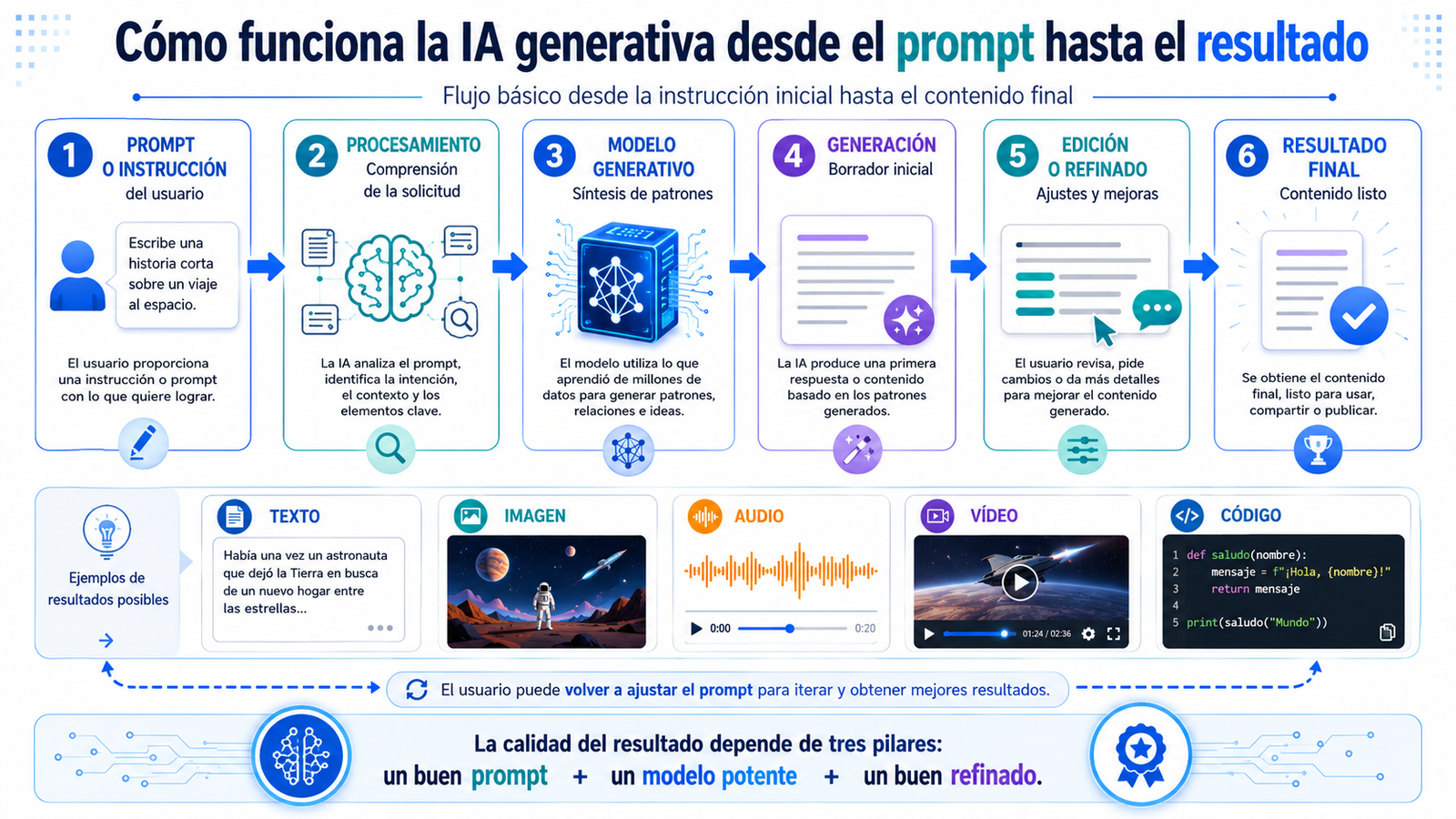
1. Model training
The model analyzes huge datasets to learn statistical relationships: language structure, shapes, colors, textures, sounds, motion and code patterns. It doesn’t necessarily store each example as a file to look up later. It adjusts a very large number of internal parameters that let it represent patterns, and the source, quality and permissions of the data shape its behavior. For more on data, training and inference, read how artificial intelligence works.
2. Prompt and input data
The prompt is the instruction the system receives. It can state the task, context, format, audience, style, constraints and what to avoid. Compare “Write a text about marketing” with “Write a 150-word intro for owners of small online shops explaining how AI can help organize customer questions, without promising higher sales.” The second removes ambiguity and fits the need far better.
3. Context and representation
The app converts your input into a representation the model can process. In a language model, text is split into tokens: a word, part of a word, a punctuation mark or a piece of code. The model analyzes the tokens and available context to estimate the most likely output. Multimodal systems can also process images, audio, video or documents.
4. Probabilistic generation
The model builds its result step by step. A language model calculates probabilities for the next tokens, while an image model may start from noise and gradually turn it into a coherent picture. This explains why the same prompt can give different results, why an answer can sound convincing and still be wrong, and why small prompt changes can alter the output a lot.
5. Result and review
Check accuracy, sources, spelling, personal data, bias, problematic similarities and usage rights before you use anything. In professional work the flow is: goal, prompt, generation, review, correction, validation, publication.
Main types of generative models
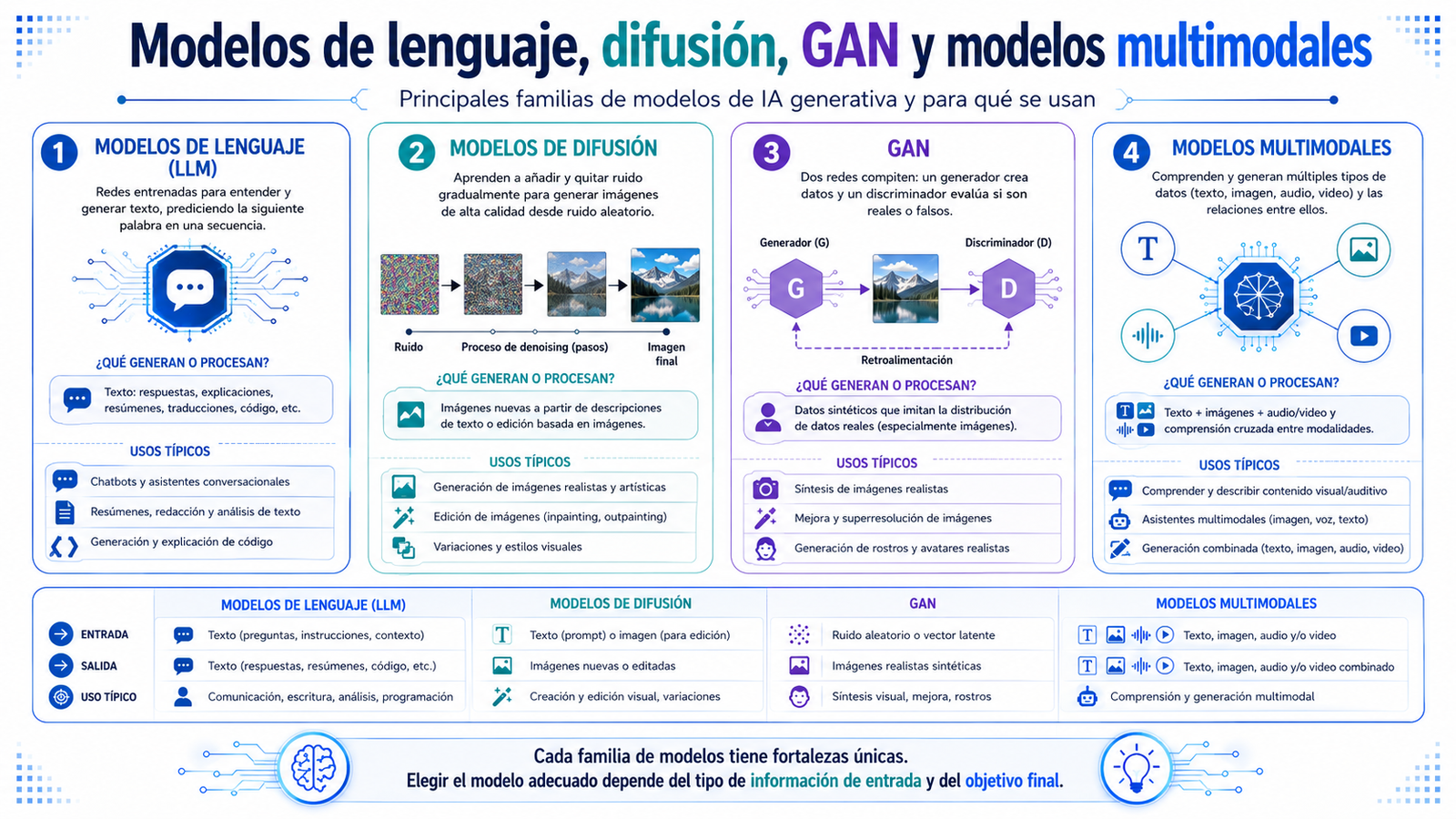
Language models and transformers
Large language models (LLMs) are trained on text or code. They can write, summarize, translate, answer questions, extract information, generate code and hold conversations. Many use the transformer architecture, which relies on attention mechanisms to process relationships within the context. They estimate which tokens should continue the sequence, which is not the same as copying a sentence, and a probable sequence isn’t guaranteed to be true.
Diffusion models
Diffusion models are used mainly to generate and edit images and video. They learn to reverse a process of adding noise: starting from noise, they remove it step by step while the prompt steers the result until shapes and details emerge. They can also use a reference image, mask, sketch, pose or depth map, which enables text-to-image, image-to-image, inpainting, upscaling, style changes and video generation.
Generative adversarial networks (GANs)
A GAN uses a generator that tries to produce samples resembling real data and a discriminator that tries to tell real samples from generated ones. Both improve through this competition. GANs have been used for images, synthetic faces and visual transformations, and today coexist with diffusion models.
Multimodal models
A multimodal model can process or generate several formats, such as text plus images, charts, audio or video. That doesn’t mean it understands every format equally well, since each modality has its own strengths and limits.
Foundation models
A foundation model is a large model trained on broad data and reusable for many tasks. It can underpin assistants, generators, search tools, agents and business apps, adapted through instructions, fine-tuning, specific data, document retrieval, tools and filters. Many generative AI apps wrap a foundation model rather than training their own from scratch.
What generative AI can create
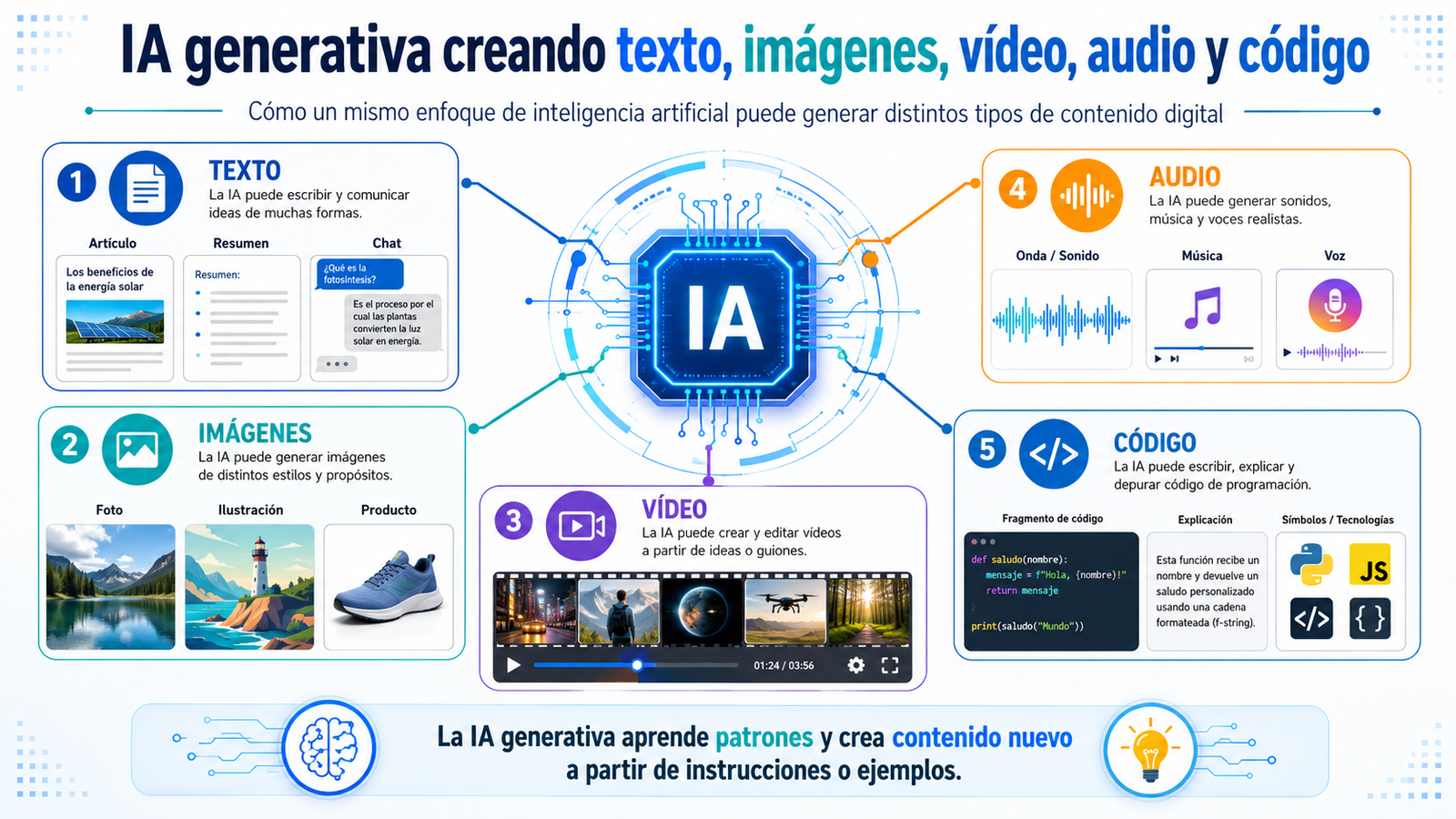
- Text: drafts, emails, summaries, scripts, outlines and translations. The model can invent data, omit information, confuse dates or produce citations that don’t exist. To compare assistants, see ChatGPT vs Claude vs Gemini.
- Images: illustrations, synthetic photography, concept art, ad visuals, product variations and textures. Quality depends on the model, prompt, references and later editing. Our guide to AI image generators covers the tools.
- Video: clips from text, animation of still images, avatars and ad scenes. The hard parts are frame consistency, physics, character continuity, text inside the scene, camera control and cost.
- Audio, voice and music: narration, dubbing, voice translation, sound effects and music. Cloning a real voice without consent can cause privacy violations, impersonation and fraud.
- Code: functions, tests, explanations, documentation and prototypes. Review and test everything, since it can contain vulnerabilities, nonexistent dependencies or logic errors.
- Designs and 3D models: industrial design, concept architecture, fashion, interfaces and game assets. It usually supports design and needs technical adaptation before anything is manufactured.
What is a prompt and why does it change the result?
A prompt can include an instruction, context, examples, format, constraints, data and a role. A useful structure is: goal, context, audience, format, constraints and criteria. A good prompt improves the result but cannot guarantee accuracy. For practical examples, see our best ChatGPT prompts.
Generating vs. retrieving vs. editing content
- Generate: the model produces a new output, such as a product description.
- Retrieve: the system searches documents, databases or the web for information.
- Edit: the system transforms existing content, like removing a photo background or summarizing a document.
- Use tools: the system calls an external function to query a database, run a calculation or create a calendar event.
So not everything an AI app does comes from the generative model. It can combine generation, search, traditional software, tools and human review.
Practical uses and benefits of generative AI
It is most useful when the task allows review, the result can be verified and sensitive information is protected. For sector examples, see applications of artificial intelligence.
- Speed for first versions: ideas, drafts and prototypes in seconds, though review time must be counted.
- Exploring alternatives: try different tones, designs and approaches quickly.
- Accessibility: conversational interfaces let people use advanced capabilities without programming.
- Personalization: adapt output to audience, level, language and format.
- Creative and technical support: beat the blank page without replacing professional judgment.
Risks and limitations of generative AI
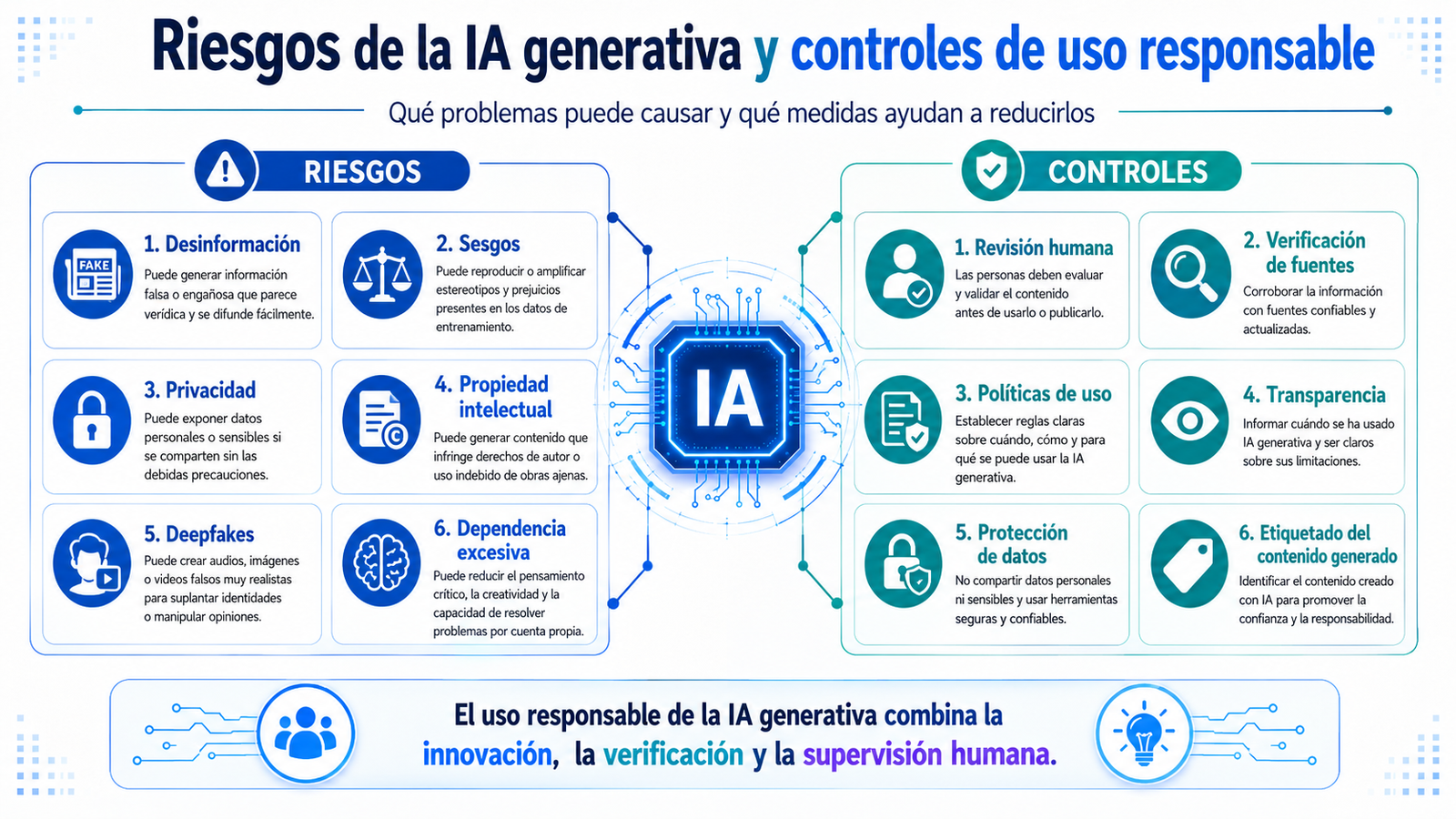
- Hallucinations and errors: false data, nonexistent sources, wrong dates and invented quotes. Verify anything factual that matters.
- Bias: learned patterns can reproduce stereotypes and unfair associations.
- Privacy and confidential data: before entering personal data, contracts, medical information, passwords or private code, check the tool’s data use, retention and training settings.
- Copyright and provenance: consider platform terms, licenses, trademarks, likeness and voice rights. In the US, the Copyright Office has said material generated purely by AI, without human authorship, can’t be registered.
- Deepfakes and misinformation: realistic images, video and voice can impersonate people, fabricate evidence and enable fraud.
- Prompt injection: an app connected to documents or tools can receive malicious instructions. Controls include least-privilege permissions, human confirmation, logs and security testing.
- Dependence: using AI without review can erode skills, repeat errors and blur accountability.
How to use generative AI responsibly
- Before generating: define the purpose, check you may use the data, avoid confidential information and choose a suitable tool.
- After generating: verify data and sources, review for bias and similarities, confirm rights, label synthetic content when appropriate and keep editorial responsibility.
For repetitive tasks, set up a flow: authorized input, generation, validation, human review, approval, publication, follow-up.
Transparency and labeling of AI-generated content
Transparency matters most when content could be mistaken for a real recording or human creation. In the European Union, the AI Act sets transparency duties for certain synthetic content and deepfakes, applying from August 2, 2026. Many US platforms also ask creators to disclose realistic AI-generated media.
Bottom line
Generative AI produces new content from learned patterns and the context you provide. Result quality depends on the model, data, prompt and your review process. Using it well takes clear instructions, authorized data, verification, privacy and security controls, rights checks, transparency and human responsibility.
Generative AI FAQ
It is a category of artificial intelligence that can produce text, images, video, audio, code or other content from an input such as a prompt, image or document.
It learns patterns during training and uses them to generate a probable output based on your prompt and context. Language models predict tokens, while diffusion models turn noise into an image.
AI is the broad field of systems that perform tasks needing intelligence, such as classifying or predicting. Generative AI is the branch that produces new content.
It doesn’t normally work like a database that retrieves an exact copy, but it can produce similarities, and some apps also connect to search or your documents. Always review the result.
It creates a new output, but that doesn’t guarantee legal originality, the absence of similarities or exclusive rights over the result.
ChatGPT, Gemini and Claude generate text and code, Midjourney creates images, and other tools produce video, voice and music.
A model trained on text or code that estimates likely continuations based on context. It powers chat assistants.
A diffusion model learns to turn noise into a structured image or video, often guided by text. A GAN trains a generator and a discriminator against each other to create realistic samples.
Because it generates likely results from patterns and context, not because it checks that every statement is true.
It depends on the platform’s terms, the content, applicable laws and third-party rights. Check before you publish or sell.
Only after checking the tool’s policies, settings and data retention. Don’t enter confidential information into tools you haven’t approved.