

Disclosure: this article contains affiliate links. If you buy through them, Bright Technology may earn a small commission at no extra cost to you. As an Amazon Associate, we earn from qualifying purchases.
The best drones for beginners are easy to fly, stable in the air and forgiving when you make mistakes. Picking one is harder than it sounds: dozens of models, endless spec sheets and conflicting reviews. Most first-time buyers really want to know which beginner drone is easiest to fly, which one has the best camera and which is worth the money right now.
The good news is that today’s entry-level drones include GPS, automatic Return to Home, subject tracking, 4K video and automated flight modes that used to be reserved for professional gear. This guide compares seven of the best beginner drones, who each is for, and their pros and cons.
- Best beginner drones compared
- What to look for in a beginner drone
- The 7 best drones for beginners
- 1. DJI Neo: best easy-to-fly drone for absolute beginners
- 2. Potensic Atom: best value beginner drone with GPS
- 3. DJI Mini 4 Pro: best drone to learn on and keep for years
- 4. DJI Mini 3: best battery life and camera for the money
- 5. HoverAir X1: easiest drone for creating content without piloting
- 6. Holy Stone HS720G: balanced mid-range option for tight budgets
- 7. Potensic Atom SE: cheapest step up to a GPS drone
- Which beginner drone should you buy for your budget?
- Do you need to register a beginner drone in the US?
- Mistakes to avoid when buying your first drone
- Bottom line: the best beginner drone for you
- Best drones for beginners FAQ
- Keep reading
Quick answer: the DJI Neo is the easiest drone for a complete beginner. The Potensic Atom is the best value beginner drone with GPS, the DJI Mini 4 Pro is the best long-term investment, the DJI Mini 3 gives you the longest flight time for the money, and the Potensic Atom SE is the cheapest way into a real GPS drone.
Best beginner drones compared
Here is a quick side-by-side of the best drones for beginners covered in this guide. Prices change often, so check current deals.
| Model | Best for | Camera | Flight time | Strength | Weakness | Price |
|---|---|---|---|---|---|---|
| DJI Neo | Starting from zero | 4K | Up to 18 min | Ease of use | Shorter flight time | Check price |
| Potensic Atom | Best value | 4K | Up to 32 min | Features for the price | Smaller ecosystem | Check price |
| DJI Mini 4 Pro | Learning and growing | 4K HDR | Up to 34 min | Very complete | Price | Check price |
| DJI Mini 3 | Travel | 4K HDR | Up to 38 min | Battery life | Fewer sensors | Check price |
| HoverAir X1 | Social media clips | 2.7K | About 11 min | Full automation | Lower image quality | Check price |
| Holy Stone HS720G | Mid-range budget | 4K EIS | Up to 26 min | Stable in wind | Heavier (377 g) | Check price |
| Potensic Atom SE | Lowest budget | 4K | Up to 31 min | Price | Fewer smart features | Check price |
What to look for in a beginner drone
Here is what matters most when you pick your first drone. For flying basics, see our guide to how to fly a drone for the first time.
- GPS and automatic Return to Home. GPS holds the drone steady when you let go of the sticks and brings it home if signal or battery runs low.
- Weight under 250 g (0.55 lb). Easier to carry and, for purely recreational US flying, exempt from FAA registration (you still need the free TRUST test).
- Flight time of 25 to 30 minutes. More time in the air means more practice per battery and less pressure to land.
- A decent 4K camera. Stabilization matters as much as resolution.
- Smart flight modes. Follow-me, Orbit and QuickShots give cinematic clips while your skills develop.
- Obstacle sensing. A real safety net if your budget allows it.
The 7 best drones for beginners
1. DJI Neo: best easy-to-fly drone for absolute beginners
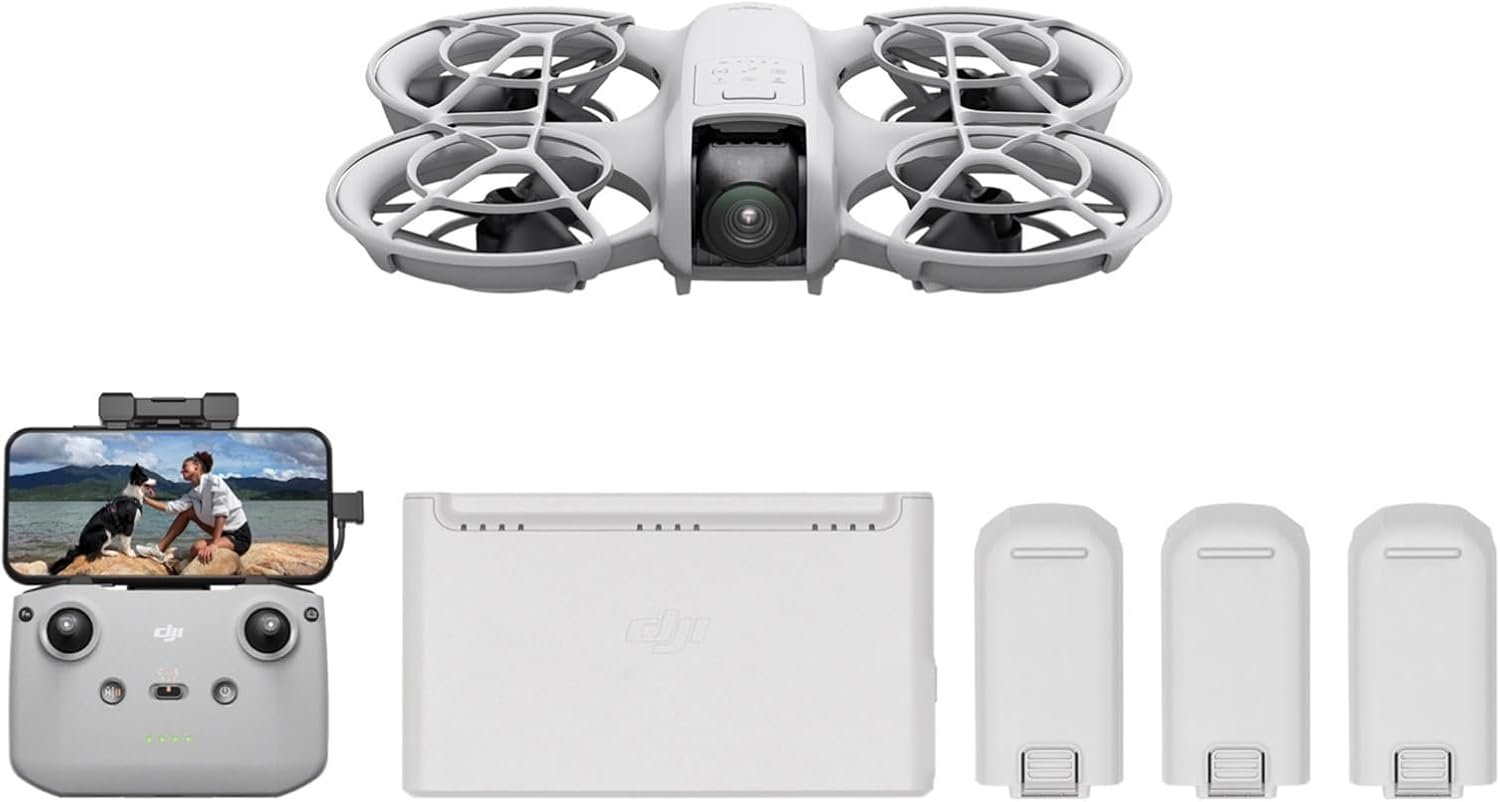
The DJI Neo was built around one idea: to be the easiest drone for people with no experience. Instead of competing on specs, DJI simplified everything: launch it from your palm and start filming. Our DJI Neo review goes deeper into the details.
At just 135 g it is one of the lightest drones you can buy, which makes it easy to carry and much less intimidating than a large quadcopter. DJI’s app is also among the most polished on the market.
Key specs
- 4K UHD camera
- Weight: 135 g
- Downward visual positioning (no GPS)
- Subject tracking
- Automatic QuickShots
- Smartphone control
- Palm takeoff
- Up to 18 minutes of flight
Camera and smart modes
The Neo records 4K video with electronic stabilization, so clips look smooth and sharp enough for TikTok, Instagram, YouTube and travel memories, even if you never edit them. It will not match the DJI Mini 4 Pro, but that is not its job.
Automatic modes do the hard work: subject tracking, Dronie, Orbit, Rocket, Spotlight and other QuickShots turn a few taps into a polished clip.
Safety note: no GPS
The Neo positions itself with a downward visual sensor rather than GPS, so fly it in open areas with good light and little wind. Its return to takeoff point is vision-based and less reliable than GPS return, so avoid sending it far away.
- Extremely easy to use
- Very light and portable
- 4K video
- Advanced automatic modes
- Great for social media
- DJI app and ecosystem
- Shorter flight time than rivals
- Not meant for advanced photography
- Less wind resistance
- Camera below the Mini 4 Pro
- No GPS
Best for: first-time pilots, travelers, social media creators and anyone who wants DJI technology at the lowest possible price.
2. Potensic Atom: best value beginner drone with GPS
If one drone has challenged DJI in the entry-level segment, it is the Potensic Atom. It offers much more than its price suggests: a foldable body under 249 g, a stabilized 4K camera, advanced GPS and up to 32 minutes of flight. Read our Potensic Atom review for the full breakdown.
Key specs
- Stabilized 4K camera
- Under 249 g
- Up to 32 minutes of flight
- Advanced GPS
- Follow Me, Orbit and Waypoints
- Automatic Return to Home
- Range of several kilometers

Flying experience and camera
The GPS holds position accurately and the drone responds smoothly, which builds confidence quickly. It folds into a small backpack and stays steady in light gusts.
The 4K camera delivers good sharpness, contrast and color for a drone in this class. Footage is great for social media, YouTube, landscapes and family videos, and the stabilizer smooths out beginner mistakes.
Smart modes and battery life
Follow Me suits cycling, hiking and sports. Orbit is ideal for buildings and monuments. Waypoint flights let you program an automatic route, and Return to Home protects you if something goes wrong. With up to 32 minutes in the air, you get far more practice per battery than the 15 to 20 minutes common on cheaper drones.
- Excellent value for money
- Very good 4K camera
- Up to 32 minutes of flight
- Precise, stable GPS
- Foldable and light
- Smart modes for growth
- App behind DJI Fly
- Tracking less advanced than DJI
- Fewer original accessories
- Smaller community than DJI
Best for: beginners who want the best price-to-performance ratio, content creators on a budget and anyone who wants a drone that will last beyond the first few months.
3. DJI Mini 4 Pro: best drone to learn on and keep for years
The Mini 4 Pro costs more, but it belongs in any list of the best beginner drones because it is the one you can buy now and still use five or six years later. Many people outgrow a simple drone within months; with the Mini 4 Pro that upgrade itch rarely arrives. See our DJI Mini 4 Pro review for more.
Key specs
- 4K HDR camera with vertical shooting
- Under 249 g
- Up to 34 minutes of flight
- Omnidirectional obstacle sensing
- ActiveTrack 360°
- Waypoint Flight
- Advanced QuickShots
- DJI O4 transmission

Design and flying experience
It combines a very compact, sub-249 g body with features from much larger drones. GPS, vision sensors and electronic assists make it stable and easy to fly within minutes, even for a first-time pilot. If you choose the pack with the DJI RC 2 controller, the built-in screen removes the need for a phone and speeds up setup.
Camera quality
The camera is the main reason to buy. Photos are highly detailed, and 4K HDR video gives more natural color and better dynamic range in sunrise, sunset and high-contrast scenes. Native vertical video is a big plus for Instagram, TikTok and YouTube Shorts because you do not have to crop. There is also headroom for color grading later. For more on shooting technique, see our guide to drone photography and video.
Smart modes and safety
Omnidirectional obstacle detection is the standout safety feature for a new pilot, since many cheaper drones only sense obstacles in some directions. Add ActiveTrack 360°, MasterShots, Hyperlapse, QuickShots, Waypoint Flight, Cruise Control and smart Return to Home, and you can start with fully automatic modes and gradually move to manual flying.
- Outstanding photo and 4K HDR video quality
- Omnidirectional obstacle sensing
- Long flight time (up to 34 min)
- ActiveTrack 360° and advanced smart modes
- Native vertical video
- Under 249 g
- Pricier than entry-level drones
- Some advanced features take time to master
- Official accessories are expensive
- Getting the most from it means learning photo and video basics
Best for: people who want to buy one drone and keep it, content creators, aerial photography fans and anyone who wants maximum in-flight safety.
4. DJI Mini 3: best battery life and camera for the money
Even with the Mini 4 Pro grabbing the spotlight, the DJI Mini 3 remains one of the best-value drones for people who want a high-quality camera without paying top dollar. It keeps the Mini family’s sub-249 g weight, excellent flight time and a camera that outperforms what most buyers expect from a drone this size.
Key specs
- 4K HDR camera
- Under 249 g
- Up to 38 minutes of flight
- Built-in GPS
- Automatic Return to Home
- QuickShots
- Vertical shooting

Flying experience and camera
It looks much like the Mini 4 Pro, and GPS plus its assist systems make it feel secure from the first flight. It lacks the Mini 4 Pro’s full sensor suite, but it is still a very safe drone for new pilots, and it holds position well even in small gusts.
The camera captures detailed photos and 4K HDR video with natural color and good dynamic range, especially at golden hour. Native vertical recording is ideal for Instagram, TikTok, Facebook and YouTube Shorts. Stabilization keeps slow, planned movements looking professional.
Safety and smart modes
The Mini 3 has no omnidirectional obstacle detection, but it does offer automatic Return to Home, QuickShots (Dronie, Rocket, Circle, Helix) and GPS-assisted flight. If signal or battery drops, it flies back to the takeoff point by itself, cutting the risk of a loss.
- Excellent 4K HDR photo and video
- Up to 38 minutes of flight, among the best in class
- Under 249 g, ideal for travel
- Vertical shooting for social media
- Very easy to fly
- Great balance of price and features
- No omnidirectional obstacle sensing
- Lacks some Mini 4 Pro features
- More limited subject tracking
- Still pricier than other entry-level drones
Best for: travelers, aerial photography beginners, social media creators and pilots who value battery life. For many buyers, the gap to the Mini 4 Pro is not worth the extra cost.
5. HoverAir X1: easiest drone for creating content without piloting
While most brands stick with controllers and endless settings, HoverAir took a different path. The X1 is closer to an intelligent flying camera than a traditional drone. It takes off from your palm and follows you automatically.
Key specs
- 2.7K camera
- About 125 g
- Palm takeoff
- AI subject tracking
- Automatic flight modes
- Foldable design
- Control from a mobile app
- About 11 minutes of flight

Design and use
You do not pair a controller or wait for GPS. Pick an automatic mode, place the drone on your palm and let it launch. At about 125 g it fits in a jacket pocket, so it suits travelers, hikers and cyclists. It is not meant to replace a Mini 4 Pro or Atom.
Camera and automatic modes
Its 2.7K camera is plenty for social media, and the stabilization looks smooth during automatic moves. The real selling point is speed: backpack to stabilized clip in seconds.
Modes include automatic follow, orbit around you, pull-back, push-in, side tracking and smart hover. Tracking works best when you walk, run or ride at moderate speed. It does not match DJI’s ActiveTrack 360° but does the job for its audience.
- Extremely easy to use
- Palm takeoff and landing
- AI subject tracking
- Very compact and light
- Great for social media
- No experience needed
- 2.7K trails the 4K rivals
- Limited flight time
- Not for advanced aerial photography
- Few manual controls
Best for: content creators on Instagram, TikTok and YouTube Shorts, travelers, athletes and people who never want to learn to pilot.
6. Holy Stone HS720G: balanced mid-range option for tight budgets
The Holy Stone HS720G is a folding mid-range drone with a 4K camera and electronic image stabilization (EIS), GPS, Follow Me, Waypoints and Orbit mode. It is much heavier than the Mini drones or Atom, but still easy to carry on trips and weekend outings.
Key specs
- 4K camera with EIS
- Weight: about 377 g
- Up to 26 minutes per battery
- Built-in GPS
- Follow Me
- Waypoint flight
- Orbit mode
- Brushless motors
- Automatic Return to Home

It feels sturdy, and thanks to its brushless motors and GPS it often handles wind better than ultralight drones, which helps while you learn. The app is not as refined as DJI Fly but is intuitive.
The 4K camera gives decent photos in good light and pleasant video during smooth movement. EIS is not a mechanical gimbal, so limits show up with speed or wind.
At about 377 g, the HS720G is above the FAA’s 250 g threshold, so you will need to register it with the FAA even for recreational flying. That is the main extra requirement compared with the sub-250 g models above.
- Good value for money
- 4K camera with electronic stabilization
- Up to 26 minutes of flight
- Very stable in flight
- GPS and automatic Return to Home
- Enough smart functions for beginners
- Heavier than sub-250 g drones
- EIS does not replace a mechanical gimbal
- App behind DJI Fly
- Lower image quality than the Mini 4 Pro
Best for: budget-minded beginners who want a fairly complete drone, aspiring aerial photographers and people who want solid stability in breezy places like the coast.
7. Potensic Atom SE: cheapest step up to a GPS drone
Not everyone wants to spend a lot on a first drone. The Potensic Atom SE keeps much of the original Atom’s character at a lower price, and offers features only pricier drones had a few years ago.
Key specs
- 4K UHD camera
- Under 249 g
- Up to 31 minutes of flight
- GPS + GLONASS
- Brushless motors
- Automatic Return to Home
- Smart flight modes
- Range up to about 4 km (depending on conditions)

Brushless motors make it quiet and efficient, and GPS holds it almost motionless when you release the sticks, which is exactly the predictability you want in the first weeks. The app is simple even if it is not DJI Fly.
You get 4K recording with good sharpness, pleasant color and solid daytime performance, ideal for travel photos, social media and family videos. Features include Return to Home, automatic recording modes, basic route planning and automatic takeoff and landing. Up to 31 minutes of flight beats many cheap drones.
- Excellent price for what it offers
- 4K recording
- Up to 31 minutes of flight
- Very stable GPS
- Light and foldable
- Very good first drone
- Fewer smart features than the Atom
- Camera a step below the DJI Mini 3
- App could be better
- Smaller accessory ecosystem than DJI
Best for: limited budgets, first-time GPS drone buyers, travelers and anyone who prioritizes value.
Which beginner drone should you buy for your budget?
| Budget | Our picks | Why |
|---|---|---|
| Lowest budget | Potensic Atom SE or DJI Neo | The Atom SE is the best GPS drone for the least money. Choose the Neo if ease of use and social content matter most. |
| Mid-range | Potensic Atom or DJI Mini 3 | The Atom has the best value. The Mini 3 offers superior battery life and a balanced camera. |
| Higher budget | DJI Mini 4 Pro | Best image quality, obstacle sensing and room to grow. |
| No piloting at all | HoverAir X1 | Automatic, hands-free filming from your palm. |
Do you need to register a beginner drone in the US?
Recreational flyers must pass the free TRUST test and carry proof of completion. Drones weighing 250 g (0.55 lb) or more must be registered with the FAA, which is why the sub-249 g DJI Mini 3, Mini 4 Pro, Neo and Potensic models are so popular with new pilots. The Holy Stone HS720G, at about 377 g, must be registered. Drones that require registration must also broadcast Remote ID.
Flying for work falls under Part 107 and needs a remote pilot certificate. Check airspace with an app like B4UFLY and keep the drone within visual line of sight. See the official FAA recreational flyer rules for current details, and everything about drones for background.
Mistakes to avoid when buying your first drone
- Buying the cheapest drone available. Toy-grade drones often lack stability, GPS and Return to Home. A step up to the Atom SE or DJI Neo is far more enjoyable.
- Ignoring weight. Drones under 250 g are easier to travel with and simplify FAA requirements for recreational flying.
- Looking only at the camera. GPS, stability, flight time and Return to Home often matter more than extra megapixels.
- Underestimating battery life. Aim for more than 25 minutes per battery.
- Buying something too advanced. A professional drone means a steeper learning curve and a big spend. Start easy and grow. Want speed later? See our FPV drone explainer.
Bottom line: the best beginner drone for you
Pick the DJI Neo for maximum ease of use, the Potensic Atom for the best value, the DJI Mini 4 Pro for a long-term investment, the DJI Mini 3 for battery life and travel, the HoverAir X1 for social content without piloting, the Holy Stone HS720G for a mid-range alternative and the Potensic Atom SE for the lowest price with GPS. Whichever you choose, practice in an open area, learn the FAA rules and take your time with the first flights.
Best drones for beginners FAQ
For a total beginner, the DJI Neo is the easiest to fly. If you want GPS and the best value, the Potensic Atom is a better all-rounder, and the DJI Mini 4 Pro is the best long-term investment.
The DJI Neo and the HoverAir X1 are the easiest. Both launch from your palm and use automatic modes, so you do not need piloting skills to get good footage.
The DJI Mini 4 Pro has the best camera in this guide, with 4K HDR and vertical video. The DJI Mini 3 and Potensic Atom offer excellent image quality for less money.
Yes, if you want to buy once. It costs more than entry-level drones, but it offers far more room to grow, plus omnidirectional obstacle sensing that helps while you learn.
Yes, ideally. GPS improves stability, makes learning easier and enables automatic Return to Home. The DJI Neo is the exception here, using a downward visual sensor instead, so fly it in open, well-lit areas.
Look for at least 25 to 30 minutes per battery, so you can practice comfortably on each outing.
The Potensic Atom SE is the cheapest serious GPS drone in this guide, with 4K video and up to 31 minutes of flight. The DJI Neo is the cheapest DJI option and is great if you prioritize ease of use.
Sub-249 g drones such as the DJI Mini 3, DJI Mini 4 Pro and Potensic Atom are compact, easy to pack and have excellent image quality. The HoverAir X1 is another pocketable option.
In the US, recreational flyers must pass the free TRUST test. Drones weighing 250 g or more must also be registered with the FAA and broadcast Remote ID. Sub-250 g drones are exempt from registration for recreational use, but you still need TRUST.
Most people can fly basic maneuvers in their first session, especially with a GPS drone that hovers on its own. Building confidence with manual flying and camera moves usually takes a few weeks of regular practice.