
Disclosure: this article contains affiliate links. If you buy through them, Bright Technology may earn a small commission at no extra cost to you. As an Amazon Associate, we earn from qualifying purchases.
The best long-range drones in 2026 are the ones with the most robust transmission systems: DJI’s O4+ and O4, followed at a distance by Potensic PixSync 4.0 and Autel SkyLink. But before comparing kilometers, it’s worth understanding what range really means, because the figure that matters depends on where you fly and on the rule that you must keep your drone in sight.
- Long-range drones compared
- What drone range really means
- Transmission systems compared: O4+, O4, PixSync and SkyLink
- 1. DJI Mavic 4 Pro: the longest range
- 2. DJI Air 3S: the best balance
- 3. DJI Mini 5 Pro: O4+ in a mini drone
- 4. DJI Mini 4 Pro: O4 range for less
- 5. Potensic Atom 2: the budget alternative
- 6. Autel EVO Lite+: outside the DJI ecosystem
- Which long-range drone should you choose?
- Long-range drone FAQ
- Keep reading
Quick answer: for most pilots, the best long-range drone is the DJI Air 3S (O4, 10 km CE / 20 km FCC, two cameras and forward LiDAR). For maximum range, the DJI Mavic 4 Pro with O4+ reaches 15 km CE / 30 km FCC. For a roughly 250 g drone, the DJI Mini 5 Pro brings O4+ with 10 km CE. Note that the Mavic 4 Pro and Mini 5 Pro haven’t been officially sold in the US.
Long-range drones compared
| Model | Transmission | CE range (Europe/UK) | FCC range (US) | Weight | Max flight time |
|---|---|---|---|---|---|
| DJI Mavic 4 Pro | O4+ | 15 km | 30 km | 1,063 g | 51 min |
| DJI Air 3S | O4 | 10 km | 20 km | 724 g | 45 min |
| DJI Mini 5 Pro | O4+ | 10 km | 20 km | 249.9 g | 36 min |
| DJI Mini 4 Pro | O4 | 10 km | 20 km | Under 249 g | 34 min |
| Potensic Atom 2 | PixSync 4.0 | Not published | 10 km | 249 g | 32 min |
| Autel EVO Lite+ | SkyLink | 6 km | 12 km | Mid-size | 40 min |
What drone range really means
Transmission range is the maximum distance at which the controller keeps the control link and live video with the drone, in open terrain without interference. It’s a lab figure: trees, buildings and radio noise reduce it dramatically.
Manufacturers publish several numbers because each region limits transmit power. The US FCC standard allows much more power than the CE standard used in Europe and the UK, so the same drone advertises roughly half the range in CE mode. Any comparison quoting “30 km” without saying which standard is giving you the US figure.
You still have to keep the drone in sight
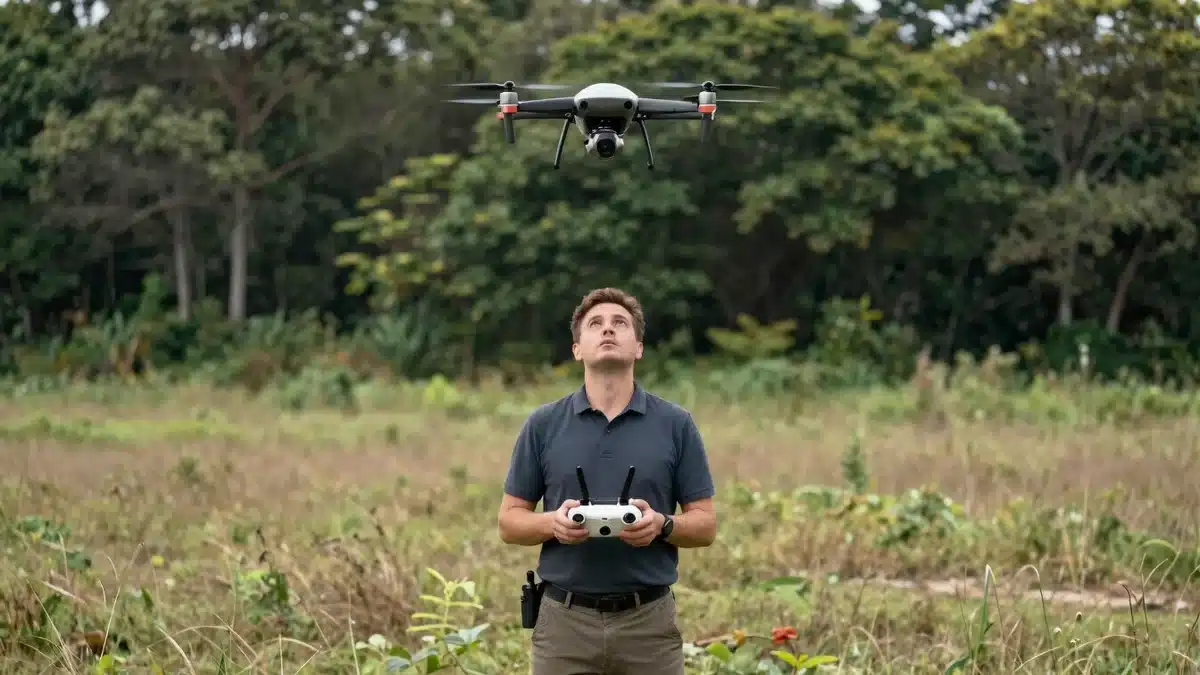
In the US, the UK and the EU, recreational pilots must keep the drone within visual line of sight and stay under 400 ft (120 m). With a small drone, it becomes a dot after a few hundred meters. So why does range matter?
Range means signal stability
A system rated for 10 km has a huge margin when you’re 300 m away behind trees, between buildings or near antennas. In practice that means fewer video dropouts and less pixelation, less risk of Return to Home triggering from signal loss, better 1080p live view at normal distances and more confidence flying near obstacles that block line of sight to the controller.
Transmission systems compared: O4+, O4, PixSync and SkyLink
- DJI O4+: DJI’s most advanced system in 2026, on the Mavic 4 Pro (15 km CE with DJI RC 2 or RC Pro 2) and Mini 5 Pro (10 km CE), with live video up to 1080p/60fps.
- DJI O4: on the Air 3S and Mini 4 Pro, working on 2.4 GHz, 5.1 GHz (where permitted) and 5.8 GHz and hopping between bands to avoid interference. 10 km CE on both.
- Potensic PixSync 4.0: 2.4 GHz only, with dual directional antennas and 1080p/30fps. Potensic quotes 10 km under FCC and doesn’t publish a CE figure.
- Autel SkyLink (EVO Lite+): tri-band (2.4, 5.1 and 5.8 GHz), 12 km FCC and up to 2.7K live video at short range. Solid, but a generation older than O4.
1. DJI Mavic 4 Pro: the longest range
The Mavic 4 Pro is the longest-range consumer drone of 2026: O4+ with 15 km CE and 30 km FCC. It adds three cameras (a 100 MP Hasselblad Four Thirds main camera, 70 mm medium tele and 168 mm long tele), 360° obstacle sensing with forward LiDAR and up to 51 minutes of rated flight time.
Its size is the price you pay: at 1,063 g it’s a C2-class drone in Europe with heavier training and registration requirements. It suits inspection, film production and professional landscape work. It hasn’t been officially sold in the US.
- O4+: the strongest link here
- Three cameras with a 4/3 main sensor
- Forward LiDAR and 360° sensing
- Up to 51 min rated flight
- 1,063 g: more paperwork
- Most expensive here
- Bulky for travel
2. DJI Air 3S: the best balance
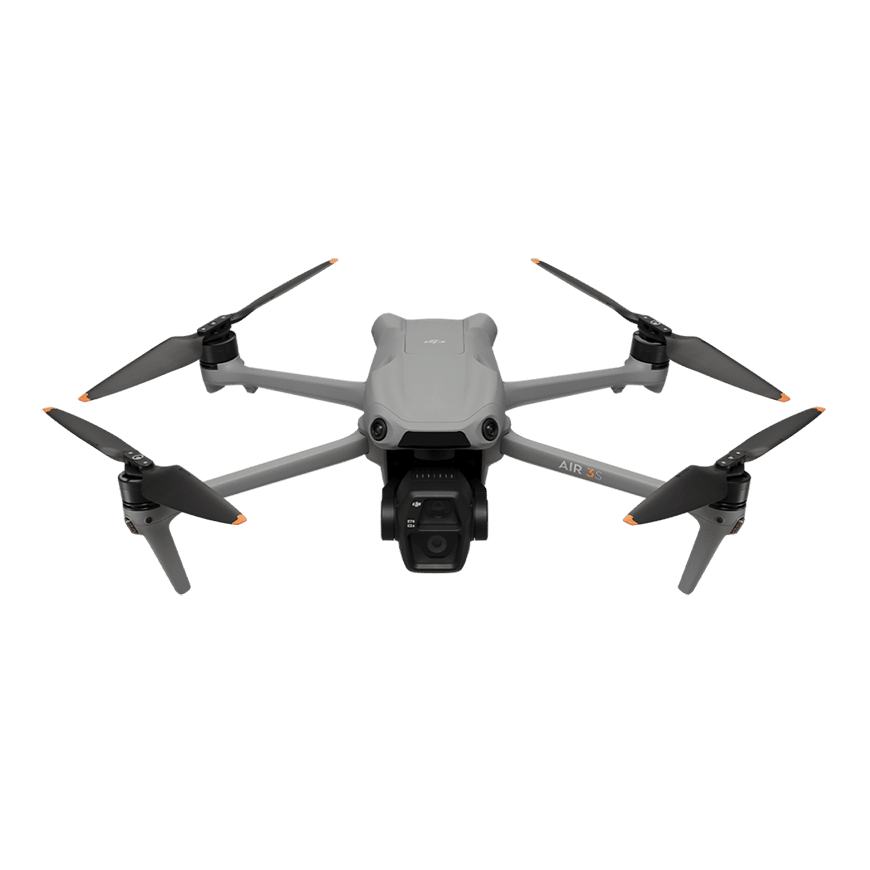
The Air 3S is our pick for most pilots. O4 gives 10 km CE and 20 km FCC on three bands, and it pairs a 1-inch, 50 MP main camera with a 1/1.3-inch, 48 MP medium telephoto.
It senses obstacles in all directions with binocular vision plus forward LiDAR, which helps a lot near trees and structures. It weighs 724 g and is rated for up to 45 minutes of flight.
- Tri-band O4, 10 km CE / 20 km FCC
- Two cameras, 1-inch main
- Omnidirectional sensing with LiDAR
- Up to 45 min flight
- 724 g: registration required
- O4, not O4+
- Bigger than a Mini
3. DJI Mini 5 Pro: O4+ in a mini drone
The Mini 5 Pro brings O4+ to a roughly 250 g drone: 10 km CE and 20 km FCC, with 1080p/60fps live view. Its 1-inch, 50 MP camera is the largest yet in the Mini series, and it adds omnidirectional sensing with LiDAR.
In the EU it’s class C0: DJI declares 249.9 g, and the certification standard allows a 3% tolerance. It only loses C0 with the Plus battery. It hasn’t been officially sold in the US.
- O4+ with 10 km CE in a C0 drone
- 1-inch 50 MP sensor
- Omnidirectional sensing and LiDAR
- Fits in a small backpack
- EU battery has less flight time than Plus
- Plus battery not sold in the EU
- More wind-sensitive than an Air
4. DJI Mini 4 Pro: O4 range for less
The Mini 4 Pro is still a great choice: O4 with 10 km CE and 20 km FCC, the same European figure as the Air 3S. It weighs under 249 g, uses a 1/1.3-inch 48 MP sensor and senses obstacles in every direction.
Since the Mini 5 Pro arrived it’s often discounted, making it the lightweight drone with the best signal-to-price ratio.
- O4 with 10 km CE
- Under 249 g
- Omnidirectional obstacle sensing
- Often discounted
- Smaller sensor than Mini 5 Pro
- 34 min with standard battery
- No LiDAR
5. Potensic Atom 2: the budget alternative
The Atom 2 is the most affordable option with a decent link: PixSync 4.0 with 10 km measured under FCC. Potensic doesn’t publish a CE figure, and transmission is 2.4 GHz only, the most crowded band in cities.
It weighs 249 g, records 4K/30fps on a 1/2-inch sensor and is rated for 32 minutes. Its big gap is the lack of obstacle sensing.
- Affordable
- 249 g
- Dual directional antennas
- 3-axis gimbal
- No official CE figure
- 2.4 GHz only
- No obstacle sensing
6. Autel EVO Lite+: outside the DJI ecosystem
If you’d rather not rely on DJI, the EVO Lite+ is the reference. Tri-band SkyLink gives 12 km FCC (6 km CE per Autel’s EVO Lite table) and up to 2.7K live video at short range.
It has a 1-inch 20 MP sensor with a variable f/2.8–f/11 aperture, records 6K, senses obstacles front, rear and below and is rated for 40 minutes. It’s a previous-generation model, so check that the seller offers warranty and support.
- Real DJI alternative
- 1-inch sensor with variable aperture
- Tri-band transmission
- 40 min rated flight
- Shorter CE range than DJI
- Previous generation
- Patchy availability
Which long-range drone should you choose?
- You want the best and fly professionally: DJI Mavic 4 Pro (where available), the only one with 15 km CE and three cameras.
- One drone for everything: DJI Air 3S, with O4, two cameras and LiDAR for much less than the Mavic.
- You travel a lot or want low weight: DJI Mini 5 Pro (where available), with O4+ at about 250 g.
- Tight budget but reliable signal: DJI Mini 4 Pro, with the same CE figure as the Air 3S.
- Your first drone: Potensic Atom 2, knowing it doesn’t avoid obstacles.
- No DJI: Autel EVO Lite+.
How to improve signal without touching the drone
- Point the flat face of the controller antennas toward the drone.
- Take off away from routers, power lines and metal structures.
- Avoid putting trees or buildings between you and the drone; obstacles cut signal far more than distance.
- Set a Return to Home altitude above local obstacles.
- Carry spare batteries and use a bright screen.
In the US, DJI availability can vary because of regulatory restrictions; check current stock before buying.
Long-range drone FAQ
The DJI Mavic 4 Pro, with O4+: 15 km in Europe (CE) and 30 km under FCC rules, in open terrain without interference.
Europe limits transmit power on the 2.4 and 5.8 GHz bands more strictly, so the same drone transmits with less power in CE mode and advertises roughly half the range.
No. Recreational rules in the US, UK and EU require visual line of sight and a 400 ft (120 m) ceiling. Transmission range gives you a stable signal, not permission to fly farther.
O4+ is the evolution of O4, with more range and robustness. In practice the Mini 5 Pro (O4+) and Air 3S (O4) both quote 10 km CE; the real jump is the Mavic 4 Pro at 15 km CE.
Third-party antennas and amplifiers exist, but changing transmit power can break radio regulations and void your warranty. Improve controller positioning and avoid obstacles and interference instead.
Keep reading
- Racing Drones: What They Are and How to Get Started
- Best Drones for Beginners in 2026: Complete Buying Guide
- Best Professional Drones of 2026: Comparison and Buying Guide
- Best Budget Drones of 2026: Cheap Drones Worth Buying
Official sources: DJI Air 3S specs · DJI Mini 4 Pro specs · DJI Mini 5 Pro specs · Potensic Atom 2 FAQ · Autel EVO Lite series · FAA recreational flyers