
Disclosure: this article contains affiliate links. If you buy through them, Bright Technology may earn a small commission at no extra cost to you. As an Amazon Associate, we earn from qualifying purchases.
This DJI Mini 4 Pro review covers a folding drone that weighs under 249 g yet shoots 48 MP photos and 4K HDR video at up to 100 fps. It adds omnidirectional obstacle sensing, ActiveTrack 360° and DJI O4 transmission to the Mini formula. Is it still worth buying in 2026? Here is how it performs, where it falls short and who should get it.
- DJI Mini 4 Pro review: specs at a glance
- What is in the box
- Design and build quality
- Flight performance and smart features
- Photo and video quality
- Pros and cons of the DJI Mini 4 Pro
- Who should buy the DJI Mini 4 Pro?
- Is the DJI Mini 4 Pro worth it?
- DJI Mini 4 Pro vs DJI Air 3
- DJI Mini 4 Pro FAQ
- Bottom line
- Keep reading
Quick answer: the DJI Mini 4 Pro is still one of the best sub-250 g drones you can buy. You get excellent image quality, omnidirectional obstacle sensing and very reliable tracking in a drone that fits in a small bag. It costs more than entry-level drones, official accessories are expensive and there is no telephoto camera like the Air 3. For travelers, creators and beginners who want room to grow, it is an easy recommendation. DJI has since launched the Mini 5 Pro, so compare current prices first.
DJI Mini 4 Pro review: specs at a glance
| Spec | DJI Mini 4 Pro |
|---|---|
| Weight | Under 249 g |
| Camera | 48 MP |
| Video | 4K HDR up to 100 fps |
| Flight time | Up to 34 min (45 min with the Plus battery where allowed) |
| Obstacle sensing | Omnidirectional |
| Transmission | DJI O4 |
| Tracking | ActiveTrack 360° |
Key specs
- Under 249 g
- 48 MP camera
- 4K HDR up to 100 fps
- Up to 34 min flight time
- Omnidirectional obstacle sensing
- DJI O4 transmission
- ActiveTrack 360°
What is in the box
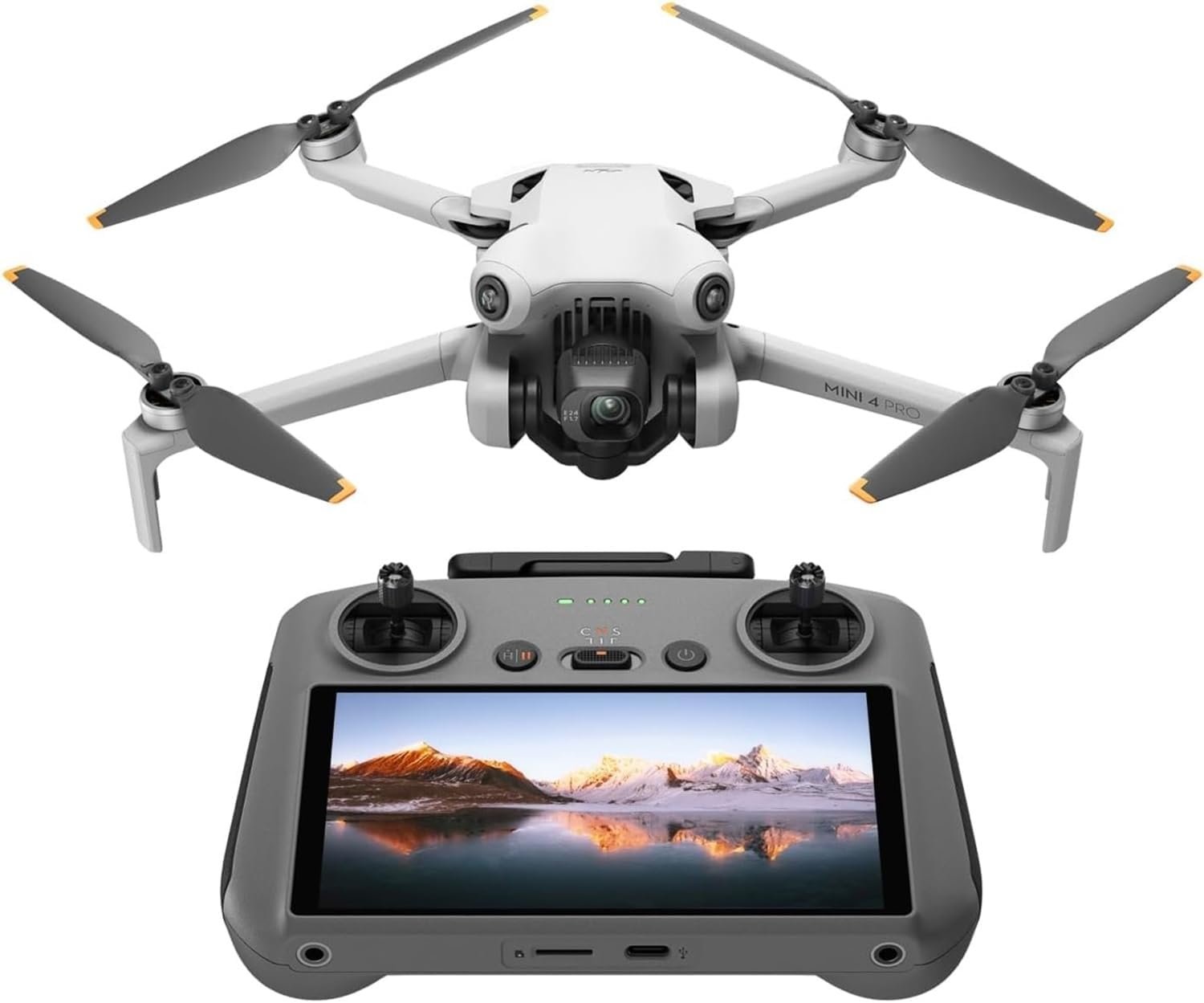
Contents vary slightly by pack, but you typically get:
- DJI Mini 4 Pro drone
- DJI RC-N2 or DJI RC 2 controller
- One intelligent battery
- Spare propellers
- Gimbal protector
- Cables and a screwdriver
- Documentation
Tip: if you plan to fly often, the Fly More Combo is worth it. It adds extra batteries, a charging hub and a carry bag.
Design and build quality
DJI keeps the Mini philosophy: compact, light and easy to carry. At under 249 g it slips into a small backpack and adds almost nothing to your luggage, which suits travel and hiking.
Despite its size it feels solid. The arms unfold firmly, the included protector keeps the gimbal safe and the finish is premium. Many tiny drones feel fragile, but this one does not. Setup is simple too: if you have flown a DJI before it takes minutes, and if it is your first drone the app walks you through every step.
Flight performance and smart features
In the air, the Mini 4 Pro inspires confidence. GPS and positioning sensors hold it steady, so you can focus on framing instead of constantly correcting. It stays planted in moderate wind and allows the precise movements that make video look professional. It is also fairly quiet next to larger drones, and the DJI RC 2 connects quickly with a smooth, low-lag live feed.
The biggest upgrade over the Mini 3 Pro is omnidirectional obstacle sensing. It does not replace good piloting, but it adds a valuable safety margin near trees, buildings and other structures. ActiveTrack 360° is also very capable at following people and bikes with natural framing, which saves a lot of time for social media and YouTube creators.
The smart features list is long, and the tools are genuinely useful rather than gimmicks:
- ActiveTrack 360° and FocusTrack for subject tracking
- MasterShots and Hyperlapse for automated cinematic clips
- Waypoint Flight and Cruise Control for repeatable moves
- QuickTransfer for fast file transfer to your phone
- Native vertical shooting for Reels, TikTok and Shorts
- Smart Return to Home
Photo and video quality
The 48 MP sensor delivers a lot of detail in good light, with natural colors and strong dynamic range. Shooting RAW lets you recover shadows and highlights, which helps for landscapes, architecture and travel photos. As with any small-sensor drone, low light is the main weak spot. You can also shoot vertical photos without cropping, which keeps the full resolution for social media.
Video is where it really convinces. 4K HDR at up to 100 fps gives smooth slow motion, while D-Log M and HLG profiles give you room for color grading in DaVinci Resolve, Premiere Pro or Final Cut. The gimbal stays steady even through fairly quick moves. For most creators, YouTubers and travel photographers, quality is more than enough for commercial work. If you want to improve your results, see our guide to drone photography and video.
Pros and cons of the DJI Mini 4 Pro
- Outstanding image quality for a sub-249 g drone
- 4K HDR video up to 100 fps
- Omnidirectional obstacle sensing
- Excellent stability in moderate wind
- Very easy to travel with
- Precise ActiveTrack 360°
- Large accessory ecosystem and regular updates
- Native vertical video for social media
- Pricier than entry-level drones
- Official accessories raise the final cost
- No telephoto camera like the DJI Air 3
- The Plus battery pushes it over 250 g and is not allowed everywhere
- Needs basic photo and video knowledge to get the most from it
What stands out most is the balance. It is small enough to carry everywhere, yet it delivers image quality that a few years ago only came from much bigger and costlier drones. What would we change? The price of batteries, propellers and the Fly More Combo, the missing telephoto and a few extra minutes of flight time for back-to-back landscape shots.
Who should buy the DJI Mini 4 Pro?
- Travel photographers who want a light kit without sacrificing image quality.
- Content creators on YouTube, Instagram or TikTok who want an easy-to-carry drone with native vertical video.
- Real estate and tourism businesses that need quality aerial photos and video.
- Upgraders who already own a basic drone and want a big jump in features.
- Long-term buyers who prefer to invest once in a drone that will last for years.
If you will only fly now and then or your budget is tight, the DJI Neo or the Potensic Atom may be a better fit. Our list of the best drones for beginners has more options.
Is the DJI Mini 4 Pro worth it?
Yes, if you want a drone to learn on, travel with and create quality content for years. Its mix of portability, safety, image quality and smart features keeps it among the most recommended drones on the market. Choose it for how you will really use it, not just for the spec sheet.
Three things to keep in mind before buying:
- Do not buy it only for the sub-249 g weight. The real reasons are image quality, safety and smart features. If you only want the smallest drone possible, cheaper alternatives exist.
- The Fly More Combo is the smart choice. Extra batteries, the charging hub and the bag are things most owners end up buying anyway, and buying them together usually costs less.
- It grows with you. Start in fully automatic mode, then move on to subject tracking, D-Log M and Waypoint flights.
In the US, the standard battery keeps it under 250 g, so purely recreational flying does not require FAA registration, but you still need to pass the free TRUST test. With the Plus battery it goes over 250 g and must be registered. Commercial flying requires a Part 107 certificate. See the FAA recreational flyers page for the current rules.
DJI Mini 4 Pro vs DJI Air 3
This is the most common comparison for buyers in the upper mid-range. In short:
| DJI Mini 4 Pro | DJI Air 3 | |
|---|---|---|
| Best for | Travel and portability | Photography-focused pilots |
| Weight class | Under 249 g | Heavier, larger body |
| Camera | Single 48 MP camera | Dual camera with a telephoto lens |
| Wind | Stable in moderate wind | Better suited to windy locations |
Choose the Mini 4 Pro if you travel often, want a sub-249 g drone and put portability first. Choose the Air 3 if you want a dual camera with telephoto, often fly in windy places or want a drone geared toward professional photography. Read our full DJI Air 3 vs DJI Mini 4 Pro comparison or the DJI Air 3 review. If you are weighing it against its successor, see Mini 5 Pro vs Mini 4 Pro.
DJI Mini 4 Pro FAQ
In the US, not for purely recreational flying with the standard battery, since it weighs under 250 g, though you must pass the free TRUST test. With the Plus battery, or for commercial flying, it must be registered. Always check the current FAA rules.
Yes. Obstacle sensing, GPS and DJI’s smart modes make it one of the easiest drones to fly, although it costs more than basic starter models.
DJI quotes up to 34 minutes, or more with the Plus battery. In real use, 25 to 30 minutes is typical depending on wind, temperature and flying style.
Yes. It records 4K HDR at up to 100 fps, with D-Log M and HLG color profiles for editing.
If both are similarly priced, yes. Better safety, transmission and tracking make the Mini 4 Pro a worthwhile upgrade.
Yes. It has omnidirectional obstacle sensing, a big step up from the Mini 3 Pro, though it should not replace careful piloting.
Pick the Mini 4 Pro for portability and travel. Pick the Air 3 if you want a telephoto camera, better handling in wind and a more photography-focused drone.
The Fly More Combo, a fast microSD card, propeller guards if you fly indoors and ND filters for video.
Bottom line
The DJI Mini 4 Pro is one of the most complete drones in its class. It is not the cheapest, but the balance of ease of use, image quality, flight time and safety justifies the price. Buy it if you want a light travel drone, excellent image quality and smart features you will use often. Look elsewhere if your budget is tight, you will fly only occasionally, you prefer FPV or you need a dual camera with telephoto.