

Artificial intelligence is already built into many of the tools and services you use every day: recommendation systems, chat assistants, image recognition, automatic translation and apps that create text, video or images. But AI is not a single technology, and it doesn’t always work the same way. Some systems predict outcomes, others classify information, generate content, recommend products or carry out tasks automatically.
This guide explains what artificial intelligence is, how it works, which types exist, where it is used, its main benefits and limits, and how you can start using it without being a programmer.
- What is artificial intelligence?
- How artificial intelligence works
- AI vs machine learning vs deep learning
- Which types of artificial intelligence exist?
- Main applications of artificial intelligence
- What is generative AI?
- Artificial intelligence tools
- Benefits of artificial intelligence
- Risks and limitations of artificial intelligence
- How to start using artificial intelligence
- How artificial intelligence may evolve
- Bottom line
- Artificial intelligence FAQ
- Keep reading
Quick answer: artificial intelligence is a field of computer science that builds systems able to turn data into predictions, recommendations, content or actions. It does not think like a person. To get started, pick one concrete task, try an accessible assistant such as ChatGPT, Gemini or Claude, give it clear context and always verify important results.
What is artificial intelligence?
Artificial intelligence (AI) is a field of computer science dedicated to developing systems that produce results we associate with intelligent abilities. Depending on the system, the output can be:
- Predictions
- Classifications
- Recommendations
- Content
- Answers
- Decisions
- Actions in a physical or digital environment
The OECD defines an AI system as a machine-based system that infers, from the inputs it receives and from explicit or implicit objectives, how to generate outputs that can influence physical or virtual environments. Systems vary in autonomy and in how well they adapt after deployment.
That doesn’t mean the machine thinks or understands like a person. A system can handle a complex task by analyzing patterns and calculating results without consciousness, intent or human understanding. For a deeper explanation of data, algorithms, training and neural networks, read our guide on what artificial intelligence is and how it works.
How artificial intelligence works
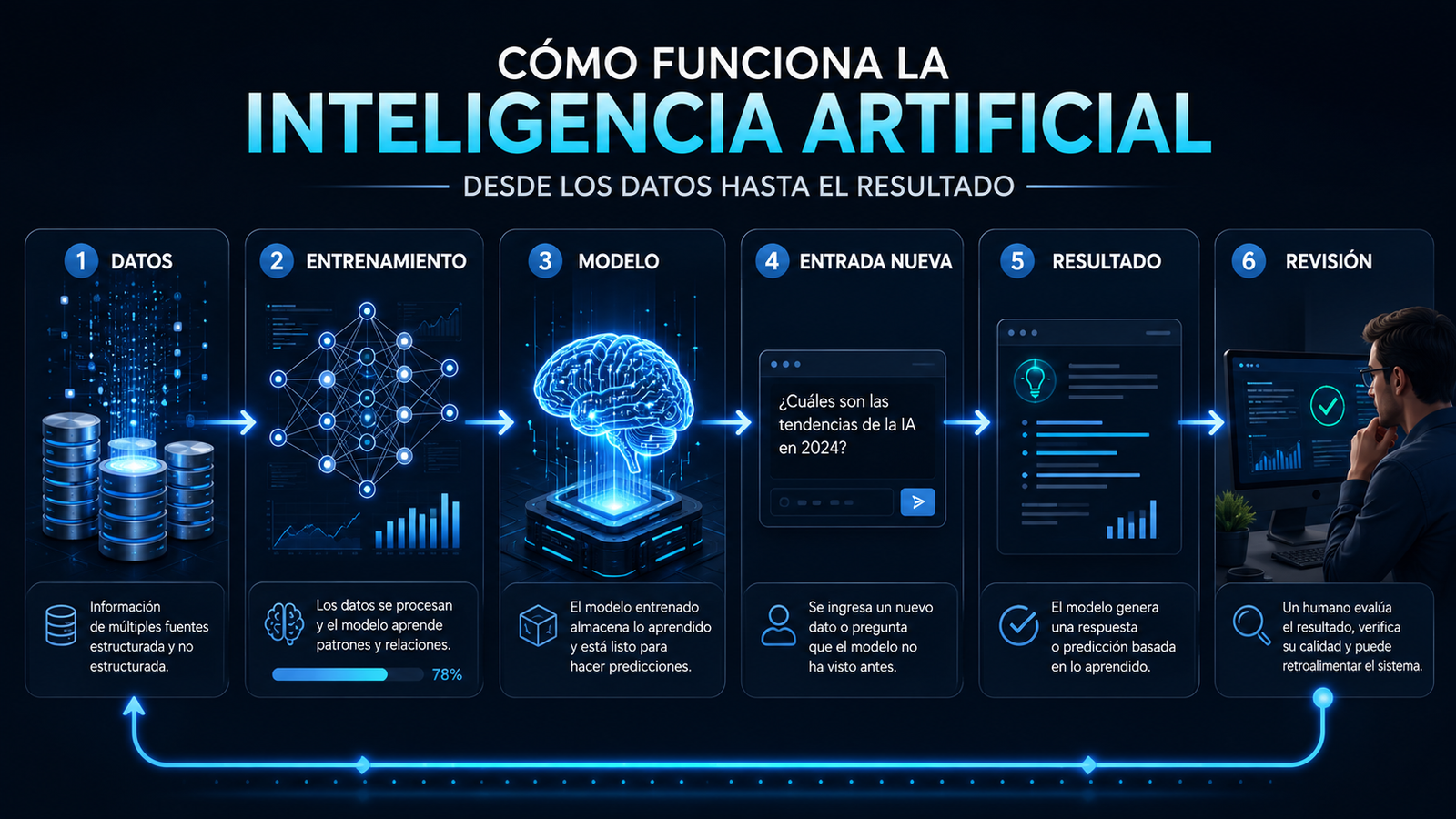
The details depend on the system, but many AI projects follow a similar process: they receive information, prepare the data, use a model to find patterns, produce a result, and then evaluate it and adjust when needed.
Input data
Data is the information the system uses: text, images, audio, video, numbers, behavior histories, sensor readings or instructions typed by a user. Quality, relevance and representativeness shape how the system behaves. Lots of data alone doesn’t guarantee good results; it must also be well selected and reviewed.
Model training
During training, the system adjusts its parameters to learn relationships and patterns in the data. An image model, for example, can study many labeled examples until it learns which features separate one category from another.
Generating results
Once trained, a model can take new input and produce an output: a category, a probability, a forecast, a recommendation, a written answer, an image or an action. When you use a chat assistant, your instruction is the input and the model builds a response from learned patterns and the context available.
Evaluation and oversight
Models must be tested for accuracy, reliability, safety and fit for the task. Human oversight may be needed to review important results, catch errors, correct bias and handle unexpected cases. An AI answer isn’t automatically right just because it sounds convincing.
AI vs machine learning vs deep learning
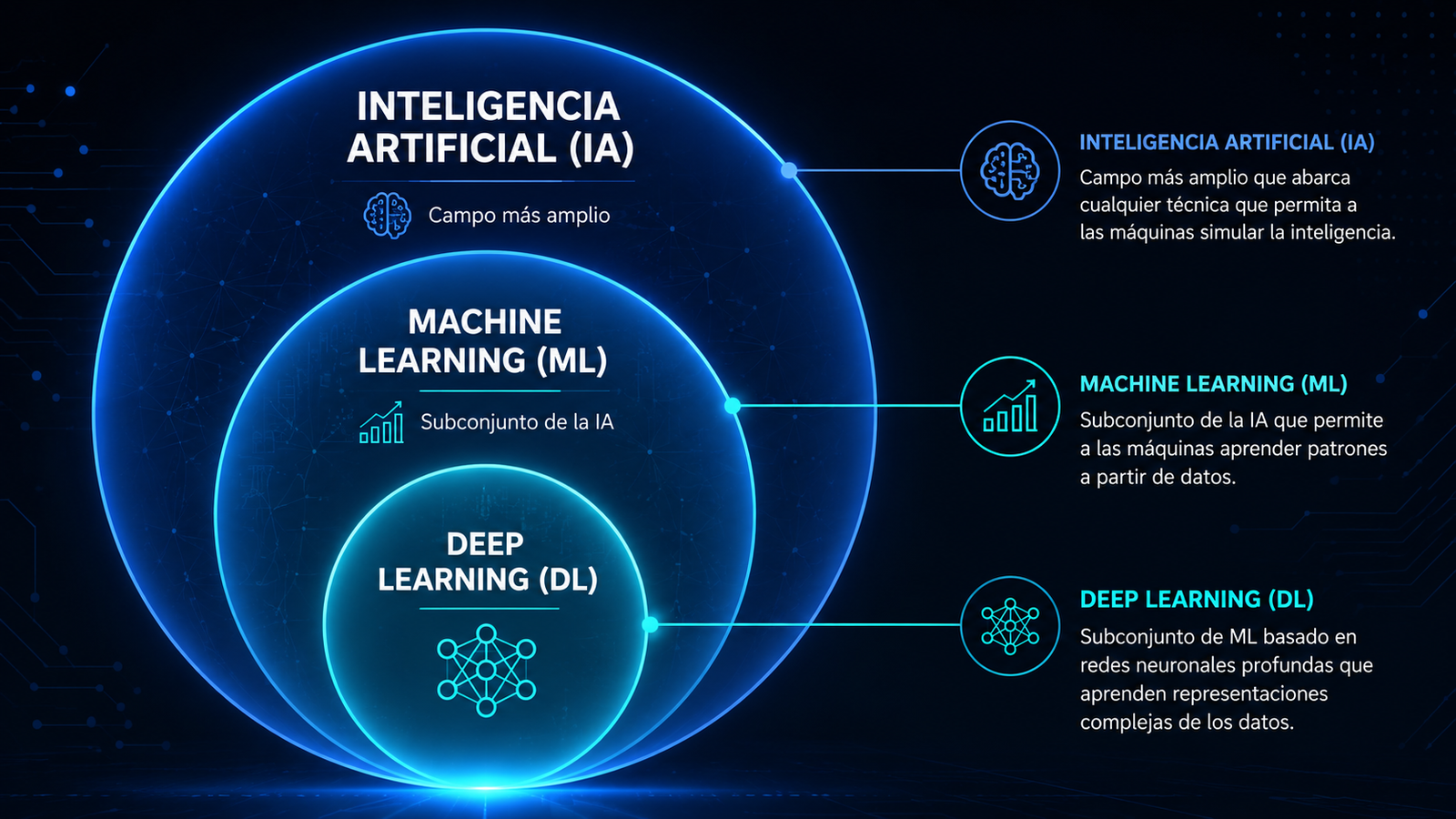
The three terms are often used as synonyms, but they are related, different concepts.
| Concept | What it means | How it works | Example |
|---|---|---|---|
| Artificial intelligence | The general field of building systems that perform intelligent tasks | Can use rules, machine learning or other techniques | Assistants, expert systems and robots |
| Machine learning | A branch of AI that learns patterns from data | Adjusts models using examples | Recommendations and fraud detection |
| Deep learning | A subfield of machine learning based on deep neural networks | Uses many layers to process complex information | Image recognition and generative models |
Deep learning sits inside machine learning, which sits inside AI, but not all AI uses machine learning or neural networks.
Which types of artificial intelligence exist?
AI can be classified in several ways, and no single list fits every context.
Types of AI by capability
- Narrow AI (ANI): designed for specific tasks.
- General AI (AGI): the concept of an AI that can handle a wide range of intellectual tasks.
- Superintelligence (ASI): a hypothetical scenario in which a system far exceeds human abilities.
The AI we use today is mostly specialized systems, although some models perform a growing variety of tasks. AGI and ASI remain research concepts and subjects of debate, not product categories that have been clearly reached.
Types of AI by task
Common categories include predictive AI (estimates what might happen), classifying AI, recommendation systems, conversational AI, computer vision, generative AI (produces new content), autonomous systems and AI agents that combine models, instructions and tools to complete goals.
Our guide to the types of artificial intelligence explains the differences in more detail.
Main applications of artificial intelligence
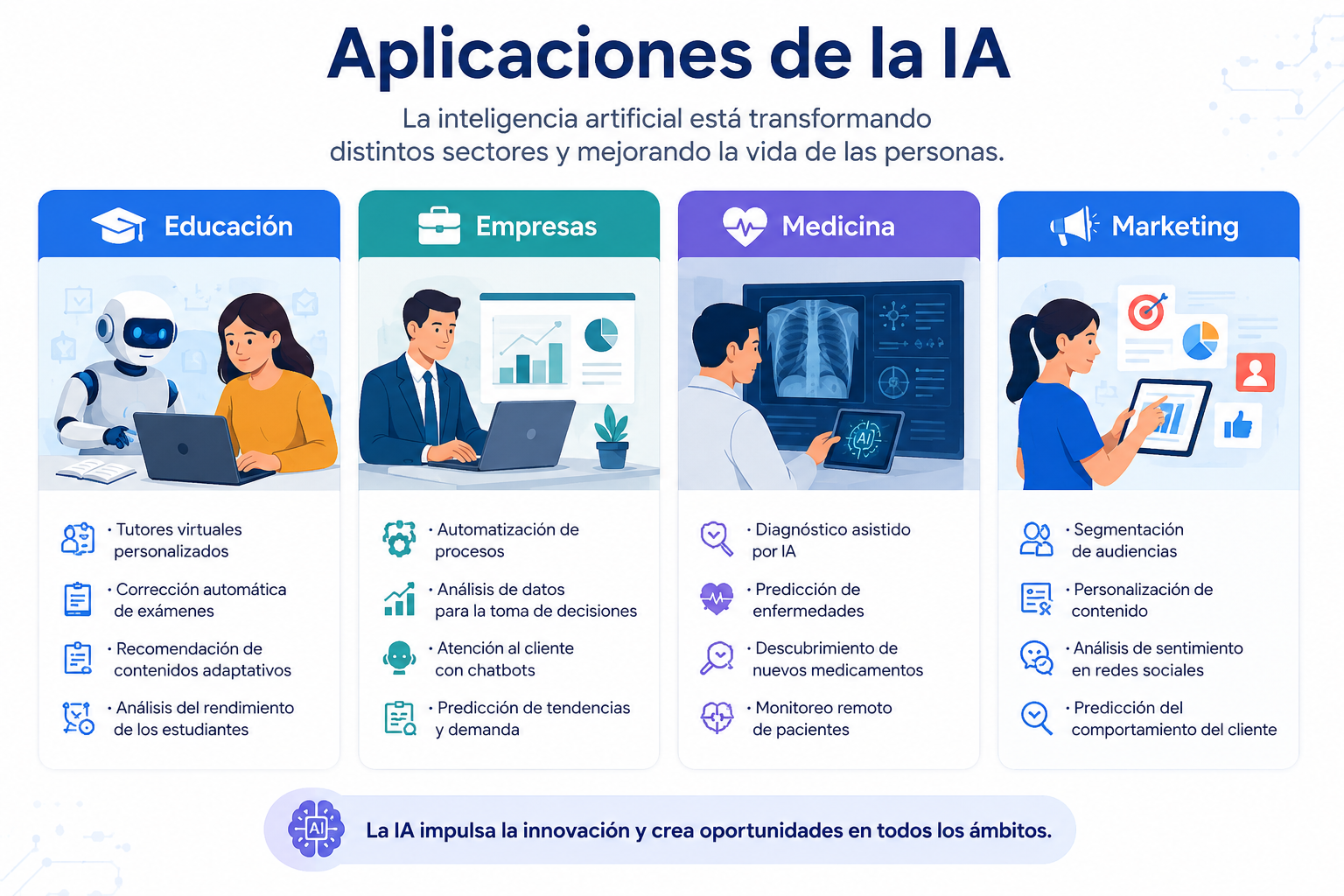
AI’s usefulness depends less on the industry than on the problem you want to solve.
| Area | Application | Example result |
|---|---|---|
| Education | Personalized learning and tutors | Explanations adapted to each student |
| Business | Automation and analysis | Faster processes and pattern detection |
| Medicine | Support for clinical analysis | Spotting signals in images or data |
| Marketing | Segmentation and content | Campaigns tailored to different audiences |
| Finance | Anomaly detection | Alerts about unusual transactions |
| Industry | Predictive maintenance | Warnings before a breakdown |
| Cybersecurity | Threat detection | Identifying abnormal behavior |
AI also shows up daily in search engines, spam filters, translation, facial recognition, voice assistants and recommendation systems. For more depth, see our guide to the applications of artificial intelligence, plus specialized guides on AI for students, AI for business, AI for marketing and AI for SEO.
What is generative AI?
Generative AI is designed to produce content from instructions, examples or other input data. It can generate text, images, audio, music, video, code, presentations and 3D models.
These systems learn relationships in their training data and build new results from probabilities, learned representations and the context you provide, rather than retrieving an exact stored answer. That’s why the same prompt can give different answers, and why the system can make mistakes, invent details or produce content that needs review. Our guide on what generative AI is covers models, formats, uses and risks.
Artificial intelligence tools
No single tool is best for every task. The right choice depends on your goal, your workflow, the integrations you need and how much control you want.
| Need | Type of tool | Examples |
|---|---|---|
| Chat and writing | AI assistant | ChatGPT, Gemini or Claude |
| Researching information | AI-assisted search | Perplexity and assistants with search |
| Creating images | Image generator | Midjourney, DALL-E and diffusion models |
| Coding help | Code assistant | Copilot and editor-integrated assistants |
| Automating processes | Automation platform | Make, Zapier, n8n |
| Office productivity | Integrated copilot | Copilots for documents, email and meetings |
These names are examples, not a definitive ranking. Features, prices and capabilities change quickly, so comparisons should be rechecked regularly. See our list of the best AI tools, the comparison of ChatGPT, Claude and Gemini and our guide to AI image generators.
Benefits of artificial intelligence
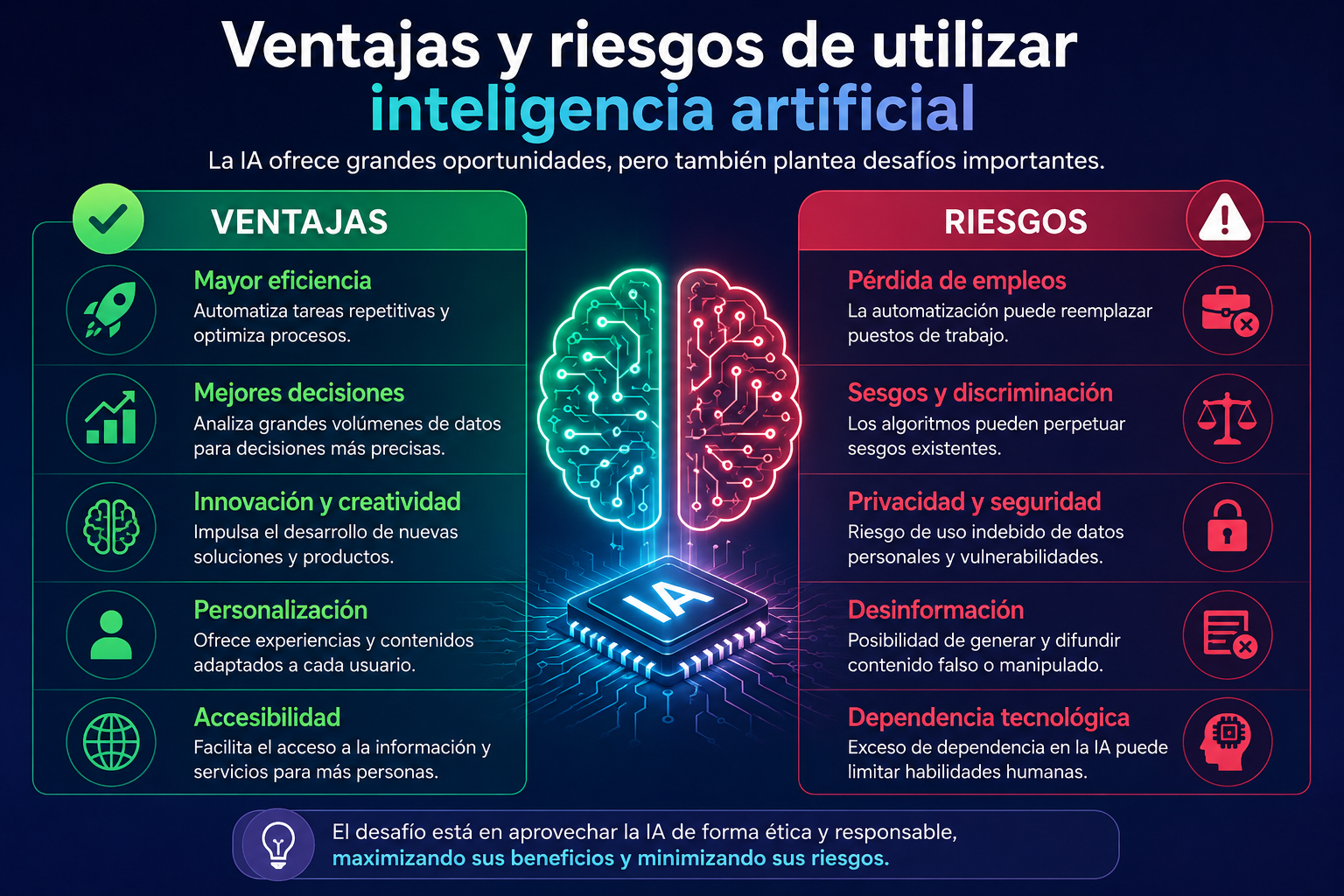
AI adds value when it is applied to the right problem and supervised properly.
- Task automation: cuts time spent on repetitive work such as sorting, data extraction and drafting.
- Analyzing large amounts of information: finds relationships and patterns in data that are hard to review by hand.
- Personalization: adapts recommendations and experiences to different people.
- Accessibility: speech recognition, transcription, translation and image descriptions make information and services easier to reach.
- Creativity and productivity: generative systems help develop ideas, drafts, designs and code that a person then reviews.
Risks and limitations of artificial intelligence
AI also has limits you should understand before using it for important tasks.
- Incorrect information: a system can give a convincing but wrong answer.
- Bias: if the data or development process is unbalanced, the model can reproduce unfair or unrepresentative results.
- Privacy: entering personal, business or confidential information into an external tool can be risky if you don’t know how it handles data.
- Lack of transparency: with complex models it is hard to know why a result was produced.
- Over-reliance: handing off tasks without checking results can erode your own judgment and multiply errors.
- Malicious use: misinformation, impersonation, scams and automated attacks.
In the US, NIST’s AI Risk Management Framework recommends managing AI risks across the whole life cycle, considering reliability, safety, privacy, transparency, bias and oversight. The practical rule is simple: the greater the impact of a decision, the more checking and human supervision it needs.
How to start using artificial intelligence
You don’t need to learn programming to begin. What matters is choosing a concrete task and checking whether the tool really improves the process.
1. Define a concrete task
Avoid a goal as broad as “I want to use AI.” Pick something specific, such as summarizing a text, creating a draft, comparing options or analyzing a document.
2. Choose a tool
Match the platform to the format: a chat assistant for text, an image generator for pictures, a specialized tool for video, a coding copilot for code or an automation platform for workflows.
3. Learn to give context
A good instruction explains what you need, why you need it, who will use the result, what information to consider, what format to answer in and what limits to respect. Our guide to ChatGPT prompts has structures and examples you can adapt, and the tutorial on how to use ChatGPT walks you through the basics.
4. Verify the results
Check facts, names, dates, sources, calculations and sensitive information. Never publish or rely on an important result without reviewing it.
5. Integrate AI gradually
Once a simple task works well, fold it into a broader process: research, draft, review by hand, then publish. For repeatable work, see our guide to AI automation.
How artificial intelligence may evolve
Systems keep advancing in language, programming, reasoning, multimedia generation, science and task execution through agents. Still, nobody can predict with certainty which capabilities will appear, when, or what impact they will have.
Likely trends include multimodal models, agents that use tools to complete whole processes, deeper integration into devices and apps, industry-specific systems, more automation and a greater need for evaluation and regulation.
Stanford’s AI Index 2026 highlights both the fast pace of progress and adoption and the difficulty of governing it at the same speed. Learning to use AI critically will be more useful than trying to guess exactly what it will look like in a few years.
Bottom line
Artificial intelligence brings together different technologies that generate predictions, recommendations, classifications, content or actions from the data and objectives they receive. It isn’t a single tool, and it isn’t equivalent to human intelligence. To use it well, choose a concrete application, give enough context, protect sensitive information and always check important results.
Artificial intelligence FAQ
Artificial intelligence is technology that can perform tasks that normally require human intelligence, such as learning, analyzing information or generating content.
It uses algorithms and mathematical models trained on large amounts of data to identify patterns and generate answers.
You shouldn’t assume it understands, reasons or has consciousness like a human. It produces complex results through mathematical models and learned patterns.
AI is the general field. Machine learning is one of its branches and builds systems that learn patterns from data.
A category of artificial intelligence that can produce text, images, audio, video, code and other content.
No. Many current tools have conversational or visual interfaces designed for people without programming knowledge.
Yes. It can produce incorrect, incomplete, outdated or biased information, so important results should always be verified.
It depends on the tool, its settings and its privacy terms. Don’t enter personal, confidential or business data without checking how it will be handled.