Artificial intelligence is not a single tool or machine that thinks exactly like a person. It is a technological field that brings together different methods to build systems capable of processing information and producing results such as predictions, classifications, recommendations, content or decisions.
Some systems work using rules defined by specialists. Others use Machine Learning to learn patterns from data. The most advanced ones can combine neural networks, large amounts of information and high processing capacity.
In this guide you will learn what artificial intelligence is, how a model is trained, what the difference is between training and inference, and what role data, algorithms, Machine Learning, Deep Learning, and neural networks play.
For an overview of its types, applications, advantages and risks, see our complete guide to artificial intelligence.
- What we mean by artificial intelligence
- Difference between a traditional program and artificial intelligence
- Fundamental concepts for understanding AI
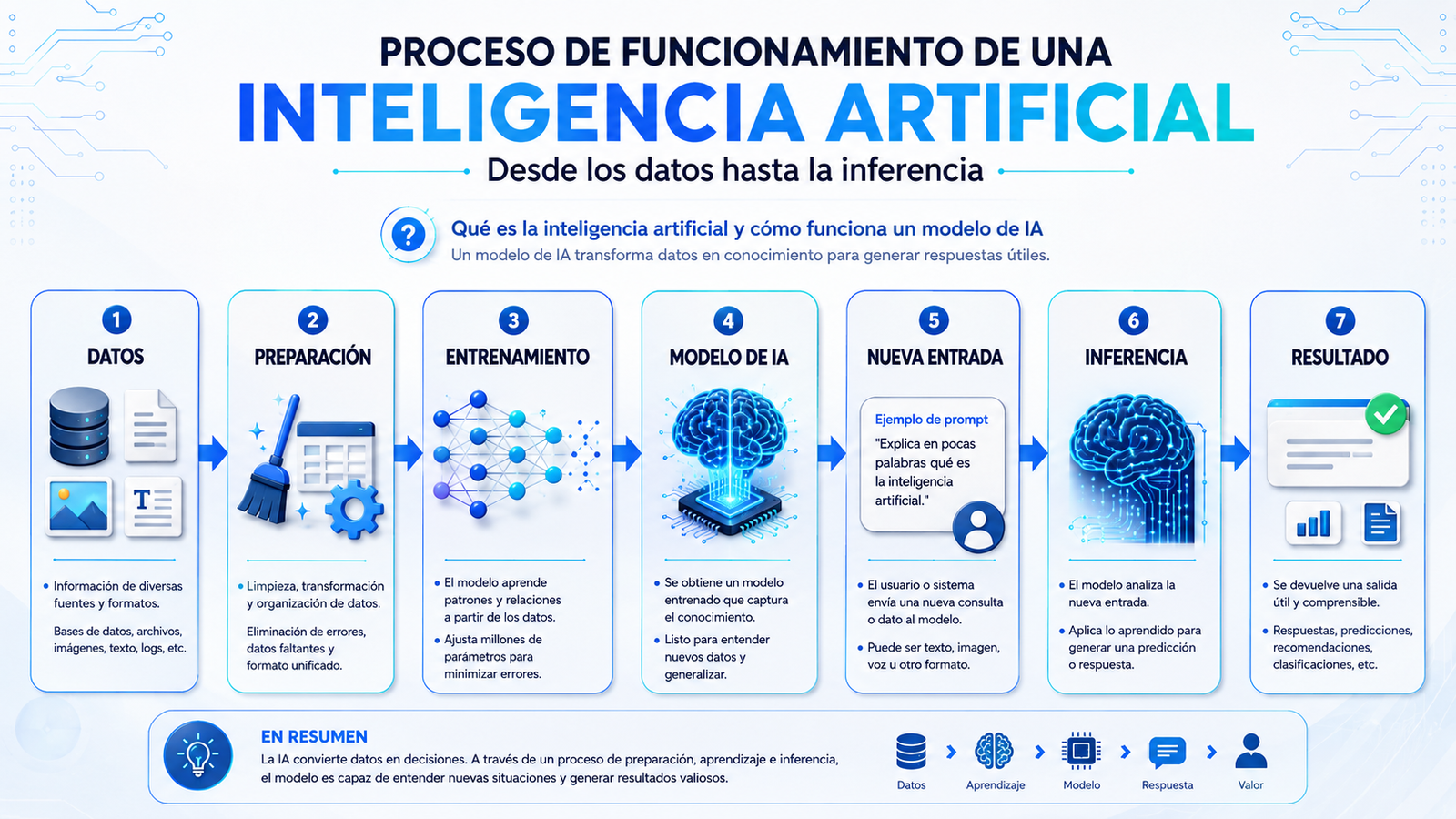
- How artificial intelligence works step by step
- What is Machine Learning?
- What is Deep Learning
- How neural networks work
- Differences between AI, Machine Learning and Deep Learning
- How an AI chatbot generates a response
- Does artificial intelligence think like a person?
- Why artificial intelligence can make mistakes
- What an AI can and cannot do
- Practical example of operation
- Conclusion
- Frequently asked questions about how Artificial Intelligence works
What we mean by artificial intelligence
Artificial intelligence is a field of computer science dedicated to developing systems capable of generating results from the information they receive and the objectives for which they have been designed.
According to the updated OECD definition, an AI system is a machine-based system that infers, from received inputs, how to generate results such as predictions, content, recommendations, or decisions that can influence physical or virtual environments. These systems can exhibit different levels of autonomy and adaptation.
In practical terms, artificial intelligence can be used to:
- Classify an image.
- Predict a demand.
- Recommend a movie.
- Detect an anomalous operation.
- Recognize a voice.
- Translate a text.
- Generate content.
- Control certain actions of a machine.
Not all of these systems work the same or use the same technologies. A recommendation system, a medical model, a robot, and a conversational assistant can be considered AI, but their data, objectives, architecture, and way of producing results are different.
Summary of fundamental concepts
| Concept | Explanation |
|---|---|
| Artificial intelligence | Field that develops systems capable of generating results from inputs and objectives |
| Data | Information that the system uses during its development or operation |
| Algorithm | Procedure used to process information or adjust a model |
| Model | Mathematical or computational representation prepared to perform a task |
| Training | Process by which model parameters are adjusted |
| Inference | Use of the already prepared model with new information |
| Machine Learning | Approach that learns relationships from data |
| Deep Learning | Machine Learning based on deep neural networks |
Difference between a traditional program and artificial intelligence
A traditional program usually works through explicit instructions written by a person.
For example:
If the temperature exceeds 30 degrees, activate the fan.The system executes a known and predefined rule.
In a Machine Learning project, however, the developer can provide examples for a model to learn a relationship without manually writing all possible rules.
For example, to detect spam, a model can be trained with thousands of messages previously classified as spam or legitimate mail. The system will adjust its parameters to identify patterns related to each category.
The difference can be summarized as follows:
| Traditional software | Machine Learning |
| Receive rules and data | Receive expected data and results |
| Executes defined instructions | Learn relationships present in the examples |
| Their behavior is explicitly programmed | Its behavior depends on the trained model |
| It is suitable for clear and stable rules | It is useful when rules are complex or difficult to write |
This does not mean that every AI system learns automatically or that traditional software has ceased to be useful. Many products combine rules, statistical models, Machine Learning, and human supervision.
Fundamental concepts for understanding AI
To understand how an artificial intelligence system works, it is important to differentiate four elements: data, algorithms, models, and parameters.
Data
Data is the information used to develop, evaluate or execute the system.
They can be:
- Texts.
- Images.
- Videos.
- Voice recordings.
- Numerical data.
- Behavioral histories.
- Measurements from sensors.
- Documents.
- Instructions provided by the user.
Quality is just as important as quantity.
A very large data set can produce poor results if it contains errors, unrepresentative examples, duplicates, incorrect labels, or information that does not correspond to the real problem.
It is also necessary to control:
- Origin.
- Permits to use.
- Privacy.
- Representativeness.
- Update.
- Possible biases.
- Separation between training and evaluation.
Algorithms
An algorithm is a procedure used to transform information or solve a task.
In Machine Learning, the training algorithm determines how the model will fit based on the data.
The algorithm should not be confused with the model:
- The algorithm describe the learning process.
- The model It is the adjusted result that is subsequently used.
We can compare it to a recipe and the prepared dish. The recipe represents the procedure; the final result is the model we will use.
Models and parameters
A model is a mathematical or computational representation that has been configured or trained to produce a certain type of result.
It can generate:
- A probability.
- A category.
- A numerical value.
- A recommendation.
- A sequence of text.
- An image.
- An action.
Parameters are internal values that condition the behavior of the model.
During training, these parameters are modified to reduce errors and improve performance on the defined task.
A small model may contain few parameters. A modern neural network can contain millions or billions, although having more parameters alone does not guarantee higher quality.
Training and inference
The training It is the process during which the model is adjusted.
The inference This is the moment when the already trained model is used to process new information.
For example:
Training:
The model analyzes thousands of images labeled as dog or cat. Inference:
The model receives a new image and estimates which category it belongs to.An AI doesn't have to be learning every time you use it.
Many systems remain unchanged during inference. To improve their abilities, they must be retrained, adjusted, or updated through a separate process.
How artificial intelligence works step by step

Although each project is different, a Machine Learning-based system is usually developed through the following phases.
1. Definition of the objective
Before selecting data or models, you must define what problem you want to solve.
Examples:
- Detect fraud.
- Predict sales.
- Classify images.
- Recommend products.
- Translate texts.
- Generate responses.
- Identify faults in a machine.
The goal should include a way to measure whether the system is working correctly.
It is not enough to say “we want to use AI”. It is necessary to establish what outcome is expected, what level of error is acceptable, and who will oversee the decisions.
2. Data collection and preparation
Data is collected, cleaned and transformed so that it can be used.
This phase may include:
- Remove duplicates.
- Correct errors.
- Manage missing values.
- Label examples.
- Convert information to a suitable format.
- Protect personal data.
- Balance categories.
- Separate training, validation and testing data.
Preparation can take up a considerable part of the project because the model will learn from the information provided to it.
3. Selection and training of the model
Specialists choose an architecture or technique appropriate for the task.
During training:
- The model receives examples.
- Produces a prediction.
- It is compared with the expected result.
- The error is calculated.
- The parameters are modified.
- The process repeats itself.
The goal is to find parameters that allow it to work well not only with known examples, but also with information that the model has not seen before.
4. Validation and evaluation
After training, the system is evaluated with separate data.
This check allows us to detect problems such as:
- Insufficient precision.
- Overfitting.
- Performance differences between groups.
- Systematic errors.
- Unreliable results outside the intended environment.
The metric used will depend on the task. A medical model, a spam filter, and a text generator should not be evaluated in exactly the same way.
5. Inference with new information
Once the model is ready, it can be integrated into an application.
Each time it receives a new input, it performs inference and produces a result.
For example:
Entrance:
Photograph of an object. Model:
Analyze visual patterns. Exit:
Probability that the object belongs to a category.Inference can be performed on a server, on a computer, on a phone, or even within a connected device.
6. Supervision and updating
The work does not end when the model is published.
It is necessary to check:
- If the actual data has changed.
- If the number of errors increases.
- If new cases appear.
- If performance remains acceptable.
- If there are security or privacy issues.
- If users are using the system in an unforeseen way.
A model can lose effectiveness when environmental conditions change. This phenomenon is usually called drift or model drift.
What is Machine Learning?
Machine Learning is a set of techniques that allows the construction of models capable of learning relationships from data.
It is part of the field of artificial intelligence, but it does not represent all AI.
Google defines machine learning as a method of training models from data, allowing them to make predictions or generate content. Its updated official course organizes learning around data, models, training, evaluation, and neural networks.
Supervised learning
The model learns with examples that include the correct answer.
Examples:
- Tagged images.
- Emails identified as spam or legitimate.
- Homes with their known price.
- Transactions classified as fraudulent or normal.
It can be used for classification or regression.
Unsupervised learning
The system receives data without a previously labeled response and searches for structures or groupings.
It can be used for:
- Segment customers.
- Find patterns.
- Reduce dimensions.
- Detect unusual behavior.
- Explore data sets.
The result requires interpretation because the model does not know in advance what each group found represents.
Reinforcement learning
An agent learns by interacting with an environment.
Receive rewards or penalties based on actions taken and try to find a strategy that maximizes the accumulated result.
It is used in research and in areas such as:
- Robotics.
- Games.
- Systems control.
- Optimization.
- Certain autonomous agents.
What is Deep Learning
Deep Learning is a subfield of Machine Learning based on multi-layered neural networks.
It is especially useful for processing complex information such as:
- Images.
- Language.
- Audio.
- Video.
- Sequences.
- Large data sets.
It should not be described simply as an “evolution” that replaces traditional Machine Learning.
Deep Learning is a family of techniques within machine learning. For many problems, simpler models remain more efficient, understandable, or suitable.
Its expansion has been facilitated by:
- Greater data availability.
- Specialized processors.
- Improvements in training algorithms.
- Large-scale computing infrastructure.
- More advanced models and architectures.
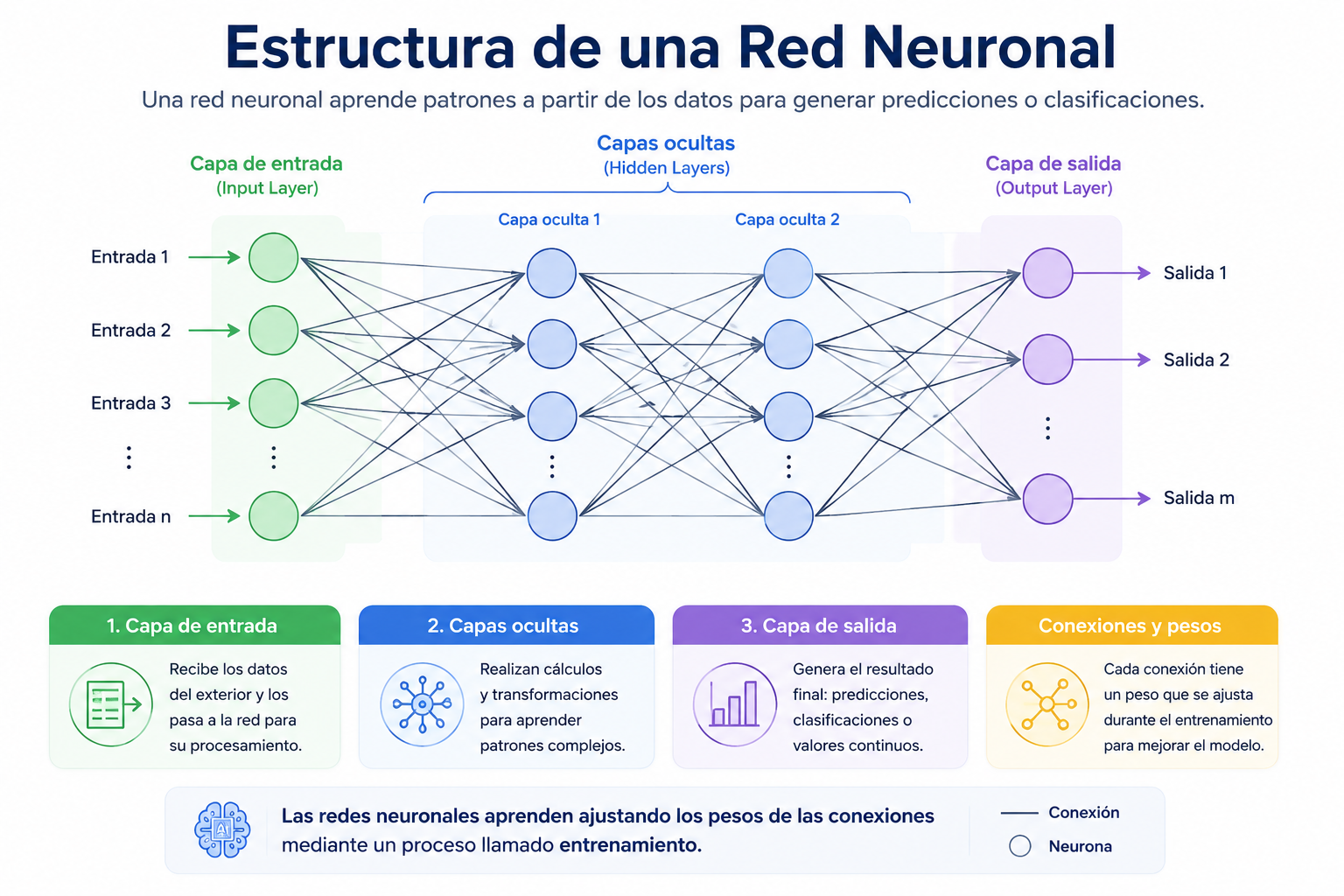
How neural networks work

A neural network is a Machine Learning architecture made up of connected units organized in layers.
Google explains that neural networks allow nonlinear patterns to be identified using nodes, hidden layers and activation functions, and that their training adjusts parameters to reduce prediction error.
Input layer
Receive the initial information.
In an image, inputs can represent pixel-related values. In a text model, numerical representations of words, fragments, or symbols are used.
Hidden layers
They progressively transform information.
Each unit combines inputs, weights, and an activation function. Layers can learn representations that are increasingly useful for solving the task.
We should not interpret that all networks literally learn edges first, then eyes, and finally identities. This behavior can be observed in some vision systems, but it depends on the architecture, the data, and the task.
Output layer
Generate the final result.
It may consist of:
- A probability.
- A category.
- A number.
- A sequence.
- A distribution of possibilities.
Weights, errors and learning
Connections contain weights that determine how much each signal influences.
During training:
- The network produces an output.
- The difference with respect to the expected result is calculated.
- The error spreads to the previous layers.
- The weights are adjusted.
- The process repeats itself.
This process allows for progressive improvement of the result, although it does not guarantee that the model will generalize correctly outside of the data used.
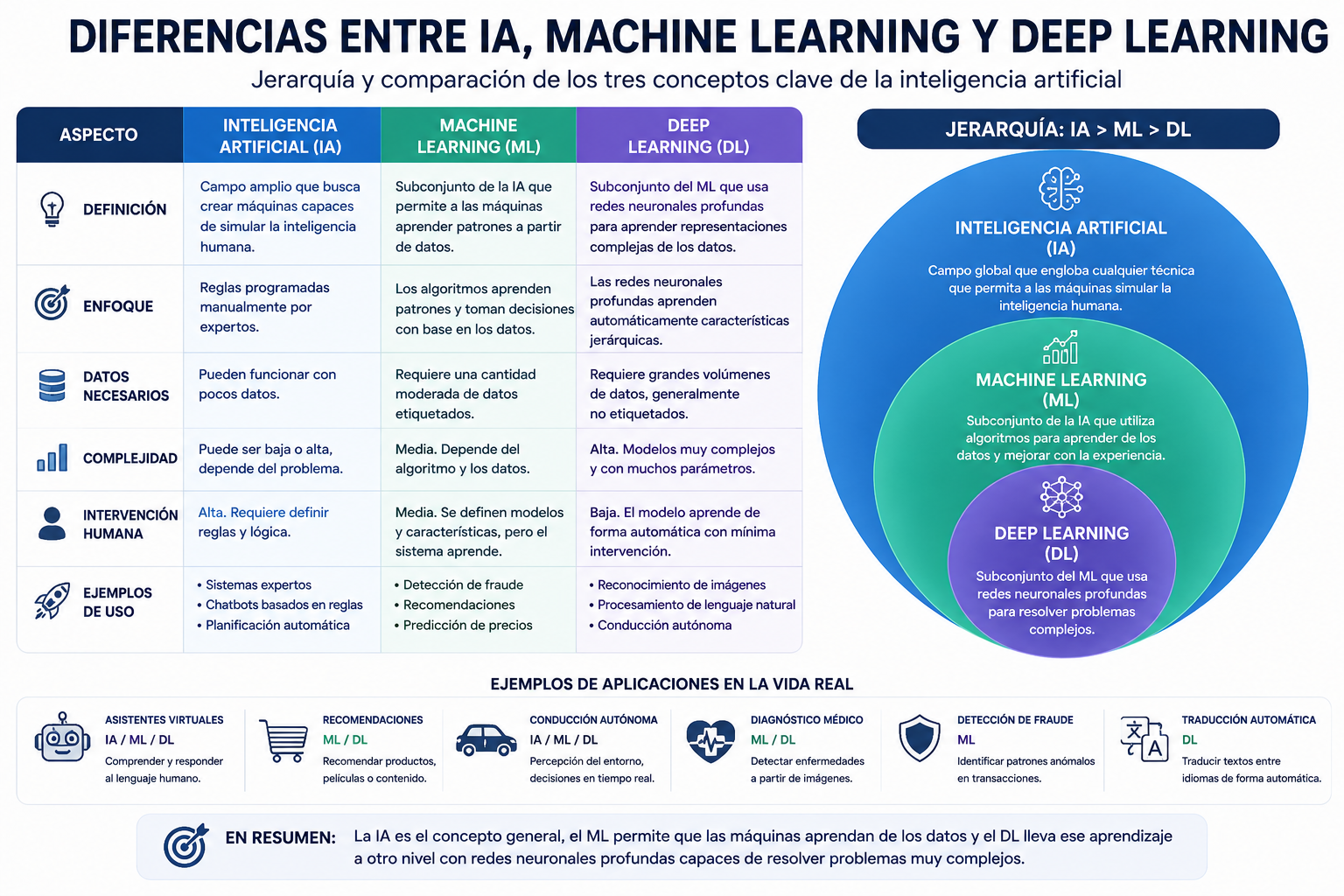
Differences between AI, Machine Learning and Deep Learning

| Concept | Scope | Method | Example |
| Artificial intelligence | General field | Rules, search, learning and other approaches | Expert or assistant system |
| Machine Learning | AI subfield | Learn relationships from data | Spam filter |
| Deep Learning | Machine Learning subfield | It uses deep neural networks | Voice recognition |
The relationship is:
Artificial intelligence
└── Machine Learning └── Deep LearningTherefore:
- Not all AI uses Machine Learning.
- Not all Machine Learning uses Deep Learning.
- All Deep Learning is part of Machine Learning.
- A product can combine several techniques.
The different approaches and classifications are developed in our guide on the types of artificial intelligence.
How an AI chatbot generates a response
Modern conversational assistants use language models trained to work with sequences of text and, in some cases, with images, audio, or other formats.
When you write an instruction:
- The system transforms content into actionable units.
- Interpret the available context.
- Calculate probability distributions.
- It progressively generates the response.
- Apply additional instructions, filters, and settings.
In a language model, predicting subsequent units is a fundamental part of the process. However, we should not use that explanation to describe all artificial intelligence, because other systems produce classifications, routes, numerical predictions, or physical actions.
Attendees can also incorporate:
- Search.
- Document recovery.
- External tools.
- Calculations.
- Conversation memory.
- Image processing.
- Code execution.
- Agents who complete several steps.
Our guide on how generative AI works develops the operation of models that produce text, images, audio, video and code.
Does artificial intelligence think like a person?
The performance of a system should not automatically be confused with human thought, consciousness, or understanding.
An AI can produce a compelling explanation, recognize an image, or pass a test without experiencing emotions or understanding the world in the same way as a person.
The OECD's operational definition describes these systems through inputs, inferences, objectives, and results; it does not attribute awareness to current models.
We must also avoid the opposite extreme.
Saying that an assistant “only repeats information” also does not correctly describe all of its processes. Models can combine patterns, generalize, solve certain problems, and produce new results, even though their mechanisms and limitations are different from those of humans.
The most precise position is:
Artificial intelligence can display advanced capabilities without demonstrating human awareness, intention, or understanding.
Why artificial intelligence can make mistakes
Errors can appear for different reasons.
Insufficient or incorrect data
The model learns unreliable relationships if the information used contains errors or does not adequately represent the problem.
Ambiguous questions
An incomplete instruction may allow for multiple interpretations.
Information outside of your training
The system can receive very different cases than those used during its development.
Overfitting
The model works well with known examples, but has difficulty generalizing.
Biases
Data, labels, or design decisions can favor certain patterns or groups.
Probabilistic generation
A generative model can produce a plausible answer that is not true.
Changes in the environment
The behavior of users, markets or systems can evolve and reduce the usefulness of the model.
Lack of access to current information
Some tools do not have real-time connection or access to up-to-date sources.
NIST recommends managing AI risks throughout their lifecycle, including reliability, security, privacy, transparency, bias, and oversight.
What an AI can and cannot do
An AI can
- Process large amounts of information.
- Recognize certain patterns.
- Classify and predict.
- Generate drafts.
- Recommend options.
- Automate parts of a process.
- Help detect anomalies.
- Adapt an output to the provided context.
AI does not guarantee
- Let the answer be true.
- That he understands the context as a person.
- That your data is up to date.
- Let the decision be fair.
- Let him know his own limits.
- That he can act without supervision.
- That the result is legal, ethical or appropriate.
- That it functions correctly outside its intended environment.
Utility depends on the task, the data, the model, the evaluation, and the way in which people integrate the system.
Practical example of operation
Let's imagine a system designed to detect spam messages.
Aim
Classify each message as:
- Spam.
- Legitimate mail.
Data
Previously classified emails are collected.
Preparation
The text is transformed into representations that the model can process.
Training
The algorithm adjusts the parameters to relate certain characteristics to each category.
Assessment
Performance is checked with messages that were not used during training.
Inference
When a new email arrives, the model calculates the probability that it is spam.
Supervision
Errors and new message types are analyzed to improve the system.
This example shows that artificial intelligence does not appear in a single step. It is the result of combining an objective, data, preparation, training, evaluation, software and supervision.
Conclusion
Artificial intelligence is a system designed to process inputs and generate results related to a goal.
Machine Learning-based models learn relationships from data. During training they adjust their parameters and, during inference, they use what they have learned to process new information.
Deep Learning uses deep neural networks, but does not represent all artificial intelligence. Similarly, a generative assistant is just one application within a much broader field.
Understanding these differences allows AI to be used with better expectations, detect its limitations, and evaluate when a response needs human verification.
To learn about its uses in education, medicine, business, marketing, industry, and everyday life, consult our guide on the real applications of artificial intelligence.
Frequently asked questions about how Artificial Intelligence works
Artificial intelligence is a branch of computer science that develops systems capable of performing tasks associated with human intelligence.
It uses algorithms and mathematical models trained on large amounts of data to identify patterns and generate responses.
The algorithm defines the procedure used to learn or process information. The model is the resulting system used to perform the task.
The training adjusts the model parameters. Inference uses the trained model to produce results with new information.
Not necessarily. Many models do not modify their parameters during normal use. To improve, they need a subsequent training or adjustment process.
Artificial intelligence is the general field. Machine Learning is one of its branches and develops models that learn relationships from data.
Deep Learning is a type of Machine Learning based on multi-layered neural networks.
There is no evidence that current systems possess human consciousness or understanding. They can demonstrate complex capabilities through different computational processes.
Generative models produce probable results from patterns. When they lack sufficient information, they can generate a plausible but incorrect answer.
No. Some systems classify, predict, recommend, detect anomalies, or control actions without creating text or images.
Not always. Some models work locally. Others need to connect to external servers or services to perform the inference.
Is it necessary to know how to program to use artificial intelligence?
Everything points to increasing integration into our professional and personal lives.