
Disclosure: this article contains affiliate links. If you buy through them, Bright Technology may earn a small commission at no extra cost to you. As an Amazon Associate, we earn from qualifying purchases.
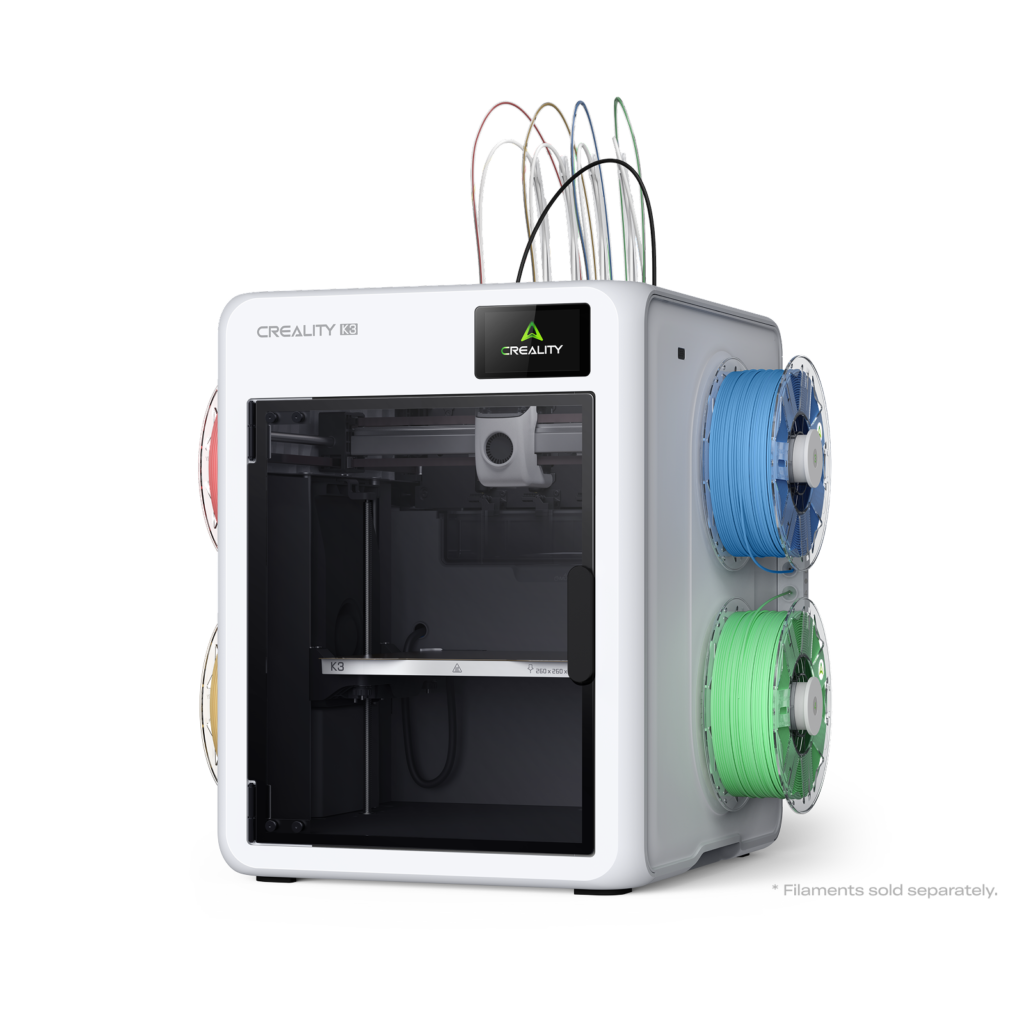
The Creality K3 is Creality’s new multicolor 3D printer: it carries four nozzles that swap in about 5 seconds thanks to the KliTek system. Pre-orders opened in the US at $849 on October 12, 2026, with shipping from early November. Here are its price, release dates, specs and how it compares with the Bambu Lab X2D and H2C, Snapmaker U1 and Prusa INDX.
- Creality K3 vs rivals: comparison table
- Creality K3 price: $849 on pre-order
- Release date: US shipping from November, Europe in December
- Creality K3 features
- How it differs from single-nozzle multicolor printers
- Creality K3 vs Bambu Lab X2D and H2C
- Creality K3 vs Snapmaker U1 and Prusa INDX
- Who is the Creality K3 for?
- What to choose
- Creality K3 FAQ
- Keep reading
Quick answer: the Creality K3 is, for the price, the most direct way into multicolor printing with several nozzles instead of a single nozzle that purges at every change. It costs $849 on pre-order, prints 260 × 260 × 260 mm, swaps nozzles in 4.8 s and promises up to 85% less wasted material. If you need four tools right now, the Snapmaker U1 is the closest alternative.
Creality K3 vs rivals: comparison table
| Model | Multicolor system | Tools | Tool change | Build volume | Max nozzle | Enclosure | Reference price |
|---|---|---|---|---|---|---|---|
| Creality K3 | KliTek nozzle swap | 4 nozzles | 4.8 s (full material change < 15 s) | 260 × 260 × 260 mm | 300 °C | Optional top cover | $849 (US pre-order) |
| Bambu Lab X2D | Dual nozzle with switching | 2 nozzles | Mechanical switching | 256 × 256 × 260 mm | 300 °C | Enclosed, 65 °C chamber | Check current price |
| Bambu Lab H2C | Vortek induction hotends | 1 fixed + up to 6 swappable | Automatic hotend change | Up to 325 × 320 × 320 mm | 350 °C | Enclosed, 65 °C chamber | Professional range |
| Snapmaker U1 | SnapSwap toolhead change | 4 toolheads | About 5 s | 270 × 270 × 270 mm | 300 °C | Optional top cover | $749 (official store) |
| Prusa INDX (Core One L) | Passive tool changer | 4 (expandable to 8) | About 12 s per material | Large format (Core One L) | Depends on printer | Enclosed | 4-tool kit: $763.80 + printer |
Data comes from each manufacturer’s official pages. K3 performance figures come from Creality’s internal tests and may vary with material and part.
Creality K3 price: $849 on pre-order
The Creality K3 costs $849 in its official pre-order, which started on October 12, 2026 and runs until November 30, 2026. During the campaign, Creality includes four spools of Hyper PLA and free shipping in eligible regions.
For context: it’s cheaper than most tool-changing printers and slightly more expensive than the Snapmaker U1, its most direct rival.
Release date: US shipping from November, Europe in December
Creality’s US store shows an estimated shipping date from November 2 for pre-orders. Europe is expected in December 2026. As with any new printer, early shipping dates can slip, so confirm the estimated date before paying if you need it for a holiday gift.
Creality K3 features
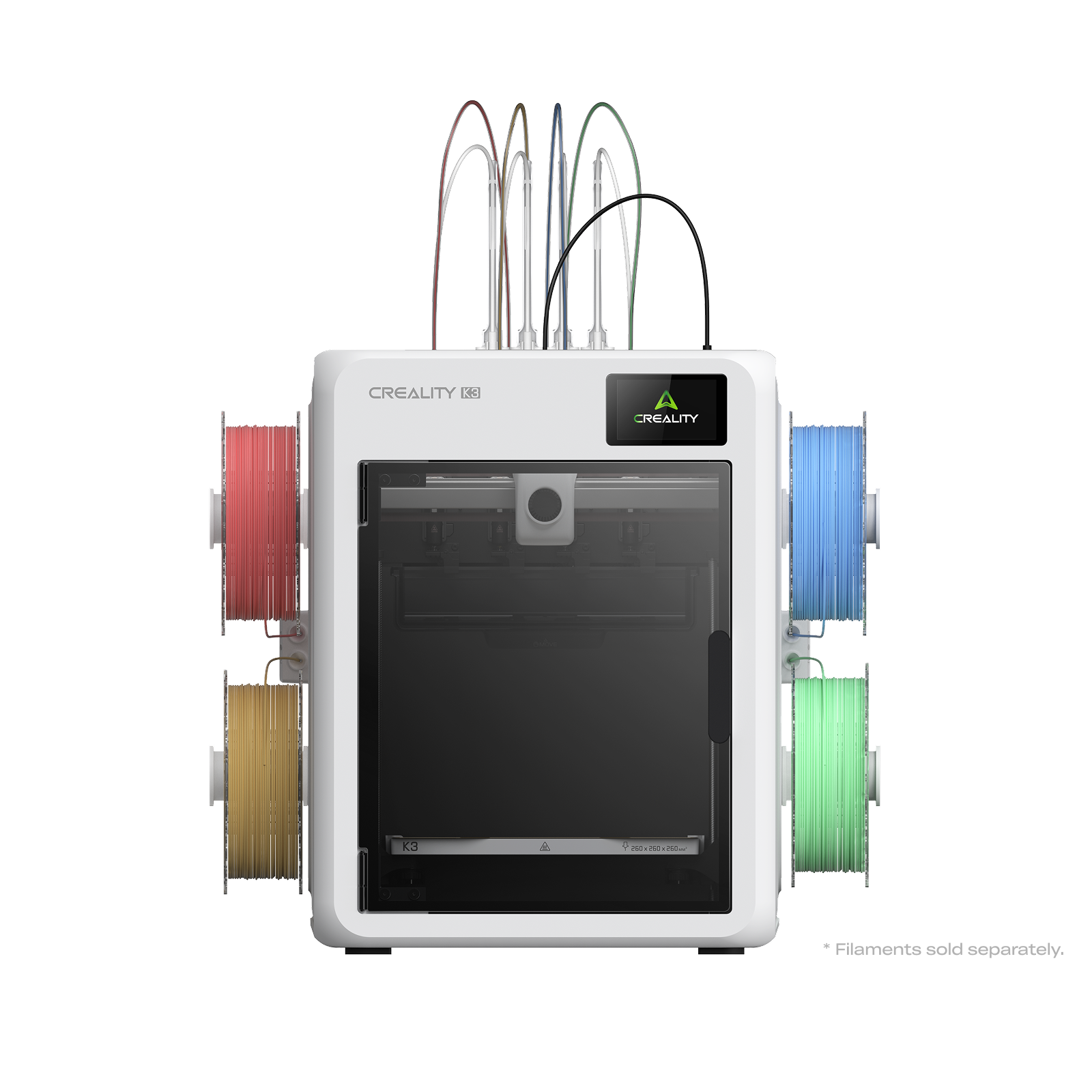
The K3 is a 260 × 260 × 260 mm printer with four nozzles, a 500 mm/s top speed and 20,000 mm/s² acceleration. Its big innovation is how it changes color: instead of cutting the filament and purging, it changes nozzles.
KliTek four-nozzle system
Each of the four filaments has its own path and nozzle. When the part needs another color, the toolhead parks one nozzle in its dock and picks up the next in 4.8 seconds; a full material change takes under 15 seconds. While they wait, parked nozzles stay preheated and retract the filament to prevent oozing and stringing. Creality claims this cuts total print time by up to 80% and filament waste by up to 85% compared with single-nozzle multicolor printing.
Precision and structure
The printer uses 37 sensors, 12 of them dedicated to aligning and locking the nozzles. According to Creality’s internal tests, repeatability after each change stays below 25 µm over more than 800,000 cycles. The frame is aluminum and, again according to the manufacturer, 30% stiffer than the previous generation and 7 dB quieter.
Temperatures, speed and volume
- Build volume: 260 × 260 × 260 mm
- Top speed: 500 mm/s
- Acceleration: 20,000 mm/s²
- Nozzle: up to 300 °C
- Heated bed: up to 100 °C
- Included nozzles: four 0.4 mm
Mixed nozzle sizes and USB-C replacements
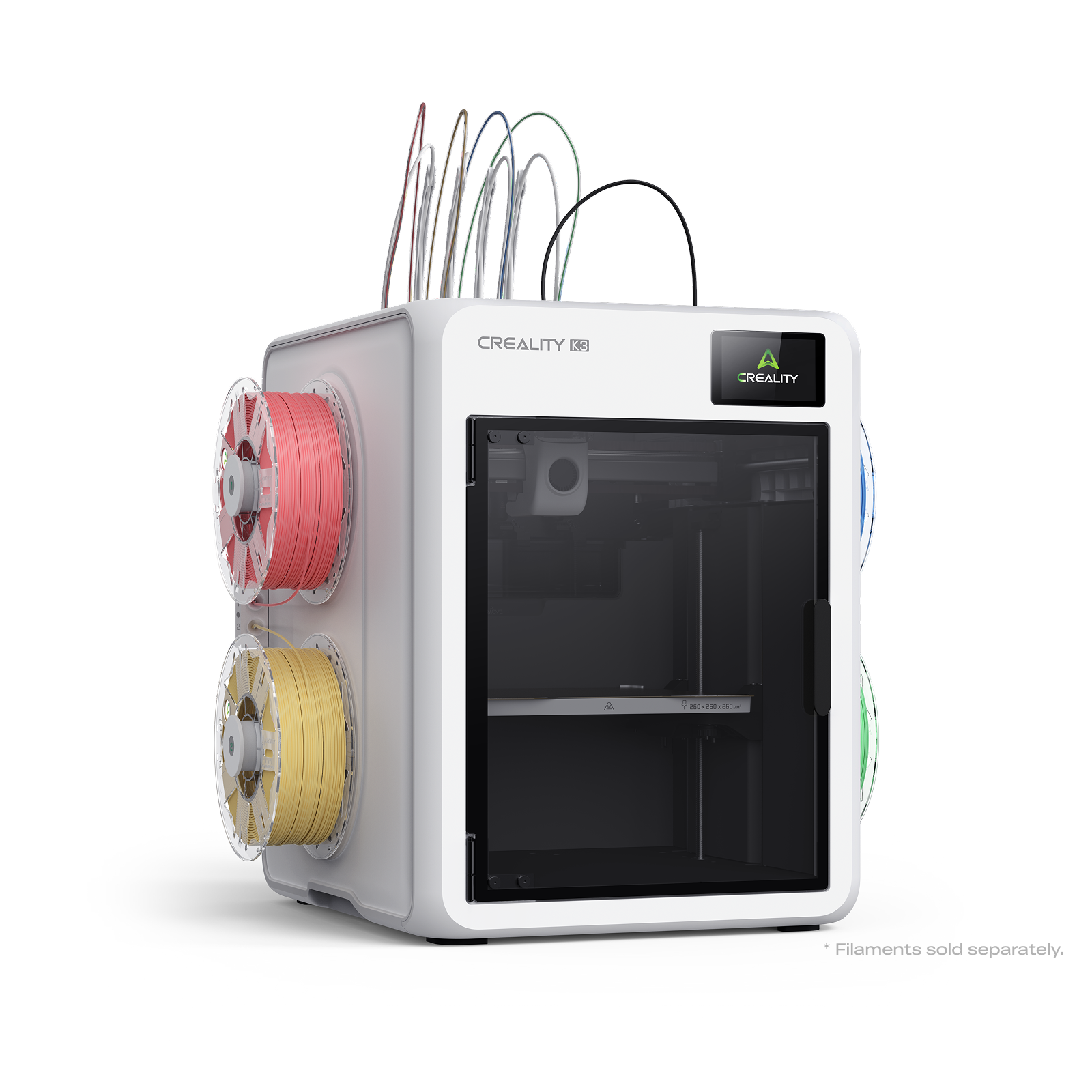
It ships with four 0.4 mm nozzles but supports 0.2, 0.4, 0.6 and 0.8 mm mixed in the same print, for example 0.8 mm for infill and 0.2 mm for details. Each nozzle connects by USB-C and is held by two screws, so if one fails you replace just that nozzle, not the whole toolhead, which Creality says cuts replacement cost by up to a third.
Materials and TPU
In its base configuration it prints PLA, PETG, PET and PCTG, and can mix them in one part. 95A TPU works without accessories thanks to the dual-gear S-Drive feeder, reaching 15 mm³/s with 95A TPU. Softer TPU (90A and 85A) needs the optional multi-material kit, which includes four dryer boxes, a CFS FLX and four high-flow nozzles. Technical and soluble filaments also depend on accessories.
Top cover, extra colors and software
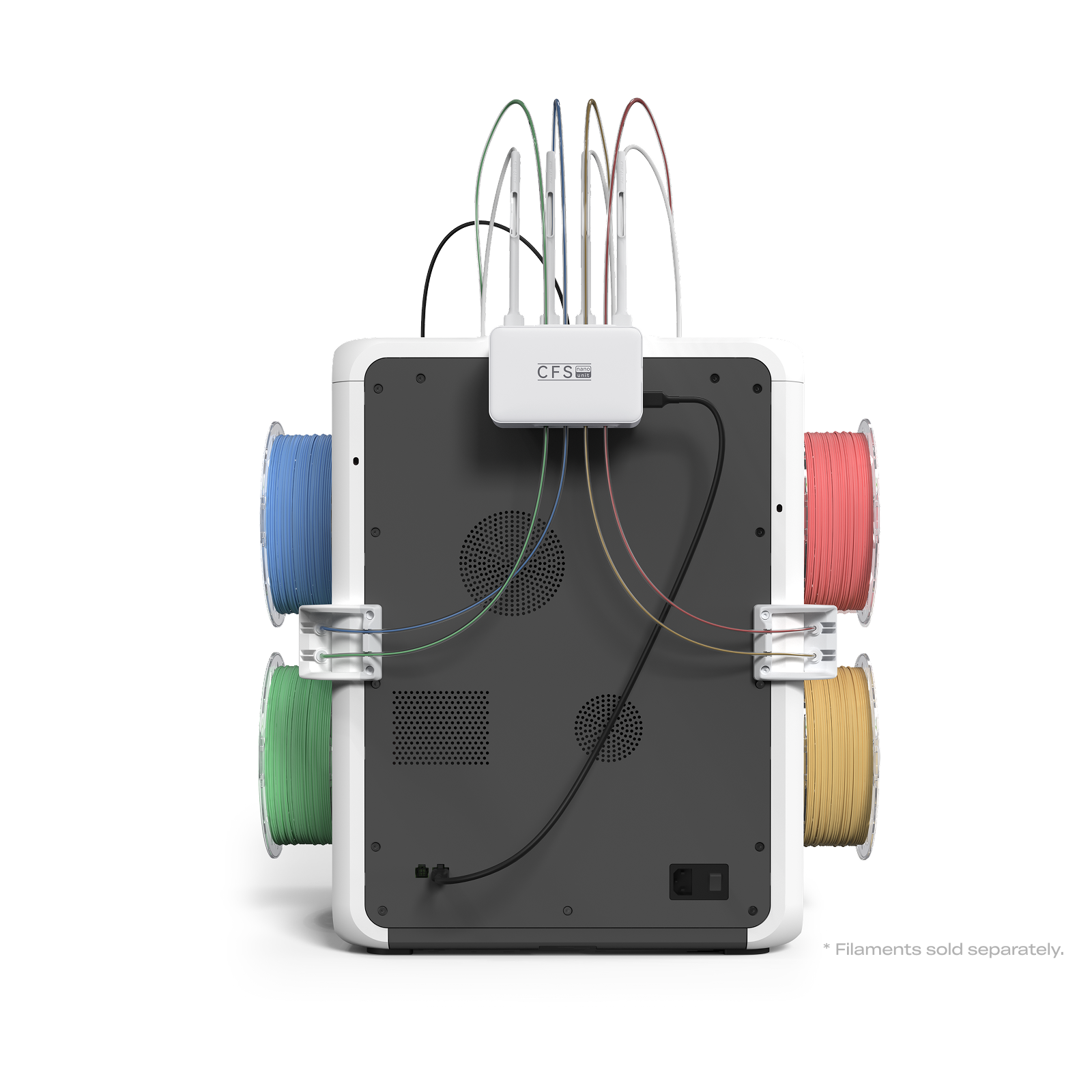
The K3 isn’t fully enclosed out of the box. The optional top cover seals the chamber, reduces noise, helps retain heat and adds HEPA and activated-carbon filtering for odors and VOCs; which accessories each bundle includes depends on the region. To go beyond four colors, it supports Creality’s CFS station through an additional CFS Hub. It also supports physical CMYK color mixing by layering translucent filaments.
For software, it’s designed for Creality Print 7.0 or later and is compatible with OrcaSlicer. The firmware is Klipper-based, will be opened in phases and the printer offers root access from day one.
How it differs from single-nozzle multicolor printers
The key difference is purging. Printers with an AMS or CFS and one nozzle must cut the filament, pull it back and extrude waste at every color change. On parts with many multicolor layers, that means hours of extra time and a pile of purged plastic. With four nozzles, each color is already loaded and hot; the change is mechanical and waste is minimal. In exchange, the system is more complex and “purge-free” colors are limited to four; with a CFS you can add more, but those extra colors purge again.
Creality K3 vs Bambu Lab X2D and H2C
Against the Bambu Lab X2D, the K3 wins on nozzle count; the X2D wins on enclosure. The X2D has two nozzles with mechanical switching: a main direct-drive nozzle and an auxiliary one. For “true” multicolor with little purging, the K3 has the edge: four nozzles versus two. For technical materials such as ABS or ASA, the X2D is better prepared thanks to its enclosed, heated chamber.
The Bambu Lab H2C is in another league. Its Vortek system stores up to six swappable induction hotends plus the fixed left nozzle, reaches 350 °C, with a 120 °C bed and an actively heated 65 °C chamber, and a build volume of up to 325 × 320 × 320 mm. It’s aimed at professional users with a matching price.
Creality K3 vs Snapmaker U1 and Prusa INDX
The Snapmaker U1 is the most direct rival: four independent toolheads, changes in about 5 seconds, 270 × 270 × 270 mm, 300 °C nozzle and 100 °C bed. It isn’t enclosed either; its top cover is optional. Snapmaker’s official store lists it at $749.
The technical difference is what gets swapped. The U1 swaps entire toolheads; the K3 swaps only the nozzle, which is lighter and cheaper to replace. The K3 also adds mixed nozzle diameters in one print and 95A TPU out of the box. The U1’s advantage is that it’s already on sale and in users’ hands.
The Prusa INDX is a tool-changer system for the Core One L. The 4-tool kit costs $763.80 on Prusa’s official store (printer not included), can be expanded to eight tools and changes material in about 12 seconds.
Who is the Creality K3 for?
It’s for people who print a lot in several colors and are tired of purging: figures, models, signs, keychains, logo parts and personalized gifts all come out faster and with less waste. It also suits anyone who wants to combine materials, such as PLA with PETG supports or rigid parts with TPU zones, and those who value open Klipper firmware with root access.
It’s not the best choice if you almost always print in a single color, if you need ABS or ASA daily without paying for extras, or if you want a machine proven by thousands of users: it’s a new model and units aren’t yet in customers’ hands.
What to choose
- Multicolor with little purging and no rush: pre-order the Creality K3.
- Four tools right now: the Snapmaker U1 is available and costs a bit less.
- Mostly single color with soluble or technical supports: the enclosed, dual-nozzle Bambu Lab X2D makes more sense.
- Engineering materials in a professional setting: the Bambu Lab H2C or the Prusa Core One L with INDX.
- Tight budget: look at simpler single-nozzle multicolor printers first.
Whatever you choose, set aside budget for filament, a filament dryer and a few basic 3D printer accessories.
Creality K3 FAQ
$849 in the official US pre-order, with four spools of Hyper PLA included until November 30, 2026.
In the US, pre-order shipping is estimated from November 2, 2026. Europe is expected in December 2026.
Creality’s nozzle-swapping system: four nozzles, each with its own filament, that swap in about 4.8 seconds. Parked nozzles stay preheated and retract filament, so there’s almost no purging between colors.
Yes. 95A TPU works out of the box thanks to the S-Drive feeder. Softer 90A or 85A TPU needs the optional multi-material kit with dryer boxes, CFS FLX and high-flow nozzles.
Not entirely. The base configuration isn’t fully enclosed; the optional top cover seals the chamber, reduces noise and adds HEPA and activated-carbon filtering. Bundle contents vary by region.
Both have four tools and changes in about 5 seconds. The U1 is already on sale and costs a bit less; the K3 swaps only the nozzle (cheaper to replace), supports mixed nozzle sizes in one print and prints 95A TPU out of the box.
Keep reading
- Bambu Lab A2L vs Elegoo Centauri Carbon 2: Which to Buy?
- PLA vs ABS vs PETG: Which 3D Printing Filament to Choose?
- Everything You Need to Know About 3D Printing
- Best Sites to Download Free STL Files in 2026
Official sources: Creality K3 · Creality K3 FAQ · Creality K3 pre-order press release · Snapmaker U1 · Bambu Lab H2C specs · Prusa INDX kit