
Disclosure: this article contains affiliate links. If you buy through them, Bright Technology may earn a small commission at no extra cost to you. As an Amazon Associate, we earn from qualifying purchases.
This DJI Neo review looks at a real change of direction in DJI’s lineup. Models like the DJI Mini 4 Pro and the DJI Air 3 are aimed at people who want advanced aerial photography. The Neo has a different goal: let anyone start flying and recording in seconds. At about 135 g, it takes off from your palm, follows you with AI tracking, runs automatic camera moves and records 4K video.
Its philosophy is closer to a smart camera with propellers than to a traditional drone, and that is its biggest strength. It also raises questions. Can it replace the Mini 4 Pro? Is it better than the Potensic Atom? Is it enough for quality video, or is it just a gadget? This guide answers them so you can decide if it is the drone you need.
- DJI Neo specs at a glance
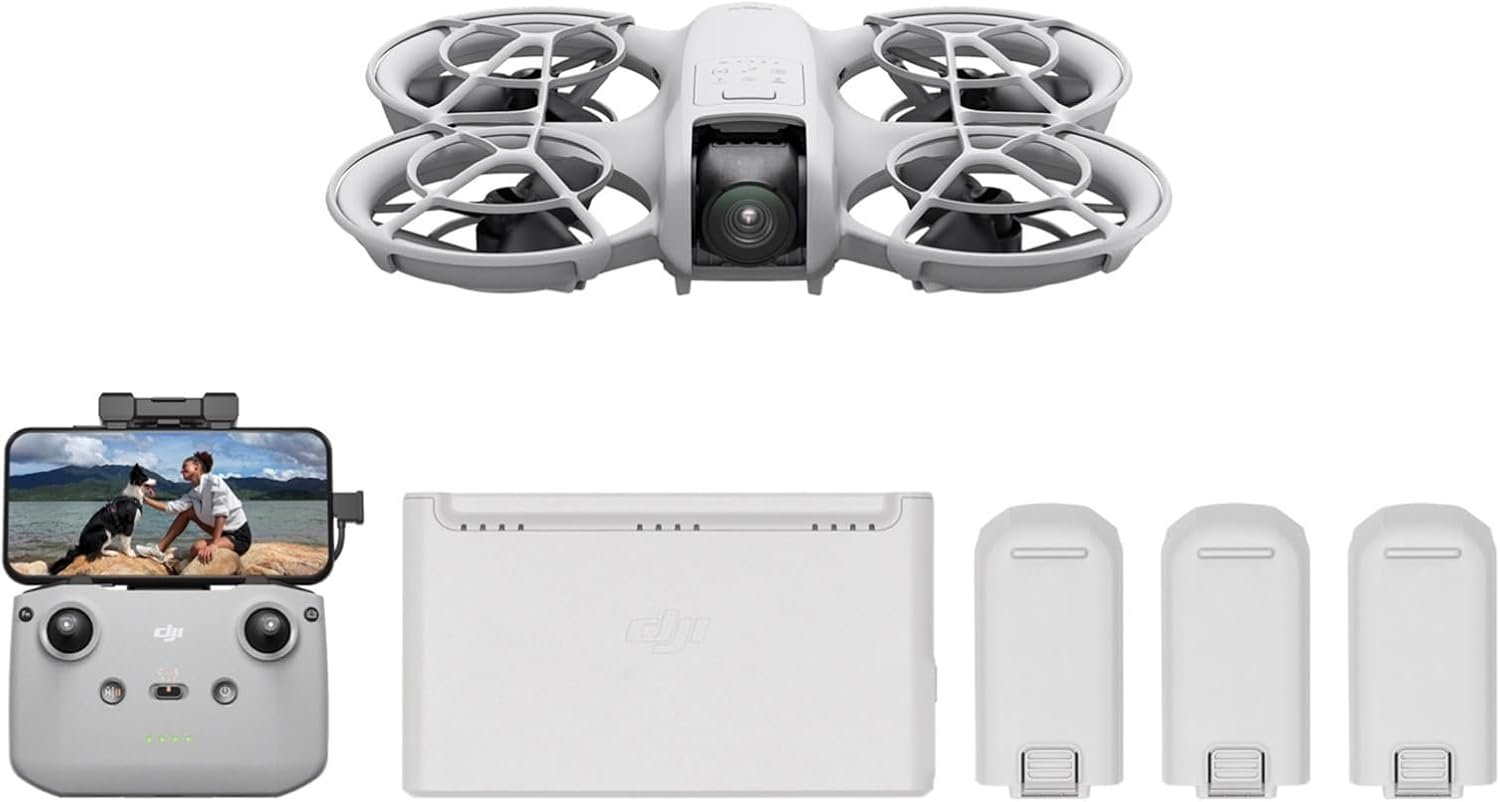
- What is in the box
- Design and build quality
- Flight experience
- Photo quality
- Video quality
- Smart modes
- What we like most, and what we would change
- DJI Neo pros and cons
- Who should buy the DJI Neo?
- DJI Neo review verdict: is it worth buying?
- Before you buy the DJI Neo
- Our decision: buy it or skip it?
- DJI Neo FAQ
- Conclusion
- Keep reading
Quick answer: the DJI Neo is one of the best first drones for social media creators and travelers who want hands-free footage with almost no learning curve. It is tiny, fun and excellent at automatic shots. It is not meant for professional photography, long flights or windy days. For that, look at the DJI Mini 4 Pro or the Potensic Atom. Best: ease of use and how fast you can start recording. Worst: flight time and the lack of some features found on higher-end models.
DJI Neo specs at a glance
| Spec | DJI Neo |
|---|---|
| Type | Ultralight drone for beginners and content creation |
| Recommended level | Beginner |
| Weight | About 135 g |
| Camera | 4K video and high-resolution photos |
| Takeoff | From your palm |
| Smart modes | AI subject tracking, QuickShots, automatic flights |
| Control | DJI Fly app, optional controller, voice control (where available) |
| Flight time | Up to 18 min (about 15 to 17 min real-world) |
Key specs
- About 135 g
- 4K video
- Palm takeoff and landing
- AI tracking and QuickShots
- App, voice or optional controller
- Up to 18 min flight
Buy it for: travel, social media, hikes and anyone who wants to start with a DJI drone. Skip it for: professional photography, demanding commercial work, or if you need optical zoom or advanced obstacle sensors.
What is in the box
The contents vary slightly by version, but you will typically find:
- DJI Neo
- Intelligent battery
- Gimbal protector (depending on the kit)
- Spare propellers
- USB-C cable
- Official documentation
Our recommendation: if you plan to use the Neo often, choose the pack with extra batteries. Flight time is one of its most limited points, and having several batteries changes the experience completely.
Design and build quality
DJI went for a very compact format with fully integrated propeller guards, which is reassuring during the first flights. They protect the drone and also the people around it, so it is more comfortable to fly in parks, gardens and open spaces than a conventional drone.
The materials are good quality and it does not feel like a toy. It looks designed for frequent use, small bumps and typical beginner mistakes, and it almost fits in a large backpack pocket. That portability means it goes with you in situations where you would leave a bigger drone at home. The best drone is not always the one with the best camera. Often it is the one you actually have with you when the chance to film comes up.
Flight experience
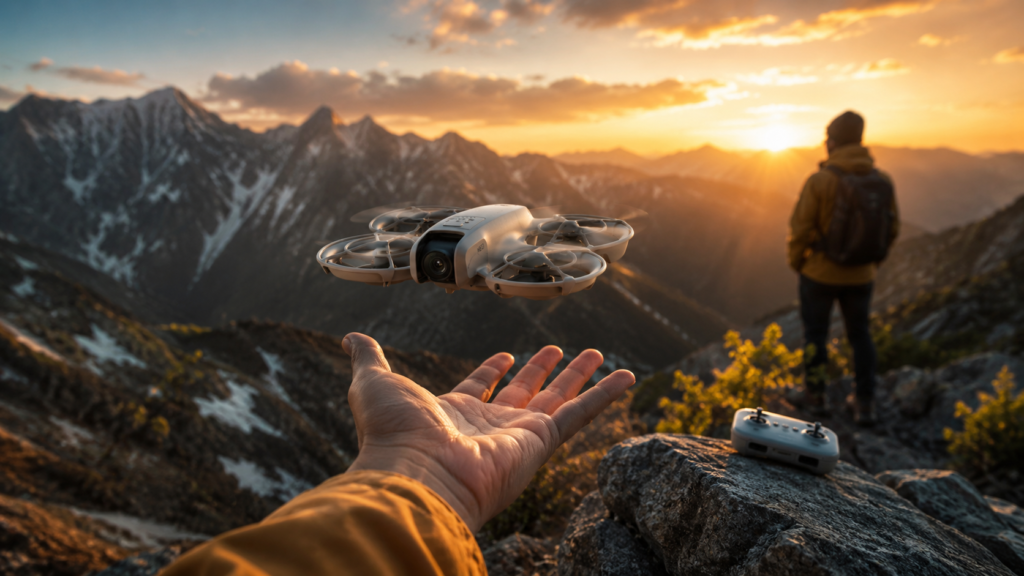
The Neo is not trying to be the fastest drone, the steadiest in wind or the one with the most professional features. Its goal is a simple experience. Where the Mini 4 Pro and Air 3 invite you to plan a flight, the Neo is made for any spare moment: a walk, the beach, a bike ride or a mountain climb, and half a minute later you are recording.
Palm takeoff removes one of the things beginners fear most, the first takeoff from the ground. In the air, it stays reasonably stable for its size in good weather, and movements are smooth and easy to control. You can fly manually from the app or an optional controller, but its strength is automation. The automatic modes handle follow shots, orbits and dynamic angles with almost no effort. A Mini 4 Pro offers more precise control, but it also asks more of the pilot. The Neo is built to simplify everything. Because it is so light, it is more sensitive to wind, so it is happiest in calm conditions.
Photo quality
For photography, the DJI Neo does well within its segment. Images have good detail, natural color and pleasant processing straight from the camera. To be realistic, it is not for professional photographers. It is meant for quick shots to share on social media, document trips or keep personal memories, and it does that well. If you want to edit RAW files heavily or print large photos, the Mini 4 Pro is still the better choice.
Video quality
Video is where the Neo shows why it has attracted so much interest. It records 4K, with more than enough quality for YouTube, Instagram, TikTok or any other platform. Stabilization does an excellent job considering the drone’s size, and automatic follow modes give smooth, pleasant footage.
Just as important is speed. You do not need minutes of preparation; within seconds you are capturing footage. That changes how often you actually use the drone, and it explains much of its success.
Smart modes
The automatic modes are the real star of the Neo. The most interesting ones:
- AI subject tracking
- Dronie (fly backward and up)
- Rocket (straight up, camera down)
- Circle (orbit around you)
- Spotlight (keep you centered)
- Palm takeoff and automatic landing
- QuickShots
All of them aim for eye-catching videos without mastering manual flying, which feels more like a smart camera than a traditional drone. DJI got this approach right.
What we like most, and what we would change
What stands out is that the Neo removes every excuse not to take the drone out. No special backpack, no ten-minute flight prep, no need to be a pilot. You take it out, launch from your hand and start recording. That simplicity means it tends to get used far more than people expect when they buy it, which is probably the best sign of a well-designed product.
There are a few things we would improve:
- Flight time. It is enough for quick flights, but it falls short when you shoot several sequences in a row. At least two extra batteries are almost essential.
- Wind resistance. It is very light, and that shows when conditions are not ideal.
- Manual settings. Some users will want more manual controls for photo and video.
None of these are serious flaws. They simply reflect the kind of user the Neo is aimed at.
DJI Neo pros and cons
- Extremely easy to use, even with no experience
- Very compact and light, perfect for travel
- Palm takeoff and landing
- 4K video that is good for social media
- Very effective AI tracking
- Excellent integration with the DJI ecosystem
- Very quick, simple setup
- One of the best ways into drones
- Shorter flight time than the Mini 4 Pro or Air 3
- Not meant for professional photography
- More sensitive to wind because of its low weight
- Fewer manual controls than other DJI drones
- You will want extra batteries for long sessions
Who should buy the DJI Neo?
The Neo’s target user is clearly defined. We would recommend it especially for:
- People buying their first drone.
- Travelers who want a very light kit.
- Social media content creators.
- Families who want to film getaways and vacations.
- Users who value ease of use over professional features.
If your main goal is advanced aerial photography, commercial work or frequent flights in wind, the Mini 4 Pro or the Air 3 are probably better options. If you are just starting out, our guide to the best drones for beginners and our tips on how to fly a drone will help.
DJI Neo review verdict: is it worth buying?
Yes, as long as you understand the kind of product you are buying. The Neo does not try to compete with the Mini 4 Pro or Air 3 on photo quality or professional features. Its goal is simpler: let anyone take off, record and enjoy a drone without complications, and it does that. It surprises more through the experience of using it than through its spec sheet.
It does not replace higher-end drones, it offers a completely different experience. Bigger drones are for planning flights and chasing the best possible photo. The Neo invites the opposite: take it out, launch in seconds and start recording. If you want a drone to travel light or keep in your backpack, it is a safe choice. If your work depends on professional photo or video, stick with higher-end models. For a side-by-side look, see DJI Mini 4 Pro vs DJI Neo and Potensic Atom vs DJI Neo.
Before you buy the DJI Neo
- It does not replace a Mini 4 Pro. The Neo prioritizes simplicity, while the Mini 4 Pro chases maximum image quality. Which one you choose depends more on use than budget.
- Buy at least one extra battery. Flights are short, and spares are a small investment that improves the experience a lot.
- Lean on the automatic modes. The Neo’s real potential is not manual flying but using the smart modes to film yourself walking, exercising or traveling.
At about 135 g, the Neo does not need FAA registration for purely recreational flying in the US, though you still need to pass the free TRUST test. DJI has since released newer Neo models, so compare prices before buying.
Our decision: buy it or skip it?
Buy it if you want a very easy first drone, a lightweight model for travel, content for Instagram, TikTok or YouTube Shorts, quick setup, or an affordable way into the DJI ecosystem.
Look elsewhere if professional aerial photography is your priority, you need long flight time, you often fly in wind, you do commercial work or you want full manual camera control.
DJI Neo FAQ
Yes. It is one of the best DJI drones for people who have never flown one, because the ease of use and automatic modes cut the learning curve a lot.
It records 4K video with very good quality for travel, social media and personal videos. For professional use, the DJI Mini 4 Pro offers better performance.
DJI quotes up to 18 minutes. In normal use, expect about 15 to 17 minutes depending on wind and the type of flight.
Yes, but because it is very light, avoid strong wind for better stability and footage.
It depends on use. For simplicity and automation, the Neo. For longer flights and more traditional piloting, the Potensic Atom may be more interesting.
Besides an extra battery, a charging hub, a fast microSD card, a hard carrying case and a travel protector are very useful.
At about 135 g it is under the 250 g threshold, so no FAA registration is needed for recreational flying, but you must pass the free TRUST test.
Conclusion
The DJI Neo shows that you do not need a complicated experience to enjoy a drone. It is made for people who want to capture memories and share content without learning technical concepts. Palm takeoff, ease of use and smart modes make it one of the most fun and accessible drones in its category. It is not DJI’s most powerful model and does not try to be, which is exactly why it suits such a wide range of users.