
Disclosure: this article contains affiliate links. If you buy through them, Bright Technology may earn a small commission at no extra cost to you. As an Amazon Associate, we earn from qualifying purchases.
This Potensic Atom review looks at one of the most popular budget alternatives to DJI’s Mini series. The Atom is a foldable GPS drone that weighs under 249 g, records 4K video and promises up to 32 minutes of flight, at a price well below most DJI models. The big question is whether saving money on an Atom is worth it, or whether a DJI Mini 4 Pro is still the better investment. Here is what it does well, where it falls short and who should buy it.
- Potensic Atom review: specs at a glance
- What is in the box
- First impressions and build quality
- Flight performance and wind handling
- Photo quality
- Video quality
- Smart modes
- What we like and what could be better
- Potensic Atom pros and cons
- Who should buy the Potensic Atom?
- Before you buy the Potensic Atom
- US rules for the Potensic Atom
- Would we buy the Potensic Atom today?
- Is the Potensic Atom worth buying?
- Potensic Atom FAQ
- Keep reading
Quick answer: the Potensic Atom is one of the best-value drones under 250 g. It flies steadily, has GPS and Return to Home, records sharp, well-stabilized 4K and lasts about 28-30 minutes in real use. The app, subject tracking and color profiles trail DJI’s, but for beginners and casual flyers it delivers most of what matters for much less money. Best: great value. Worst: the ecosystem and smart features are a step behind DJI.
Potensic Atom review: specs at a glance
| Spec | Potensic Atom |
|---|---|
| Type | Ultralight foldable GPS drone |
| Weight | Under 249 g |
| Camera | 12 MP photos, 4K video, gimbal-stabilized |
| Flight time | Up to 32 min (about 28-30 min real-world) |
| Range | Up to 6 km, depending on conditions and local rules |
| Positioning | GPS |
| Smart modes | Follow, QuickShots, Return to Home |
| Recommended level | Beginner to intermediate |
Potensic Atom key specs
- Under 249 g
- 12 MP camera with 4K video
- Up to 32 min flight
- Up to 6 km range
- GPS and Return to Home
- Foldable, compact design
What is in the box
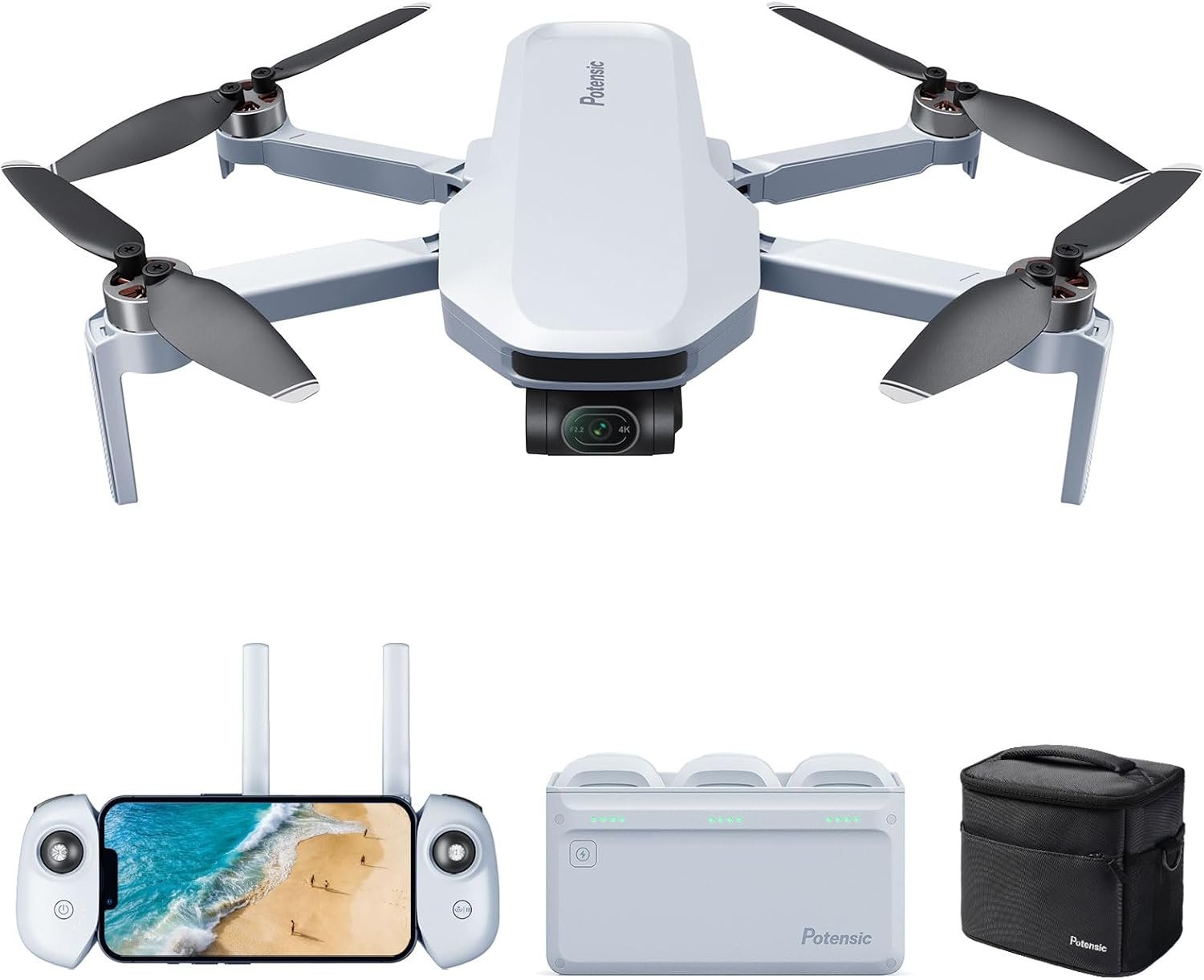
Contents vary slightly by bundle, but you will normally find:
- Potensic Atom drone
- Remote controller
- One intelligent battery
- Spare propellers
- USB cable
- Gimbal protector
- Official documentation
If you find a good deal on a Fly More Combo or a bundle with several batteries, take it. Flight time is one of the Atom’s strengths, and extra batteries let you make the most of every outing.
First impressions and build quality
The first surprise is that the Atom does not feel like a cheap alternative. It looks well finished, the folding mechanism is precise and the controller is comfortable even on long flights. Setup is intuitive and the drone is ready to fly in minutes.
The design follows the compact, foldable layout popularized by DJI’s Mini series, so it slips into a small backpack and is easy to take on trips and hikes. The arms are rigid, the hinges feel secure and the gimbal is well protected in transit. It is not as refined as the DJI Mini 4 Pro, but it does not feel fragile either. For a direct matchup, see our Potensic Atom vs DJI Mini 4 Pro comparison.
Flight performance and wind handling
Stability is where Potensic has done its best work. The Atom holds position reliably thanks to GPS, responds progressively to the sticks and produces fluid footage without constant corrections, which helps beginners a lot.
It copes well with moderate wind for a sub-250 g drone, though the DJI Mini 4 Pro keeps a slight edge thanks to its stabilization and more mature algorithms. Speed modes let you match its behavior to your skill: Normal is very easy to control, while Sport is more agile for livelier flying. If this is your first drone, our guide on how to fly a drone covers the basics.
Photo quality
The camera is one of the areas where Potensic has improved most. The 12 MP sensor captures good detail, pleasant colors and fairly balanced exposure in most situations, with strong results for landscapes, cityscapes and well-lit scenes. As with almost every drone in this class, low light brings more noise and less dynamic range.
That is more than enough for recreation, travel and content creation. For professional photography the DJI Mini 4 Pro keeps an advantage, but the gap is smaller than many expect.
Video quality
Video is probably the Atom’s strongest point. It records sharp 4K footage with natural colors and stabilization that covers most situations. The gimbal keeps the image steady through small direction changes and light gusts, and the result is far better than most budget drones can manage.
It lacks DJI’s advanced professional color profiles, but for the vast majority of users that will not matter.
Smart modes
The Atom has a set of smart features that make flying and content creation easier:
- Automatic Return to Home
- QuickShots automated camera moves
- Subject tracking
- Waypoint flight (depending on app version)
- Automatic takeoff and landing
- Precise GPS positioning
The system is not as sophisticated as DJI’s ecosystem, but these features work properly and add real value in daily use, especially for newcomers.
What we like and what could be better
What stands out: you get a lot more drone than the price suggests. The Atom does not try to copy DJI; it has its own identity as a balanced, easy-to-use drone with surprisingly good image quality for the money.
What could improve: the app has come a long way, but DJI’s software is still more polished. Automatic tracking works, but it lacks the precision of DJI’s ActiveTrack when the subject changes direction or obstacles appear, and there are fewer color profiles for people who edit video seriously. The Atom also has no obstacle-avoidance sensors, so you need to keep a close eye on your surroundings.
Potensic Atom pros and cons
- Excellent value for money
- Under 249 g
- Very good flight time for its class
- 4K video with good stabilization
- Compact and easy to carry
- Precise GPS and very stable flight
- Great for beginners and intermediates
- Clearly cheaper than many DJI models
- App still behind DJI’s ecosystem
- Subject tracking could be better
- Fewer advanced color profiles
- Smaller user community than DJI
- Official accessories are harder to find
- No obstacle-avoidance sensors
Who should buy the Potensic Atom?
Buy it if you want the most drone for your money, want to start in aerial photo and video, need a compact travel drone, are a content creator who does not need advanced professional features, or simply prefer to save money without giving up decent image quality.
Skip it if you want the best smart tracking, a full DJI ecosystem or professional work on a regular basis. Then the DJI Mini 4 Pro, which you can read about in our DJI Mini 4 Pro review, is the better fit.
| Buy the Potensic Atom if… | Buy the DJI Mini 4 Pro if… |
|---|---|
| You want the most performance per dollar | You want the best camera in the sub-250 g class |
| You want a lightweight travel drone | You value very advanced subject tracking |
| You do not need DJI’s advanced features | You want a fuller ecosystem of accessories and updates |
| It is your first drone or a cheap upgrade | You do intensive professional work or content creation |
Before you buy the Potensic Atom
- You are not just paying for a brand. The Atom delivers an experience quite close to DJI for a considerably lower price, which matters if your budget is limited.
- Get the bundle with several batteries. The Atom’s flight time is a strength, so buying extra batteries from the start greatly improves the experience.
- Think about how you will really use it. For travel, landscapes and fun, the Atom likely covers everything. Pay more for a Mini 4 Pro only if you know you will use its advanced photo, video and tracking features.
If you are comparing other low-cost models, see our list of the best budget drones.
US rules for the Potensic Atom
At under 250 g, the Atom does not need FAA registration in the US when flown purely for fun, but recreational pilots must pass the free TRUST test and follow the FAA’s recreational rules. Flying for work requires a Part 107 certificate.
Would we buy the Potensic Atom today?
Yes, as long as budget is a priority. Potensic has positioned itself as the most serious alternative to DJI among sub-250 g drones. For a travel drone to learn on and shoot good video without spending what a Mini 4 Pro costs, the Atom is an easy pick. If money were no object and you needed the best tracking, a more mature app or a bigger accessory ecosystem, DJI is still the safer choice.
Is the Potensic Atom worth buying?
The Potensic Atom is one of the most interesting drones for anyone who wants strong performance at a lower price. It does not try to beat the DJI Mini 4 Pro in every area; its strategy is to offer a very complete experience for much less money, and it succeeds. If your budget is around the Atom’s price and you want to learn, travel and shoot quality content, it is a very recommendable buy.
Potensic Atom FAQ
It depends on how you fly. If you want the best image quality, advanced smart features and a complete ecosystem, the DJI Mini 4 Pro is still better. If price is your priority, the Atom offers excellent value.
Yes. Its stability, ease of control and flight time make it one of the most recommendable drones to start with.
Potensic quotes up to 32 minutes. In real use, expect roughly 28-30 minutes depending on wind and flying style.
Yes. It records 4K video with a gimbal-stabilized camera, which is very good quality for travel, social media and personal projects.
Yes. It handles wind well for a drone under 249 g, though in strong gusts the DJI Mini 4 Pro keeps a slight stability advantage.
Potensic is an independent consumer drone brand known for affordable camera and beginner drones. It is a separate company, not part of DJI.
No. Potensic and DJI are different, competing manufacturers. The Atom mimics the compact, foldable design popularized by DJI’s Mini series, but it has its own app, hardware and software.
The Atom shows that Potensic has come a long way. It offers stable flight, good 4K video and strong battery life for the price, though its app and smart features still trail DJI’s.
At under 250 g it does not need FAA registration for recreational flying, but you must pass the free TRUST test. Commercial flying requires a Part 107 certificate.