

Disclosure: this article contains affiliate links. If you buy through them, Bright Technology may earn a small commission at no extra cost to you. As an Amazon Associate, we earn from qualifying purchases.
This DJI Avata 2 review looks at DJI’s ready-to-fly FPV cinewhoop: a 377 g drone with built-in prop guards, a 4K camera and DJI’s O4 video link, designed to work with DJI Goggles 3 and the RC Motion 3 controller. Its promise is simple: real first-person flying without building a quad, tuning Betaflight or spending weeks learning Acro mode.
Quick answer: the DJI Avata 2 is the best way for most people to get into FPV. The Goggles 3 and RC Motion 3 make immersive flying intuitive from the first session, the 4K camera records smooth, dynamic footage and the ducted frame is forgiving. It’s not a photo drone, flights are shorter than a regular camera drone and the full kit is a significant investment.
DJI Avata 2 at a glance
| Spec | DJI Avata 2 |
|---|---|
| Weight | 377 g |
| Type | FPV cinewhoop |
| Video | 4K up to 100 fps |
| Field of view | Ultra-wide |
| Flight time | Up to 23 min (about 18–22 min real-world) |
| Video transmission | DJI O4 |
| Control | DJI RC Motion 3 or DJI FPV Remote Controller 3 |
| Protection | Integrated propeller guards |
Key specs
- 377 g cinewhoop
- 4K up to 100 fps
- Ultra-wide field of view
- DJI O4 transmission
- Up to 23 min flight
- Integrated prop guards
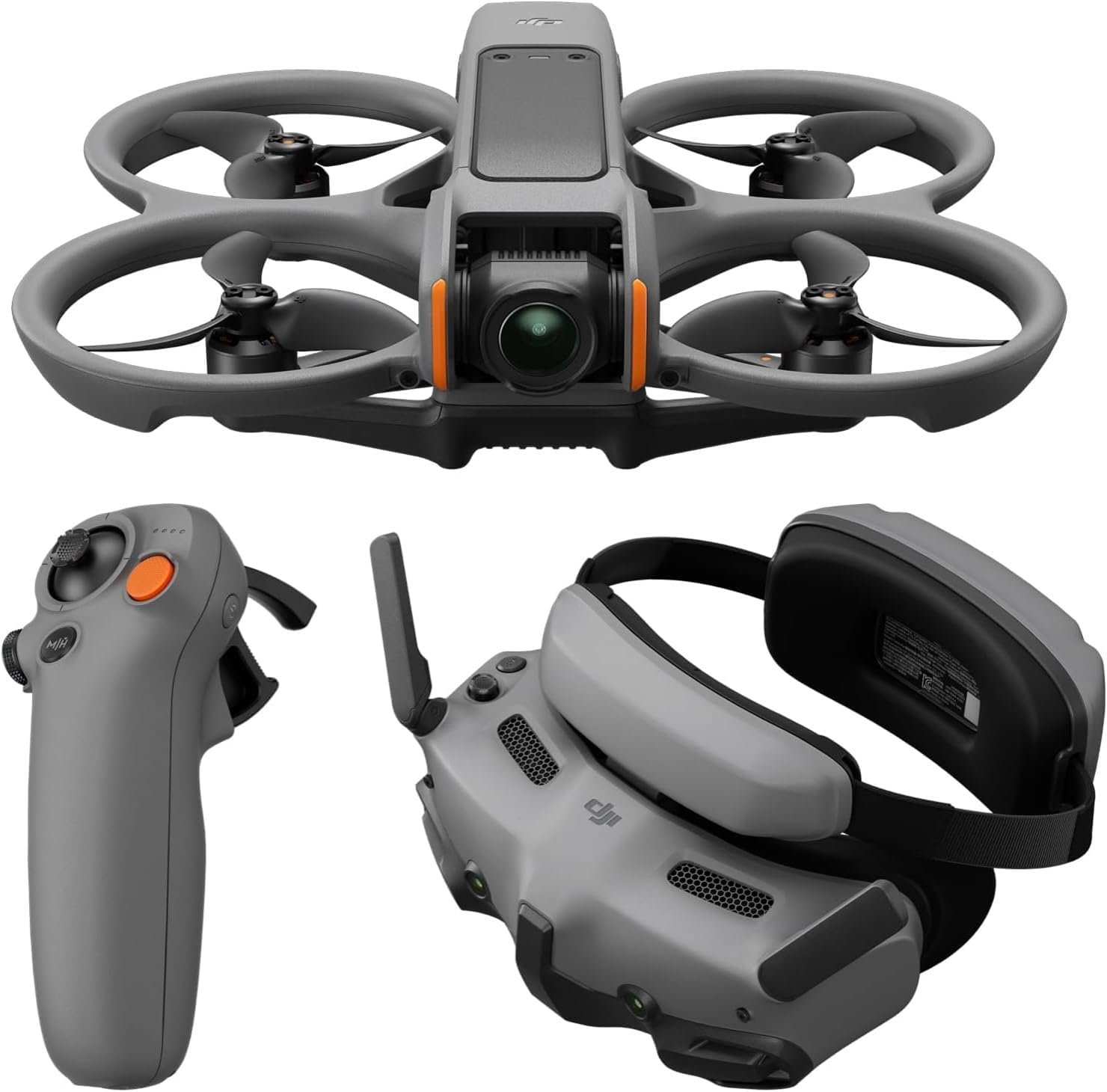
What’s in the box
Depending on the bundle: the Avata 2, an intelligent battery, spare propellers, gimbal protector, USB-C cable and documentation. Combo kits add the DJI Goggles 3 and RC Motion 3, and Fly More bundles add extra batteries.
Design and build
The Avata 2 is a cinewhoop: a compact drone with ducts around the propellers. That design makes it much safer near people, trees and indoors, and it shrugs off light bumps that would end a flight on an open-prop drone. Build quality is excellent.
Flight experience
This is where the Avata 2 shines. With the RC Motion 3, you point the controller where you want to go and squeeze the trigger to fly, which feels natural within minutes. Normal and Sport modes keep it stable and assisted; Manual mode unlocks full acrobatic freedom but needs practice, ideally on a simulator first. The result is fluid, immersive flight that feels completely different from flying a regular camera drone.
Image and video quality
The Avata 2 records 4K at up to 100 fps with an ultra-wide view and strong stabilization, producing smooth, dynamic footage for property tours, travel, sports and social media. It isn’t designed for classic aerial photography: there’s no tilting gimbal for top-down stills and it lacks the sensor and photo modes of a Mini or Air.
DJI Goggles 3 and RC Motion 3
The Goggles 3 are the star of the experience, with a clear, low-latency feed that makes flying genuinely immersive. The RC Motion 3 removes most of the fear of FPV: its motion-based control is the easiest way for newcomers to fly confidently. Pilots who want full manual control can add the FPV Remote Controller 3.
Pros and cons
- Best entry point into FPV
- Spectacular immersive flight
- 4K up to 100 fps
- Very easy with RC Motion 3
- Clear, low-latency Goggles 3
- Ducted frame with guarded props
- Excellent build quality
- Full kit is a big investment
- Shorter flights than camera drones
- Not for classic aerial photography
- Manual mode takes practice
- Repairs can be costly
Who should buy the DJI Avata 2?
Buy it if you’ve always wanted to try FPV, want the most immersive flying experience, create dynamic content for YouTube or social media and value a ready-to-fly cinewhoop in the DJI ecosystem.
Skip it if you mainly want aerial photos, need long flight times, want the cheapest drone possible, need it for inspections or technical work or simply aren’t interested in FPV.
Before you buy
- It isn’t a conventional drone. Expect a different, more active way of flying.
- The full combo is worth it. Goggles, motion controller and extra batteries are what make the experience.
- Spend a few hours in the simulator before trying Manual mode.
At 377 g, the Avata 2 must be registered with the FAA in the US, and you’ll need the free TRUST test for recreational flying. FAA rules also require a visual observer beside you whenever you fly with goggles.
Bottom line
The DJI Avata 2 makes FPV accessible. It combines immersive flight, smooth 4K footage and a forgiving ducted design with controls that newcomers can master quickly. If you want aerial photography or long flights, choose a Mini or Air instead; if you want to experience flying from the cockpit, the Avata 2 is the easiest way in.
DJI Avata 2 FAQ
Yes. It’s the most beginner-friendly FPV drone thanks to the RC Motion 3, which makes control intuitive from the first flights.
Yes. It’s designed to be flown with the DJI Goggles 3, which are central to the immersive experience.
DJI quotes up to 23 minutes; in real use expect about 18–22 minutes depending on how you fly.
Yes, at up to 100 fps, with excellent quality for immersive and cinematic video.
For ease of use and a ready-to-fly experience, yes. For racing or extreme freestyle, a custom-built quad offers more performance and customization.
In the US, yes: it weighs more than 250 g, so it must be registered with the FAA.