

Disclosure: this article contains affiliate links. If you buy through them, Bright Technology may earn a small commission at no extra cost to you. As an Amazon Associate, we earn from qualifying purchases.
DJI Neo vs Potensic Atom is one of the most common dilemmas for first-time drone buyers. Both are small, affordable and easy to carry, but they follow completely different philosophies. The DJI Neo is about absolute simplicity: pull it out, launch it from your palm and start filming. The Potensic Atom is a traditional GPS drone with a controller, longer flights and more room to grow as a pilot.
The right choice depends less on price than on what kind of user you are. Here’s how they compare.
Quick answer: buy the DJI Neo if you’ve never flown a drone and mainly want quick hands-free clips for TikTok, Instagram or Shorts. Buy the Potensic Atom if you want to learn to fly a real drone, care about photos and landscapes, and want roughly double the flight time and better value.
Quick verdict
Buy the DJI Neo if…
- You’ve never flown a drone
- You want to film yourself for social media
- You want the simplest drone possible
- You value getting from pocket to recording in seconds
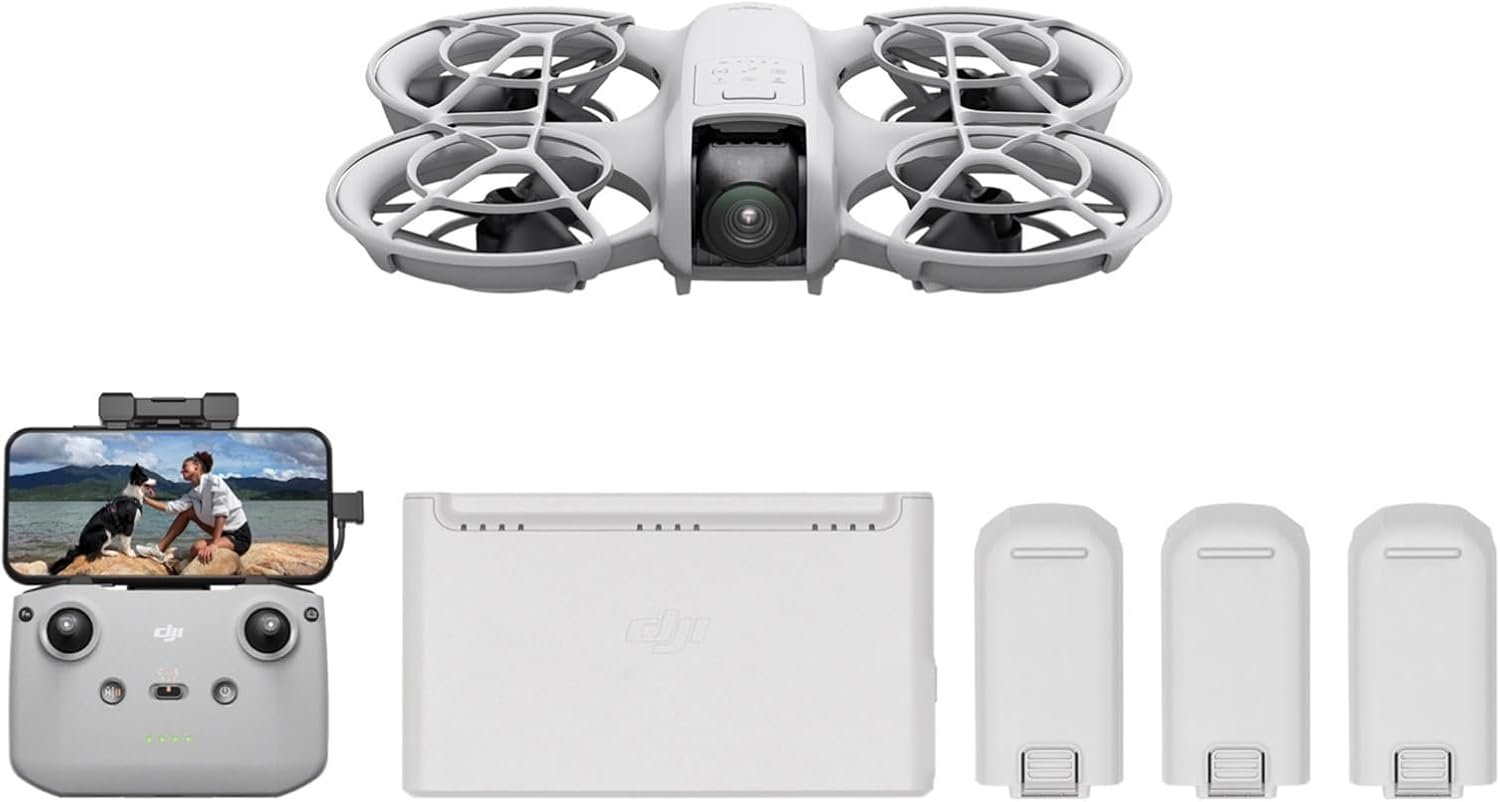
DJI Neo at a glance
- Weight: 135 g
- 4K video
- Palm takeoff and landing
- AI subject tracking
- Real flight time: about 15–17 min
- No GPS
Buy the Potensic Atom if…
- You want a traditional drone with a controller
- You want longer flight time
- You care more about photo and video than automatic modes
- You want the best value
Potensic Atom at a glance
- Weight: 249 g
- 4K video
- GPS positioning and Return to Home
- Folding design
- Real flight time: about 28–30 min
- Classic controller-based flying

Specs compared
| DJI Neo | Potensic Atom | |
|---|---|---|
| Weight | 135 g | 249 g |
| Video | 4K | 4K |
| Real flight time | 15–17 min | 28–30 min |
| GPS | No | Yes |
| Smart modes | Very complete | Good |
| Palm takeoff | Yes | No |
| Tracking | AI vision | GPS-based |
| Portability | Excellent | Excellent |
| Price | Usually lower | Usually higher |
| Flying style | Automatic | Traditional |
Both weigh under 250 g, so in the US you don’t need to register either one for purely recreational flying, though you still need to pass the FAA’s free TRUST test.
The three differences that really matter
- They’re made for different people. The Neo is for filming from minute one without learning to fly; the Atom is for learning to pilot a conventional drone with full control.
- Flight time changes everything. The Atom offers roughly double the Neo’s real-world flight time, which matters a lot if you like exploring or longer flights.
- Experience vs capability. The Neo wins on simplicity; the Atom wins on technical capability.
Design and portability
Both are compact, but they’re designed differently. The tiny Neo practically disappears in a backpack or a large jacket pocket and has full propeller guards. The Atom uses a classic folding design: it takes a bit more space and you unfold the arms before flying, but it feels more like a full-size drone. The Neo invites you to carry it everywhere; the Atom invites you to plan a proper flight.
Winner: DJI Neo, for convenience.
Camera and photo quality
Both record 4K, but with different goals. The Neo captures moments quickly with pleasing colors and solid stabilization for social media and travel clips. The Potensic Atom gives you more room for considered photography: more detailed stills and more consistent results when you plan your shots and edit later.
Winner: Potensic Atom.
Video
The Neo is unbeatable for speed: launch from your hand, pick an automatic mode and you have a shareable clip in seconds. The Atom needs a little more setup but gives you more control over longer flights and more complex compositions.
Winner: tie. Neo for speed, Atom for creative control.
Flight time
| Drone | Real-world flight time |
|---|---|
| DJI Neo | 15–17 minutes |
| Potensic Atom | 28–30 minutes |
With the Neo you usually do one or two quick flights to capture a moment. With the Atom you can explore an area much longer without watching the battery constantly.
Winner: Potensic Atom, by a wide margin.
Flying experience
The Neo practically removes the learning curve: quick takeoff, automatic modes and fun from minute one. The Atom offers a traditional experience: you fly with a regular controller, have full control and build skills that transfer to more advanced drones. Neither is better; they’re simply different.
Winner: tie. Neo for automated flying, Atom for real piloting.
Ease of use
The Neo is designed for people who have never flown a drone: palm takeoff, no complicated setup and automatic modes that do most of the work. The Atom is also easy, but you’ll need to learn basic piloting.
Winner: DJI Neo, clearly.
Which should you buy?
| If you are… | Our pick |
|---|---|
| A first-time flyer | DJI Neo |
| A traveler who wants quick clips | DJI Neo |
| Focused on social media | DJI Neo |
| Into photography | Potensic Atom |
| Keen to learn to pilot | Potensic Atom |
| Someone who values flight time | Potensic Atom |
| Looking for the best value | Potensic Atom |
Bottom line
The DJI Neo and Potensic Atom look like direct rivals, but they serve different needs. The Neo is for people who want to skip the technical side and start filming immediately; it’s light, intuitive and ideal for social creators. The Atom is a step toward real piloting, with longer flights, a more versatile camera and full control that lets you grow as a pilot.
Choose the Neo for simplicity and speed; choose the Atom to learn to fly properly and get the most performance for your money. There’s no wrong choice, just a different kind of fun.
DJI Neo vs Potensic Atom FAQ
If you’ve never flown and just want to film without learning to pilot, the DJI Neo. If you want to learn to fly a conventional drone and keep improving, the Potensic Atom is the better investment.
Both shoot 4K, but the Potensic Atom delivers more consistent image quality, especially for photos and footage you plan to edit. The Neo is great for social media and personal clips.
The Potensic Atom, with about 28–30 minutes in real use versus roughly 15–17 minutes for the DJI Neo.
Both are great travel companions. The Neo is tiny and films you hands-free; the Atom is better if you want to spend time photographing landscapes.
The Potensic Atom offers one of the best balances of features, flight time and price in its class.
Not for purely recreational flying, since both weigh under 250 g. You still need to pass the free FAA TRUST test.