
There are many types of drones, and they don’t all fly the same way or do the same jobs. Some hover perfectly still to film a scene; others use wings to cover huge areas; some carry heavy payloads and others are built for racing through gates at full speed. To understand drone classification, you first need to know which criterion you’re using.
This guide explains the main types of drones by design and by use, with their strengths, limitations and the kind of user each one suits.
Quick answer: by design, drones are multirotors (the most common), single-rotor helicopters, fixed-wing aircraft and hybrid VTOL drones. By use, the main categories are recreational, camera, professional, FPV, racing, agricultural, mapping, industrial inspection, emergency and delivery drones. One drone can belong to several categories at once.
How drones are classified
- By design and how they generate lift
- By number and layout of rotors
- By intended use
- By piloting system (line of sight or FPV)
- By sensors and cameras
- By size, weight or performance
- By level of automation
These overlap. A single drone can be a multirotor (design), professional (use), FPV (piloting style) and camera-equipped (payload) all at once. The clearest approach is to classify by design first, then by application.
Types of drones by design
Multirotor drones
Multirotors use several motors and propellers to generate thrust. They’re the most common type for hobbyists, photographers, creators and small businesses. By rotor count: tricopters (3), quadcopters (4), hexacopters (6) and octocopters (8). Quadcopters dominate because they balance size, cost, stability and ease of control.
- Pros: vertical takeoff and landing, hovering, maneuverability, little space needed, great for photo, video and inspection, models for every level.
- Limitations: shorter flight time than a comparable fixed-wing, constant energy use to stay airborne, wind sensitivity, and more rotors mean more cost and complexity.
Single-rotor drones
Built like a helicopter, with one large main rotor for lift and usually a tail rotor to control rotation. They can carry heavier payloads, stay airborne longer than some multirotors and may use combustion engines.
- Pros: efficiency, large blades, good payload capacity, hovering, long endurance on some models.
- Limitations: mechanical complexity, higher price, vibration, the risks of a large rotor, and specialized maintenance and training. Not a beginner choice.
Fixed-wing drones
Shaped like airplanes, their wings generate lift as they move forward, which makes them very efficient on long flights. They’re used for mapping, agriculture, large-area surveillance, pipeline and power-line inspection, environmental monitoring and long-range missions.
- Pros: long endurance, energy efficiency, long distances, high cruise speed, ideal for mapping large areas.
- Limitations: can’t hover, often need space or launch systems to take off and land, poor for slow close-up inspections, more demanding to plan and fly.
A fixed-wing can map hundreds of acres in one flight but is impractical for filming a house or slowly inspecting a building facade.
Hybrid VTOL drones
Hybrid VTOL (vertical takeoff and landing) drones combine both worlds: they take off and land vertically on rotors, then transition to efficient wing-borne forward flight.
- Pros: vertical takeoff, longer range than multirotors, large-area coverage, no runway needed, suited to mapping, surveillance and logistics.
- Limitations: complex design, high cost, more components, demanding flight transitions and specialized maintenance.
Drone designs compared
| Design | Can hover | Typical endurance | Takeoff space | Best for | Difficulty |
|---|---|---|---|---|---|
| Multirotor | Yes | Short to medium | Minimal | Photo, video, inspection | Low to medium |
| Single-rotor | Yes | Medium to long | Medium | Heavy payloads, specialist work | High |
| Fixed-wing | No | Long | Medium to large | Mapping large areas | Medium to high |
| Hybrid VTOL | Yes | Long | Minimal | Long-range technical missions | High |
No design is best for everything. It depends on whether you need hovering, endurance, speed, payload or portability.
Types of drones by use
Recreational and beginner drones
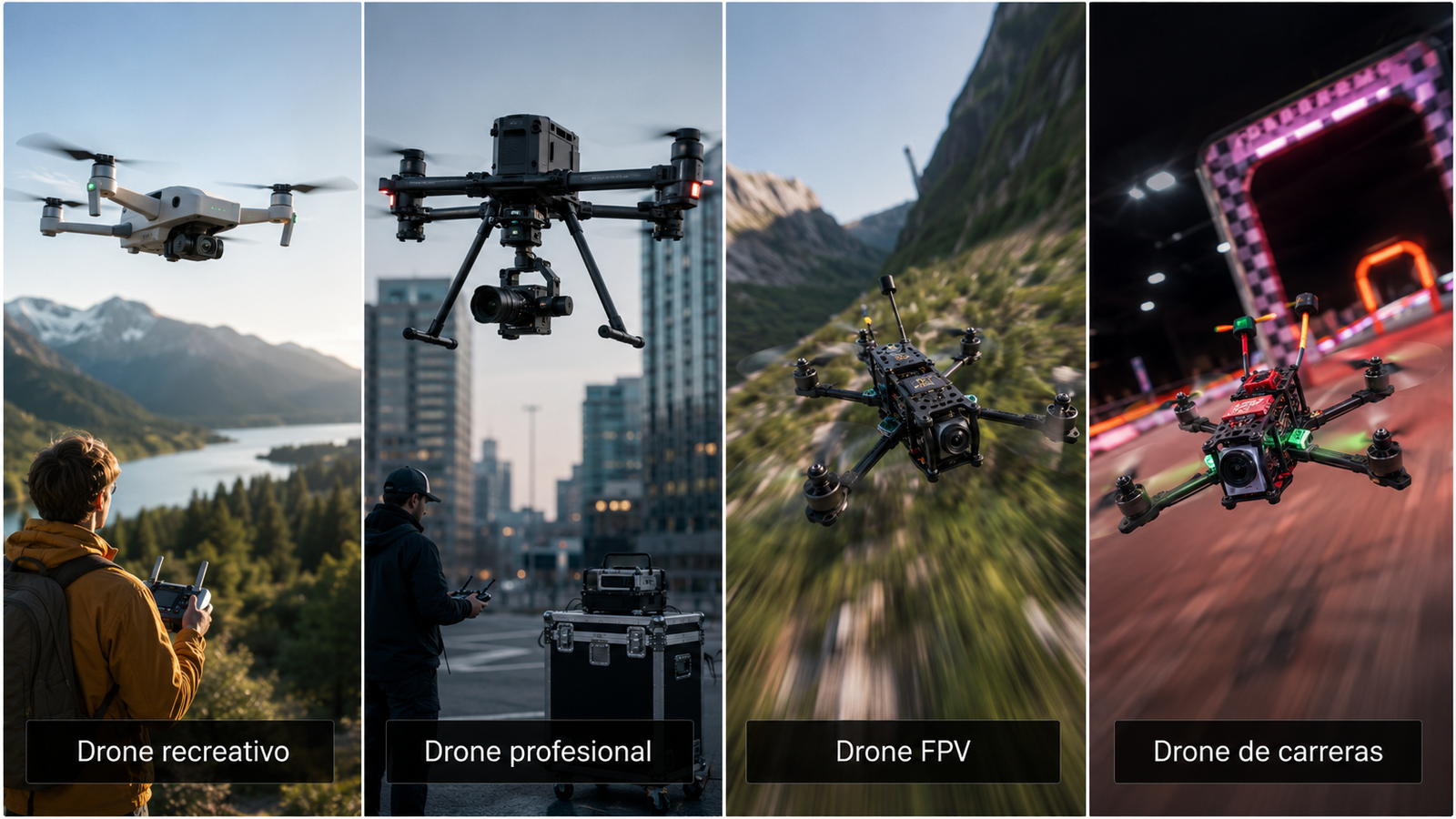
Made for fun, learning and occasional flying, usually compact quadcopters. They focus on ease of use, stability, an affordable price, a simple app, assisted flight modes, Return to Home on GPS models and a basic or mid-range camera. Limits are typically flight time, wind resistance, camera quality and obstacle sensing.
Camera drones
Not a separate aerodynamic design but usually a multirotor with an integrated or interchangeable camera, used for travel photography, social video, film production, real estate, sports tracking, visual inspection and photogrammetry. What matters: sensor size and quality, gimbal stabilization, resolution and frame rate, dynamic range, RAW photos, color profiles, video transmission and smart capture modes. Resolution alone doesn’t guarantee better images.
Professional drones
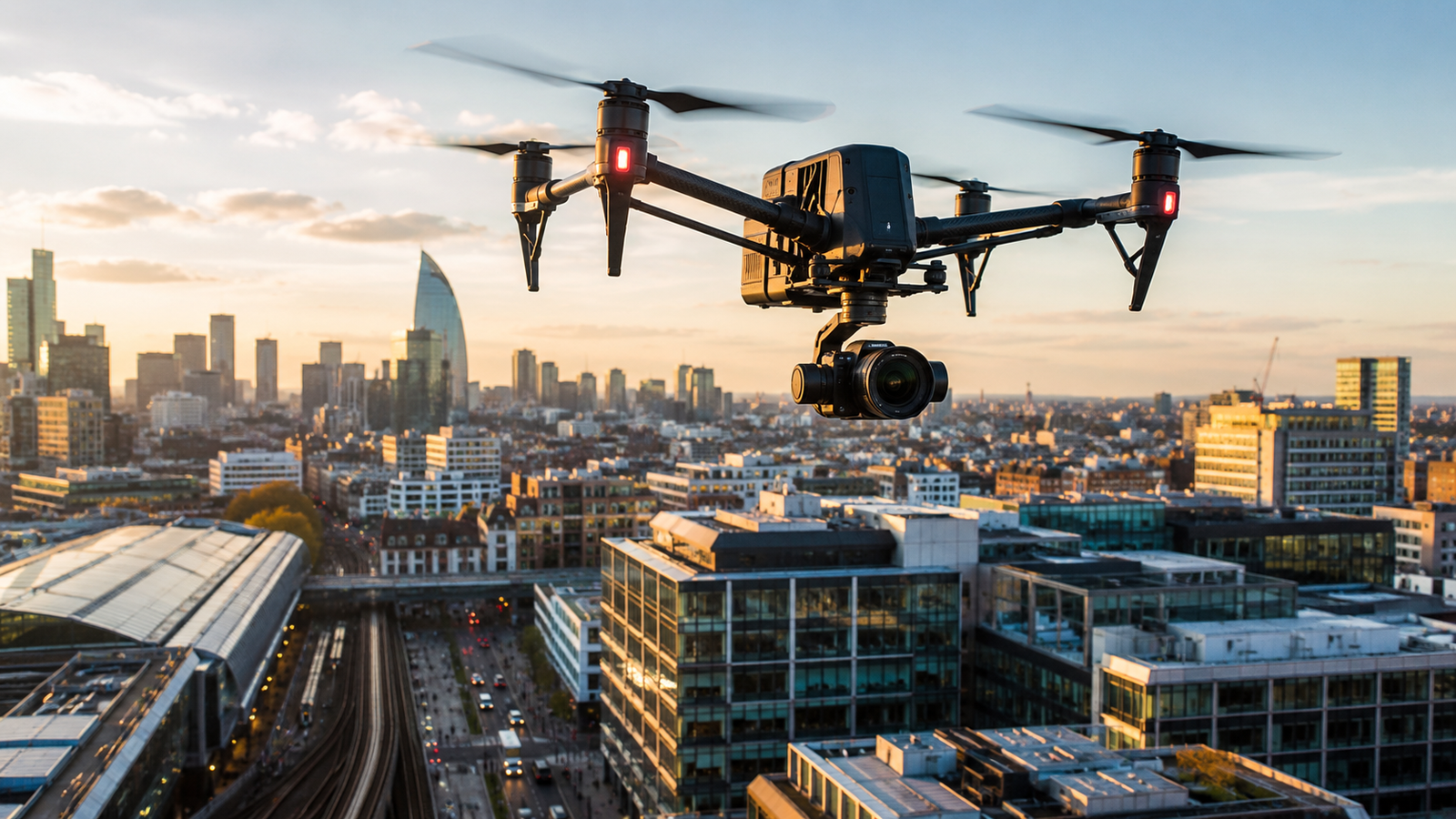
“Professional” describes readiness for demanding work, not a single airframe. These drones may carry large-sensor cameras, thermal cameras, multispectral sensors, RTK positioning, interchangeable payloads, sensor redundancy, mission planning, specialist software support, weather protection and advanced transmission. They serve film, construction, agriculture, surveying, energy, security and inspection.
FPV drones
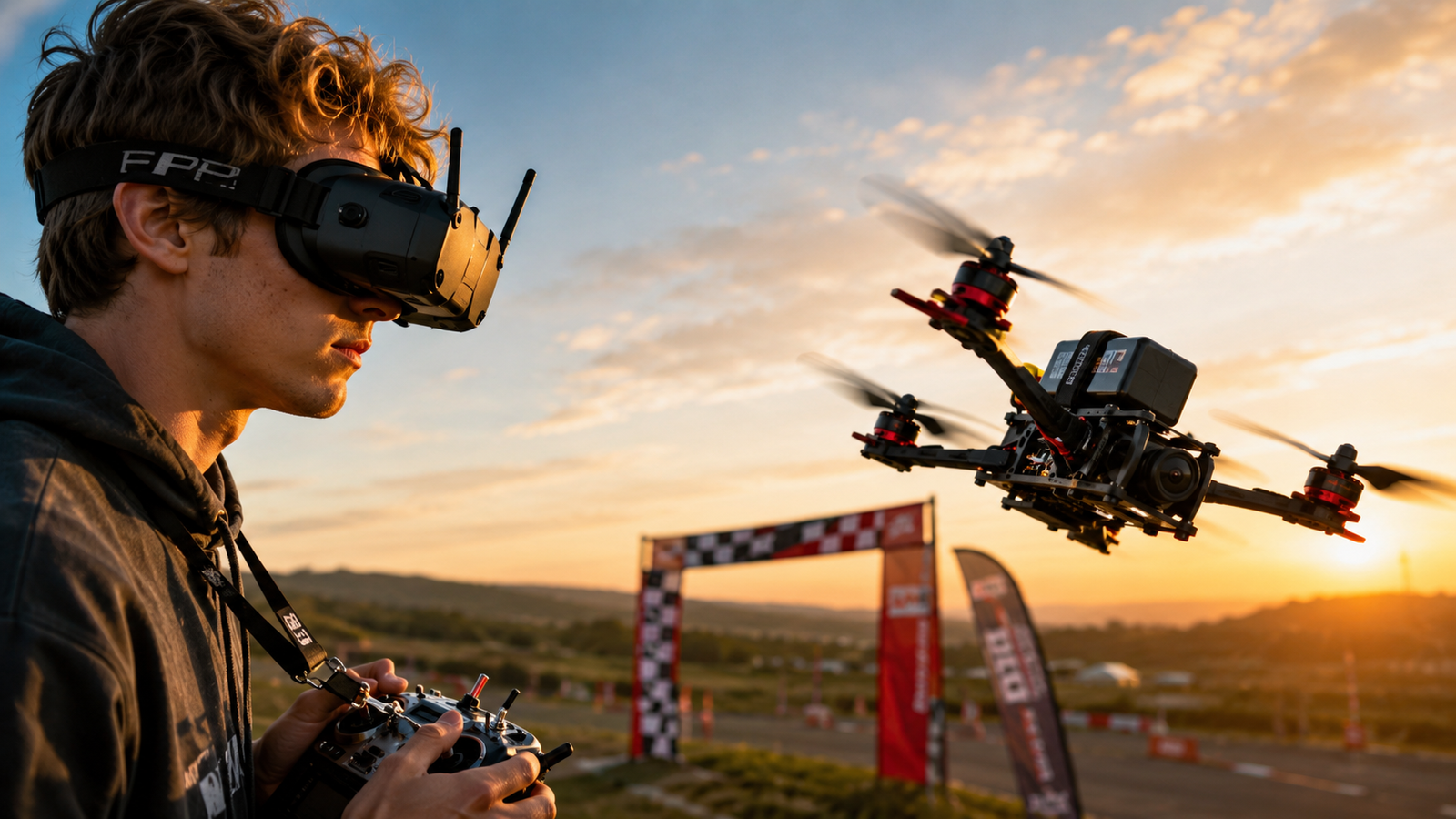
FPV (first-person view) drones stream live video to goggles so the pilot flies from the drone’s perspective. Sub-types include beginner kits, indoor tiny whoops, freestyle quads, cinewhoops, long-range builds, racing drones and ready-to-fly consumer FPV systems. They’re agile, fast and great for dynamic footage, but have a steeper learning curve, fewer automatic aids and more repairs.
Racing drones
A specialized branch of FPV, built for acceleration, instant response, low latency, light frames, agility and easy repairs. They don’t prioritize flight time, camera stabilization or the automatic modes of camera drones. Pilots race manually through marked courses with gates and obstacles.
Agricultural drones
Two main groups: monitoring drones capture RGB, thermal or multispectral images to assess crop health, spot stressed areas, map fields, track irrigation and count plants; application drones carry tanks and spraying or spreading systems. Monitoring drones can be multirotor, fixed-wing or hybrid; spraying drones are usually large multirotors that can fly slowly with heavy loads.
Mapping and surveying drones
They collect imagery and data to build orthomosaics, 3D models, point clouds, elevation maps, land measurements, construction progress reports and volume calculations, often with RTK or PPK for precise positioning. Multirotors suit small or complex sites; fixed-wings are more efficient over large areas.
Industrial and inspection drones
Used to inspect wind turbines, power lines, solar farms, buildings, roofs, bridges, construction sites and industrial plants. Depending on the job they carry zoom or thermal cameras, lights, gas sensors or LiDAR, plus dust and water protection and high-precision positioning. Their big benefit is reaching awkward places while reducing risk to workers.
Public safety and emergency drones
They give responders a fast aerial view for search and rescue, firefighting, accident assessment, hard-to-reach areas and damage evaluation, prioritizing reliability, live video, zoom, thermal imaging and the ability to fly in tough conditions.
Delivery and logistics drones
Designed to carry small packages and supplies between set points. Multirotors suit precise short-range drops; hybrid VTOL and fixed-wing designs are more efficient on longer routes. Payload, range, operational safety and airspace integration are the main challenges.
Recreational vs professional vs FPV drones
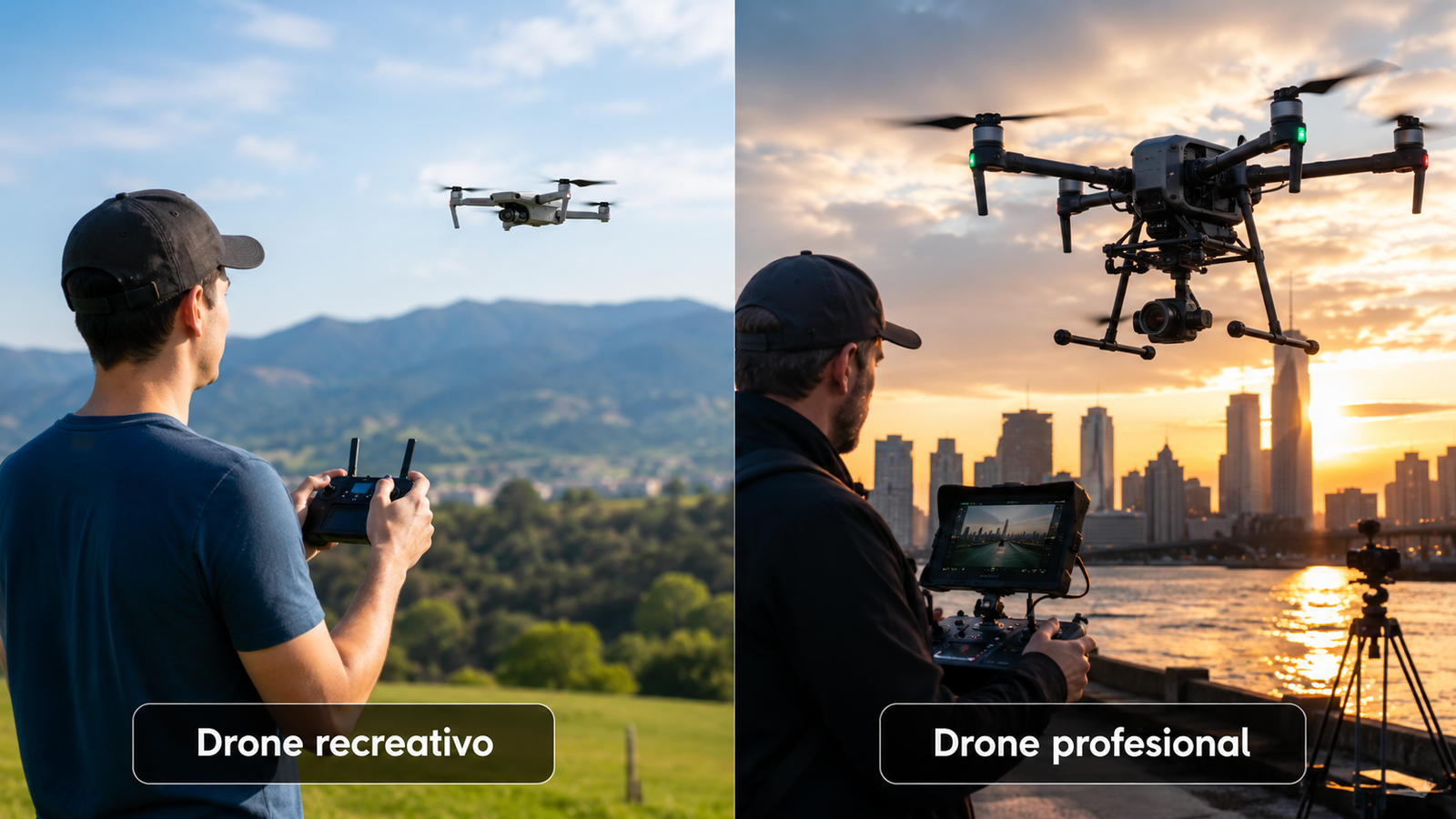
| Feature | Recreational | Professional | FPV |
|---|---|---|---|
| Goal | Fun and learning | Work and data collection | Immersive flying |
| Typical design | Multirotor | Multirotor, fixed-wing or VTOL | Multirotor |
| Ease for beginners | High | Medium | Low to medium |
| Automatic modes | Common | Advanced or specialized | Varies |
| Camera | Basic to mid-range | Professional or specialist | Flight camera, sometimes recording |
| Repairs | Limited | Specialist service | Often repairable part by part |
| Flight time | Medium | Depends on mission | Usually short |
| User | Beginner or hobbyist | Professional or business | Advanced hobbyist or specialist pilot |
These are typical orientations, not rigid categories: an FPV drone can be used professionally, and a recreational drone can have an excellent camera.
Which type of drone should you choose?
| Your need | Recommended type |
|---|---|
| Learning to fly | Recreational multirotor |
| Travel and filming | Compact camera multirotor |
| Photo and video | Camera drone with gimbal |
| Dynamic video | FPV or cinewhoop |
| Racing | FPV racing drone |
| Mapping a small site | Multirotor with a suitable camera |
| Covering large areas | Fixed-wing or hybrid VTOL |
| Inspecting a structure | Industrial multirotor |
| Precision agriculture | Agricultural monitoring drone |
| Spraying crops | Heavy-lift agricultural multirotor |
| Small package delivery | Multirotor or hybrid VTOL |
| High-end video work | Professional large-sensor camera drone |
Also weigh your experience, total budget, batteries and accessories, portability, spare parts, camera quality, real flight time, wind resistance, safety systems, software and the legal requirements for your flights. In the US, recreational flyers follow FAA recreational rules, while commercial work requires a Part 107 certificate.
Bottom line
Drones can be classified by design, piloting system, equipment or job. Multirotors excel at stability and hovering, fixed-wings at efficiently covering large areas, and hybrid VTOLs combine vertical takeoff with long-range flight. Once you know the right design, pick a category that fits your use: recreation, photography, racing, agriculture, mapping, inspection or professional work.
Types of drones FAQ
There’s no single number because drones can be classified in different ways. By design, the main types are multirotor, single-rotor, fixed-wing and hybrid VTOL. By use, the best-known categories are recreational, camera, professional, FPV, racing, agricultural and industrial drones.
The quadcopter, thanks to its stability, size, ease of control and vertical takeoff.
A multirotor uses several propellers, takes off vertically and can hover. A fixed-wing must keep moving forward to generate lift and is usually more efficient on long flights.
An aircraft that can take off and land vertically. Hybrid VTOL drones use rotors for takeoff and wings for efficient forward flight.
Not exactly. Racing drones are part of the FPV world, but FPV also includes freestyle, cinewhoops, long-range and beginner models.
A stable recreational quadcopter with assisted modes, available spare parts and a simple app.