
Disclosure: this article contains affiliate links. If you buy through them, Bright Technology may earn a small commission at no extra cost to you. As an Amazon Associate, we earn from qualifying purchases.
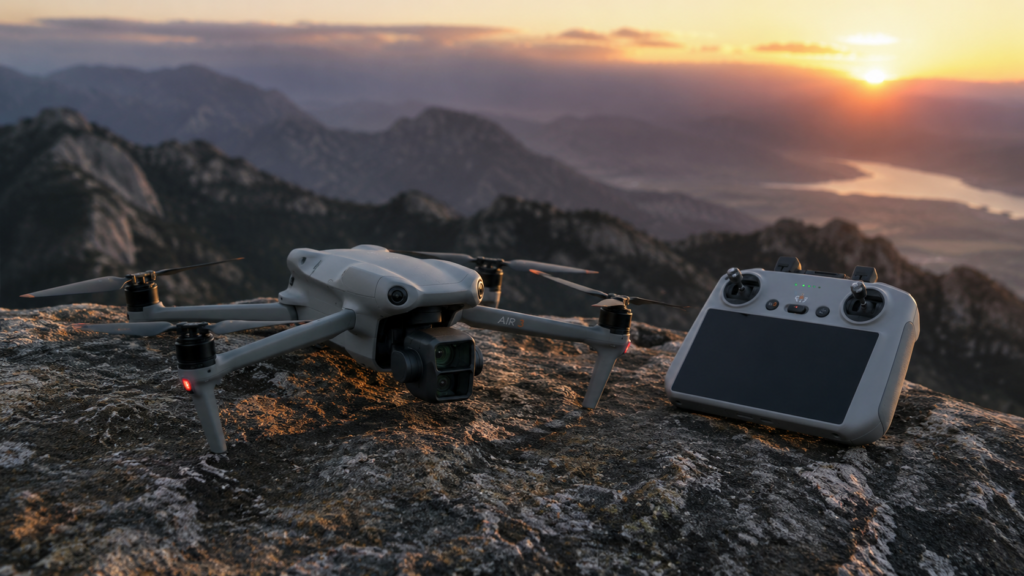
This DJI Air 3 review looks at DJI’s mid-range drone for creators who want more than the Mini series can offer. Its headline feature is a dual-camera system, a 48 MP wide camera plus a 70 mm medium telephoto, backed by up to 46 minutes of flight, omnidirectional obstacle sensing and DJI O4 transmission.
Quick answer: the DJI Air 3 is one of the best drones for serious photography and video without going full professional. The dual camera adds real creative flexibility, flight time is excellent and it’s more stable in wind than the Mini series. It’s heavier, bigger and pricier than a Mini 4 Pro, so it’s best for pilots who will fly often and want a drone to grow into.
DJI Air 3 at a glance
| Spec | DJI Air 3 |
|---|---|
| Weight | 720 g |
| Main camera | 48 MP wide-angle |
| Second camera | 70 mm medium telephoto |
| Video | 4K up to 100 fps on both cameras |
| Flight time | Up to 46 min (about 35–40 min real-world) |
| Obstacle sensing | Omnidirectional |
| Transmission | DJI O4 |
| Tracking | ActiveTrack 360° |
Key specs
- 720 g
- 48 MP wide camera
- 70 mm medium telephoto
- 4K up to 100 fps
- Up to 46 min flight
- Omnidirectional sensing
- DJI O4
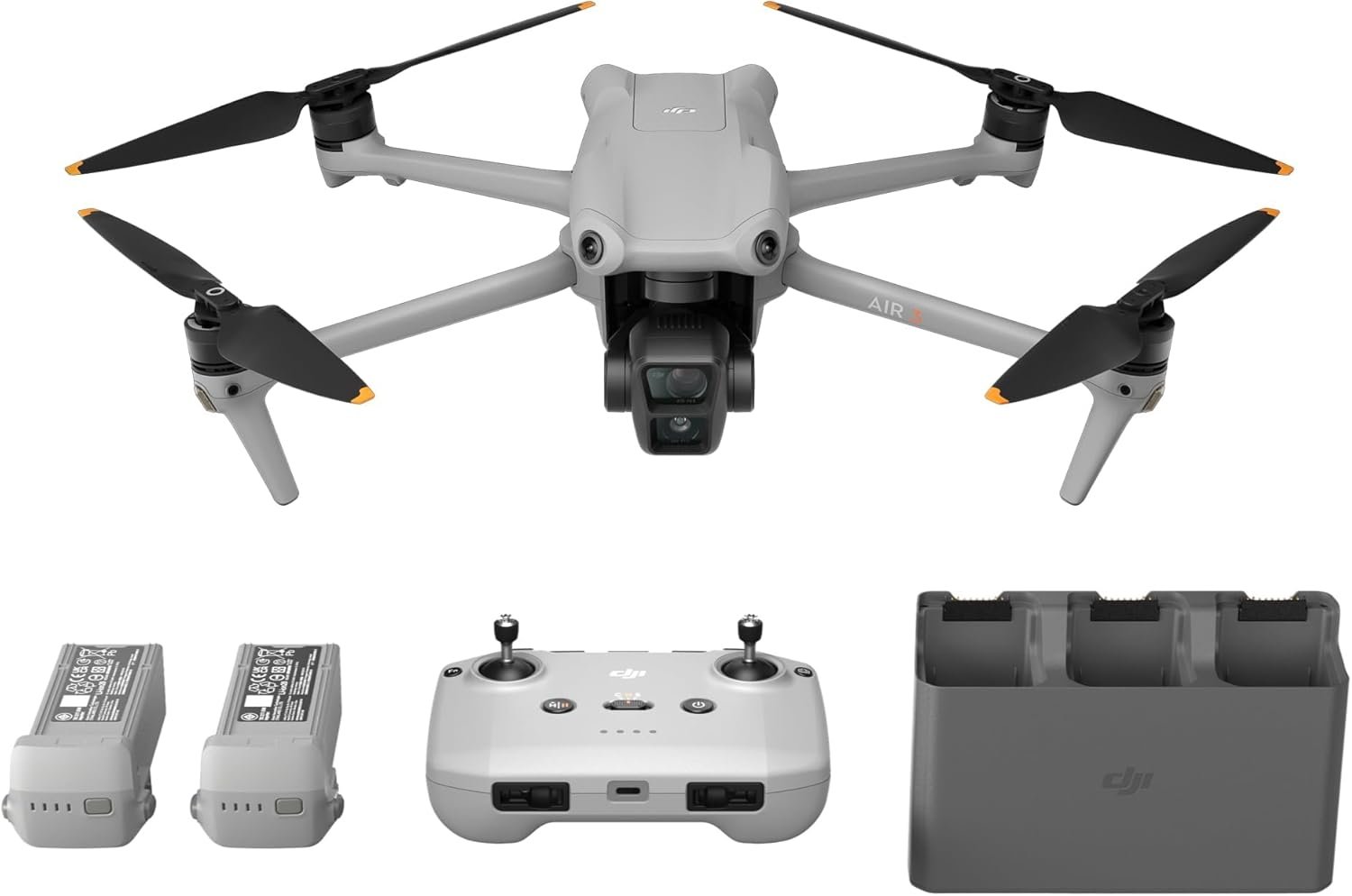
What’s in the box
- DJI Air 3
- DJI RC-N2 or DJI RC 2 controller
- One intelligent battery (Fly More Combo adds more)
- Gimbal protector
- Spare propellers
- Cables
- Documentation
Design and build
The Air 3 is a folding drone with excellent build quality. It’s noticeably larger and heavier than a Mini, so it needs a bigger bag, but it still travels well and feels robust in the hand.
Flight performance
Extra weight pays off in the air: the Air 3 is very stable, including in moderate wind, with smooth, precise control. Omnidirectional obstacle sensing and DJI’s advanced Return to Home add a strong safety net, and O4 transmission delivers a clear, reliable feed.
Photo quality
The 48 MP wide camera produces detailed, well-exposed images, while the 70 mm telephoto lets you compress perspective and isolate subjects, which is great for landscapes, architecture, real estate, tourism, events and nature. Having two focal lengths in one flight opens up compositions a single-camera drone can’t achieve.
Video quality
Both cameras record 4K at up to 100 fps, with D-Log M and HLG profiles for grading. The ability to switch between wide and telephoto mid-flight makes the Air 3 a strong tool for YouTube, ads and corporate video.
Smart features
- ActiveTrack 360°
- FocusTrack
- MasterShots
- QuickShots
- Hyperlapse
- Waypoint flight
- Cruise Control
- Advanced Return to Home
- QuickTransfer
Pros and cons
- Dual camera with 70 mm telephoto
- Excellent photo and video quality
- Up to 46 minutes of flight
- Stable in moderate wind
- Omnidirectional sensing
- Precise ActiveTrack 360°
- Excellent build quality
- Heavier than the Mini series
- Pricier than the Mini 4 Pro
- Accessories add up
- Takes more space
- Overkill for occasional flyers
Before you buy
- The dual camera is the real reason to choose it. If you won’t use the telephoto, a Mini 4 Pro may be enough.
- The Fly More Combo is the best investment. More batteries mean more time in the air.
- It’s built for pilots who want to progress.
At 720 g, the Air 3 must be registered with the FAA in the US, and recreational pilots need the free TRUST test; commercial work requires Part 107. DJI availability in the US can vary because of regulatory restrictions.
Bottom line
Buy the DJI Air 3 if you want high-end photo and video, a versatile dual camera, better wind stability and a drone ready for professional jobs that you’ll keep for years. Choose a Mini 4 Pro instead if you prioritize a sub-250 g, ultra-compact travel drone or will only fly occasionally.
DJI Air 3 FAQ
The Air 3 adds a second telephoto camera, longer flight time and better wind handling. The Mini 4 Pro is lighter (under 249 g) and easier to carry.
Yes, but it’s best suited to pilots with some experience or those who want one drone for many years.
DJI quotes up to 46 minutes; expect about 35–40 minutes depending on wind, temperature and flying style.
Yes, both cameras record 4K at up to 100 fps, with D-Log M and HLG profiles.
Yes. The dual camera, longer flight time and improved tracking are a major step forward.
In the US, yes: it weighs 720 g, so it must be registered with the FAA.