

AI for SEO means using artificial intelligence tools to research keywords, plan and write content, optimize pages and spot ranking opportunities faster than you could by hand. Used well, it multiplies what one person can do. Used badly, it floods a site with generic pages that never rank.
A few years ago, keyword research, competitor analysis, content briefs and audits could eat most of a working day. Today ChatGPT, Claude, Gemini and AI features inside classic SEO suites handle the repetitive parts in minutes, leaving you more time for strategy. This guide shows how to use AI for SEO step by step: keyword research, AI content for blogs, on-page optimization, the best tools and the mistakes to avoid. It also builds on our AI for marketing guide.
- What is AI for SEO?
- Why AI is changing SEO
- How AI is used in SEO today
- Benefits of using AI for SEO
- The best AI tools for SEO
- How to use AI for keyword research
- AI content for blogs: a simple SEO workflow
- How to create SEO content with AI
- Optimizing for AI Overviews and AI search
- What Google says about AI-generated content
- Mistakes to avoid when using AI for SEO
- The future of SEO with artificial intelligence
- Which AI tool for which SEO task?
- Bottom line
- AI for SEO FAQ
- Keep reading
Quick answer: AI can’t rank a website on its own, but it is now the fastest way to do keyword research, build content briefs, find semantic gaps and refresh old articles. Combine it with real expertise, Search Console data and human editing, and it becomes one of the most powerful tools in your SEO stack.
What is AI for SEO?
AI for SEO is the use of machine learning and large language models to speed up or improve search engine optimization tasks. In practice, these tools help you:
- Research keywords and group them into topics
- Analyze what top-ranking competitors cover
- Draft outlines, briefs and first drafts
- Optimize existing articles for intent and semantic coverage
- Write titles, meta descriptions and FAQs
- Automate repetitive tasks like classification and reporting
The key point: AI doesn’t replace SEO knowledge. It amplifies it. The people getting the best results pair solid SEO fundamentals with smart automation.
Why AI is changing SEO
Speed
Jobs that used to take hours, like building outlines, clustering keywords or doing a first pass on topic research, now take minutes.
Broader semantic coverage
Language models are good at surfacing synonyms, entities, related terms and long-tail questions, which helps you write more complete content that matches how people actually search.
Scalability
Blogs, niche sites, e-commerce stores and publishers that produce content constantly can plan and update far more pages with the same team.
Automation
Keyword classification, brief creation, internal-link suggestions and first-pass content reviews can all be partly automated.
How AI is used in SEO today
Keyword research
AI can expand a seed keyword into primary and secondary terms, long-tail variations, common questions and full topic clusters. It won’t give you reliable search volumes on its own, so validate its ideas with real data.
Content creation
This is the most popular use: outlines, drafts, expansions and semantic suggestions. Every draft still needs a human pass to add experience, examples and accuracy.
On-page optimization
Paste an existing article and ask the model to check headings, topic coverage, search intent and missing subtopics. It’s one of the quickest ways to improve pages that already get impressions.
Competitor analysis
AI speeds up the review of competing pages: their topics, structure, angles and gaps you can fill.
Benefits of using AI for SEO
- Time savings: less manual grunt work, more time for strategy.
- Higher output: one specialist can plan, write and refresh more content.
- Better topic coverage: articles answer more of the questions behind a query.
- Idea generation: AI is excellent at spotting new content angles.
- Process automation: repetitive steps scale without extra headcount.
The best AI tools for SEO
No single tool does everything. Some shine at writing, others at research or data analysis, so a modern SEO workflow usually combines several.
ChatGPT
ChatGPT is the most versatile option. It can build SEO outlines, generate content ideas, find related keywords, write FAQs, design topic silos, rewrite titles and meta descriptions, and analyze search intent.
Example prompt: Act as an SEO consultant. Analyze the keyword “AI for small business”. Give me primary keywords, secondary keywords, long-tail variations, FAQs and an H1–H3 outline. Prompts like this cut planning time dramatically. For more ready-made instructions, see our list of the best ChatGPT prompts.
Claude
Claude is particularly strong with long documents. It’s useful for reviewing long articles, spotting redundancy, improving clarity, and analyzing audits or SEO documentation, which is why many SEOs use it alongside ChatGPT.
Gemini
Gemini works well in the research phase: exploring a topic, spotting trends, investigating an industry and finding new content opportunities before you write.
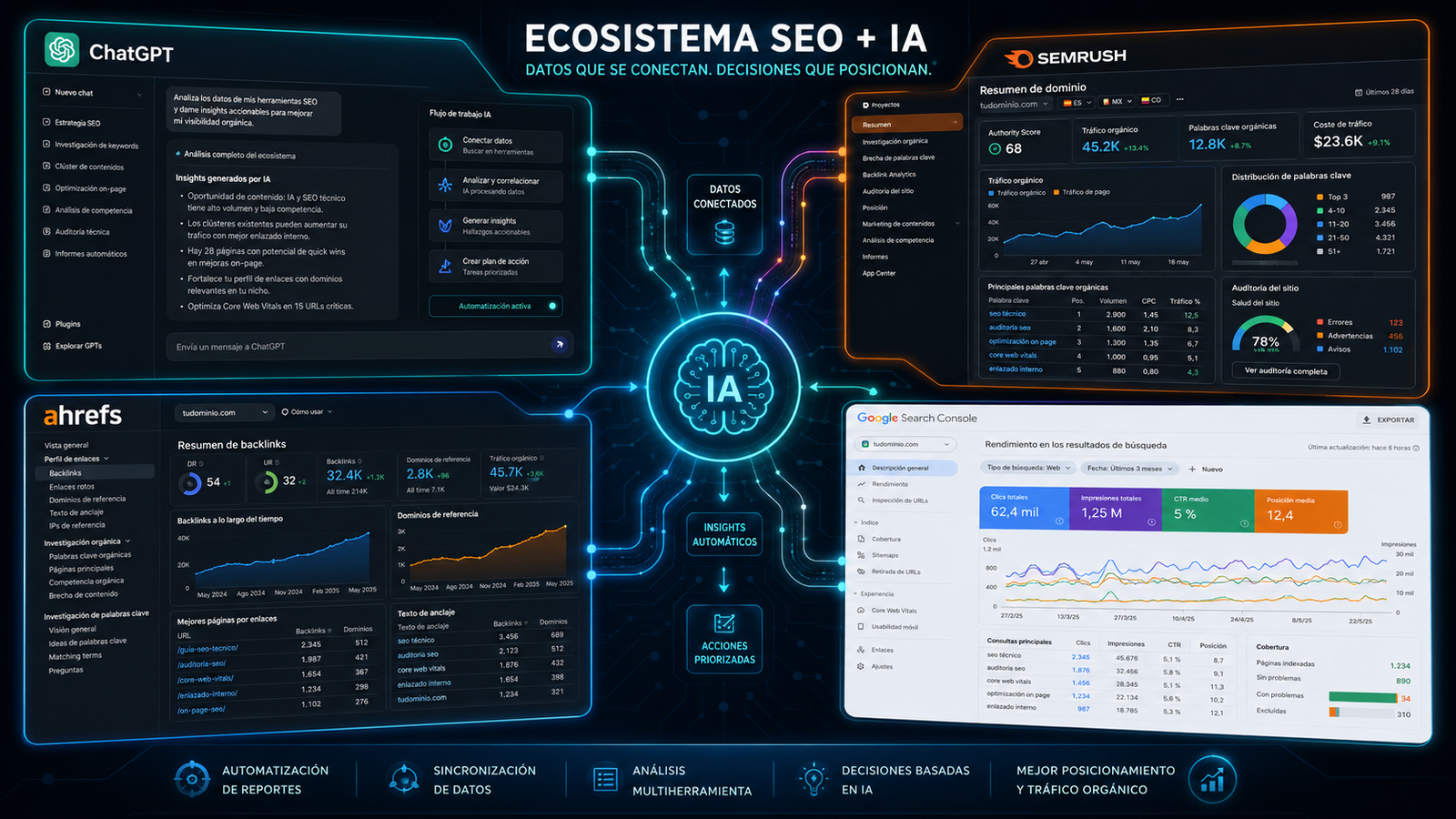
Semrush and Ahrefs with AI features
Classic SEO platforms now include AI features for keyword research, competitor analysis, clustering and opportunity detection. Combining real search data with AI is where these suites shine.
Google Search Console
The most overlooked tool of all. Export your queries and ask an AI model to find pages with high impressions but low clicks, keywords you rank for by accident and topics worth a new article. It’s free and it’s your own data.
How to use AI for keyword research
Find secondary keywords
From one main keyword, generate variants, synonyms, entities and long-tail phrases to broaden your topic coverage.
Uncover real questions
AI is good at listing the questions people ask about a topic, which feeds FAQ sections, featured snippet targets and conversational searches.
Build topic clusters
This is one of the most powerful uses. For a pillar like artificial intelligence, a cluster could include: what AI is, types of AI, generative AI, AI for business, AI for SEO and AI automation. Each becomes its own article, all linked to the pillar. That is the structure behind our own artificial intelligence guide.

AI content for blogs: a simple SEO workflow
Blog writers search for “AI blog SEO” and “AI content SEO” because they want speed without losing rankings. The workflow that works is short:
- Pick one keyword and one intent. Check what the top results actually are (guide, list, product page) before you write.
- Ask AI for the outline, not the finished article. Compare it with the headings of the top pages and fill the gaps.
- Write or edit with real input. Add first-hand experience, examples, screenshots and data AI can’t invent.
- Optimize titles, meta descriptions and FAQs. AI is excellent at producing several options to choose from.
- Refresh old posts. Use Search Console data to find pages with impressions but low clicks and update them.
Done this way, AI content optimization is about better editing, not about publishing more pages.
How to create SEO content with AI
There is a big difference between generating text automatically and using AI to create genuinely useful, optimized content. The second follows a process:
- Research: collect key concepts, entities, keywords and questions.
- Structure: draft the H1, H2s, H3s and FAQ before writing a word.
- Assisted writing: use AI for drafts, then add your experience, data and examples.
- Semantic optimization: ask the model which concepts, synonyms or entities are missing.
- Human review: fact-check every claim, number and product detail before publishing.
Optimizing for AI Overviews and AI search
Search is no longer just ten blue links. Google’s AI Overviews and chat-style assistants now summarize answers directly. The same principles that help you rank also help you get cited there:
- Answer the main question clearly in the first paragraphs.
- Use descriptive headings that mirror real questions.
- Add concise definitions, lists and tables that are easy to quote.
- Show real expertise and keep facts up to date.
- Mark up FAQs and keep pages technically clean so they can be crawled.
What Google says about AI-generated content
Google has said that it rewards helpful, reliable, people-first content however it is produced. Using AI is not against its guidelines; using automation to mass-produce pages mainly to manipulate rankings is treated as spam. In practice, that means AI-assisted articles can rank if they are accurate, original and written for the reader, and thin, repetitive pages will not.
Because of this, keep your focus on experience, expertise and trust. Add author information, cite real sources and update facts. Our guide to AI automation shows which repetitive tasks are safe to automate.
Mistakes to avoid when using AI for SEO
Publishing without review
The most common error. Every AI-generated piece must be reviewed, fact-checked and enriched before it goes live.
Creating generic content
Search engines increasingly reward experience, originality and usefulness. If your article says what every other AI-written page says, it has no reason to rank.
Ignoring search intent
Stuffing keywords isn’t enough. The page has to answer exactly what the searcher wants.
Trusting AI numbers
Language models can invent search volumes, rankings and statistics. Verify every figure with Search Console, Semrush, Ahrefs or another real data source.
Over-automating
Automation is useful, but strategy is still human. The best projects combine SEO knowledge, AI, real experience and industry expertise.

The future of SEO with artificial intelligence
AI and SEO will keep converging. Expect tools that analyze content automatically, surface opportunities, build topic strategies and optimize pages with less manual effort.
The paradox is that the easier generic content becomes to produce, the more experience, authority, credibility and specialization matter. Sites that combine AI with real expertise will keep a clear competitive edge.
Which AI tool for which SEO task?
| Task | Good fit | Watch out for |
|---|---|---|
| Outlines, FAQs, titles and meta descriptions | ChatGPT | Generic phrasing; edit for your voice |
| Long articles, audits and redundancy checks | Claude | Still needs fact-checking |
| Topic research and trends | Gemini | Verify sources it cites |
| Search volume, difficulty and competitors | Semrush, Ahrefs | Paid plans; AI features vary by plan |
| Finding quick wins in your own data | Google Search Console + AI | Export clean data before analysis |
| Technical crawling | Screaming Frog | AI can’t replace a real crawler |
To compare more assistants beyond SEO, see our roundup of the best AI tools.
Bottom line
AI for SEO is now one of the most valuable tools in any search marketer’s kit. It speeds up research, reveals opportunities and improves content in ways that were impractical a few years ago. ChatGPT, Claude, Gemini, AI-powered SEO suites and Search Console data are reshaping how strategy is planned and executed.
The advantage isn’t using AI. It’s using it better than everyone else: combining automation, real data, hands-on experience and quality content. AI doesn’t replace SEO; it makes good SEO faster.
AI for SEO FAQ
Using artificial intelligence tools to improve search engine optimization tasks: keyword research, content creation, competitor analysis, on-page optimization and automation of repetitive work. The goal is higher productivity and better content, not replacing SEO expertise.
No. AI helps you create and optimize content faster, but rankings still depend on content quality, expertise, site authority, links, user experience and matching search intent. Treat AI as a support tool, not a magic button.
Yes. It’s one of the most widely used SEO tools for generating ideas, outlines, related keywords, drafts, FAQs and topic clusters. Always review and enrich what it produces.
Google doesn’t penalize content just because AI helped create it. It evaluates quality. Helpful, accurate content that satisfies search intent can rank no matter how it was produced, while low-value mass-produced pages can be demoted.
Popular choices include ChatGPT, Claude and Gemini for research and writing, Semrush and Ahrefs for data-driven keyword and competitor work, Screaming Frog for technical audits and Google Search Console for your own performance data.
It can help a lot by reviewing content, structure and semantic gaps. Technical audits still need specialized crawlers and an expert to interpret the results.
Give the model one seed keyword and ask for variations, long-tail phrases, questions and topic clusters. Then validate volume and difficulty in a real SEO tool and in Search Console, because AI can’t be trusted for exact numbers.
Not by itself. Unreviewed, generic, mass-produced AI text tends to perform poorly. AI-assisted content that is accurate, original and edited by a person can perform well.
No. AI speeds up research, drafting and analysis, but strategy, judgment, original experience and technical know-how are still human work.
Answer the question clearly near the top, use descriptive headings, add short lists and tables, keep facts current and show real expertise. The same quality signals that help you rank also help you get cited.