

Disclosure: this article contains affiliate links. If you buy through them, Bright Technology may earn a small commission at no extra cost to you. As an Amazon Associate, we earn from qualifying purchases.
AI smart glasses are no longer a lab experiment. In the US you can now buy glasses that take photos, record 3K video, play music, translate conversations and answer questions about what you are looking at, all hands-free. Some even put a small display in front of your eye. The lineup is confusing, though, and the right pick depends on whether you want a camera, a display, sports features or the lowest price.
This guide compares the AI glasses you can buy in the US in October 2026, with list prices in dollars, what the AI actually does, who each model suits and what to know about privacy before you record other people. If the jargon is new, start with our explainer on what artificial intelligence is.
- Best AI smart glasses compared (US prices, October 2026)
- What can AI glasses do?
- 1. Ray-Ban Meta (Gen 3): best AI glasses for most people
- 2. Ray-Ban Meta (Gen 2): classic style, lower price
- 3. Meta Adventurer: the cheapest AI glasses with a camera
- 4. Oakley Meta Vanguard: best AI glasses for cycling and running
- 5. Oakley Meta HSTN: sporty everyday AI glasses
- 6. Even Realities G2: AI glasses with a display and no camera
- 7. Meta Ray-Ban Display: the high-end option with a wristband
- Other options: Xreal, Samsung and audio-only glasses
- AI glasses privacy in the US: what to know before you record
- Which AI glasses should you choose?
- AI smart glasses FAQ
- Keep reading
Quick answer: For most people in the US, the best AI glasses are the Ray-Ban Meta (Gen 3), starting at $449: up to 9 hours of battery, a 12 MP camera, 3K video and six microphones. On a tighter budget, the Meta Adventurer starts at $299 (and $249 in a new plug-in-case version). For sports, pick the Oakley Meta Vanguard ($499). If you want a display and no camera, the Even Realities G2 costs $599. The Meta Ray-Ban Display launched at $799 with a color display and a wristband, but it is a different, more expensive category.
Best AI smart glasses compared (US prices, October 2026)
Prices are US list prices at launch. Final prices vary by frame, lens type and retailer, so confirm on the product page before you buy.
| Model | US price (from) | Camera | Display | Battery (claimed) | Best for |
|---|---|---|---|---|---|
| Ray-Ban Meta (Gen 3) | $449 | 12 MP, 3K video | No | Up to 9 h (about 50 h with case) | Most people |
| Ray-Ban Meta (Gen 2) | $379 at launch | 12 MP, 3K video | No | Up to 8 h (about 48 h with case) | Classic Ray-Ban looks for less |
| Meta Adventurer (Meta Glasses) | $299; $249 plug-in-case version | 12 MP, 3K video | No | 8 h (+40 h with the standard case) | Lowest price with a camera |
| Oakley Meta Vanguard | $499 | 12 MP ultrawide, 3K video | No | Up to 9 h | Cycling and running |
| Oakley Meta HSTN | $399 | 12 MP, 3K video | No | Up to 8 h | Everyday sporty style |
| Even Realities G2 | $599 (R1 ring $249) | None | Yes (monochrome green) | About 2 days | Meetings, privacy |
| Meta Ray-Ban Display | $799 at launch, with Neural Band | 12 MP, 3x zoom | Yes (full color) | Up to 6 h (about 30 h with case) | Early adopters |
What can AI glasses do?
Most AI smart glasses combine a camera, microphones, open-ear speakers and a voice assistant built on generative AI. You say “Hey Meta” and the assistant answers in your ear. Typical uses:
- Capture hands-free: photos and video without taking out your phone.
- Ask about what you see: identify a landmark, read a menu or get help with a recipe.
- Live translation: conversations translated through the speakers.
- Calls and music: open-ear audio, so you still hear traffic.
- Fitness: on the Oakley models, heart-rate and pace queries by voice and Garmin or Strava integration.
Models with a display, such as the Even G2 and the Meta Ray-Ban Display, add captions, notifications and prompts in front of your eyes. Camera glasses without a screen are lighter and cheaper, but everything arrives as audio. Features roll out in phases, so check the Meta AI app first.
1. Ray-Ban Meta (Gen 3): best AI glasses for most people
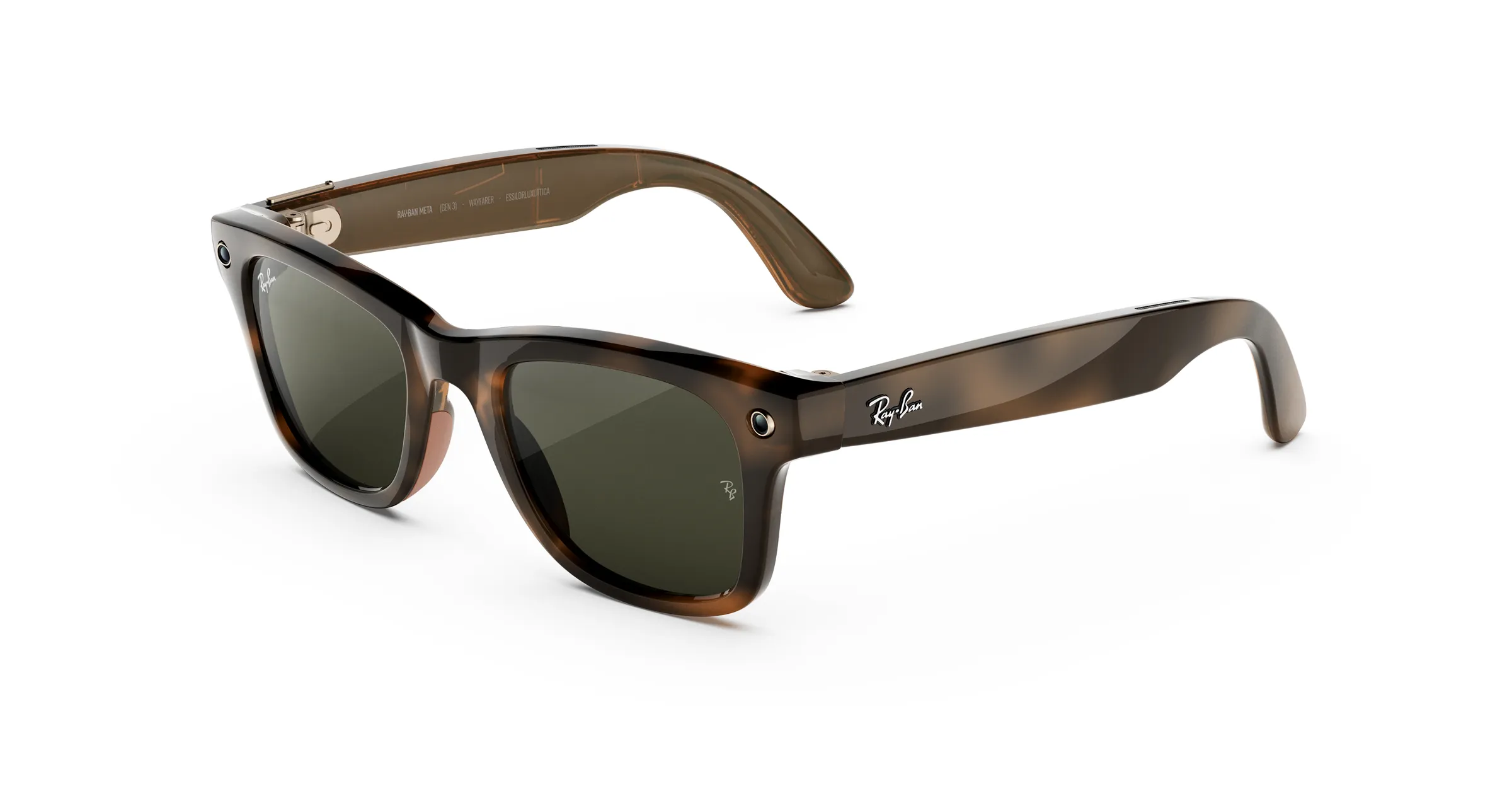
Meta announced the Gen 3 in September 2026 at $449. The design is slimmer, there are six microphones instead of five for better noise reduction, and a new action button can summon Meta AI or act as a shortcut. Video stays at 3K from a 12 MP camera, and Meta says Dolby Atmos capture and playback will arrive in a later update.
Styles are Wayfarer, Aviator and a new cat-eye frame called Zena, with clear, sunglass, polarized, Transitions and prescription options. Battery is rated up to 9 hours, with the case adding roughly 50 hours in total.
- Up to 9 hours of rated battery, one more than Gen 2
- 12 MP camera and 3K video
- Configurable action button and six-mic array
- Regular Ray-Ban looks, prescription options
- No display: information arrives by audio
- Transitions and prescription lenses raise the price
2. Ray-Ban Meta (Gen 2): classic style, lower price
The Gen 2 is still on sale and launched at $379, about $70 less than the Gen 3. It has the same 12 MP camera and 3K video, up to 8 hours of battery and a case that adds about 48 hours. Most new software features are also coming to the Gen 2.
Frames are Wayfarer, Skyler and Headliner. Best for: buyers who want the Ray-Ban look and do not need the extra hour of battery or the action button.
- Same 12 MP camera and 3K video as Gen 3
- Case adds about 48 hours of charge
- Skyler and Headliner styles
- Only about $70 cheaper than Gen 3 at list price
- One hour less battery
- No configurable action button
3. Meta Adventurer: the cheapest AI glasses with a camera
In June 2026 Meta launched its own Meta Glasses line without the Ray-Ban brand. The Adventurer and Fury start at $299, and the Kylie Jenner-designed Starfire at $399. All include a 12 MP camera with a 100-degree field of view, video at 1080p/60 or 3K/30, about 8 hours of battery and an extra 40 hours from the charging case.
In late September 2026 Meta added a cheaper Adventurer at $249. It has a black frame with gray lenses and ships with a plug-in case that has no battery, so you must plug the case in to recharge the glasses. It was set to release October 23.
- Lowest price with camera and Meta AI: $299, or $249 with the plug-in case
- 12 MP camera and 3K video
- Customizable action button and adjustable temple tips
- Generic design without the Ray-Ban name
- The $249 version has no battery in the case
4. Oakley Meta Vanguard: best AI glasses for cycling and running
The Vanguard is built for outdoor sports. It is rated IP67 for dust and water (the HSTN is only IPX4), claims up to 9 hours of battery and shoots 12 MP ultrawide photos and 3K video. Its main selling point is integration with Garmin and Strava through the Meta AI app, so you can ask for your heart rate by voice and sync workout data.
The list price at launch was $499. Android Central notes that it does not offer prescription lenses.

- IP67 dust and water protection
- Garmin and Strava integration
- Up to 9 hours of battery
- Wraparound fit that stays put
- Bold wraparound look that is less discreet off the bike
- Most expensive Meta glasses without a display
- No prescription lens option
5. Oakley Meta HSTN: sporty everyday AI glasses
The HSTN is Oakley’s everyday version, with the same 12 MP camera and 3K video as the Ray-Ban Meta Gen 2, up to 8 hours of battery and IPX4 splash resistance. It uses Prizm lenses, with Transitions and prescription options. Launch list price was $399.
- Sporty Oakley style that works day to day
- 12 MP camera and 3K video
- Prizm lens options
- IPX4 only: not for heavy rain or water sports
- No Garmin or Strava integration
- Costs more than a Gen 2 with similar hardware
6. Even Realities G2: AI glasses with a display and no camera
The Even Realities G2 takes the opposite approach from Meta: a display, but no camera or speakers. The text appears in green on a micro-LED display, the glasses weigh 36 grams and the maker claims about two days of use. They are rated IP65 and support prescriptions from -12 to +12.
The AI is aimed at work. Even AI answers prompts, Conversate gives live talking points and summaries during conversations, and there are translation, a teleprompter, navigation and a dashboard for notifications and meetings. The G2 costs $599, and the optional R1 control ring costs $249.

- No camera, so fewer privacy worries
- Captions, translation and teleprompter on the lens
- Light at 36 g with long battery life
- Wide prescription range
- No photos or video
- Monochrome green display
- $599 plus $249 for the ring
7. Meta Ray-Ban Display: the high-end option with a wristband
The Meta Ray-Ban Display is Meta’s most advanced pair: a full-color display in the right lens and the Meta Neural Band, a wristband that reads small finger gestures. It launched in the US on September 30, 2025 at $799 including the band, with a 600 by 600 pixel display, a 12 MP camera with 3x zoom, up to 6 hours of battery and about 30 hours with the case.
At Connect in September 2026 Meta added cycling and transit directions (US and Canada), landmark-based navigation, a US-only calendar app and a Holograms avatar for WhatsApp calls in US early access. You can now order online instead of booking an in-store demo. The UK and Canada got the glasses too, and France, Italy and Germany from October 13, 2026.
I could not confirm whether the US list price has changed since launch, so check Meta’s page before ordering. Prescription support is limited (about -4.0 to +4.0 at launch).
- Only Meta glasses with a full-color display
- Neural Band gesture control
- Captions, navigation and messages in the lens
- Highest price among Meta’s lineup
- Narrow prescription range
- Several features limited to select cities or US-only
Other options: Xreal, Samsung and audio-only glasses
Xreal One Pro and Xreal Aura
The Xreal One Pro is a different category: micro-OLED display glasses for watching your phone, laptop or console on a giant virtual screen. They are not AI assistants and have no camera by default, and I could not verify a current US price. The newer Xreal Aura runs Android XR with Gemini and starts at $1,279. Preorders opened in October 2026 for reservation holders; first shipments go to the US, Canada, Japan and South Korea.
Samsung Android XR glasses and Ray-Ban Meta Audio
Samsung has been reported to plan Android XR glasses with a camera and Gemini, but I could not verify a US price or release date, so treat them as unconfirmed. If you live in Gemini, it may be worth waiting; see our comparison of ChatGPT, Claude and Gemini.
Ray-Ban Meta Audio glasses have no camera and are rated for about 12 hours of music, but I could not confirm their current US price or availability.
AI glasses privacy in the US: what to know before you record
Wearing a camera on your face is legal in the US, but how you use it is governed by a patchwork of state laws. This is general information, not legal advice.
- Audio is the risky part. Most states are one-party consent, meaning you can record a conversation you are part of. About a dozen states, including California, Florida, Illinois, Pennsylvania and Washington, require everyone’s consent to record private conversations. When in doubt, ask.
- Video in public is usually fine, where people have no reasonable expectation of privacy. It is not fine in bathrooms, locker rooms, changing areas or someone’s home, where voyeurism and wiretap laws can apply.
- Check venue rules. Hospitals, schools, gyms, courthouses, workplaces and concerts often ban recording.
- Do not rely on the LED alone. Meta glasses show a capture light, but people may not notice or understand it. Never cover or tamper with it, and say out loud when you are recording.
- Publishing is a separate step. Posting a clip of a private person or a child can raise publicity or harassment issues even if the recording was legal.
- Review settings. Glasses can collect location and usage data. Turn off what you do not need in the Meta AI app.
Meta has reportedly studied a facial-recognition feature; it has not launched. Rules in the EU and UK are stricter than in most US states, so if you travel with camera glasses, expect tighter limits on recording people there. If privacy is your main concern, camera-free glasses like the Even G2 remove the issue.

Which AI glasses should you choose?
- Best overall, no display: Ray-Ban Meta (Gen 3), from $449.
- Lowest price: Meta Adventurer, $299 or $249 with the plug-in case.
- Prefer Skyler or Headliner frames: Ray-Ban Meta (Gen 2).
- Cycling or running: Oakley Meta Vanguard, $499.
- Sporty look for daily wear: Oakley Meta HSTN, $399.
- Meetings, presentations or no camera: Even Realities G2, $599.
- Color display and gesture control: Meta Ray-Ban Display, $799 at launch.
To get more from AI beyond glasses, browse our picks of the best AI tools and these applications of artificial intelligence in everyday life.
AI smart glasses FAQ
For most people in the US, the Ray-Ban Meta (Gen 3), starting at $449, with up to 9 hours of battery, a 12 MP camera and 3K video. For a lower price, the Meta Adventurer starts at $299 ($249 with a plug-in case). For sports, the Oakley Meta Vanguard is $499.
Meta camera glasses range from about $249 to $499 at list price. The Even Realities G2 is $599 and the Meta Ray-Ban Display launched at $799 with its Neural Band. Transitions and prescription lenses cost extra.
Yes. They launched in the US on September 30, 2025 at $799 including the Neural Band, and Meta has since allowed online ordering. Check Meta’s site for the current price and any fitting requirements.
Not fully. Meta glasses are set up and updated through the Meta AI app and rely on your phone’s connection for the assistant, and the Even G2 depends on the Even Realities app. Most AI features need the phone.
Mostly yes. Ray-Ban Meta, the Oakley HSTN and Meta Glasses support prescription lenses, the Even G2 covers -12 to +12, and the Meta Ray-Ban Display supports a narrower range. The Oakley Meta Vanguard reportedly has no prescription option.
Generally yes in public, but laws vary by state. Audio recording is the main risk: about a dozen states require all parties to consent. Never record in bathrooms, locker rooms or changing areas, and follow venue rules.
Meta’s camera glasses have an LED that signals when you capture photos or video. It is not a substitute for telling people you are recording, and you should not cover it.
The Gen 3 adds one hour of battery (up to 9 vs 8), six microphones instead of five, a configurable action button and a slimmer design, for about $70 more. Camera quality and 3K video are the same.
The Oakley Meta Vanguard: IP67 water and dust resistance, up to 9 hours of battery and Garmin and Strava integration. The HSTN is lighter on features and rated only IPX4.
They are if you often capture photos or video hands-free or want audio and translation without earbuds. If not, a cheaper pair or waiting for the next generation is reasonable.
Keep reading
- ChatGPT Prompts: The Best Examples to Save Time
- AI Automation: How to Save Time and Boost Productivity
- How to Use ChatGPT Step by Step: A Complete Beginner’s Guide
- AI Image Generators: The Best Tools and How to Use Them
Official sources: Meta AI glasses · Even Realities