
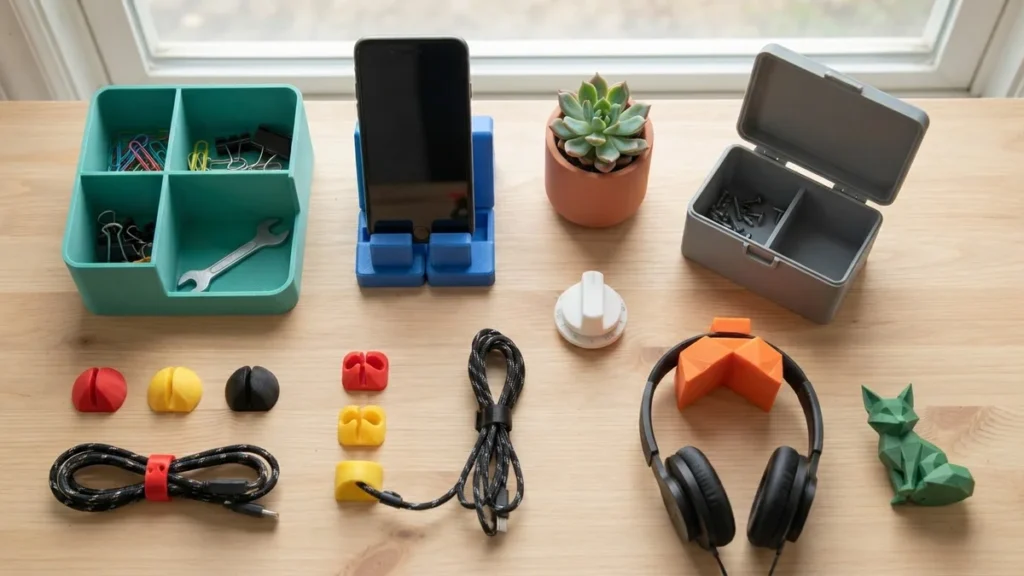
Finding useful things to 3D print is the question that arrives right after your first test boat: the printer works, but what now? This guide gives you more than 30 practical ideas sorted by category, with the best material for each, how hard it is and the mistakes that turn a good idea into a part that breaks within a week.
- The 15 best ideas to start with
- Ideas for home and organization
- Ideas for your desk and tech
- Ideas for kitchen and garden
- Gifts and personalized ideas
- Games, hobbies and kids
- Repairs and custom parts
- Upgrades for your own printer
- Basic settings so functional parts last
- Where to find models to print
- Learning to design your own parts
- Common mistakes when choosing what to print
- What to print based on your situation
- Frequently asked questions
- Keep reading
Quick answer: start with small objects that solve a problem at home: drawer organizers, hooks, cable clips, phone stands and replacement knobs. They print fast, use little filament and teach you to tune your printer. Then move on to custom parts, personalized gifts and bigger projects.
The 15 best ideas to start with
This table collects the ideas with the best balance of usefulness and ease. All of them are available as free models and work on any home filament printer.
| Idea | Material | Difficulty | Why it is worth it |
|---|---|---|---|
| Modular drawer organizer | PLA | Easy | Fits your drawer exactly |
| Cable clips and channels | PLA or PETG | Easy | Tidies a desk in minutes |
| Phone or tablet stand | PLA | Easy | Set the angle you like |
| Wall or closet hooks | PETG | Easy | Replace store hooks for pennies |
| Replacement knobs and pulls | PETG | Medium | Fix furniture without replacing it |
| Planter with saucer | PETG | Easy | Handles moisture better than PLA |
| Headphone stand | PLA | Medium | Frees up desk space |
| Box with printed hinge | PLA | Medium | Teaches tolerances and moving parts |
| Door stops | TPU | Easy | Flexible material will not scratch floors |
| Corner guards | TPU | Easy | Handy with small children around |
| Custom keychains | PLA | Easy | Quick gift with a name or initials |
| Board game inserts | PLA | Medium | Organize pieces and speed up setup |
| Tool holder | PETG | Medium | Every tool in its place |
| Cookie cutter | PLA | Easy | Short use only, washed well |
| Articulated figure | PLA | Medium | Prints in one piece with moving joints |
Ideas for home and organization
This is where a 3D printer pays for itself fastest. Almost anything you buy to organize your home can be printed to size.
- Modular drawer organizers: measure the drawer and pick a grid-based system to combine pieces.
- Adhesive or screw-on hooks for keys, towels or bags.
- Broom and mop holders for the cleaning closet.
- Shelf and closet dividers.
- Door stops and corner guards in TPU.
- Router or power strip mounts under the desk.
- Raised labels for storage boxes and jars.
Ideas for your desk and tech
Desk accessories are perfect for practice: small parts, short prints and something useful from day one.
- Phone or tablet stand at your preferred angle.
- Headphone stand that clamps to the desk edge.
- Cable clips and channels.
- Controller stand for a console or TV remote.
- Folding laptop riser.
- Replacement keys or caps for remotes and peripherals, if you find the exact model.
- Enclosures for electronics boards if you like to tinker.
Ideas for kitchen and garden
Think about the material before the design here. Moisture, sun and heat ruin PLA much sooner than you might expect.
- Planters and saucers in PETG, which copes better with water and sun.
- Plant and garden labels.
- Bag clips for food.
- Spice racks and cutlery drawer organizers.
- Cookie cutters for occasional use.
- Drip irrigation fittings and hose holders.
Be careful with anything that touches food: printed layers leave gaps where bacteria build up, and not every filament or nozzle is food-safe. For brief contact, wash the part well; for daily use, buy a commercial product.
Gifts and personalized ideas
What sets a printed gift apart is personalization. Adding a name, a date or a special shape takes minutes in free design software.
- Name keychains or initials.
- Lithophane lamps that reveal a photo when lit.
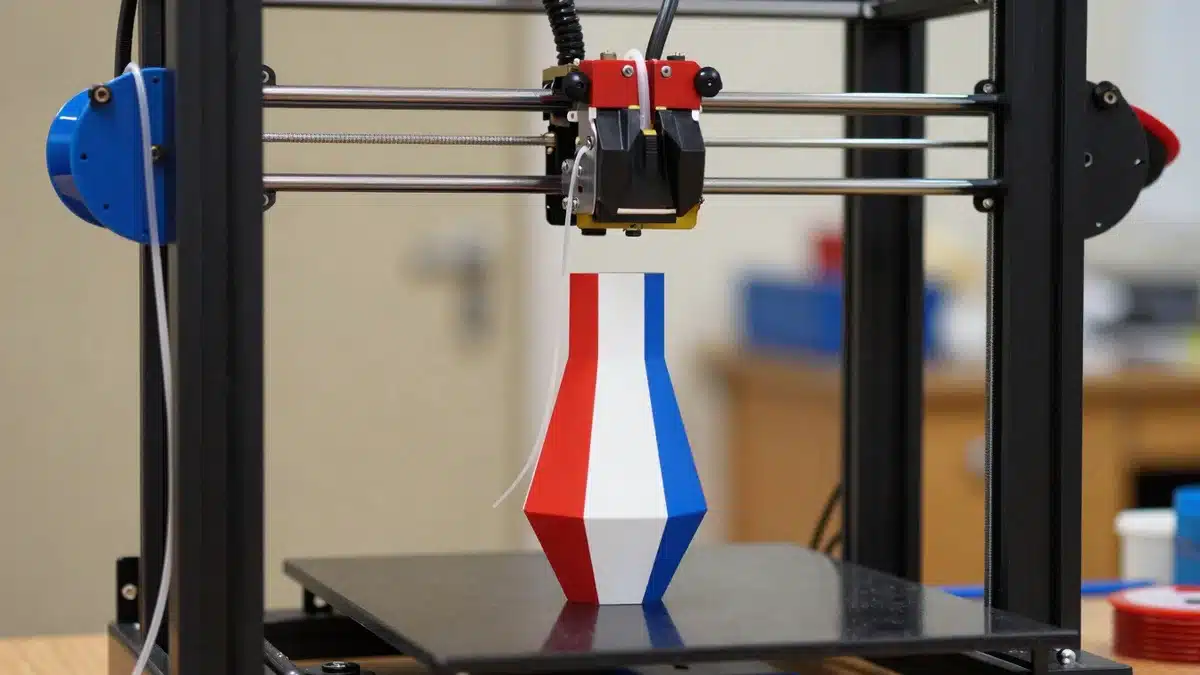
- Spiral-mode vases, very decorative and fast.
- Photo frames and desk photo holders.
- Figures and busts of characters or pets.
- Holiday ornaments and seasonal decor.
Games, hobbies and kids
- Board game inserts to organize tokens and cards.
- Miniatures and terrain for tabletop games and modeling.
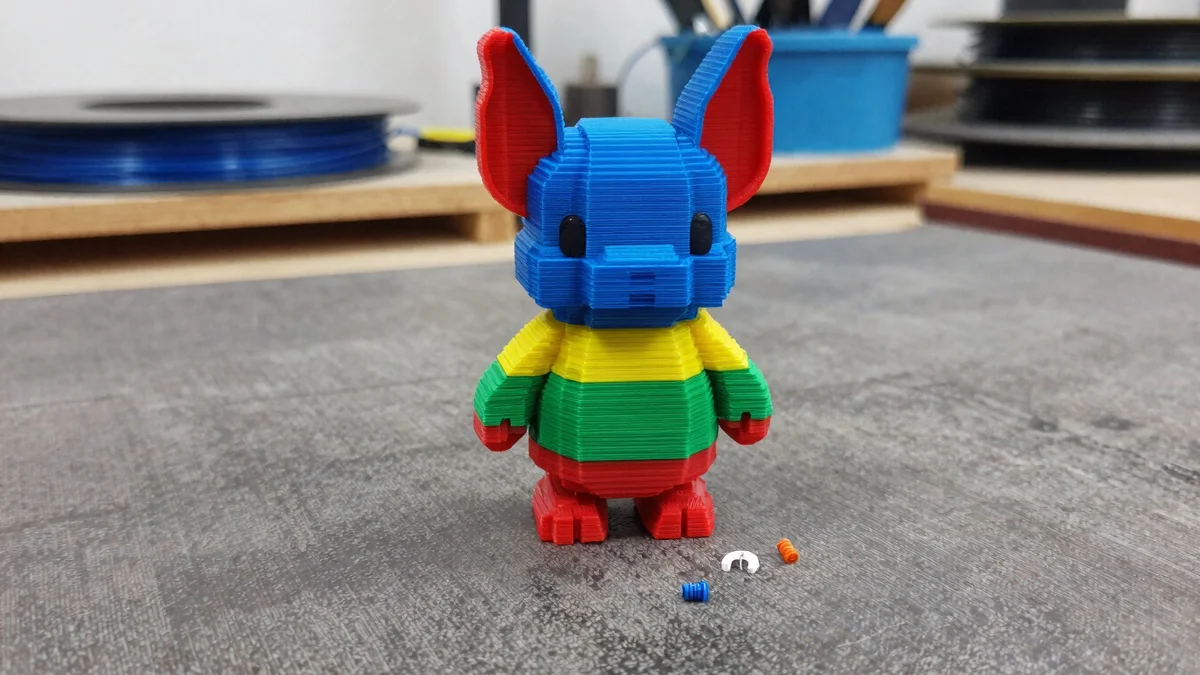
- Toys with moving parts, such as articulated figures or gears.
- Mechanical puzzles and brain teasers.
- Educational models: relief maps, geometric solids or molecule models.
For highly detailed miniatures, resin printing beats filament. If that interests you, see our guide to the best 3D printer for miniatures.
Repairs and custom parts
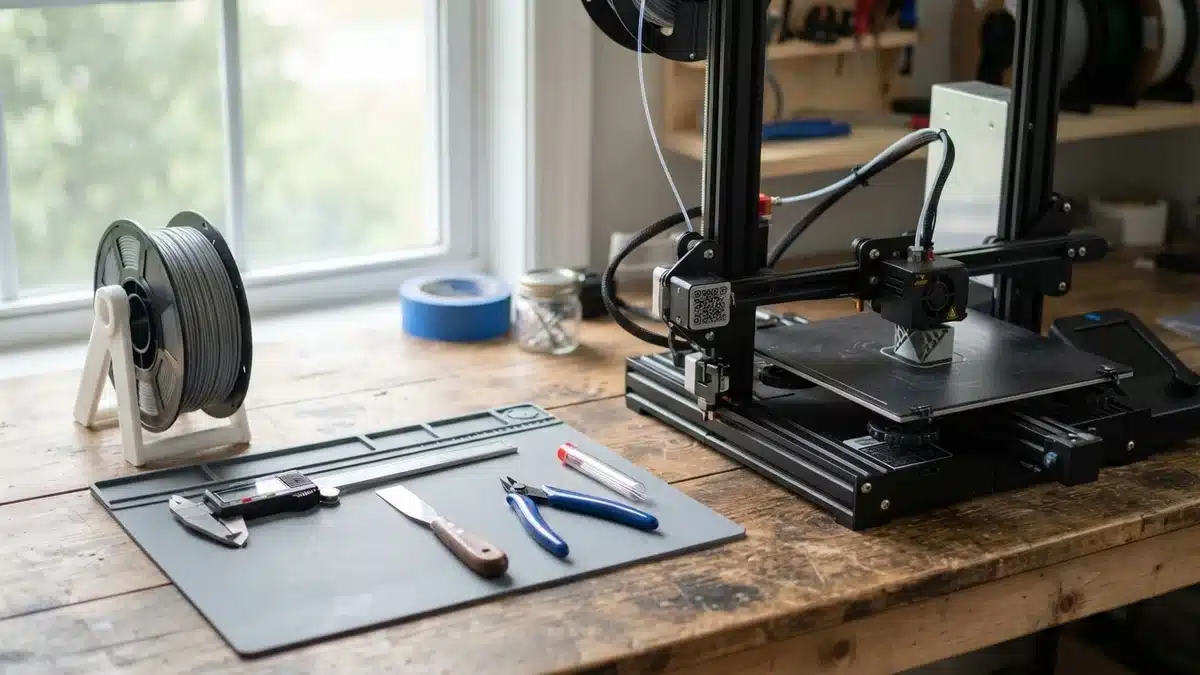
This is the most satisfying use: fixing something you would otherwise throw away. A broken tab on an appliance, a drawer knob or a blind clip can be reproduced with calipers and simple design software.
- First check whether the model already exists: many replacement parts are shared online.
- If not, measure with digital calipers and design it in free modeling software.
- Print a small test version first to check sizes and tolerances.
- Use PETG for parts under load or moderate heat.
Choosing the right material makes all the difference here. We explain it in PLA vs PETG vs ABS and in our 3D printing materials guide.
Upgrades for your own printer
One of the first things almost everyone prints is accessories for the printer itself:
- Spool holder or filament guide.
- Box for nozzles and tools.
- Scraper holder next to the printer.
- Anti-vibration feet in TPU.
Basic settings so functional parts last
A decorative part and a part that will carry load are not printed the same way. These starting settings work well on most printers:
- 0.2 mm layer height as a balance between time and finish.
- 15-20% infill for decorative parts and 30-50% for hooks, brackets and working parts.
- 3 or 4 walls on functional parts: they add more strength than cranking up the infill.
- Smart orientation: let the load run along the layers instead of trying to pull them apart.
A small 20-gram part uses just 2% of a 1 kg spool, so getting it wrong and reprinting is cheap. Use that to experiment with settings until a part feels solid in your hand.
Where to find models to print
You do not need design skills to start. There are repositories with millions of free models, many with photos from people who have already printed them. Our list of the best sites for free STL files covers the best ones.
Before downloading, check three things: real photos of the printed part, no comments warning about sizing errors, and a license that allows your intended use, especially if you plan to sell what you print.
Learning to design your own parts
Sooner or later you will want something that does not exist yet. The good news is that simple functional parts need very little design skill.
- Start with box-based modeling: most organizers, spacers and brackets are just boxes and cylinders combined or subtracted.
- Remix before you design: many repositories let you customize an existing model by changing its measurements.
- Leave clearance: parts that must fit together usually need a gap of around 0.2 mm, depending on your printer.
- Print a quick test slice of the critical area before committing to a long print.
Free browser-based CAD tools are enough for all of this, and our 3D printing software guide covers where to start.
Common mistakes when choosing what to print
- Using PLA in a car or outdoors: it warps with heat, and a parked car in summer easily exceeds what it can handle.
- Printing load-bearing parts without thinking about orientation: layers are the weak point.
- Using printed parts in daily contact with food.
- Starting with very long projects: a failure halfway is discouraging; build practice with short parts.
- Ignoring the model license if you plan to sell prints.
What to print based on your situation
- You just unboxed the printer: cable clips, hooks and a drawer organizer.
- You want to save money at home: replacement parts and custom organizers.
- You need a gift: custom keychains, lithophanes or spiral vases.
- You love board games: inserts and miniatures.
- You want to earn from it: read how to make money with 3D printing.
Frequently asked questions
A small, useful part that prints in under an hour, such as a cable clip or a hook. It lets you check calibration and build confidence before long projects.
Yes. Custom organizers, replacement parts, stands and hooks are everyday objects that cost cents in filament.
PETG or ASA. PLA warps with heat and degrades in sunlight, so it is a poor choice outdoors or in a car.
Only for brief contact and with care. Layers trap bacteria and not every material is food-safe. For daily use, a commercial product is better.
On free 3D model repositories, where you can filter by category and see real prints from other users.