
Disclosure: this article contains affiliate links. If you buy through them, Bright Technology may earn a small commission at no extra cost to you. As an Amazon Associate, we earn from qualifying purchases.
The best drones for kids depend mostly on age: up to about 9 years old, a camera-free indoor mini drone is the right call, and from around 12 a sub-250 g DJI with a 4K camera becomes realistic. In between sits the part almost nobody explains: what the FAA expects when a child is the one flying.
Below are six models ordered by age, with manufacturer data, plus the US rules (TRUST, registration and recreational flying limits) in plain English.
- Drones for kids compared
- FAA rules when kids fly drones
- 1. Holy Stone HS210: the first drone for little kids
- 2. Potensic A20: the indoor alternative
- 3. DJI Neo: the first drone with a camera
- 4. DJI Neo 2: the safest drone with a camera
- 5. DJI Flip: full protection and longer flights
- 6. DJI Lito 1: a "real" first drone for teens
- Which drone for which age?
- Safety tips for kids flying drones
- Common mistakes when buying a drone for a child
- Drones for kids FAQ
- Keep reading
Quick answer: for kids ages 6 to 9, an indoor mini drone like the Holy Stone HS210. For ages 10 to 12, the DJI Neo (135 g), always with an adult beside them. From age 12, the DJI Neo 2 if you want safety, or the DJI Lito 1 for a teen who wants to make real videos. In the US, none of these six weighs 250 g or more, so none needs FAA registration for recreational flying, but whoever flies outdoors should pass the free TRUST test.
Drones for kids compared
| Model | Suggested age | Weight | Camera | Flight time | Protection | FAA registration* |
|---|---|---|---|---|---|---|
| Holy Stone HS210 | 6–9 (with an adult) | 24.8 g | No | 9 min × 3 batteries | Full prop guards | No (under 250 g) |
| Potensic A20 | 6–9 (with an adult) | Mini drone | No | ≈10 min × 3 batteries | Full prop guards | No (mini toy drone) |
| DJI Neo | 10–12 | 135 g | 4K/30 fps | 18 min | Ducted propellers | No (under 250 g) |
| DJI Neo 2 | 12+ | 151 g | 4K/60 fps | 19 min | Ducted + omnidirectional sensing | No (under 250 g) |
| DJI Flip | 12+ | 249 g | 4K/60 fps HDR | 31 min | Full folding prop guards | No, but only 1 g under the limit |
| DJI Lito 1 | 13+ | Under 249 g | 4K/60 fps | 36 min | Omnidirectional obstacle sensing | No (under 250 g) |
*For recreational flying. The FAA’s registration threshold is based on takeoff weight, 250 g or more, so adding accessories can change the answer. The suggested age combines maturity and the rules explained in the next section.
FAA rules when kids fly drones
In the United States, the rules depend on weight and on whether the flight is recreational. A child flying for fun falls under the FAA’s recreational rules. Here is how they work in practice.
| Question | Answer for recreational flying |
|---|---|
| Is there a minimum age? | The FAA does not set a minimum age for recreational flying, so the real limit is maturity. A remote pilot certificate for commercial work (Part 107) requires being at least 16. |
| Must the pilot pass TRUST? | Yes. The Recreational UAS Safety Test is free and online, and it applies to recreational flyers outdoors regardless of drone weight. Have the adult take it first, and have any child who will fly alone take it as well. |
| Must the drone be registered? | Only if it weighs 250 g (0.55 lb) or more at takeoff. All six drones in this guide are under that limit. |
| Is Remote ID required? | It applies to drones that must be registered, so the sub-250 g drones here are not affected for recreational use. |
| Do indoor flights count? | FAA airspace rules are written for the national airspace, so flying inside your home is generally outside them. Outdoors, the rules apply. |
Rules for every outdoor flight
- Fly at or below 400 feet in uncontrolled airspace and keep the drone within your visual line of sight.
- Do not fly over people, stadiums or crowded places, and never near emergency response efforts.
- Check the airspace before you go. Near airports you need FAA authorization, which you can request through LAANC-enabled apps, and the free B4UFLY tools show restricted areas.
- Follow community-based safety guidelines, and check state, local and park rules, which can be stricter than federal ones.
- Registration for commercial use: if a teen ever flies for pay, Part 107 rules apply and registration is required whatever the weight.
A camera does not trigger registration in the US; weight does. If you live outside the US, the rules differ: in the EU, for instance, minimum ages and operator registration depend on the drone’s class. You can read the official details on the FAA’s recreational flyers page and the drone registration page.
One practical note on the DJI models: the situation of DJI in the United States has changed over time, so availability of specific models can vary. Check current listings before you plan a purchase.
1. Holy Stone HS210: the first drone for little kids
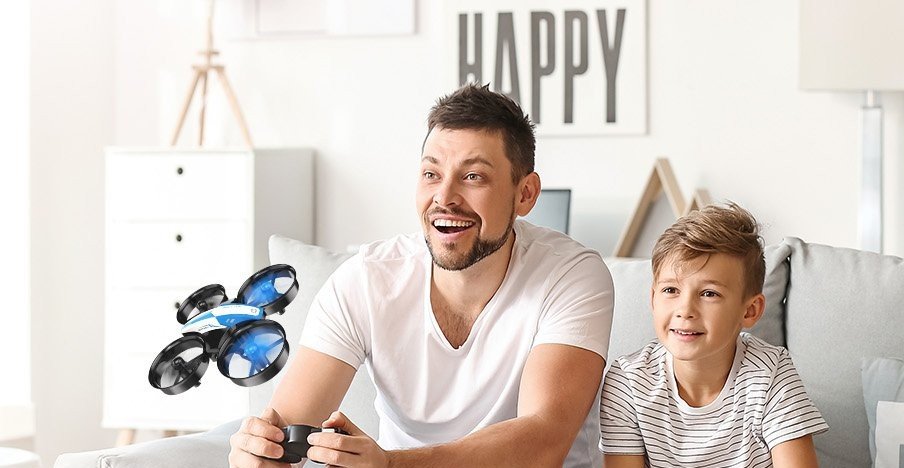
It weighs 24.8 g, measures 8 × 8 cm and has guards around all four propellers. It comes with three batteries of up to 9 minutes each, altitude hold, headless mode (the drone responds the same way no matter where it faces) and three speed settings. There is no camera, so there are no privacy concerns.
The manufacturer recommends that children under 10 fly with close adult supervision. It is made for a living room or a windless yard: with a breeze, it gets carried away.
Ideal for: kids ages 6 to 9 flying indoors.
- Very light and protected: bumps do no harm
- Three batteries included
- No camera, so no privacy worries
- Indoor or windless use only
- Short flight time per battery
2. Potensic A20: the indoor alternative
Another camera-free toy mini drone, with protective rings, three batteries of about 10 minutes each, barometer-based altitude hold, headless mode and stunt flips. It is controlled only with its own remote, no phone needed.
Like the HS210, it is indoor-only: there is no GPS and it tends to drift if you do not correct it. The remote must be paired every time it is switched on, something to explain to younger kids.
Ideal for: learning to fly at home.
- No app or phone needed
- Three batteries
- Full protective rings
- Drifts while hovering
- Not suited to outdoor use
3. DJI Neo: the first drone with a camera
At 135 g, with ducted propellers and takeoff from the palm of your hand, it is DJI’s easiest drone to use. It records 4K at 30 fps, follows the user without a controller and makes automatic shots for social media. Flight time is 18 minutes.
For a 10 to 12 year old it is ideal with an adult nearby. It is under the 250 g threshold, so it needs no registration for recreational flying. It does not detect obstacles, so kids need to learn to stay away from trees. Our DJI Neo review has the full analysis.
Ideal for: ages 10 to 12 with an adult.
- Ducted propellers
- Takes off from your hand
- Affordable for a DJI
- No obstacle detection
- 18 minutes of flight time
- Not for windy days
4. DJI Neo 2: the safest drone with a camera
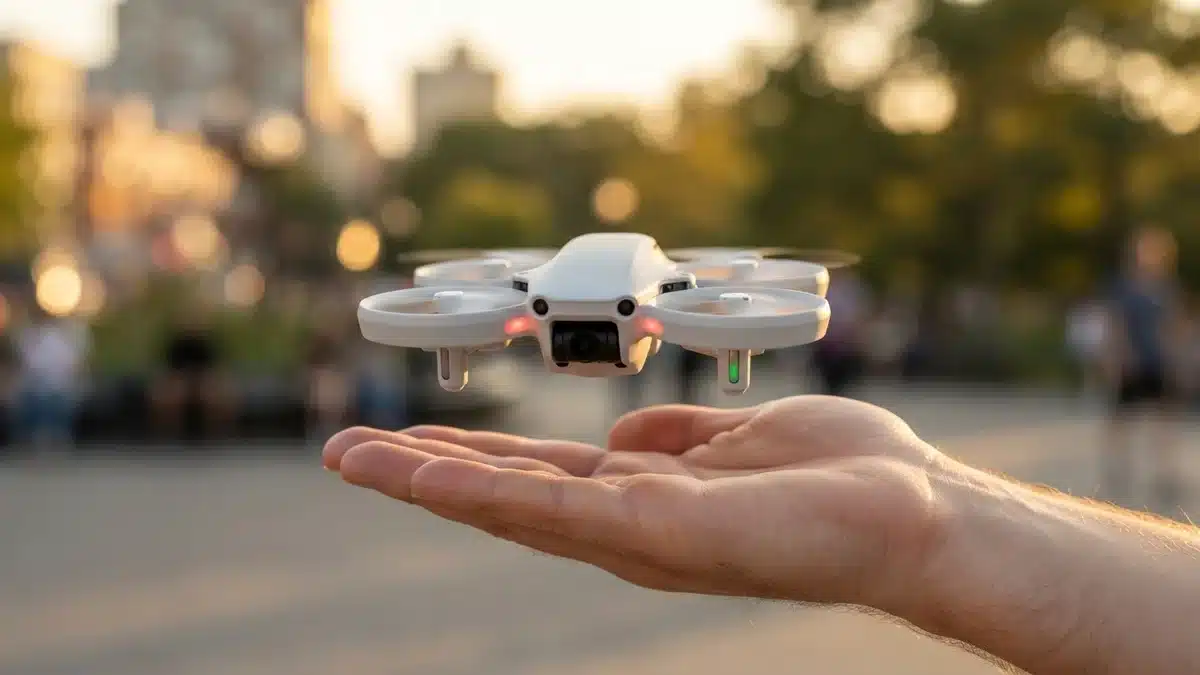
It keeps the ducted format, weighs 151 g and adds what the Neo lacked: omnidirectional obstacle sensing with front LiDAR and a two-axis gimbal. It records 4K at 60 fps and flies for 19 minutes.
If the child will fly outdoors around trees or lampposts, obstacle sensing justifies the price difference. A physical controller is optional.
Ideal for: preteens flying outdoors.
- Omnidirectional obstacle sensing
- Stabilized 4K at 60 fps
- Ducted propellers
- Short flight time
- Controller sold separately
5. DJI Flip: full protection and longer flights
It weighs 249 g and has folding guards that cover the propellers above and below. It offers up to 31 minutes of flight and 4K at 60 fps HDR video. It launched in January 2025.
It is a good option for a teenager who wants to shoot seriously but will still bump into things: full protection forgives mistakes that would break a propeller on a regular folding drone. At 249 g it sits right under the FAA’s 250 g line, so adding accessories could change the registration answer.
Ideal for: teens who want quality video.
- Folding full prop guards
- 31 minutes of flight
- Good image quality
- More expensive
- Bulkier than a Neo
6. DJI Lito 1: a “real” first drone for teens
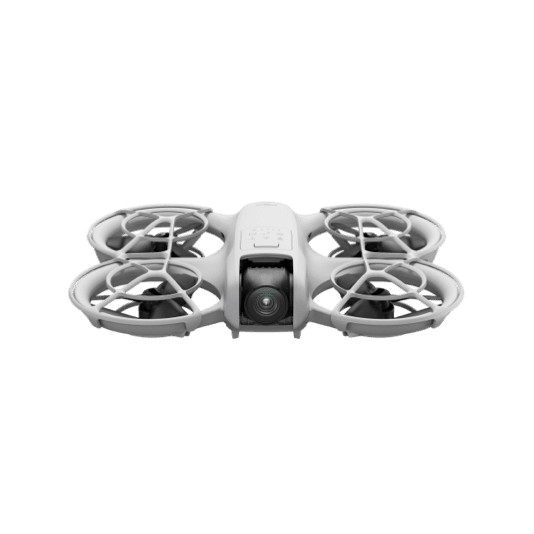
This is DJI’s entry-level series introduced in April 2026: under 249 g, a 1/2-inch sensor, 4K at 60 fps video, omnidirectional obstacle sensing, O4 transmission and up to 36 minutes of flight. It includes the RC-N3 controller.
It does not have guarded propellers like the Neo or the Flip, so it is for teens age 13 and up with some experience. In return, it is a true folding drone a teenager can keep learning on for years.
Ideal for: experienced teens.
- 36 minutes of flight
- Omnidirectional sensing
- Controller included
- Unprotected propellers
- Requires more responsibility
Which drone for which age?
- Ages 6 to 9: a camera-free indoor mini drone (HS210 or A20). First they need to learn orientation and how to land without crashing.
- Ages 10 to 12: the DJI Neo, flown with an adult beside them who has taken TRUST.
- Ages 12 to 14: the DJI Neo 2 or DJI Flip, with company for the first few flights.
- Age 13 or 14 and up with experience: the DJI Lito 1, or a model from our list of drones for beginners.
If budget decides, our budget drone guide has more options.
Safety tips for kids flying drones
- Start indoors or in an open field with no people. No crowded parks or summer beaches.
- Teach them to let go of the sticks. Many drones hover in place when the sticks are released; it is the safest reaction to a scare.
- Check the wind. A 25 g mini drone is carried off by any breeze; a 135 g DJI handles a little more, but not a windy day.
- Tie back long hair and keep hands away from the propellers, even with guards.
- Keep batteries under control. Charge them with an adult present and never leave them charging overnight.
- Practice first in a simulator or beginner mode. Our guide on how to fly a drone has the first exercises.
Common mistakes when buying a drone for a child
- Buying a camera drone for a 6 year old. They will not get the use out of it, and it adds cost and responsibility.
- Choosing the cheapest “4K camera” model. On toy drones that number is often interpolated: the real image is far worse.
- Forgetting spare batteries. With 8 to 10 minutes per battery, a single one is not enough and the child gets frustrated.
- Assuming a toy has no rules. Outdoors, the FAA’s recreational rules and TRUST apply regardless of weight.
- Flying without checking the map. Near an airport, even a mini drone can be off limits.
Drones for kids FAQ
It depends on age. For 6 to 9 year olds, an indoor mini drone without a camera such as the Holy Stone HS210 is best. For 10 to 12, the DJI Neo with an adult beside them; for teens, the DJI Neo 2, Flip or Lito 1.
The FAA does not set a minimum age for recreational flying, so the limit is maturity and supervision. A Part 107 remote pilot certificate for commercial flights requires being at least 16.
Recreational flyers must pass TRUST, the free online Recreational UAS Safety Test. A good approach is for the parent to take it first and have any child who will fly outdoors alone take it too.
Only if it weighs 250 g (0.55 lb) or more at takeoff. All the drones in this guide are under that weight, so no registration is needed for recreational flying. The DJI Flip is only about a gram under the limit, so accessories matter.
An indoor mini drone without a camera, such as the Holy Stone HS210 or the Potensic A20. They are light, have propeller guards and come with several batteries to extend playtime.
It is one of the safest camera drones: it weighs 135 g and has ducted propellers. It does not detect obstacles, so children under 12 should fly it with an adult nearby.
Not for recreational flying: you need to pass TRUST, not a license. A Part 107 certificate is only required for commercial flights.
Start indoors or in an open field without people, under 400 feet and in sight. Avoid crowds, airports and restricted areas, and check state and local rules for parks.
Keep reading
- Racing Drones: What They Are and How to Get Started
- Best Long Range Drones of 2026: 6 Models and Real Range
- Best Drones for Beginners in 2026: Complete Buying Guide
- Best Professional Drones of 2026: Comparison and Buying Guide
Official sources: FAA: recreational flyers and TRUST · FAA: register your drone · Holy Stone: HS210 specifications