
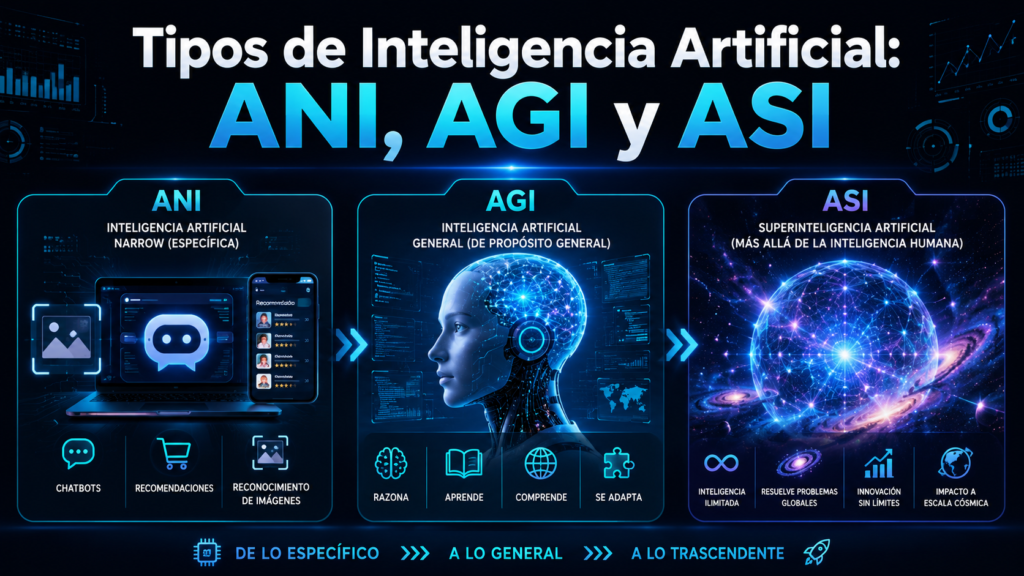
- Cómo se clasifica la inteligencia artificial
- Tipos de IA según su capacidad
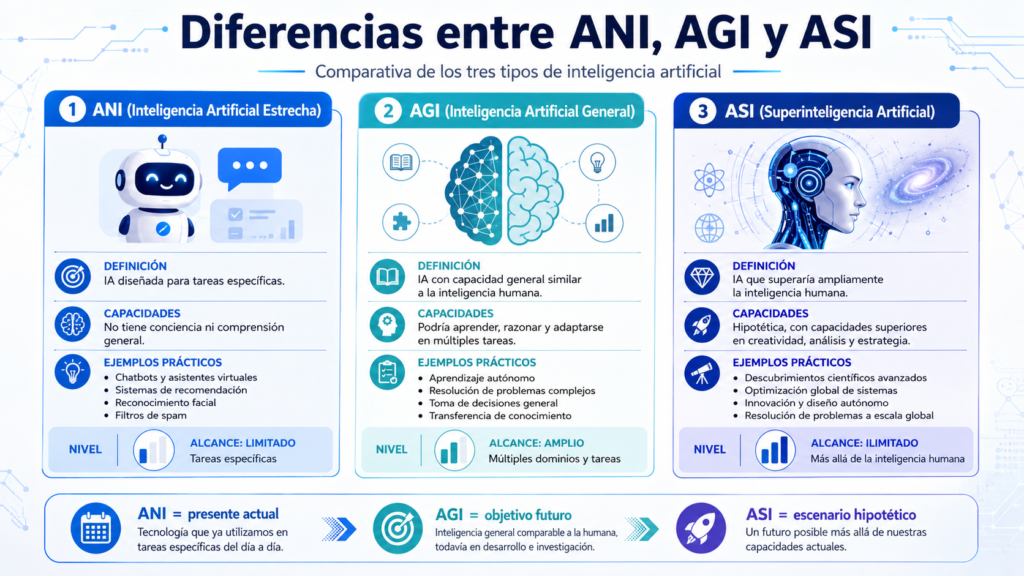
- Comparativa entre ANI, AGI y ASI
- Tipos de IA según su enfoque técnico
- Tipos de IA según su forma de aprendizaje
- Tipos de IA según el resultado que producen
- Tipos de IA según su nivel de autonomía
- Máquinas reactivas, memoria limitada y teoría de la mente
- Un mismo sistema puede pertenecer a varias categorías
- Qué tipos de inteligencia artificial existen actualmente
- Conclusión
- Preguntas frecuentes sobre los tipos de Inteligencia Artificial
La inteligencia artificial puede clasificarse de distintas maneras. ANI, AGI y ASI describen niveles de capacidad, pero no explican por sí solos cómo aprende un sistema, qué tipo de resultado produce o cuánto puede actuar sin intervención humana.
Una IA también puede ser predictiva, generativa, conversacional, basada en reglas, entrenada mediante aprendizaje supervisado o funcionar como un agente capaz de utilizar herramientas.
Por eso, cuando preguntamos cuántos tipos de inteligencia artificial existen, la respuesta depende del criterio utilizado.
En esta guía conocerás las principales clasificaciones, sus diferencias y cuáles corresponden a tecnologías existentes o a conceptos que continúan siendo hipotéticos.
Para obtener una visión general sobre su funcionamiento, aplicaciones, ventajas y riesgos, puedes consultar nuestra guía completa de inteligencia artificial.
Cómo se clasifica la inteligencia artificial
No existe una única clasificación capaz de describir todos los sistemas de IA.
Podemos agruparlos según:
- Su capacidad para trabajar en uno o varios dominios.
- La tecnología o enfoque utilizado.
- La forma en la que aprenden.
- El tipo de resultado que producen.
- El formato de información que procesan.
- Su capacidad para actuar de manera autónoma.
- La función para la que han sido diseñados.
Un mismo sistema puede pertenecer a varias categorías.
Por ejemplo, un asistente puede ser:
- Inteligencia artificial especializada.
- Modelo basado en Deep Learning.
- IA generativa.
- IA conversacional.
- Sistema multimodal.
- Agente con acceso a herramientas.
Cada término describe un aspecto diferente.
| Criterio | Categorías principales | Qué describe |
|---|---|---|
| Capacidad | ANI, AGI y ASI | Amplitud y generalidad de sus capacidades |
| Enfoque técnico | Reglas, Machine Learning y Deep Learning | Tecnología utilizada |
| Aprendizaje | Supervisado, no supervisado, refuerzo y autosupervisado | Cómo aprende el modelo |
| Resultado | Predictiva, generativa y clasificadora | Qué produce |
| Modalidad | Texto, imagen, audio, vídeo o multimodal | Qué información procesa |
| Autonomía | Asistente, agente o sistema agéntico | Cuánto puede actuar por sí mismo |
Tipos de IA según su capacidad
La clasificación ANI, AGI y ASI compara la amplitud de las capacidades de una IA con la flexibilidad de la inteligencia humana.
Es un marco conceptual útil, pero sus fronteras no cuentan con pruebas universalmente aceptadas.
ANI o inteligencia artificial estrecha
ANI significa Artificial Narrow Intelligence, traducido como inteligencia artificial estrecha, especializada o limitada.
Describe sistemas diseñados para realizar determinadas tareas dentro de unos contextos concretos.
Entre sus posibles funciones encontramos:
- Clasificar imágenes.
- Recomendar productos.
- Traducir textos.
- Detectar operaciones anómalas.
- Generar contenido.
- Calcular rutas.
- Reconocer voz.
- Predecir una demanda.
La palabra “estrecha” no significa necesariamente que el sistema solo pueda ejecutar una acción.
Un modelo multimodal puede trabajar con texto, imágenes, documentos, audio, programación y herramientas. Sin embargo, continúa dependiendo de una arquitectura, unos datos, unas instrucciones y un entorno definidos.
Características de la ANI
- Está diseñada o entrenada para determinados objetivos.
- Su rendimiento varía según la tarea.
- No posee automáticamente todas las habilidades humanas.
- Puede superar a especialistas en actividades concretas.
- No generaliza de forma ilimitada a cualquier situación.
- Necesita evaluación y supervisión.
Bajo esta clasificación, los sistemas desplegados actualmente suelen incluirse dentro de la IA especializada, aunque algunos sean muy versátiles.
AGI o inteligencia artificial general
AGI significa Artificial General Intelligence o inteligencia artificial general.
Se utiliza para describir un sistema capaz de aprender, razonar y aplicar conocimientos en una amplia variedad de tareas y dominios, incluyendo situaciones nuevas.
Una posible AGI debería mostrar capacidades como:
- Aprender nuevas tareas con poca información.
- Transferir conocimientos entre dominios.
- Adaptarse a situaciones desconocidas.
- Planificar objetivos complejos.
- Resolver problemas diversos.
- Utilizar herramientas.
- Corregir errores.
- Mantener un rendimiento sólido en muchos contextos.
No existe una definición ni una prueba universal para certificar que un sistema es AGI.
Por ello, diferentes investigadores, empresas y organizaciones pueden utilizar el término de manera distinta.
Algunos se centran en alcanzar un rendimiento comparable al humano en muchas pruebas. Otros exigen adaptación, memoria, autonomía, aprendizaje continuo o capacidad para desenvolverse en entornos reales.
AGI no significa necesariamente conciencia
La inteligencia general y la conciencia no son conceptos equivalentes.
Un sistema podría mostrar una gran capacidad para resolver tareas sin que eso demostrara que posee emociones, experiencia subjetiva o conciencia.
Por tanto, una tabla sobre ANI y AGI no debería utilizar la conciencia como requisito técnico principal.
¿Existe actualmente una AGI?
No existe un consenso ampliamente aceptado de que algún sistema haya alcanzado una inteligencia artificial general.
Los modelos actuales pueden ofrecer capacidades muy amplias, pero continúan mostrando perfiles irregulares: destacan en ciertas tareas y fallan en otras que una persona podría considerar sencillas.
Por eso resulta más preciso evaluar capacidades concretas que afirmar de manera absoluta que una herramienta es o no “inteligente como un humano”.
ASI o superinteligencia artificial
ASI significa Artificial Superintelligence o superinteligencia artificial.
Describe un escenario hipotético en el que un sistema superaría ampliamente las capacidades humanas en una gran variedad de disciplinas.
Podría incluir un rendimiento superior en:
- Investigación científica.
- Ingeniería.
- Planificación.
- Matemáticas.
- Desarrollo tecnológico.
- Estrategia.
- Resolución de problemas.
- Creación de conocimiento.
La ASI no representa una tecnología disponible actualmente.
Tampoco existe una forma establecida de saber cómo se desarrollaría, qué capacidades tendría o si surgiría como consecuencia de una AGI.
Su estudio se relaciona principalmente con debates sobre:
- Seguridad.
- Control.
- Alineación de objetivos.
- Concentración de poder.
- Gobernanza.
- Riesgos sistémicos.
Conviene diferenciar estos debates de las limitaciones y riesgos reales de los sistemas que ya se utilizan.
Comparativa entre ANI, AGI y ASI
| Característica | ANI | AGI | ASI |
|---|---|---|---|
| Significado | IA especializada | IA general | Superinteligencia |
| Estado | Sistemas reales | Concepto de investigación sin prueba universal | Escenario hipotético |
| Alcance | Tareas y contextos definidos | Amplia variedad de dominios | Superaría ampliamente las capacidades humanas |
| Transferencia entre tareas | Limitada o variable | Amplia | Teóricamente superior |
| Adaptación a situaciones nuevas | Depende del sistema | Debería ser elevada | Hipotéticamente muy elevada |
| Ejemplos verificados | Sistemas actuales de IA | Ninguno aceptado universalmente | Ninguno |
| Implica conciencia | No | No necesariamente | No necesariamente |
La tabla no debe interpretarse como una escala automática por la que todo sistema tenga que avanzar.
ANI, AGI y ASI son categorías conceptuales basadas en la amplitud de las capacidades.
Tipos de IA según su enfoque técnico
También podemos clasificar la inteligencia artificial según la tecnología utilizada para producir sus resultados.
IA basada en reglas y conocimiento
Estos sistemas utilizan reglas, representaciones lógicas o conocimiento introducido por especialistas.
Un ejemplo sencillo sería:
Si se cumplen las condiciones A y B, recomienda la opción C.
Pueden utilizarse en:
- Sistemas expertos.
- Diagnósticos basados en reglas.
- Configuradores.
- Motores de decisión.
- Validaciones.
- Planificación.
Sus ventajas son la trazabilidad y el control.
Sin embargo, mantener miles de reglas puede resultar difícil cuando el problema cambia o contiene demasiadas excepciones.
Machine Learning
El Machine Learning permite construir modelos que aprenden relaciones a partir de datos.
En lugar de escribir manualmente todas las reglas, se utilizan ejemplos para ajustar un modelo.
Puede aplicarse a:
- Clasificación.
- Regresión.
- Detección de anomalías.
- Segmentación.
- Recomendación.
- Procesamiento del lenguaje.
- Visión artificial.
Deep Learning
El Deep Learning es un subcampo del Machine Learning basado en redes neuronales con múltiples capas.
Se utiliza frecuentemente en tareas relacionadas con:
- Lenguaje.
- Imágenes.
- Audio.
- Vídeo.
- Modelos multimodales.
- Generación de contenido.
- Reconocimiento de patrones complejos.
No sustituye a todos los modelos de Machine Learning. Para determinados problemas, una técnica más sencilla puede resultar más rápida, interpretable y eficiente.
La relación entre estos conceptos se explica en la guía sobre cómo funciona una inteligencia artificial.
Tipos de IA según su forma de aprendizaje
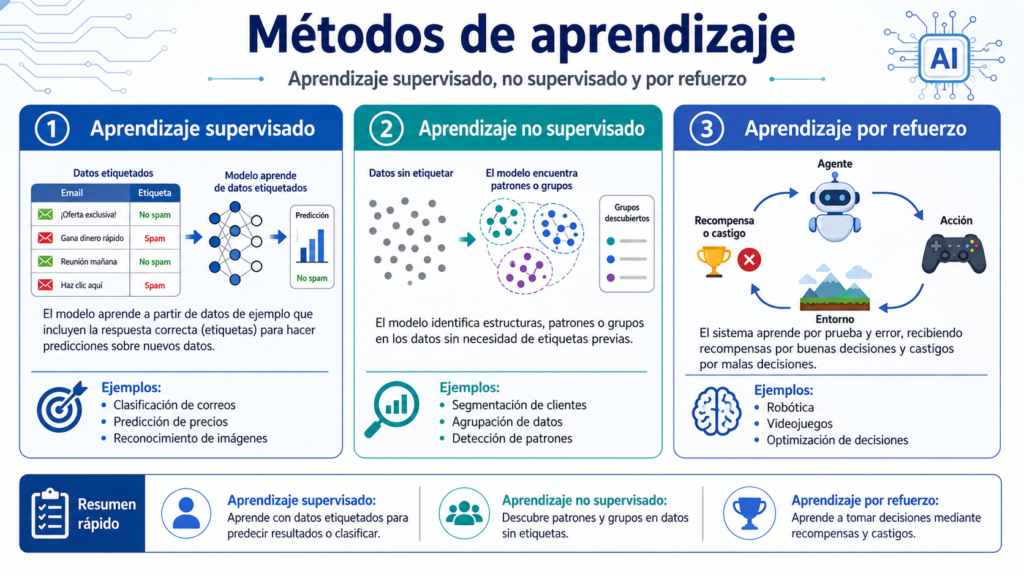
Dentro del Machine Learning podemos diferenciar varios métodos.
Aprendizaje supervisado
El modelo aprende utilizando ejemplos que incluyen una respuesta correcta o etiqueta.
Por ejemplo:
- Correos clasificados como spam o legítimos.
- Imágenes etiquetadas.
- Operaciones marcadas como fraudulentas.
- Viviendas acompañadas de su precio.
Se emplea principalmente para:
- Clasificación.
- Regresión.
- Predicción.
Aprendizaje no supervisado
El modelo recibe datos sin respuestas previamente etiquetadas y busca estructuras o agrupaciones.
Puede utilizarse para:
- Segmentar clientes.
- Agrupar documentos.
- Detectar patrones.
- Explorar conjuntos de datos.
- Reducir dimensiones.
- Identificar comportamientos atípicos.
El sistema encuentra relaciones, pero una persona debe interpretar qué significan los grupos obtenidos.
Aprendizaje por refuerzo
Un agente aprende interactuando con un entorno.
Cada acción puede producir una recompensa o penalización. El objetivo es encontrar una estrategia que maximice la recompensa acumulada.
Se utiliza en:
- Robótica.
- Juegos.
- Control de sistemas.
- Planificación.
- Optimización.
- Investigación sobre agentes.
Aprendizaje autosupervisado
El aprendizaje autosupervisado permite crear señales de entrenamiento a partir de los propios datos sin tener que etiquetar manualmente cada ejemplo.
Por ejemplo, un modelo puede aprender intentando:
- Predecir una parte oculta de un texto.
- Reconstruir una imagen incompleta.
- Relacionar representaciones de contenido.
- Identificar la siguiente parte de una secuencia.
Este enfoque ha desempeñado un papel importante en el desarrollo de grandes modelos de lenguaje y modelos fundacionales.
Tipos de IA según el resultado que producen
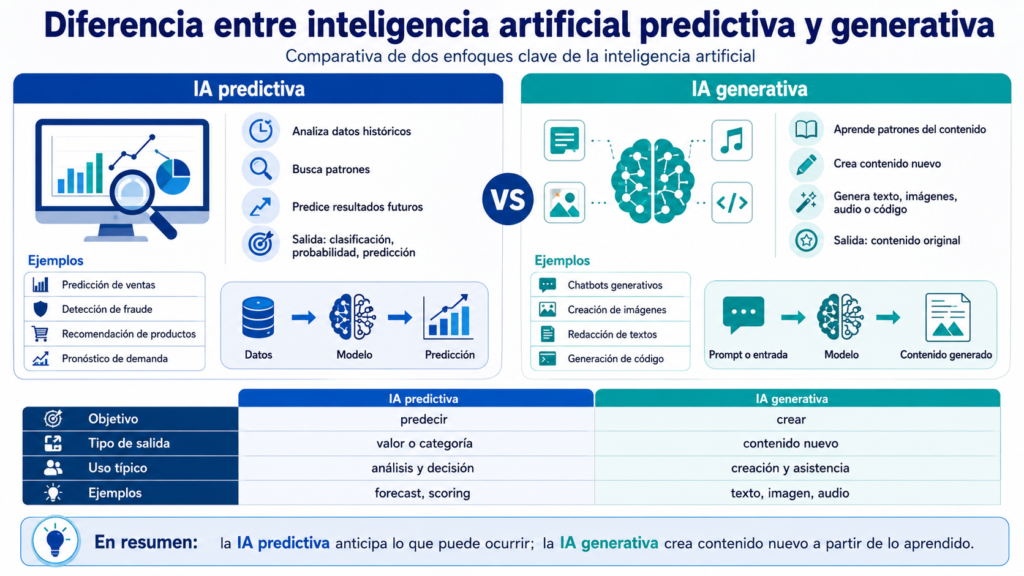
Otra clasificación especialmente útil diferencia los sistemas según la salida que generan.
IA predictiva
La IA predictiva calcula qué resultado podría producirse a partir de determinados datos.
Puede generar:
- Una probabilidad.
- Un valor numérico.
- Una previsión.
- Una estimación de riesgo.
- Una demanda esperada.
- Una alerta.
Ejemplos:
- Predicción de ventas.
- Estimación del tiempo de entrega.
- Riesgo de impago.
- Previsión de averías.
- Probabilidad de abandono de un cliente.
Sus resultados suelen poder compararse posteriormente con lo que realmente ocurrió.
IA generativa
La IA generativa produce contenido nuevo a partir de una entrada.
Puede generar:
- Texto.
- Imágenes.
- Audio.
- Música.
- Vídeo.
- Código.
- Presentaciones.
- Modelos tridimensionales.
No debe confundirse con AGI.
Un sistema generativo puede crear contenido en varios formatos y continuar siendo una inteligencia artificial especializada.
Consulta nuestra guía sobre qué es la inteligencia artificial generativa para conocer sus modelos, funcionamiento y limitaciones.
IA discriminativa o clasificadora
Los modelos discriminativos separan ejemplos, calculan categorías o estiman relaciones entre una entrada y un resultado.
Pueden utilizarse para:
- Identificar objetos.
- Clasificar correos.
- Detectar enfermedades en imágenes.
- Reconocer intenciones.
- Diferenciar operaciones normales y anómalas.
“Generativo” y “discriminativo” describen enfoques diferentes, aunque un mismo producto puede combinar ambos.
Sistemas de recomendación
Analizan información sobre usuarios, productos o contenidos para ordenar opciones que podrían resultar relevantes.
Se utilizan en:
- Comercio electrónico.
- Plataformas audiovisuales.
- Música.
- Redes sociales.
- Publicidad.
- Noticias.
- Formación.
Pueden combinar filtrado colaborativo, modelos predictivos, contenido y contexto.
IA conversacional
La IA conversacional procesa lenguaje para mantener interacciones mediante texto o voz.
Puede incluir:
- Chatbots.
- Asistentes.
- Sistemas de atención.
- Interfaces de voz.
- Agentes con herramientas.
No toda IA conversacional es generativa. Algunos sistemas siguen flujos, intenciones y respuestas predeterminadas.
Visión artificial
La visión artificial analiza imágenes o vídeos.
Puede realizar tareas como:
- Clasificación de imágenes.
- Detección de objetos.
- Segmentación.
- Reconocimiento óptico de caracteres.
- Seguimiento.
- Inspección de calidad.
- Interpretación de escenas.
Robótica y sistemas autónomos
Estos sistemas combinan percepción, planificación y actuación dentro de un entorno físico.
Pueden incorporar:
- Cámaras.
- Sensores.
- Modelos predictivos.
- Localización.
- Planificación de rutas.
- Control de movimiento.
- Aprendizaje por refuerzo.
Su autonomía depende del diseño, las restricciones y el nivel de supervisión.
La guía sobre aplicaciones de la inteligencia artificial explica en qué sectores se utilizan estas categorías.
Tipos de IA según su nivel de autonomía
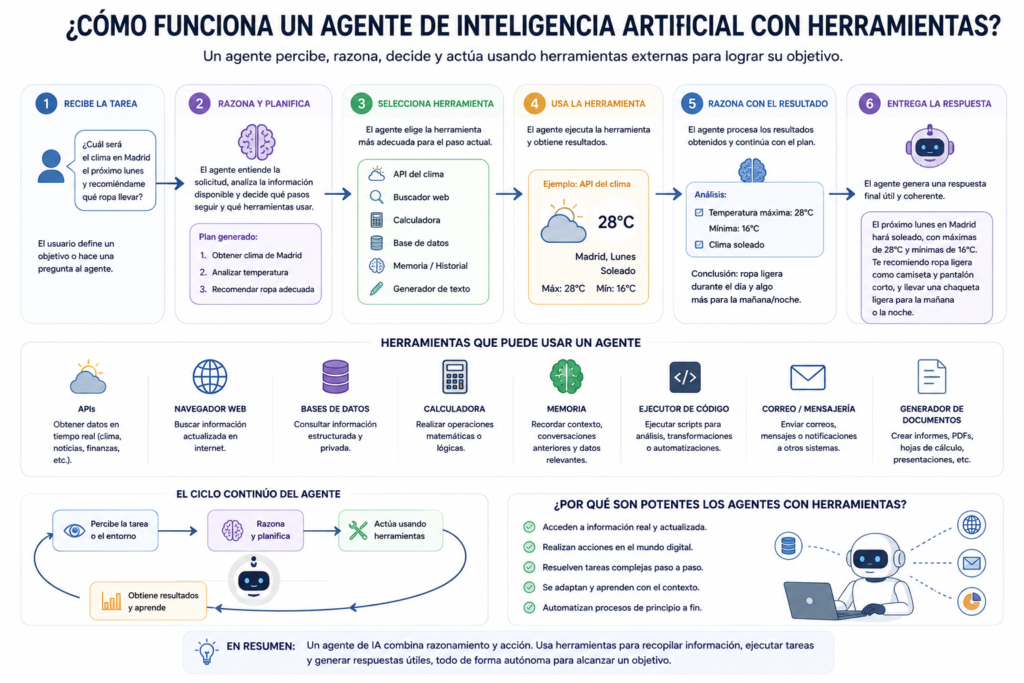
La autonomía describe hasta qué punto el sistema puede seleccionar y ejecutar acciones sin que una persona confirme cada paso.
Herramientas de asistencia y copilotos
Ayudan a una persona a completar una tarea, pero el usuario mantiene el control principal.
Pueden:
- Sugerir texto.
- Resumir información.
- Recomendar acciones.
- Generar borradores.
- Proponer código.
- Analizar documentos.
La persona revisa y decide qué resultado utilizar.
Agentes de inteligencia artificial
Un agente puede recibir un objetivo, planificar varios pasos, utilizar herramientas y actuar sobre un entorno digital o físico.
Puede realizar acciones como:
- Consultar una base de datos.
- Navegar por una aplicación.
- Ejecutar código.
- Crear archivos.
- Enviar información.
- Comprobar resultados.
- Modificar su plan.
Esto no significa que tenga voluntad propia. Su comportamiento continúa condicionado por objetivos, permisos, instrucciones, herramientas y sistemas de control.
Sistemas de IA agéntica
La IA agéntica puede coordinar varios agentes o procesos para completar objetivos más amplios durante periodos prolongados.
Puede incluir:
- División de una tarea en subtareas.
- Delegación entre agentes.
- Uso coordinado de herramientas.
- Seguimiento de resultados.
- Adaptación del plan.
- Intervención humana en puntos de control.
Cuanta más autonomía tenga el sistema, más importantes resultan los permisos, la supervisión, los registros de actividad y los mecanismos para detenerlo.
Este tipo de sistemas puede utilizarse en procesos de automatización con inteligencia artificial.
Máquinas reactivas, memoria limitada y teoría de la mente
Otra clasificación popular distingue cuatro niveles funcionales:
- Máquinas reactivas.
- IA con memoria limitada.
- Teoría de la mente.
- IA autoconsciente.
Debe tratarse como un marco conceptual, no como una taxonomía técnica universal.
Máquinas reactivas
Responden a una situación concreta sin construir una memoria persistente sobre experiencias anteriores.
Pueden ser eficaces dentro de un entorno bien delimitado.
IA con memoria limitada
Utiliza información reciente, contexto o datos almacenados para producir una respuesta.
Muchos sistemas modernos podrían encajar parcialmente en esta descripción, aunque la expresión es demasiado amplia para explicar sus diferencias técnicas.
Teoría de la mente
Describe la hipotética capacidad de interpretar de forma general las emociones, creencias, intenciones y estados mentales de otras personas.
Existen sistemas que detectan señales emocionales o infieren intenciones concretas, pero eso no demuestra una teoría de la mente humana completa.
IA autoconsciente
Representaría un sistema con conciencia o experiencia subjetiva propia.
No existe evidencia aceptada de que los sistemas actuales sean autoconscientes.
Esta categoría pertenece principalmente al debate filosófico e hipotético y no debe confundirse con la capacidad de conversar o hablar en primera persona.
Un mismo sistema puede pertenecer a varias categorías
Las clasificaciones no son excluyentes.
Un asistente moderno podría describirse como:
- IA especializada según su capacidad.
- Deep Learning según su arquitectura.
- Autosupervisado según parte de su entrenamiento.
- Generativo según el resultado.
- Conversacional según la interfaz.
- Multimodal según los formatos.
- Agente si puede utilizar herramientas y ejecutar acciones.
Del mismo modo, un sistema de detección de fraude podría ser:
- IA especializada.
- Machine Learning supervisado.
- IA predictiva.
- Modelo discriminativo.
- Sistema de apoyo a decisiones.
Por eso no es correcto preguntar simplemente:
¿Qué tipo de IA es esta?
La pregunta más precisa sería:
¿Según qué criterio queremos clasificarla?
Qué tipos de inteligencia artificial existen actualmente
Actualmente existen sistemas reales de:
- IA basada en reglas.
- Machine Learning.
- Deep Learning.
- IA predictiva.
- IA generativa.
- Visión artificial.
- Procesamiento del lenguaje.
- Sistemas de recomendación.
- Robótica.
- Agentes de IA.
- Sistemas especializados multimodales.
Bajo el marco ANI, AGI y ASI, estos sistemas suelen clasificarse como inteligencias especializadas.
Algunos presentan capacidades amplias y pueden realizar muchas tareas, pero no existe una prueba universalmente aceptada que permita certificar que un sistema ha alcanzado la AGI.
La ASI continúa siendo un escenario hipotético.
Esta distinción ayuda a evitar dos errores:
- Restar importancia a las capacidades reales de la IA actual.
- Atribuirle capacidades generales, conciencia o autonomía que no han sido demostradas.
Conclusión
Los tipos de inteligencia artificial dependen del criterio utilizado.
ANI, AGI y ASI describen amplitud de capacidades. El aprendizaje supervisado, no supervisado, por refuerzo y autosupervisado describe cómo se entrenan determinados modelos. Las categorías predictiva, generativa, conversacional o visual explican qué resultados producen, mientras que los agentes describen su nivel de autonomía.
Los sistemas actuales pueden combinar varias de estas categorías.
Por ello, para comprender una IA debemos analizar:
- Qué tarea realiza.
- Qué datos utiliza.
- Cómo ha sido entrenada.
- Qué resultado produce.
- Qué herramientas puede utilizar.
- Cuánta autonomía posee.
- Qué supervisión necesita.
Preguntas frecuentes sobre los tipos de Inteligencia Artificial
No existe una cifra única. La IA puede clasificarse según capacidad, tecnología, aprendizaje, función, modalidad y autonomía.
ANI describe IA especializada; AGI, una capacidad general comparable a la humana en numerosos dominios; y ASI, una hipotética inteligencia ampliamente superior.
Existen sistemas especializados, predictivos, generativos, conversacionales, visuales, robóticos y agentes. No existe consenso de que algún sistema actual constituya una AGI.
Dentro de la clasificación ANI, AGI y ASI, normalmente se consideraría IA especializada o ANI. Puede realizar muchas tareas, pero no existe consenso ni una prueba universal que lo certifique como AGI.
No existe un consenso aceptado de que estos u otros asistentes actuales sean AGI. Son modelos con capacidades amplias, pero continúan presentando limitaciones y perfiles de rendimiento irregulares.
La predictiva estima un resultado, valor o probabilidad. La generativa produce contenido como texto, imágenes, audio, vídeo o código.
No. Un modelo puede generar contenido en numerosos formatos y seguir siendo una IA especializada.
El Machine Learning aprende relaciones a partir de datos. El Deep Learning es una parte del Machine Learning basada en redes neuronales profundas.
Es un sistema que puede recibir un objetivo, planificar acciones, utilizar herramientas y actuar con cierto grado de autonomía.
Se refiere a sistemas capaces de coordinar agentes o procesos, dividir objetivos en tareas y ejecutar acciones durante periodos más largos con menor intervención directa.
No. La capacidad general y la conciencia son conceptos diferentes. Una definición de AGI puede centrarse en aprendizaje y adaptación sin demostrar experiencia subjetiva.
No. La superinteligencia artificial sigue siendo un escenario hipotético.
Son sistemas que responden a entradas concretas sin construir una memoria persistente de experiencias pasadas.
Sí. Una IA puede ser simultáneamente especializada, generativa, multimodal, conversacional y funcionar como agente.