
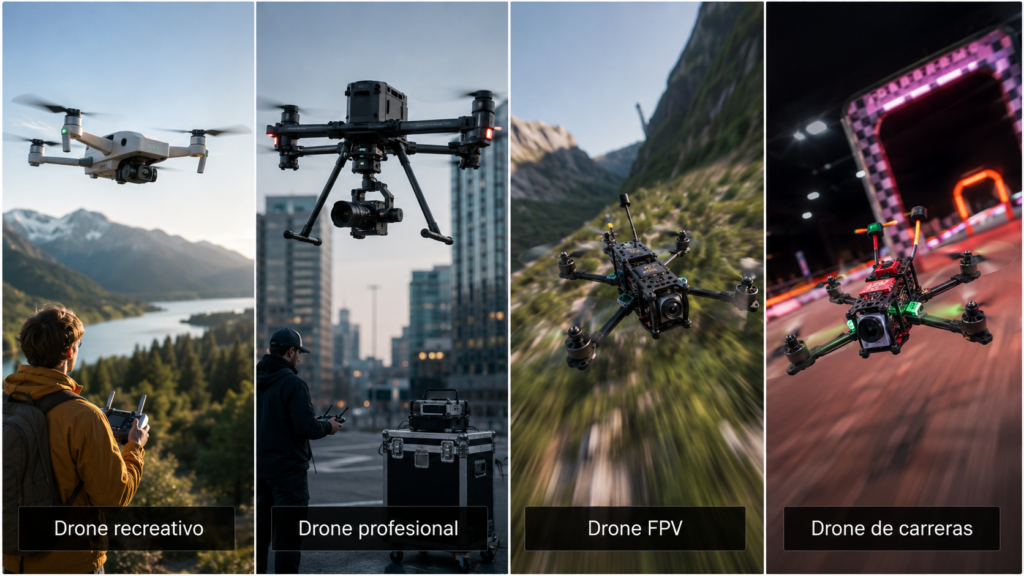
- Cómo se clasifican los drones
- Tipos de drones según su diseño y forma de vuelo
- Comparativa de drones según su diseño
- Tipos de drones según su uso
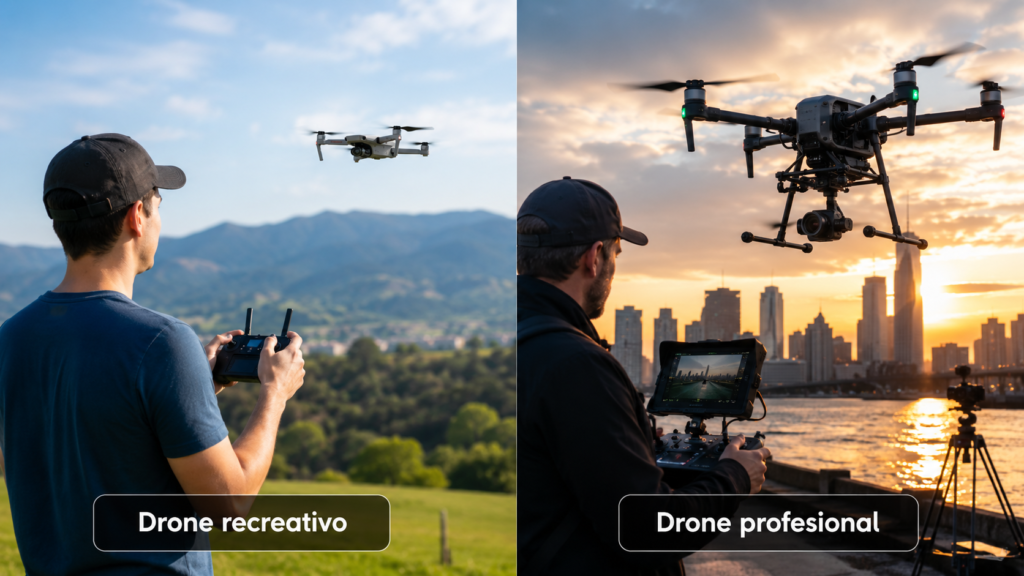
- Diferencias entre drones recreativos, profesionales y FPV
- Qué tipo de drone elegir según tus necesidades
- Conclusión
- Preguntas frecuentes sobre los tipos de drones
No todos los drones están diseñados para volar de la misma manera ni para realizar las mismas tareas. Algunos pueden mantenerse inmóviles para grabar una escena, mientras que otros utilizan alas para recorrer grandes superficies de forma más eficiente.
También existen drones orientados al aprendizaje, la fotografía, el vuelo FPV, la agricultura, la topografía o la inspección de infraestructuras. Por eso, para entender cuántos tipos de drones existen, primero debemos saber qué criterio estamos utilizando para clasificarlos.
En esta guía conocerás los principales tipos de drones según su diseño y aplicación, sus ventajas, sus limitaciones y el perfil de usuario para el que resulta más adecuada cada categoría.
Para obtener una visión general sobre su funcionamiento, normativa y criterios de compra, puedes consultar nuestra guía completa sobre drones.
Cómo se clasifican los drones
Los drones pueden clasificarse de diferentes maneras:
- Según su diseño y forma de generar sustentación.
- Según el número y la disposición de sus rotores.
- Según el uso para el que están preparados.
- Según el sistema de pilotaje.
- Según los sensores o cámaras que incorporan.
- Según su tamaño, peso o prestaciones.
- Según el nivel de automatización.
Estas clasificaciones pueden solaparse.
Por ejemplo, un drone puede ser al mismo tiempo multirrotor, profesional, FPV y estar equipado con una cámara. “Multirrotor” describe su diseño; “profesional”, su nivel de utilización; “FPV”, la forma de pilotarlo; y “con cámara”, uno de sus equipamientos.
Por este motivo, la forma más clara de entender las categorías consiste en separarlas primero por diseño y después por aplicación.
Tipos de drones según su diseño y forma de vuelo
La forma de la aeronave condiciona su capacidad para despegar verticalmente, mantenerse suspendida, recorrer grandes distancias, transportar cargas o trabajar en espacios reducidos.
Drones multirrotor
Los drones multirrotor utilizan varios motores y hélices para generar el empuje necesario para volar.
Son los más habituales entre usuarios particulares, fotógrafos, creadores de contenido y pequeñas empresas.
Dependiendo del número de rotores encontramos:
- Tricópteros: tres rotores.
- Cuadricópteros: cuatro rotores.
- Hexacópteros: seis rotores.
- Octocópteros: ocho rotores.
Los cuadricópteros son los más extendidos porque ofrecen un buen equilibrio entre tamaño, coste, estabilidad y facilidad de control.
Ventajas de los multirrotores
- Pueden despegar y aterrizar verticalmente.
- Pueden mantenerse suspendidos en una posición.
- Son maniobrables.
- Necesitan poco espacio para despegar.
- Resultan adecuados para fotografía, vídeo e inspección.
- Existen modelos para todos los niveles.
Limitaciones
- Su autonomía suele ser menor que la de un ala fija equivalente.
- Consumen energía continuamente para mantenerse en el aire.
- Pueden verse afectados por el viento.
- Los modelos con muchos rotores suelen ser más caros y complejos.
Para comprender cómo la controladora modifica la velocidad de los motores, consulta nuestra guía sobre cómo funciona un drone.
Drones de rotor único
Los drones de rotor único tienen una configuración parecida a la de un helicóptero.
Utilizan un rotor principal de gran tamaño para generar sustentación y, normalmente, un rotor de cola u otro sistema para controlar el giro.
Pueden resultar apropiados para transportar cargas, permanecer más tiempo en vuelo que determinados multirrotores o utilizar motores de combustión.
Ventajas
- Mayor eficiencia que algunas configuraciones multirrotor.
- Posibilidad de utilizar hélices de mayor tamaño.
- Buena capacidad de carga.
- Pueden mantenerse suspendidos.
- Algunos modelos alcanzan autonomías elevadas.
Limitaciones
- Mayor complejidad mecánica.
- Precio superior.
- Vibraciones.
- Mayor riesgo asociado a un rotor grande.
- Requieren mantenimiento y formación especializada.
No suelen ser la primera elección para un usuario principiante.
Drones de ala fija
Los drones de ala fija tienen una estructura parecida a la de un avión.
Sus alas generan sustentación cuando la aeronave se desplaza hacia delante. Esto permite utilizar la energía de manera más eficiente durante vuelos largos.
Se emplean principalmente para:
- Cartografía.
- Agricultura.
- Vigilancia de grandes superficies.
- Inspección de líneas e infraestructuras.
- Seguimiento medioambiental.
- Misiones de largo alcance.
Ventajas
- Mayor autonomía.
- Mayor eficiencia energética.
- Capacidad para cubrir grandes distancias.
- Velocidad de desplazamiento elevada.
- Adecuados para mapear superficies extensas.
Limitaciones
- No pueden permanecer suspendidos como un multirrotor.
- Muchos necesitan espacio o sistemas específicos para despegar y aterrizar.
- Son menos adecuados para inspecciones estáticas de proximidad.
- Su pilotaje y planificación pueden ser más exigentes.
Un ala fija puede resultar excelente para cartografiar cientos de hectáreas, pero poco práctica para grabar una vivienda o inspeccionar lentamente una fachada.
Drones híbridos VTOL
Los drones híbridos VTOL combinan características de los multirrotores y las aeronaves de ala fija.
Pueden despegar y aterrizar verticalmente utilizando sus rotores y, después, pasar a un vuelo horizontal más eficiente apoyado por las alas.
Ventajas
- Despegue y aterrizaje vertical.
- Mayor alcance que un multirrotor convencional.
- Capacidad para cubrir grandes superficies.
- No necesitan una pista tradicional.
- Adecuados para cartografía, vigilancia y logística.
Limitaciones
- Diseño más complejo.
- Coste elevado.
- Mayor número de componentes.
- Transición de vuelo más exigente.
- Mantenimiento especializado.
Son especialmente interesantes para operaciones que necesitan combinar precisión en el despegue con desplazamientos prolongados.
Comparativa de drones según su diseño
| Diseño | Puede mantenerse quieto | Autonomía habitual | Espacio de despegue | Uso más adecuado | Dificultad |
|---|---|---|---|---|---|
| Multirrotor | Sí | Media o reducida | Poco | Fotografía, vídeo e inspección | Baja o media |
| Rotor único | Sí | Media o alta | Medio | Carga y operaciones especializadas | Alta |
| Ala fija | No | Alta | Medio o elevado | Cartografía y grandes superficies | Media o alta |
| Híbrido VTOL | Sí | Alta | Poco | Largo alcance y operaciones técnicas | Alta |
No existe un diseño mejor para todas las situaciones. La elección depende de si necesitas vuelo estacionario, autonomía, velocidad, capacidad de carga o facilidad de transporte.
Tipos de drones según su uso
Una vez entendido el diseño de la aeronave, podemos clasificarlos según la tarea para la que están preparados.
Drones recreativos y para principiantes
Los drones recreativos están orientados al ocio, el aprendizaje y los vuelos ocasionales.
La mayoría son cuadricópteros compactos y fáciles de transportar.
Suelen priorizar:
- Facilidad de uso.
- Estabilidad.
- Precio accesible.
- Aplicación sencilla.
- Modos de vuelo asistido.
- Retorno automático en los modelos con posicionamiento.
- Cámara básica o intermedia.
Sus limitaciones suelen encontrarse en la autonomía, la resistencia al viento, la cámara o la detección de obstáculos.
Para empezar conviene elegir un modelo estable, con repuestos disponibles y sistemas de asistencia. Puedes consultar nuestra selección de mejores drones para principiantes.
Drones con cámara
Un drone con cámara no constituye un diseño aerodinámico independiente. Generalmente es un multirrotor equipado con una cámara integrada o intercambiable.
Puede estar orientado a:
- Fotografía de viajes.
- Vídeo para redes sociales.
- Producción audiovisual.
- Fotografía inmobiliaria.
- Seguimiento deportivo.
- Inspección visual.
- Fotogrametría.
Los aspectos más importantes son:
- Tamaño y calidad del sensor.
- Estabilización mediante gimbal.
- Resolución y frecuencia de grabación.
- Rango dinámico.
- Fotografía RAW.
- Perfiles de color.
- Transmisión de vídeo.
- Modos automáticos de captura.
Una resolución elevada no garantiza por sí sola una mejor imagen. También influyen el sensor, la óptica, la estabilización y el procesamiento.
En nuestra comparativa de drones con cámara recomendados puedes encontrar modelos orientados a distintos niveles.
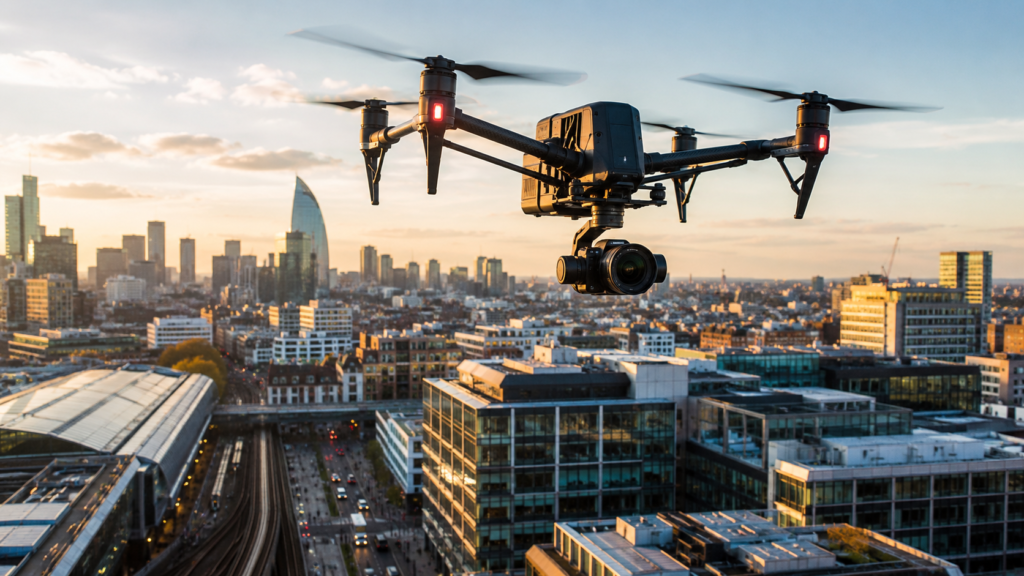
Drones profesionales
La expresión “drone profesional” no identifica una única forma de aeronave.
Puede tratarse de un multirrotor, un ala fija, un rotor único o un sistema híbrido. Lo que lo diferencia es su preparación para realizar un trabajo con determinadas exigencias de precisión, fiabilidad, seguridad y recopilación de datos.
Pueden incorporar:
- Cámaras de gran sensor.
- Cámaras térmicas.
- Sensores multiespectrales.
- Sistemas RTK.
- Cámaras intercambiables.
- Redundancia de sensores.
- Planificación de misiones.
- Compatibilidad con software especializado.
- Protección frente a condiciones ambientales.
- Sistemas avanzados de transmisión.
Se utilizan en producción audiovisual, construcción, agricultura, topografía, energía, seguridad e inspección.
Para comparar equipos orientados al trabajo puedes consultar nuestra guía de mejores drones profesionales.
Drones FPV
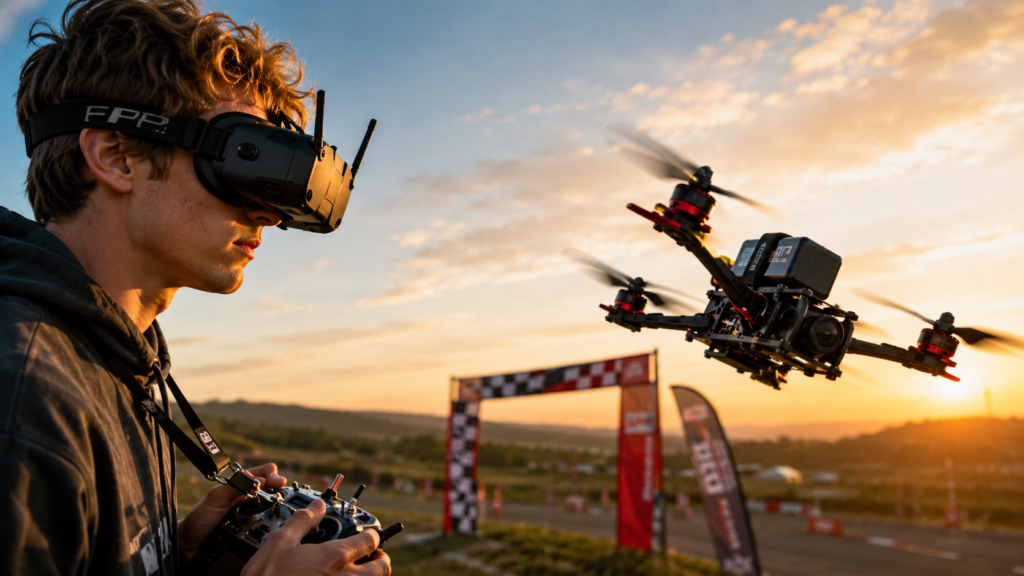
FPV significa First Person View o visión en primera persona.
El piloto recibe en tiempo real la imagen captada por la cámara del drone mediante unas gafas o una pantalla. Esto genera una experiencia de vuelo más directa e inmersiva.
Existen diferentes tipos de drones FPV:
- Modelos para principiantes.
- Tiny Whoop para interiores.
- Freestyle.
- Cinemáticos o cinewhoop.
- Largo alcance.
- Carreras.
- Sistemas FPV integrados de consumo.
Sus principales ventajas son la maniobrabilidad, la velocidad y la posibilidad de realizar grabaciones dinámicas.
Como limitaciones encontramos una curva de aprendizaje mayor, menor presencia de ayudas automáticas en determinados equipos y una necesidad superior de mantenimiento o reparación.
La guía sobre qué son los drones FPV desarrolla sus componentes, sistemas de vídeo y modalidades.
Drones de carreras
Los drones de carreras son una especialización dentro del vuelo FPV.
Están diseñados para ofrecer:
- Gran aceleración.
- Respuesta inmediata.
- Baja latencia.
- Estructura ligera.
- Alta maniobrabilidad.
- Facilidad de reparación.
No suelen priorizar la autonomía, la estabilización de cámara ni los sistemas automáticos habituales en los drones fotográficos.
Los pilotos compiten en circuitos señalizados con puertas y obstáculos. El control suele ser manual y exige práctica, coordinación y capacidad para reaccionar rápidamente.
Consulta nuestra guía sobre drones de carreras para conocer el equipo necesario y cómo empezar.
Drones agrícolas
Los drones agrícolas se utilizan para observar cultivos, recopilar datos o aplicar determinados productos.
Podemos diferenciarlos en dos grandes grupos:
- Drones de monitorización: capturan imágenes RGB, térmicas o multiespectrales.
- Drones de aplicación: transportan depósitos y sistemas de pulverización o distribución.
Entre sus usos encontramos:
- Evaluación del estado de los cultivos.
- Identificación de zonas con estrés.
- Creación de mapas.
- Seguimiento del riego.
- Detección de anomalías.
- Aplicación localizada.
- Recuento o análisis de plantas.
Los drones de monitorización pueden ser multirrotores, alas fijas o híbridos. Los de aplicación suelen utilizar configuraciones multirrotor de gran tamaño por su capacidad para volar lentamente y transportar carga.
Drones de cartografía y topografía
Estos drones están preparados para recopilar imágenes o datos que posteriormente se utilizan para crear:
- Ortomosaicos.
- Modelos tridimensionales.
- Nubes de puntos.
- Mapas de elevación.
- Mediciones de terrenos.
- Seguimiento de obras.
- Cálculos volumétricos.
Pueden incorporar sistemas RTK o PPK para mejorar la precisión del posicionamiento.
Los multirrotores resultan adecuados para superficies reducidas, zonas complejas y vuelos de precisión. Los de ala fija son más eficientes cuando deben cubrirse áreas extensas.
Drones industriales y de inspección
Los drones industriales se utilizan para observar instalaciones, medir variables o recopilar datos en entornos técnicos.
Sus aplicaciones incluyen:
- Inspección de aerogeneradores.
- Revisión de líneas eléctricas.
- Inspección de paneles solares.
- Supervisión de edificios.
- Revisión de cubiertas.
- Seguimiento de obras.
- Inspección de puentes.
- Análisis de instalaciones industriales.
Dependiendo de la tarea pueden incorporar:
- Cámara con zoom.
- Cámara térmica.
- Iluminación.
- Sensores de gas.
- LiDAR.
- Protección frente al polvo o la humedad.
- Sistemas de posicionamiento de alta precisión.
Su principal ventaja es que permiten acceder a lugares complicados y reducir la exposición de trabajadores a determinados riesgos.
Drones de seguridad y emergencias
Los servicios de emergencia pueden utilizar drones para obtener una vista aérea rápida de una situación.
Entre sus posibles aplicaciones encontramos:
- Búsqueda de personas.
- Observación de incendios.
- Evaluación de accidentes.
- Inspección de zonas de difícil acceso.
- Apoyo en operaciones de rescate.
- Obtención de imágenes térmicas.
- Evaluación de daños.
Estos equipos suelen priorizar la fiabilidad, la transmisión en directo, el zoom, la cámara térmica y la capacidad para operar en condiciones exigentes.
Drones de reparto y logística
Los drones de reparto están diseñados para transportar pequeños paquetes, suministros o material entre puntos determinados.
Pueden utilizar:
- Configuración multirrotor.
- Ala fija.
- Diseño híbrido VTOL.
Los multirrotores resultan adecuados para entregas precisas a corta distancia. Los sistemas híbridos o de ala fija pueden resultar más eficientes para rutas largas.
Los principales retos de esta categoría son la capacidad de carga, la autonomía, la seguridad de la operación y la integración en el espacio aéreo.
Diferencias entre drones recreativos, profesionales y FPV
| Característica | Recreativo | Profesional | FPV |
| Objetivo | Ocio y aprendizaje | Trabajo y recopilación de datos | Vuelo inmersivo |
| Diseño habitual | Multirrotor | Multirrotor, ala fija o VTOL | Multirrotor |
| Facilidad inicial | Alta | Media | Baja o media |
| Modos automáticos | Habituales | Avanzados o especializados | Variables |
| Cámara | Básica o intermedia | Profesional o especializada | Cámara de pilotaje y, a veces, grabación |
| Reparación | Normalmente modular limitada | Servicio técnico especializado | Frecuentemente reparable por piezas |
| Autonomía | Media | Depende de la misión | Normalmente reducida |
| Usuario | Principiante o aficionado | Profesional o empresa | Aficionado avanzado o piloto especializado |
Un drone FPV también puede utilizarse profesionalmente y un drone recreativo puede incorporar una cámara de gran calidad. La tabla refleja su orientación habitual, no categorías completamente cerradas.
Qué tipo de drone elegir según tus necesidades
Antes de escoger una categoría, define cuál será la tarea principal.
| Necesidad | Tipo recomendado |
| Aprender a pilotar | Multirrotor recreativo |
| Viajar y grabar | Multirrotor compacto con cámara |
| Fotografía y vídeo | Drone con cámara y gimbal |
| Vídeo dinámico | FPV o cinewhoop |
| Competición | FPV de carreras |
| Cartografiar una finca pequeña | Multirrotor con cámara adecuada |
| Cubrir grandes superficies | Ala fija o híbrido VTOL |
| Inspeccionar una estructura | Multirrotor industrial |
| Agricultura de precisión | Agrícola de monitorización |
| Aplicar productos | Multirrotor agrícola de carga |
| Transportar pequeños paquetes | Multirrotor o híbrido VTOL |
| Trabajo audiovisual avanzado | Drone profesional con cámara de gran sensor |
También debes valorar:
- Nivel de experiencia.
- Presupuesto total.
- Baterías y accesorios necesarios.
- Facilidad de transporte.
- Disponibilidad de repuestos.
- Calidad de cámara.
- Autonomía real.
- Resistencia al viento.
- Sistemas de seguridad.
- Software compatible.
- Requisitos legales de la operación.
El tipo de aeronave también puede afectar a la formación y a la forma de operar. Antes de volar, consulta la normativa para drones en España.
Cuando tengas definida la categoría que necesitas, puedes consultar nuestra comparativa de mejores drones del mercado.
Conclusión
Los drones pueden clasificarse por su diseño, su sistema de pilotaje, su equipamiento o la tarea que realizan.
Los multirrotores destacan por su estabilidad y capacidad para mantenerse suspendidos. Los drones de ala fija ofrecen mayor eficiencia para recorrer grandes superficies. Los híbridos VTOL combinan despegue vertical y vuelo horizontal, mientras que los drones FPV priorizan la experiencia inmersiva y la maniobrabilidad.
Después de identificar el diseño adecuado, debes escoger una categoría adaptada al uso: recreativo, fotografía, competición, agricultura, cartografía, inspección o trabajo profesional.
Preguntas frecuentes sobre los tipos de drones
No existe una única cifra porque pueden clasificarse mediante diferentes criterios. Según su diseño destacan los multirrotores, los de rotor único, los de ala fija y los híbridos VTOL. Existen numerosos tipos de drones, pero las categorías más conocidas son:
Drones recreativos.
Drones con cámara.
Drones profesionales.
Drones FPV.
Drones de carreras.
Drones agrícolas.
Drones industriales.
Cada uno está diseñado para necesidades y usuarios diferentes.
Entre los usuarios particulares, el cuadricóptero es la configuración más habitual por su estabilidad, tamaño, facilidad de control y capacidad para despegar verticalmente.
El multirrotor utiliza varias hélices, puede despegar verticalmente y mantenerse suspendido. El ala fija necesita desplazarse para generar sustentación y suele ser más eficiente en recorridos largos.
Es una aeronave capaz de despegar y aterrizar verticalmente. Los modelos híbridos pueden utilizar rotores durante el despegue y alas durante el desplazamiento horizontal.
Es una categoría por equipamiento y aplicación, no un diseño aerodinámico. La mayoría de drones con cámara son multirrotores, aunque también existen alas fijas con sistemas de captura.
Dependerá del sector.
Por ejemNo exactamente. Los drones de carreras pertenecen al mundo FPV, pero el FPV también incluye vuelo freestyle, cinewhoop, largo alcance y modelos orientados al aprendizaje.
Un cuadricóptero recreativo estable, con modos asistidos, repuestos disponibles y una aplicación sencilla suele ser la opción más adecuada.
Generalmente los drones de ala fija ofrecen una mayor eficiencia para recorrer largas distancias. La autonomía concreta depende del peso, la batería, la propulsión, la carga y las condiciones de vuelo.
Se utilizan multirrotores, alas fijas y sistemas híbridos. La elección depende de si se pretende monitorizar cultivos, cartografiar terrenos o transportar y aplicar productos.
No.
Aunque actualmente la mayoría de drones modernos incorporan GPS para drones, especialmente los modelos recreativos avanzados y profesionales, todaLos multirrotores son habituales porque pueden mantenerse quietos y acercarse lentamente a una estructura. Pueden incorporar cámaras térmicas, zoom, LiDAR u otros sensores.
No. Un drone profesional puede ser compacto si cumple las necesidades del trabajo. Lo que lo define es su adecuación, fiabilidad, precisión y equipamiento, no únicamente su tamaño.
Sí. Un mismo drone puede ser multirrotor, profesional, FPV y llevar cámara. Cada término describe un aspecto distinto de la aeronave o de su utilización.