
- Qué es la inteligencia artificial generativa
- Diferencias entre IA predictiva, discriminativa y generativa
- Cómo funciona la IA generativa paso a paso
- Principales tipos de modelos generativos
- Qué contenido puede crear la IA generativa
- Qué es un prompt y por qué influye en el resultado
- Diferencia entre generar, recuperar y editar contenido
- Aplicaciones prácticas de la IA generativa
- Ventajas de la IA generativa
- Riesgos y limitaciones de la IA generativa
- Cómo utilizar IA generativa de forma responsable
- Transparencia del contenido generado por IA
- Conclusión
- Preguntas frecuentes sobre IA generativa
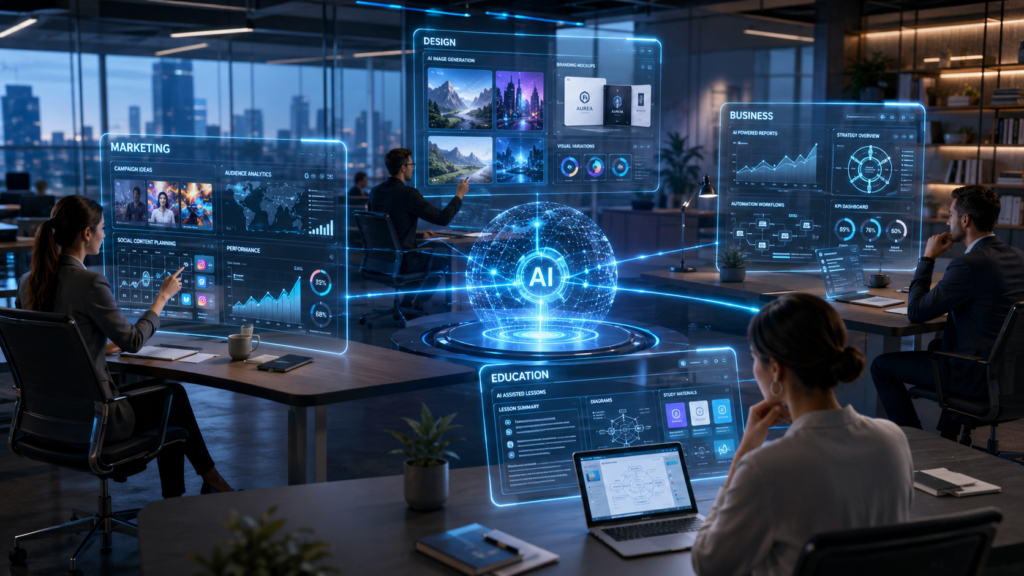
La IA generativa permite crear texto, imágenes, vídeo, audio, código y otros contenidos a partir de una instrucción, una imagen de referencia, un documento o diferentes tipos de datos.
Estos sistemas no funcionan como una base de datos que simplemente copia una respuesta almacenada. Utilizan modelos entrenados para representar patrones y generar una salida probable según el contexto recibido.
Sin embargo, que un contenido sea nuevo no significa automáticamente que sea correcto, original desde el punto de vista jurídico o adecuado para publicarlo sin revisión.
En esta guía aprenderás qué es la IA generativa, cómo funciona, qué tipos de modelos existen, qué puede crear y qué controles debes aplicar para utilizarla de manera responsable.
Para conocer previamente las principales ramas, aplicaciones, ventajas y riesgos de la IA, puedes consultar nuestra guía completa de inteligencia artificial.
Qué es la inteligencia artificial generativa
La inteligencia artificial generativa es una categoría de IA diseñada para producir nuevas salidas a partir de patrones aprendidos durante su entrenamiento.
Puede generar:
- Texto.
- Imágenes.
- Vídeo.
- Voz.
- Música.
- Código.
- Diseños.
- Presentaciones.
- Datos sintéticos.
- Modelos tridimensionales.
El resultado se construye a partir de una entrada proporcionada por el usuario o por otro sistema.
Esa entrada puede ser:
- Una instrucción escrita.
- Una pregunta.
- Una fotografía.
- Un boceto.
- Un documento.
- Un archivo de audio.
- Una secuencia de vídeo.
- Datos estructurados.
- Una combinación de varios formatos.
La salida es sintética porque ha sido producida por el modelo.
No debe asumirse que sea verdadera, inédita, legalmente original o apta para cualquier utilización.
Diferencias entre IA predictiva, discriminativa y generativa
Los sistemas pueden clasificarse según el tipo de resultado que producen.
| Tipo | Función principal | Ejemplo |
|---|---|---|
| IA predictiva | Estima un valor o resultado futuro | Previsión de demanda |
| Modelo discriminativo | Clasifica o diferencia entradas | Detección de spam |
| IA generativa | Produce una nueva salida | Generación de texto o imagen |
| Sistema híbrido | Combina análisis y generación | Analiza un documento y redacta un informe |
Un modelo discriminativo podría calcular si una imagen contiene un perro o un gato.
Un modelo generativo podría producir una imagen nueva a partir de la instrucción:
Crea una ilustración de un perro y un gato viajando en tren.
En una aplicación real, ambas capacidades pueden combinarse. Un sistema puede analizar una imagen, recuperar información, clasificarla y posteriormente generar una explicación.
Por tanto, “predictiva” y “generativa” no siempre representan productos completamente separados, sino capacidades que pueden formar parte del mismo servicio.
Cómo funciona la IA generativa paso a paso
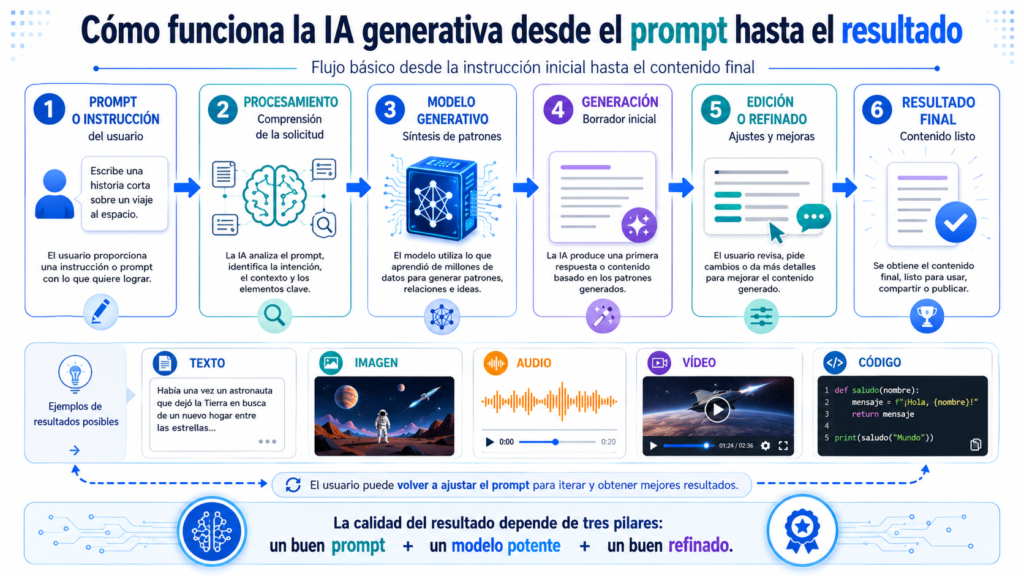
El proceso exacto depende del modelo, pero puede resumirse en cinco fases.
Entrenamiento del modelo
Durante el entrenamiento, el modelo analiza grandes conjuntos de datos para aprender relaciones estadísticas y representaciones.
Dependiendo del formato, puede aprender:
- Estructuras del lenguaje.
- Relaciones entre palabras.
- Formas.
- Colores.
- Texturas.
- Sonidos.
- Movimiento.
- Patrones de código.
- Relaciones entre texto e imagen.
El modelo no almacena necesariamente cada ejemplo como un archivo que posteriormente recuperará.
Ajusta numerosos parámetros internos que le permiten representar patrones y producir resultados.
El origen, calidad, diversidad y permisos asociados a los datos influyen en el comportamiento final.
La explicación completa sobre datos, entrenamiento, modelos e inferencia se encuentra en nuestra guía sobre cómo funciona una inteligencia artificial.
Prompt y datos de entrada
El prompt es la instrucción o información que recibe el sistema.
Puede indicar:
- La tarea.
- El contexto.
- El formato.
- El público.
- El estilo.
- Las restricciones.
- Los datos que debe utilizar.
- Los elementos que debe evitar.
Ejemplo poco preciso:
Escribe un texto sobre marketing.
Ejemplo más útil:
Redacta una introducción de 150 palabras para propietarios de pequeñas tiendas online. Explica cómo la IA puede ayudar a organizar consultas de clientes, sin prometer incrementos de ventas.
La segunda instrucción reduce la ambigüedad y permite generar un resultado más adaptado.
Contexto y representación
La aplicación transforma la entrada en una representación que el modelo pueda procesar.
En un modelo de lenguaje, el texto suele dividirse en unidades llamadas tokens.
Un token puede representar:
- Una palabra.
- Parte de una palabra.
- Un signo.
- Un símbolo.
- Parte de un código.
El modelo analiza los tokens y el contexto disponible para estimar qué salida resulta más probable.
En sistemas multimodales también pueden procesarse imágenes, audio, vídeo o documentos.
Generación probabilística
El modelo produce el resultado progresivamente.
En un modelo de lenguaje, calcula probabilidades sobre posibles tokens posteriores y selecciona una secuencia según su configuración.
En un modelo de imagen, el proceso puede comenzar con ruido y transformarlo gradualmente hasta obtener una imagen coherente con la instrucción.
La generación probabilística explica por qué:
- Una misma instrucción puede producir resultados diferentes.
- El sistema puede ofrecer varias versiones.
- Una respuesta puede parecer convincente y ser incorrecta.
- Pequeños cambios en el prompt pueden alterar mucho la salida.
Resultado y revisión
La salida generada debe evaluarse antes de utilizarla.
Comprueba:
- Exactitud.
- Coherencia.
- Fuentes.
- Ortografía.
- Datos personales.
- Posibles sesgos.
- Similitudes problemáticas.
- Adecuación al público.
- Derechos de utilización.
- Cumplimiento de la finalidad.
La generación no representa el final del proceso.
En trabajos profesionales, el flujo correcto suele ser:
Objetivo → Prompt → Generación → Revisión → Corrección → Validación → Publicación
Principales tipos de modelos generativos
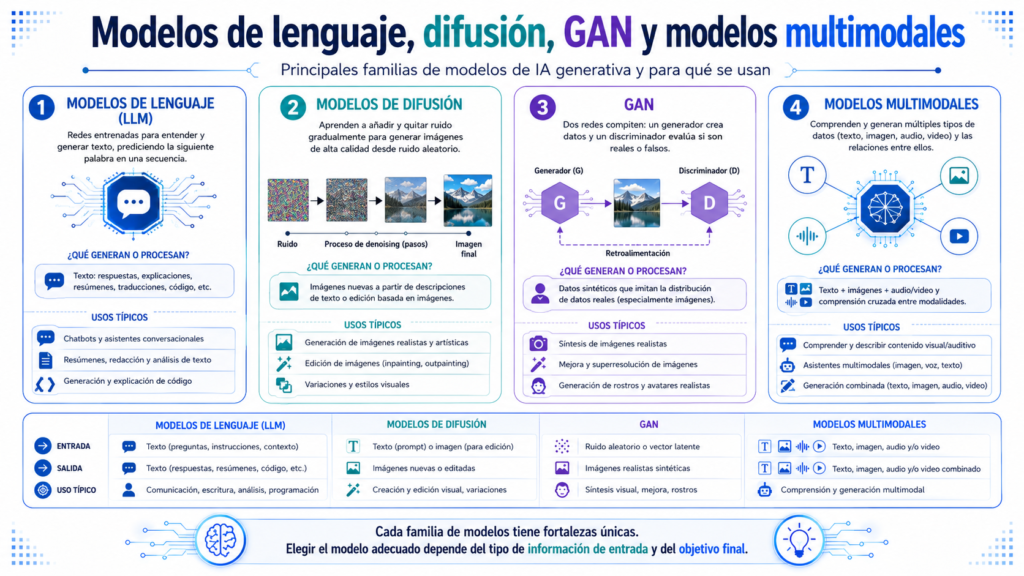
No existe una única arquitectura para generar todos los formatos.
Modelos de lenguaje y transformers
Los modelos de lenguaje están entrenados para trabajar con secuencias de texto o código.
Los grandes modelos de lenguaje, conocidos como LLM, pueden utilizarse para:
- Redactar.
- Resumir.
- Traducir.
- Responder preguntas.
- Extraer información.
- Generar código.
- Reorganizar documentos.
- Mantener conversaciones.
Muchos modelos modernos utilizan arquitecturas transformer, capaces de procesar relaciones dentro del contexto mediante mecanismos de atención.
El modelo estima qué tokens pueden continuar la secuencia.
Esto no significa que simplemente copie una frase existente. Genera una salida según las relaciones representadas en sus parámetros y el contexto recibido.
Sin embargo, predecir una secuencia probable tampoco garantiza que el contenido sea verdadero.
Modelos de difusión
Los modelos de difusión se utilizan especialmente para generar y editar imágenes y vídeo.
Durante el entrenamiento aprenden a invertir un proceso de degradación o adición de ruido.
De forma simplificada:
- Se parte de una representación con ruido.
- El modelo elimina ruido progresivamente.
- La instrucción condiciona el proceso.
- La imagen adquiere estructura, formas y detalles.
- Se produce el resultado final.
También pueden utilizar:
- Una imagen de referencia.
- Una máscara.
- Un boceto.
- Una pose.
- Un mapa de profundidad.
- Una composición previa.
Esto permite realizar tareas como:
- Texto a imagen.
- Imagen a imagen.
- Relleno de zonas.
- Ampliación.
- Cambio de estilo.
- Edición localizada.
- Generación de vídeo.
Redes generativas adversarias
Las GAN o redes generativas adversarias utilizan dos componentes:
- Un generador.
- Un discriminador.
El generador intenta producir muestras similares a los datos reales.
El discriminador intenta distinguir las muestras reales de las generadas.
Durante el entrenamiento, ambos mejoran mediante esta competición.
Las GAN han sido utilizadas para crear imágenes, rostros sintéticos, datos y transformaciones visuales. Actualmente conviven con modelos de difusión y otras arquitecturas generativas.
Modelos multimodales
Un modelo multimodal puede procesar o generar varios formatos.
Por ejemplo:
- Recibir texto e imagen.
- Interpretar un documento.
- Responder sobre un gráfico.
- Generar una imagen a partir de texto.
- Analizar audio y producir un resumen.
- Combinar vídeo, voz y lenguaje.
La multimodalidad no significa que el sistema comprenda todos los formatos con la misma precisión.
Cada modalidad puede presentar capacidades y limitaciones diferentes.
Modelos fundacionales
Un modelo fundacional es un modelo de gran escala entrenado sobre información amplia y reutilizable para numerosas tareas.
Puede servir como base para:
- Asistentes.
- Generadores.
- Buscadores.
- Agentes.
- Herramientas empresariales.
- Aplicaciones especializadas.
Posteriormente puede adaptarse mediante:
- Instrucciones.
- Ajuste fino.
- Datos específicos.
- Recuperación de documentos.
- Herramientas.
- Reglas y filtros.
No todas las aplicaciones de IA generativa entrenan su propio modelo desde cero. Muchas integran un modelo fundacional dentro de un producto más amplio.
Qué contenido puede crear la IA generativa
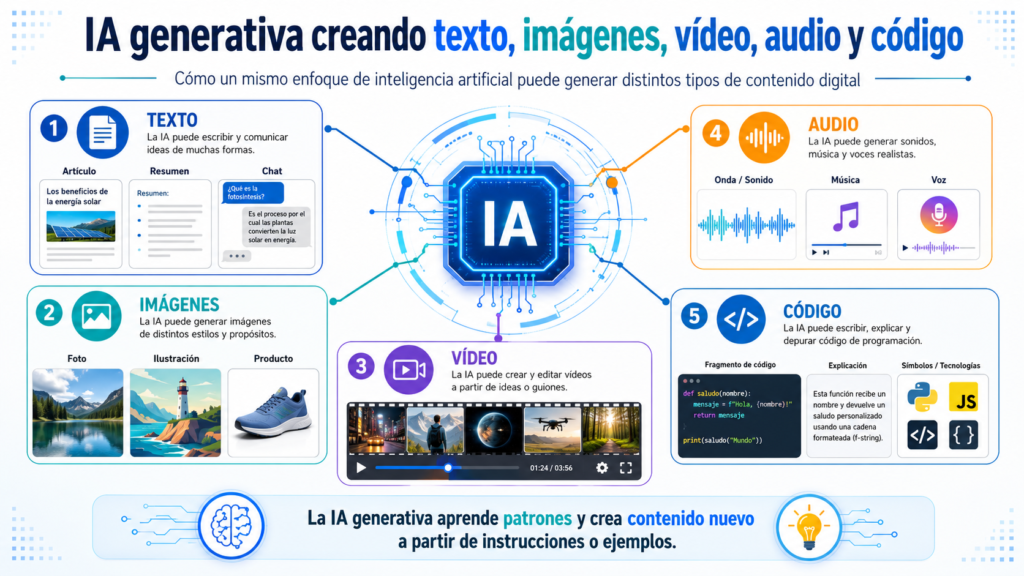
Generación de texto
Puede ayudar a producir:
- Borradores.
- Correos.
- Resúmenes.
- Guiones.
- Descripciones.
- Informes iniciales.
- Preguntas.
- Esquemas.
- Traducciones.
- Variaciones de un mensaje.
El contenido necesita revisión porque el modelo puede:
- Inventar datos.
- Omitir información.
- Repetirse.
- Utilizar un tono genérico.
- Confundir fechas.
- Producir citas inexistentes.
Para comparar asistentes de texto puedes consultar nuestra guía sobre ChatGPT, Gemini y Claude.
Generación de imágenes
Puede generar:
- Ilustraciones.
- Fotografía sintética.
- Diseños conceptuales.
- Imágenes publicitarias.
- Variaciones de producto.
- Fondos.
- Texturas.
- Infografías iniciales.
- Bocetos.
- Personajes.
La calidad depende de:
- Modelo.
- Resolución.
- Prompt.
- Referencias.
- Composición.
- Edición posterior.
- Coherencia anatómica y espacial.
Nuestra guía sobre cómo crear imágenes con inteligencia artificial explica las herramientas y el proceso práctico.
Generación de vídeo
Los modelos de vídeo pueden producir:
- Clips desde texto.
- Animaciones.
- Movimiento a partir de imágenes.
- Escenas publicitarias.
- Transiciones.
- Avatares.
- Vídeo con voz sintética.
- Variaciones de una secuencia.
Entre sus principales dificultades se encuentran:
- Coherencia entre fotogramas.
- Física.
- Movimiento.
- Continuidad de personajes.
- Texto dentro de la escena.
- Control exacto de cámara.
- Duración y coste.
Generación de audio, voz y música
Puede utilizarse para:
- Narraciones.
- Voces sintéticas.
- Doblaje.
- Traducción de voz.
- Efectos.
- Música.
- Limpieza o reconstrucción de audio.
- Prototipos sonoros.
El uso de voces reales requiere especial precaución.
Clonar una voz sin consentimiento puede generar problemas de privacidad, suplantación, derechos y fraude.
Generación de código
Los modelos pueden:
- Proponer funciones.
- Crear pruebas.
- Explicar código.
- Generar documentación.
- Traducir entre lenguajes.
- Sugerir refactorizaciones.
- Encontrar posibles errores.
- Crear prototipos.
El código generado debe revisarse y probarse.
Puede contener:
- Vulnerabilidades.
- Dependencias inexistentes.
- Funciones obsoletas.
- Errores lógicos.
- Problemas de rendimiento.
- Fragmentos incompatibles.
Diseños y modelos tridimensionales
La IA generativa también puede ayudar en:
- Diseño industrial.
- Arquitectura conceptual.
- Moda.
- Modelado tridimensional.
- Diseño de interfaces.
- Optimización de formas.
- Prototipado.
- Creación de activos para videojuegos.
Normalmente funciona como apoyo al diseño y necesita adaptación técnica antes de fabricar o implementar el resultado.
Qué es un prompt y por qué influye en el resultado
Un prompt es la entrada que guía la generación.
Puede incluir:
- Instrucción.
- Contexto.
- Ejemplos.
- Formato.
- Restricciones.
- Datos.
- Rol.
- Criterios de evaluación.
Una estructura útil es:
Objetivo:
Qué debe realizar.

Contexto:
Información necesaria.

Público:
Quién utilizará el resultado.

Formato:
Cómo debe responder.

Restricciones:
Qué debe evitar.

Criterios:
Cómo se evaluará.
El prompt mejora el resultado, pero no puede garantizar exactitud.
Una instrucción excelente no corrige:
- Datos de entrenamiento inadecuados.
- Falta de acceso a información.
- Limitaciones del modelo.
- Errores en las fuentes.
- Una tarea fuera de su capacidad.
La guía sobre cómo escribir mejores prompts contiene ejemplos prácticos para distintas tareas.
Diferencia entre generar, recuperar y editar contenido
Una aplicación moderna puede combinar varias funciones.
Generar
El modelo produce una nueva salida.
Ejemplo:
Crear una descripción de producto.
Recuperar
El sistema busca información dentro de documentos, bases de datos o Internet.
Ejemplo:
Encontrar las especificaciones de un producto en una base documental.
Editar
El sistema transforma un contenido existente.
Ejemplo:
Eliminar el fondo de una fotografía o resumir un documento.
Utilizar herramientas
El sistema llama a una función externa.
Ejemplo:
Consultar una base de datos, realizar un cálculo o crear un evento.
Por tanto, no todo lo que hace una aplicación de IA procede exclusivamente del modelo generativo.
Puede combinar generación, búsqueda, software tradicional, herramientas y revisión humana.
Aplicaciones prácticas de la IA generativa
Puede utilizarse como apoyo en:
- Ideación.
- Creación de borradores.
- Diseño conceptual.
- Atención al cliente.
- Formación.
- Marketing.
- Programación.
- Investigación inicial.
- Prototipado.
- Documentación.
- Personalización.
- Automatización.
Su utilidad aumenta cuando:
- La tarea admite revisión.
- Existe una persona responsable.
- El resultado puede verificarse.
- Se protege la información sensible.
- El modelo se utiliza dentro de un proceso claro.
- Se mide el valor real.
Para conocer casos de uso por sectores, consulta nuestra guía sobre las aplicaciones de la inteligencia artificial.
Ventajas de la IA generativa
Velocidad para crear primeras versiones
Puede generar rápidamente:
- Ideas.
- Esquemas.
- Borradores.
- Variaciones.
- Prototipos.
Esto no significa que el resultado final sea inmediato. El tiempo ahorrado debe compararse con el trabajo de revisión.
Exploración de alternativas
Permite probar diferentes:
- Tonos.
- Composiciones.
- Diseños.
- Enfoques.
- Escenarios.
- Soluciones.
Accesibilidad
Las interfaces conversacionales permiten utilizar determinadas capacidades sin necesidad de programar.
Personalización
Puede adaptar una salida según:
- Público.
- Nivel.
- idioma.
- Formato.
- Contexto.
- Necesidad.
Apoyo creativo y técnico
Puede ayudar a superar una página en blanco, organizar ideas o explorar una solución inicial.
No sustituye automáticamente el criterio, la experiencia o la responsabilidad profesional.
Riesgos y limitaciones de la IA generativa
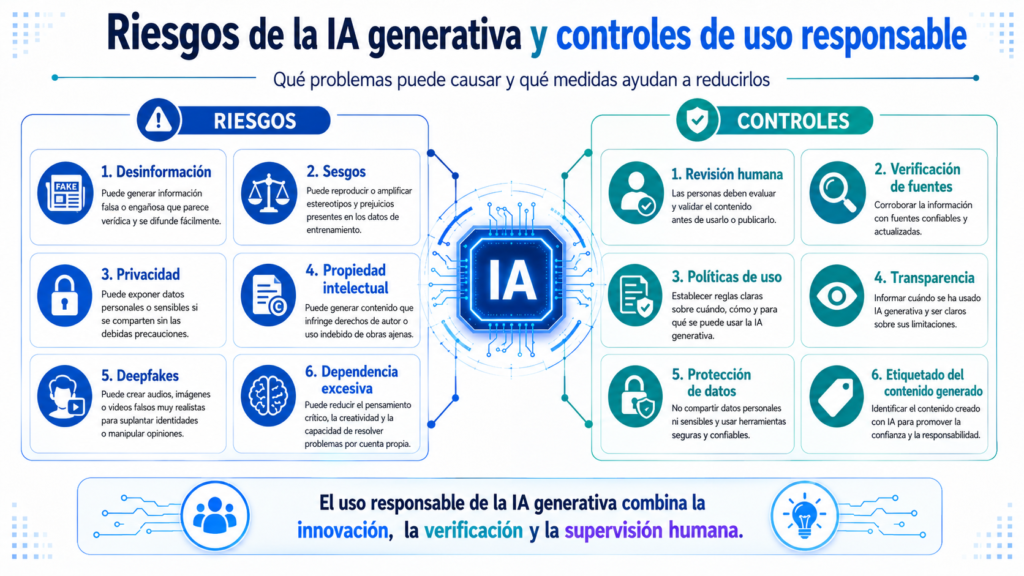
Alucinaciones y errores
Los modelos pueden generar:
- Datos falsos.
- Fuentes inexistentes.
- Fechas incorrectas.
- Cálculos erróneos.
- Citas inventadas.
- Explicaciones convincentes pero equivocadas.
Todo contenido factual importante debe verificarse.
Sesgos
Los patrones aprendidos pueden reproducir:
- Estereotipos.
- Desequilibrios.
- Omisiones.
- Diferencias de representación.
- Asociaciones injustas.
La revisión debe valorar no solo la calidad formal, sino también quién puede verse afectado.
Privacidad y datos confidenciales
No debes introducir información sensible sin comprobar:
- Política de privacidad.
- Uso de datos.
- Retención.
- Ubicación del servicio.
- Configuración de entrenamiento.
- Acceso de terceros.
- Condiciones empresariales.
Ejemplos de información sensible:
- Datos personales.
- Contratos.
- Información médica.
- Contraseñas.
- Estrategias.
- Código privado.
- Datos financieros.
- Información de clientes.
Derechos de autor y procedencia
Antes de utilizar un resultado debes valorar:
- Condiciones de la plataforma.
- Origen de los datos.
- Licencias.
- Posibles similitudes.
- Marcas.
- Derechos de imagen.
- Derechos de voz.
- Uso comercial.
- Requisitos de atribución.
Que una plataforma permita descargar el contenido no significa que garantice su uso en cualquier contexto.
Deepfakes y desinformación
La generación de imágenes, vídeo y voz puede utilizarse para:
- Suplantar personas.
- Fabricar pruebas.
- Manipular declaraciones.
- Crear noticias falsas.
- Engañar a clientes.
- Realizar fraudes.
El contenido sintético debe identificarse cuando su naturaleza pueda inducir a error.
Seguridad y prompt injection
Una aplicación conectada a documentos o herramientas puede recibir instrucciones maliciosas.
Un ataque de prompt injection intenta hacer que el sistema ignore sus reglas, revele información o realice acciones indebidas.
Los controles pueden incluir:
- Permisos mínimos.
- Separación de datos.
- Validación de acciones.
- Filtrado.
- Confirmación humana.
- Registros.
- Límites.
- Pruebas de seguridad.
Dependencia y pérdida de criterio
Utilizar IA sin revisar puede provocar:
- Pérdida de conocimientos.
- Contenido uniforme.
- Errores repetidos.
- Menor capacidad crítica.
- Dependencia de una plataforma.
- Falta de responsabilidad.
La IA debe apoyar el proceso, no eliminar la comprensión de la tarea.
Cómo utilizar IA generativa de forma responsable
Antes de generar:
- Define la finalidad.
- Comprueba si puedes utilizar los datos.
- Evita introducir información confidencial.
- Elige una herramienta adecuada.
- Establece qué necesita revisión humana.
Después de generar:
- Verifica datos y fuentes.
- Comprueba cálculos.
- Revisa sesgos.
- Evalúa posibles similitudes.
- Corrige el tono.
- Confirma derechos y permisos.
- Identifica el contenido sintético cuando corresponda.
- Conserva responsabilidad editorial.
Para tareas repetitivas puedes establecer un flujo:
Entrada autorizada
→ Generación
→ Validación automática
→ Revisión humana
→ Aprobación
→ Publicación
→ Seguimiento
Transparencia del contenido generado por IA
La transparencia es especialmente importante cuando el contenido puede confundirse con una grabación, declaración o creación humana real.
En la Unión Europea, el Reglamento de Inteligencia Artificial establece obligaciones de transparencia para determinados contenidos sintéticos.
Entre otras medidas, exige que los proveedores de sistemas que generan audio, imagen, vídeo o texto sintético permitan detectar que el contenido ha sido generado o manipulado artificialmente.
También establece obligaciones para determinados deepfakes y textos generados con la finalidad de informar al público sobre asuntos de interés general, con excepciones y condiciones específicas.
Estas obligaciones generales del artículo 50 comienzan a aplicarse el 2 de agosto de 2026.
La transparencia no debe limitarse a cumplir una norma.
También ayuda a:
- Mantener la confianza.
- Evitar engaños.
- Atribuir responsabilidad.
- Explicar el proceso.
- Diferenciar creación, edición y generación.
- Facilitar la verificación.
Conclusión
La IA generativa produce contenido nuevo a partir de patrones aprendidos y del contexto proporcionado.
Los modelos de lenguaje generan secuencias de texto o código. Los modelos de difusión producen y editan imágenes o vídeo. Las GAN utilizan un generador y un discriminador, mientras que los modelos multimodales combinan diferentes formatos.
La calidad del resultado depende del modelo, los datos, el prompt, el contexto y el proceso de revisión.
Por ello, utilizar IA generativa correctamente requiere:
- Instrucciones claras.
- Datos autorizados.
- Verificación.
- Protección de la privacidad.
- Control de seguridad.
- Revisión de derechos.
- Transparencia.
- Responsabilidad humana.
Preguntas frecuentes sobre IA generativa
Es una categoría de inteligencia artificial capaz de producir texto, imágenes, vídeo, audio, código u otros contenidos a partir de una entrada.
Aprende patrones durante el entrenamiento y utiliza esos patrones para generar una salida probable según el prompt y el contexto.
No funciona normalmente como una base de datos que recupera una copia exacta, pero puede producir similitudes y también integrarse con sistemas de búsqueda o documentos. El resultado debe revisarse.
Crea una salida nueva, pero eso no garantiza originalidad jurídica, ausencia de similitudes ni derechos exclusivos sobre el resultado.
La predictiva estima valores, probabilidades o resultados. La generativa produce contenido.
Es un modelo entrenado para trabajar con secuencias de texto o código y estimar posibles continuaciones según el contexto.
Es un modelo que aprende a transformar ruido en una representación estructurada, frecuentemente condicionado por texto o imágenes.
Es una arquitectura que entrena conjuntamente un generador y un discriminador para crear muestras similares a los datos reales.
Es un modelo capaz de procesar o generar más de un formato, como texto, imagen, audio o vídeo.
Sí. Es una aplicación basada en modelos generativos capaz de producir texto, código y otros tipos de salida según las funciones disponibles.
Depende de la aplicación. El modelo puede no tener acceso directo, pero el producto puede conectarlo a búsqueda, herramientas o bases de datos.
Porque genera resultados probables según patrones y contexto, no porque compruebe automáticamente que cada afirmación sea verdadera.
Depende de las condiciones de la plataforma, el contenido generado, las referencias utilizadas, las leyes aplicables y los derechos de terceros.
Solo después de comprobar las políticas, configuración, tratamiento y retención de datos. No introduzcas información confidencial en herramientas no autorizadas.
Depende del contenido, el contexto y la normativa aplicable. En la Unión Europea existen obligaciones específicas de transparencia para determinados contenidos sintéticos y deepfakes.