
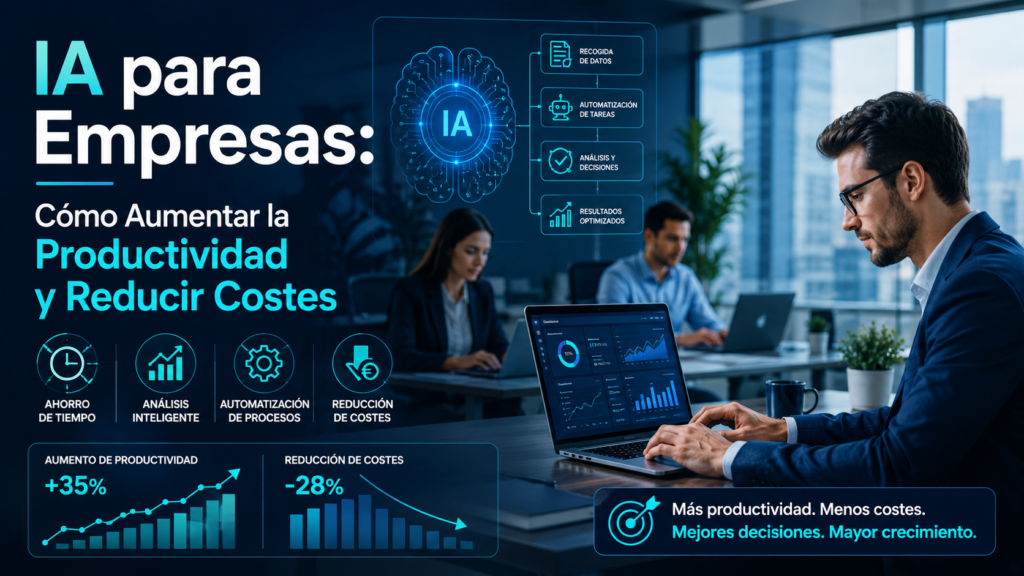
- IA para Empresas
- Por qué la Inteligencia Artificial es importante para las empresas
- Beneficios de implementar IA en una empresa
- Áreas de una empresa donde la IA genera más impacto
- Las mejores herramientas de IA para empresas
- ChatGPT para empresas
- Claude para análisis empresarial
- Gemini para productividad empresarial
- Microsoft Copilot para oficinas y equipos de trabajo
- n8n: automatización avanzada para empresas
- Zapier: automatización sencilla para pequeñas empresas
- Casos reales de uso de IA en empresas
- Qué departamentos deberían implementar IA primero
- Cómo implementar Inteligencia Artificial en una empresa paso a paso
- Errores comunes al implementar IA en empresas
- IA para pymes: una oportunidad histórica
- Conclusión
- Sigue aprendiendo sobre Inteligencia Artificial
- Preguntas frecuentes sobre IA para empresas
IA para Empresas
La Inteligencia Artificial para empresas ya no es una tecnología reservada para grandes corporaciones.
Actualmente, pequeñas empresas, autónomos, startups y multinacionales están utilizando herramientas basadas en IA para automatizar tareas, mejorar la productividad y reducir costes operativos.
De hecho, muchas organizaciones están descubriendo que la inteligencia artificial no sólo permite trabajar más rápido, sino también tomar mejores decisiones y ofrecer un mejor servicio a sus clientes.
El problema es que muchas empresas todavía no saben por dónde empezar.
Escuchan constantemente términos como:
- ChatGPT para empresas
- automatización con IA
- IA para productividad
- IA para atención al cliente
- IA para marketing
Pero no tienen claro cómo aplicar estas tecnologías en su negocio.
En esta guía descubrirás cómo utilizar la inteligencia artificial en empresas, qué herramientas ofrecen mejores resultados y cuáles son las áreas donde la IA puede generar un mayor impacto.
Por qué la Inteligencia Artificial es importante para las empresas
La principal ventaja de la IA para negocios es que permite automatizar tareas que anteriormente requerían intervención humana constante.
Esto genera beneficios muy claros:
- Mayor productividad.
- Reducción de costes.
- Menos errores.
- Procesos más rápidos.
- Mejor experiencia del cliente.
- Mayor capacidad de crecimiento.
Por ejemplo, una empresa puede utilizar inteligencia artificial para responder consultas de clientes, generar informes, crear contenido o analizar datos sin necesidad de aumentar su plantilla.
Este tipo de mejoras pueden tener un impacto enorme en la rentabilidad.
Beneficios de implementar IA en una empresa
Cada organización es diferente, pero existen ventajas que prácticamente cualquier negocio puede aprovechar.
Aumento de la productividad
Uno de los principales beneficios de la inteligencia artificial empresarial es la capacidad de realizar tareas repetitivas en cuestión de segundos.
Por ejemplo:
- Redacción de correos.
- Elaboración de informes.
- Clasificación de documentos.
- Gestión de datos.
- Atención básica al cliente.
Esto permite que los empleados dediquen más tiempo a tareas estratégicas.
Reducción de costes operativos
La automatización reduce la necesidad de dedicar recursos a tareas manuales y repetitivas.
No significa sustituir personas.
Significa utilizar mejor el tiempo disponible.
Muchas empresas descubren que pueden aumentar su producción sin necesidad de aumentar proporcionalmente los costes.
Mejora en la toma de decisiones
La IA puede analizar grandes cantidades de información y detectar patrones difíciles de identificar manualmente.
Esto ayuda a:
- Identificar oportunidades.
- Detectar riesgos.
- Analizar tendencias.
- Optimizar estrategias.
Especialmente útil en áreas como marketing, ventas o finanzas.
Mejor experiencia del cliente
Los consumidores esperan respuestas rápidas y personalizadas.
Las herramientas de IA permiten ofrecer soporte prácticamente inmediato.
Por ejemplo:
- Chatbots.
- Asistentes virtuales.
- Automatización de correos.
- Recomendaciones personalizadas.
Esto mejora significativamente la satisfacción del cliente.
Áreas de una empresa donde la IA genera más impacto
Una de las ventajas de la inteligencia artificial es su versatilidad.
Prácticamente cualquier departamento puede beneficiarse de ella.
Sin embargo, existen algunas áreas donde el impacto suele ser especialmente elevado.
Atención al cliente
La atención al cliente es una de las aplicaciones más populares de la IA para empresas.
Los asistentes inteligentes pueden responder preguntas frecuentes, gestionar incidencias simples y ofrecer soporte continuo.
Beneficios:
- Disponibilidad 24/7.
- Menos carga para el equipo.
- Respuestas inmediatas.
- Mayor satisfacción del cliente.
Marketing digital
La inteligencia artificial está transformando completamente el marketing.
Actualmente puede ayudar a:
- Crear contenido.
- Optimizar campañas.
- Analizar audiencias.
- Investigar palabras clave.
- Automatizar correos electrónicos.
Por este motivo muchas agencias y departamentos de marketing utilizan herramientas como ChatGPT diariamente.
Ventas
La IA también puede mejorar enormemente los procesos comerciales.
Por ejemplo:
- Calificación de leads.
- Análisis de clientes potenciales.
- Automatización de seguimientos.
- Predicción de ventas.
Esto permite aumentar la eficiencia de los equipos comerciales.
Recursos Humanos
Los departamentos de RRHH están incorporando inteligencia artificial para:
- Filtrar currículums.
- Analizar perfiles.
- Automatizar procesos de selección.
- Gestionar documentación.
Reduciendo así gran parte del trabajo administrativo.
Las mejores herramientas de IA para empresas
Una de las preguntas más frecuentes que se hacen empresarios, autónomos y responsables de departamentos es:
¿Qué herramientas de Inteligencia Artificial debería utilizar en mi empresa?
La respuesta dependerá del tamaño del negocio, los objetivos y los procesos que quieras optimizar.
Sin embargo, actualmente existen varias soluciones que destacan claramente por encima del resto.
ChatGPT para empresas
Cuando hablamos de IA para empresas, ChatGPT suele ser una de las primeras herramientas que vienen a la mente.
Su principal ventaja es la versatilidad.
Puede utilizarse prácticamente en cualquier departamento:
- Marketing.
- Ventas.
- Atención al cliente.
- Recursos Humanos.
- Formación.
- Administración.
Por ejemplo, muchas empresas utilizan ChatGPT para:
- Redactar correos profesionales.
- Crear informes.
- Elaborar propuestas comerciales.
- Generar contenido SEO.
- Diseñar estrategias de marketing.
- Crear documentación interna.
Ejemplo práctico
Una empresa puede pedir:
Actúa como director comercial.

Redacta una propuesta para un cliente interesado en servicios de consultoría tecnológica.

Incluye beneficios, objeciones frecuentes y llamada a la acción.
Lo que antes requería horas de trabajo puede obtenerse en minutos.
Ventajas de ChatGPT para empresas
✅ Fácil implementación.
✅ Muy versátil.
✅ Ahorro de tiempo.
✅ Gran capacidad de adaptación.
✅ Amplia comunidad y documentación.
Claude para análisis empresarial
Mientras que ChatGPT destaca por su versatilidad, Claude sobresale en tareas relacionadas con análisis y documentación.
Muchas empresas trabajan diariamente con:
- Contratos.
- Informes.
- Estudios de mercado.
- Documentación interna.
- Procedimientos.
Y aquí Claude ofrece una gran ventaja.
Su capacidad para analizar grandes cantidades de texto permite extraer información valiosa de forma rápida y eficiente.
Casos de uso habituales
- Análisis de contratos.
- Resumen de informes.
- Documentación técnica.
- Procedimientos internos.
- Consultoría empresarial.
Por este motivo muchas empresas están incorporando Claude en departamentos de gestión, operaciones y estrategia.
Gemini para productividad empresarial
Las empresas que trabajan dentro del ecosistema Google suelen encontrar en Gemini una solución especialmente interesante.
Su integración con:
- Gmail.
- Google Drive.
- Google Docs.
- Google Workspace.
permite mejorar considerablemente la productividad.
Aplicaciones habituales
- Gestión de documentos.
- Organización de información.
- Colaboración entre equipos.
- Automatización de tareas administrativas.
Gemini resulta especialmente útil para empresas que ya utilizan herramientas de Google como parte central de su operativa diaria.
Microsoft Copilot para oficinas y equipos de trabajo
Microsoft ha integrado la inteligencia artificial directamente en herramientas utilizadas diariamente por millones de empresas.
Gracias a Microsoft Copilot, ahora es posible utilizar IA dentro de:
- Word.
- Excel.
- Outlook.
- Teams.
- PowerPoint.
Esto permite automatizar numerosas tareas cotidianas.
Ejemplos prácticos
En Excel
- Análisis de datos.
- Creación de informes.
- Detección de tendencias.
En Word
- Redacción de documentos.
- Resúmenes automáticos.
- Corrección de textos.
En Outlook
- Redacción de correos.
- Gestión de respuestas.
- Organización de tareas.
Para muchas organizaciones, Copilot representa una de las formas más sencillas de introducir inteligencia artificial sin cambiar sus herramientas habituales.
n8n: automatización avanzada para empresas
Si existe una herramienta que está revolucionando la productividad empresarial actualmente, esa es n8n.
A diferencia de otras soluciones, n8n permite crear flujos de trabajo automatizados conectando múltiples aplicaciones.
Por ejemplo:
- Formularios web.
- CRM.
- Gmail.
- Google Sheets.
- WordPress.
- ChatGPT.
- Slack.
Todo puede integrarse dentro de un mismo proceso automatizado.
Ejemplo real
Imagina que un cliente rellena un formulario en tu página web.
Automáticamente:
- Se registra en tu CRM.
- Se crea una tarea comercial.
- Se envía un correo personalizado.
- Se genera un resumen mediante IA.
- Se notifica al equipo de ventas.
Todo ello sin intervención humana.
Este tipo de automatizaciones permiten ahorrar cientos de horas de trabajo al año.
Zapier: automatización sencilla para pequeñas empresas
Otra herramienta muy popular es Zapier.
Su filosofía es similar a n8n, aunque suele estar más orientada a usuarios que buscan una configuración sencilla.
Permite conectar miles de aplicaciones sin necesidad de conocimientos técnicos avanzados.
Es una excelente opción para:
- Autónomos.
- Pequeñas empresas.
- Equipos reducidos.
- Negocios digitales.
Casos reales de uso de IA en empresas
Muchas organizaciones ya están obteniendo resultados extraordinarios gracias a la inteligencia artificial.
Veamos algunos ejemplos prácticos.
Empresa de marketing digital
Utiliza ChatGPT para:
- Crear contenido.
- Generar ideas.
- Diseñar estrategias.
- Automatizar informes.
Resultado:
Mayor productividad y reducción de tiempos de ejecución.
Ecommerce
Utiliza IA para:
- Atención al cliente.
- Recomendación de productos.
- Creación de fichas.
- Automatización de emails.
Resultado:
Incremento de ventas y mejora de la experiencia de compra.
Consultoría empresarial
Utiliza Claude para analizar documentación y generar informes.
Resultado:
Reducción drástica del tiempo dedicado a tareas administrativas.
Empresa de servicios
Implementa n8n para automatizar procesos internos.
Resultado:
Menos errores, más eficiencia y mejor seguimiento de clientes.
Qué departamentos deberían implementar IA primero
Una de las preguntas más habituales es:
¿Dónde debería empezar una empresa?
La respuesta suele ser bastante clara.
Las áreas que normalmente generan un retorno más rápido son:
Marketing
- Contenido.
- SEO.
- Redes sociales.
- Email marketing.
Atención al cliente
- Chatbots.
- Automatización de respuestas.
- Gestión de incidencias.
Administración
- Informes.
- Procesamiento documental.
- Gestión de datos.
Ventas
- Seguimiento de leads.
- Automatización comercial.
- Análisis de oportunidades.
Estas áreas suelen ofrecer resultados visibles en poco tiempo y permiten demostrar rápidamente el valor de la inteligencia artificial dentro de la organización.
Cómo implementar Inteligencia Artificial en una empresa paso a paso
Uno de los errores más comunes que cometen muchas organizaciones es pensar que la implementación de Inteligencia Artificial para empresas requiere grandes presupuestos, equipos técnicos complejos o proyectos millonarios.
La realidad actual es muy diferente.
Hoy en día cualquier empresa, incluso una pequeña pyme o un autónomo, puede empezar a utilizar herramientas de IA con una inversión mínima.
La clave está en avanzar paso a paso.
Paso 1: Identificar tareas repetitivas
Antes de elegir herramientas, conviene analizar qué tareas consumen más tiempo dentro de la empresa.
Por ejemplo:
- Responder correos.
- Elaborar informes.
- Crear contenido.
- Gestionar documentación.
- Introducir datos manualmente.
- Atender consultas frecuentes.
Estas tareas suelen ser excelentes candidatas para automatización.
Paso 2: Priorizar procesos con alto impacto
No es necesario automatizar toda la empresa desde el primer día.
Lo recomendable es empezar por aquellas áreas donde la IA puede generar resultados rápidos.
Normalmente suelen ser:
- Marketing.
- Atención al cliente.
- Administración.
- Ventas.
- Recursos humanos.
De esta forma es más sencillo medir resultados y justificar futuras inversiones.
Paso 3: Elegir las herramientas adecuadas
No todas las empresas necesitan las mismas soluciones.
Algunas opciones habituales son:
| Necesidad | Herramienta recomendada |
|---|---|
| Creación de contenido | ChatGPT |
| Productividad empresarial | Copilot |
| Investigación y análisis | Claude |
| Ecosistema Google | Gemini |
| Automatización avanzada | n8n |
| Automatización sencilla | Zapier |
Lo importante es empezar con pocas herramientas y dominarlas correctamente.
Paso 4: Formar al equipo
La tecnología por sí sola no genera resultados.
Las personas deben aprender a utilizarla correctamente.
Por ello es recomendable invertir tiempo en:
- Formación interna.
- Creación de procedimientos.
- Buenas prácticas.
- Seguridad y privacidad.
Las empresas que mejor aprovechan la IA suelen ser aquellas cuyos equipos entienden cómo integrarla en su trabajo diario.
Paso 5: Medir resultados
Toda implementación debe evaluarse mediante indicadores claros.
Por ejemplo:
- Horas ahorradas.
- Reducción de costes.
- Incremento de ventas.
- Productividad.
- Satisfacción del cliente.
Esto permite identificar qué procesos generan más valor y cuáles necesitan ajustes.
Errores comunes al implementar IA en empresas
La adopción de la inteligencia artificial ofrece enormes ventajas, pero también puede generar frustraciones si se realiza incorrectamente.
Estos son algunos de los errores más habituales.
Intentar automatizarlo todo desde el principio
Muchas empresas quieren transformar todos sus procesos de golpe.
Esto suele generar:
- Confusión.
- Resistencia interna.
- Problemas de implementación.
Es mucho más eficaz empezar con proyectos pequeños y escalarlos progresivamente.
Elegir herramientas sin una estrategia clara
La popularidad de la IA ha provocado la aparición de cientos de soluciones diferentes.
Sin embargo, utilizar muchas herramientas no significa obtener mejores resultados.
Lo importante es que cada herramienta resuelva un problema concreto.
No formar a los empleados
La inteligencia artificial no sustituye automáticamente los conocimientos del equipo.
Si los trabajadores no entienden cómo utilizarla correctamente, el retorno será muy limitado.
Ignorar la supervisión humana
Aunque la IA puede automatizar numerosos procesos, siempre debe existir supervisión humana en tareas críticas.
Especialmente cuando hablamos de:
- Finanzas.
- Aspectos legales.
- Recursos humanos.
- Atención al cliente compleja.
La combinación de inteligencia artificial y criterio humano suele ofrecer los mejores resultados.
No medir el retorno de la inversión
Muchas empresas implementan herramientas de IA sin establecer métricas claras.
Esto dificulta enormemente evaluar si la inversión está generando beneficios reales.
IA para pymes: una oportunidad histórica
Durante años, muchas tecnologías avanzadas estuvieron reservadas para grandes corporaciones.
La inteligencia artificial está cambiando esa situación.
Actualmente una pequeña empresa puede acceder a herramientas que hace apenas unos años sólo estaban al alcance de multinacionales.
Por ejemplo:
- Creación de contenido automatizada.
- Atención al cliente inteligente.
- Automatización de procesos.
- Análisis de datos.
- Productividad empresarial.
Esto permite competir en mejores condiciones y acelerar el crecimiento del negocio.
Por este motivo la IA para pymes se ha convertido en una de las tendencias empresariales más importantes de los últimos años.
Conclusión
La IA para empresas ya no es una tecnología del futuro.
Es una herramienta real que está ayudando a organizaciones de todos los tamaños a mejorar su productividad, reducir costes y optimizar procesos.
Desde asistentes inteligentes como ChatGPT, Claude o Gemini, hasta plataformas de automatización como n8n o Zapier, las posibilidades son enormes.
La clave no está en implementar inteligencia artificial por moda.
La clave está en identificar procesos donde realmente aporte valor.
Las empresas que empiecen a adoptar estas tecnologías de forma estratégica tendrán una ventaja competitiva cada vez mayor en los próximos años.
Y lo más importante:
Nunca ha sido tan fácil comenzar.
Sigue aprendiendo sobre Inteligencia Artificial
La IA está transformando la forma en que trabajamos, aprendemos y gestionamos negocios. Si quieres seguir profundizando en este campo, te recomendamos las siguientes guías:
👉 Todo lo que necesitas saber sobre Inteligencia Artificial
👉 Qué es la Inteligencia Artificial y cómo funciona
👉 Tipos de Inteligencia Artificial
👉 Aplicaciones de la Inteligencia Artificial
👉 Mejores herramientas de IA
👉 ChatGPT vs Gemini vs Claude
👉 Cómo usar ChatGPT paso a paso
👉 IA para estudiantes
👉 Automatización con IA
Estas guías te ayudarán a descubrir nuevas oportunidades para aprovechar la inteligencia artificial tanto a nivel profesional como empresarial.
Preguntas frecuentes sobre IA para empresas
La Inteligencia Artificial para empresas consiste en utilizar herramientas y sistemas inteligentes para automatizar tareas, mejorar procesos, aumentar la productividad y optimizar la toma de decisiones.
La IA puede ayudar a reducir costes, ahorrar tiempo, automatizar tareas repetitivas, mejorar la atención al cliente, aumentar ventas y facilitar la toma de decisiones.
Prácticamente cualquier organización puede beneficiarse de la IA.
Desde autónomos y pequeñas empresas hasta grandes corporaciones.
Dependerá del objetivo.
ChatGPT para contenido y productividad.
Claude para análisis documental.
Gemini para usuarios de Google.
Copilot para Microsoft 365.
n8n para automatización avanzada.
La IA está diseñada principalmente para automatizar tareas repetitivas y aumentar la productividad.
En la mayoría de casos actúa como complemento del trabajo humano.
Actualmente existen herramientas gratuitas y planes muy asequibles.
Muchas empresas pueden comenzar a utilizar IA con una inversión mínima.
Las áreas donde normalmente se obtiene un retorno más rápido son:
Marketing.
Ventas.
Atención al cliente.
Administración.
Recursos humanos.
Las pequeñas empresas pueden:
Automatizar procesos.
Reducir costes.
Ahorrar tiempo.
Mejorar la productividad.
Competir de forma más eficiente.
No necesariamente.
La mayoría de herramientas actuales están diseñadas para usuarios sin conocimientos técnicos avanzados.
Todo indica que la inteligencia artificial será una pieza fundamental de la transformación digital empresarial durante los próximos años.