
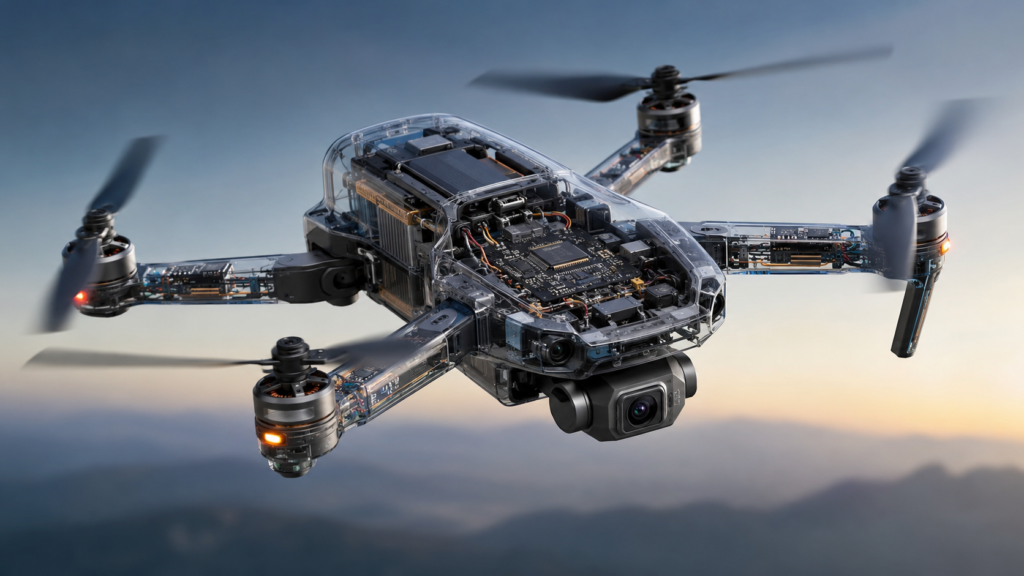
Qué es un drone y cómo funciona: componentes y tecnología
Un drone es mucho más que una cámara con hélices. Para mantenerse en el aire necesita coordinar motores, sensores, sistemas de posicionamiento, comunicaciones inalámbricas y un software capaz de realizar correcciones constantes durante el vuelo.
Cuando el piloto mueve una palanca del mando, la orden se transmite al drone, la controladora calcula cómo debe responder y los motores modifican su velocidad. Al mismo tiempo, los sensores comprueban la inclinación, la altura, la orientación y la posición para mantener la aeronave estable.
En esta guía aprenderás qué es un drone, qué piezas lo componen y cómo trabajan conjuntamente sus motores, hélices, sensores, GPS, controladora de vuelo y sistemas de seguridad.
Para obtener una visión más amplia sobre sus usos, categorías, normativa y criterios de elección, puedes consultar nuestra guía completa sobre drones.
Qué es un drone y qué significan UAV y UAS
Un drone o dron es una aeronave que puede volar sin llevar un piloto a bordo. Puede controlarse a distancia, ejecutar maniobras asistidas o seguir determinadas instrucciones programadas mediante su sistema de vuelo.
Aunque suelen utilizarse como sinónimos, los términos drone, UAV y UAS no significan exactamente lo mismo:
- Drone o dron: término común utilizado para referirse a una aeronave no tripulada.
- UAV: siglas de Unmanned Aerial Vehicle. Se refiere principalmente a la aeronave.
- UAS: siglas de Unmanned Aircraft System. Incluye la aeronave, el mando o estación de control, los enlaces de comunicación y los demás elementos necesarios para operar.
Tampoco todos los drones tienen cuatro hélices. Existen multirrotores, modelos de ala fija y configuraciones híbridas. Estas diferencias se desarrollan en nuestra guía sobre los diferentes tipos de drones.
En este artículo nos centraremos principalmente en el funcionamiento de los drones multirrotor, que son los más habituales entre los usuarios particulares.
Por qué puede volar un drone
Un multirrotor vuela gracias al empuje generado por sus hélices.
Los motores hacen girar las hélices a gran velocidad y desplazan aire hacia abajo. Como reacción, se genera una fuerza en sentido contrario que impulsa la aeronave hacia arriba.
Sustentación, empuje y peso
Para despegar, el empuje conjunto de las hélices debe superar el peso del drone.
Cuando el empuje y el peso se equilibran, la aeronave puede mantenerse aproximadamente a la misma altura. Si aumenta el empuje, asciende; si disminuye, desciende.
En un cuadricóptero, dos hélices suelen girar en un sentido y las otras dos en sentido contrario. Esta configuración ayuda a compensar el par de giro y permite controlar la orientación de la aeronave.
Los cuatro movimientos: throttle, pitch, roll y yaw
El desplazamiento de un drone se controla mediante cuatro órdenes fundamentales:
- Throttle o potencia: regula el empuje conjunto y permite ascender o descender.
- Pitch o cabeceo: inclina la aeronave hacia delante o hacia atrás.
- Roll o alabeo: la inclina hacia la izquierda o la derecha.
- Yaw o guiñada: hace que gire sobre su eje vertical.
Para avanzar, por ejemplo, la controladora reduce y aumenta ligeramente la potencia de determinados motores. El drone se inclina hacia delante y parte del empuje comienza a desplazarlo horizontalmente.
La estabilidad depende de que estas variaciones sean rápidas, coordinadas y proporcionales a las órdenes del piloto.
Partes principales de un drone
Aunque la configuración cambia según el modelo, la mayoría de los multirrotores comparten los siguientes componentes:
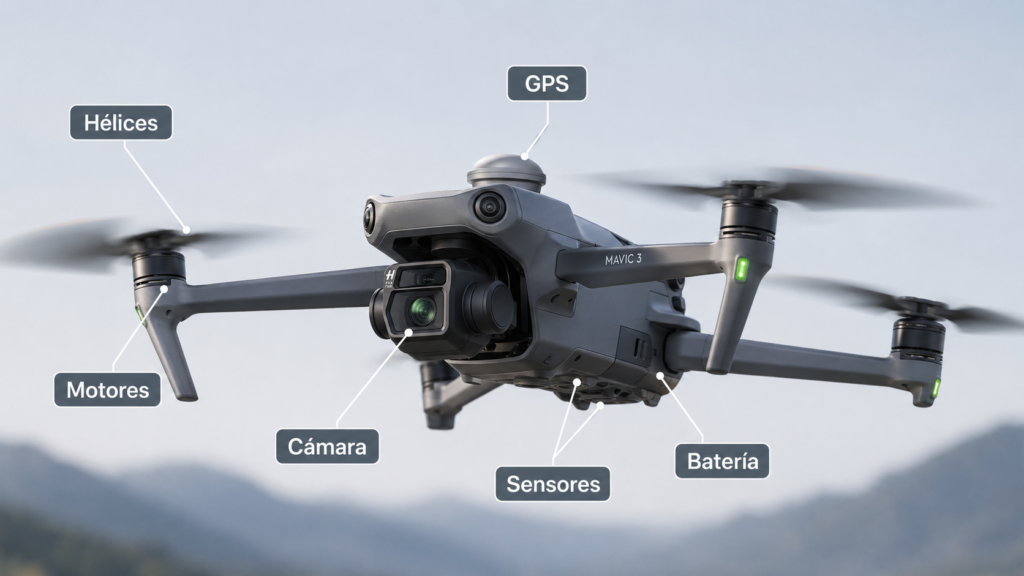
| Componente | Función principal |
|---|---|
| Chasis o estructura | Sostiene y protege los componentes |
| Motores | Transforman la energía eléctrica en movimiento |
| Hélices | Generan el empuje necesario para volar |
| ESC | Regulan la velocidad de cada motor |
| Batería | Suministra energía a los motores y la electrónica |
| Controladora de vuelo | Procesa órdenes y estabiliza la aeronave |
| IMU | Mide aceleración y velocidad de rotación |
| Barómetro | Ayuda a estimar y mantener la altura |
| Magnetómetro | Proporciona una referencia de orientación |
| GPS o GNSS | Ayuda a calcular la posición |
| Receptor y antenas | Reciben las órdenes del mando |
| Sistema de transmisión | Envía telemetría e imagen al piloto |
| Cámara | Captura fotografías o vídeos |
| Gimbal | Estabiliza y orienta la cámara |
| Firmware | Gestiona el funcionamiento electrónico |
Chasis
El chasis es la estructura sobre la que se montan los motores, la batería y los componentes electrónicos.
Debe ser suficientemente rígido para mantener la geometría del drone y, al mismo tiempo, ligero para no aumentar innecesariamente el consumo de energía.
Motores y hélices
Los motores convierten la energía eléctrica en movimiento rotatorio. Las hélices transforman ese movimiento en empuje.
El tamaño, la forma y la inclinación de las hélices influyen en la eficiencia, el ruido, la velocidad y la capacidad de carga.
Reguladores electrónicos de velocidad
Los ESC, o reguladores electrónicos de velocidad, controlan la potencia enviada a cada motor.
La controladora transmite continuamente instrucciones a los ESC para acelerar o reducir la velocidad de los motores. Sin esta regulación independiente, el drone no podría estabilizarse ni cambiar de dirección con precisión.
Batería
La mayoría de los drones utiliza baterías de litio, principalmente LiPo o Li-ion.
La autonomía real depende de factores como:
- Capacidad de la batería.
- Peso de la aeronave.
- Velocidad.
- Temperatura.
- Viento.
- Maniobras realizadas.
- Accesorios instalados.
- Estado y antigüedad de la batería.
El tiempo anunciado por los fabricantes suele obtenerse en condiciones favorables, por lo que la duración real puede ser inferior.
Controladora de vuelo
La controladora es el sistema central que coordina el vuelo.
Recibe las órdenes del piloto, consulta los sensores, calcula la respuesta necesaria y determina cuánta potencia debe enviar cada ESC a su motor.
También gestiona funciones como:
- Estabilización.
- Modos de vuelo.
- Posicionamiento.
- Retorno al punto de origen.
- Limitaciones de altura o distancia.
- Avisos de batería.
- Respuesta ante pérdida de señal.
Cómo funciona un drone paso a paso
El funcionamiento puede entenderse como un circuito continuo entre el piloto, la controladora, los motores y los sensores.
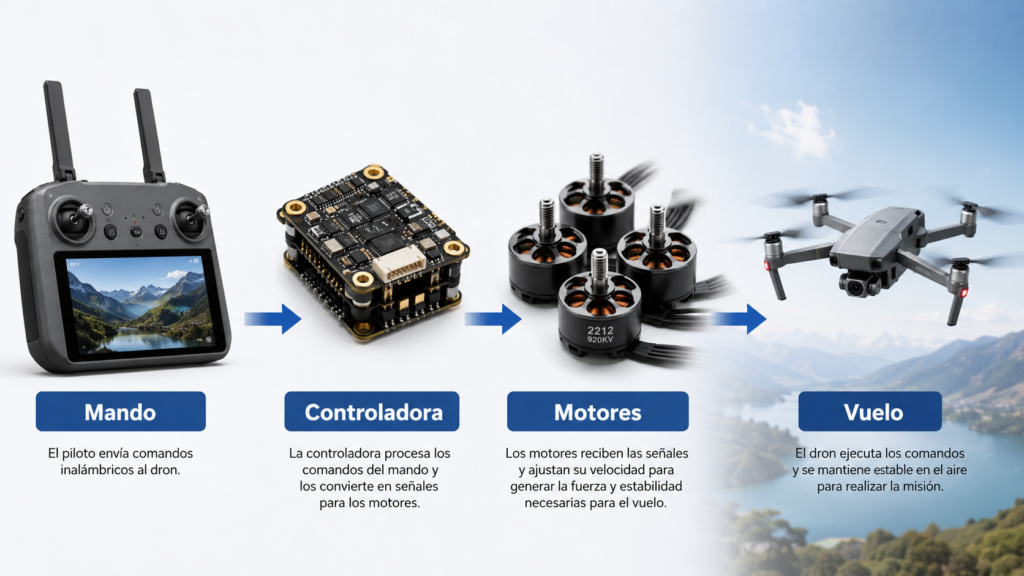
1. Inicialización de los sistemas
Al encender el drone, la controladora comprueba el estado de la batería, los sensores, los motores, las comunicaciones y el sistema de posicionamiento.
Durante esta fase puede establecerse el punto de origen y realizarse comprobaciones de la IMU, la brújula o el sistema visual.
El piloto no debería despegar hasta que la aplicación confirme que los sistemas necesarios están disponibles.
2. Envío de la orden
El piloto mueve una palanca, pulsa un botón o selecciona una función automática.
El mando convierte esa acción en una señal digital y la transmite mediante el enlace de control.
3. Procesamiento de la controladora
La controladora recibe la orden y la compara con el estado actual de la aeronave.
Para realizar el cálculo utiliza información como:
- Inclinación.
- Velocidad de rotación.
- Altura estimada.
- Orientación.
- Posición.
- Velocidad de desplazamiento.
- Estado de la batería.
4. Regulación de los motores
Después de calcular la maniobra, la controladora envía una instrucción a cada ESC.
Los reguladores modifican la potencia de los motores. Las diferencias de velocidad entre ellos hacen que el drone ascienda, descienda, se incline o gire.
5. Corrección mediante sensores
Los sensores comprueban si el movimiento real coincide con el solicitado.
Cuando detectan una desviación, la controladora vuelve a ajustar los motores. Este proceso se repite continuamente durante el vuelo y forma un sistema de control en bucle cerrado.
Gracias a estas correcciones, un drone asistido puede nivelarse, mantener la altura o conservar una posición pese a pequeñas perturbaciones.
6. Envío de telemetría y vídeo
Mientras vuela, la aeronave envía información al mando o a la aplicación.
Esta telemetría puede incluir:
- Nivel de batería.
- Altura.
- Distancia.
- Velocidad.
- Calidad de la señal.
- Número de satélites.
- Estado de sensores.
- Avisos de seguridad.
Cuando existe una cámara, también puede transmitirse vídeo en tiempo real.
Qué sensores utiliza un drone
Los sensores permiten que la controladora conozca el estado aproximado de la aeronave.
No todos los modelos incluyen los mismos sistemas y su comportamiento puede cambiar según el entorno.
IMU: giroscopio y acelerómetro
La IMU o unidad de medición inercial suele integrar, entre otros elementos, un giroscopio y un acelerómetro.
El giroscopio mide la velocidad de rotación sobre los diferentes ejes. El acelerómetro detecta aceleraciones y ayuda a estimar la orientación y los movimientos.
La controladora combina estos datos para determinar si el drone se está inclinando o girando y aplicar las correcciones necesarias.
Barómetro
El barómetro mide los cambios de presión atmosférica y ayuda a estimar variaciones de altura.
Es especialmente útil para mantener una altitud relativamente estable, aunque la presión puede cambiar por las condiciones meteorológicas y otros factores.
Magnetómetro o brújula
El magnetómetro proporciona una referencia de orientación respecto al campo magnético terrestre.
Puede verse afectado por:
- Estructuras metálicas.
- Vehículos.
- Líneas eléctricas.
- Altavoces.
- Imanes.
- Interferencias electromagnéticas.
Por eso no es recomendable despegar desde superficies metálicas ni ignorar los avisos de brújula de la aplicación.
GPS y otros sistemas GNSS
El receptor GNSS utiliza señales procedentes de constelaciones de satélites para estimar la posición de la aeronave.
Dependiendo del modelo, puede combinar:
- GPS.
- Galileo.
- GLONASS.
- BeiDou.
Esta información permite mantener la posición, registrar rutas y utilizar funciones automáticas.
Sensores visuales y detección de obstáculos
Algunos drones incorporan cámaras, sensores infrarrojos, ultrasonidos, sistemas de tiempo de vuelo u otras tecnologías para observar el entorno.
Pueden utilizarse para:
- Mantener la posición cerca del suelo.
- Estimar la distancia respecto a una superficie.
- Detectar obstáculos.
- Frenar.
- Rodear determinados objetos.
- Ayudar durante el aterrizaje.
Su funcionamiento puede empeorar con poca luz, superficies uniformes, objetos transparentes, ramas finas, cables, agua o movimientos rápidos.
Por tanto, la detección de obstáculos no debe interpretarse como una garantía contra colisiones.
Cómo funciona el GPS o GNSS de un drone
Aunque se habla habitualmente de “GPS”, muchos drones utilizan realmente un receptor GNSS compatible con varias constelaciones.
El receptor calcula una estimación de posición a partir de las señales recibidas. La controladora combina ese resultado con la IMU, el barómetro, la brújula y, cuando están disponibles, los sensores visuales.
Esta combinación se conoce como fusión de sensores.
Gracias al posicionamiento, el drone puede:
- Mantener una posición.
- Medir la distancia respecto al punto de origen.
- Registrar la ruta.
- Ejecutar misiones programadas.
- Activar determinadas funciones de retorno.
- Mostrar su posición en el mapa.
Sin embargo, la precisión puede reducirse cerca de edificios altos, estructuras metálicas, montañas, zonas con interferencias o lugares con mala visibilidad del cielo.
Un drone también puede volar sin GPS, pero posiblemente no mantendrá la posición horizontal de la misma manera. Su comportamiento dependerá del modo de vuelo y de los demás sensores disponibles.
Cómo se comunica el mando con el drone
La comunicación no consiste únicamente en enviar órdenes. En muchos equipos existen varios flujos de información simultáneos.
Enlace de control
Transporta las órdenes desde el mando hasta la aeronave:
- Potencia.
- Dirección.
- Orientación.
- Movimientos de cámara.
- Activación de funciones.
Su estabilidad depende del sistema utilizado, las antenas, la distancia, los obstáculos y las interferencias.
Telemetría
La telemetría envía información desde el drone hacia el piloto.
Permite supervisar el estado de la aeronave y recibir advertencias durante el vuelo.
Transmisión de vídeo
Los drones con cámara pueden enviar una imagen en directo al mando, teléfono o gafas.
La calidad y latencia de esa transmisión dependen del sistema empleado. En el vuelo inmersivo, la baja latencia adquiere especial importancia; este funcionamiento se desarrolla en nuestra guía sobre cómo funcionan los drones FPV.
Sistemas de seguridad y respuesta ante fallos
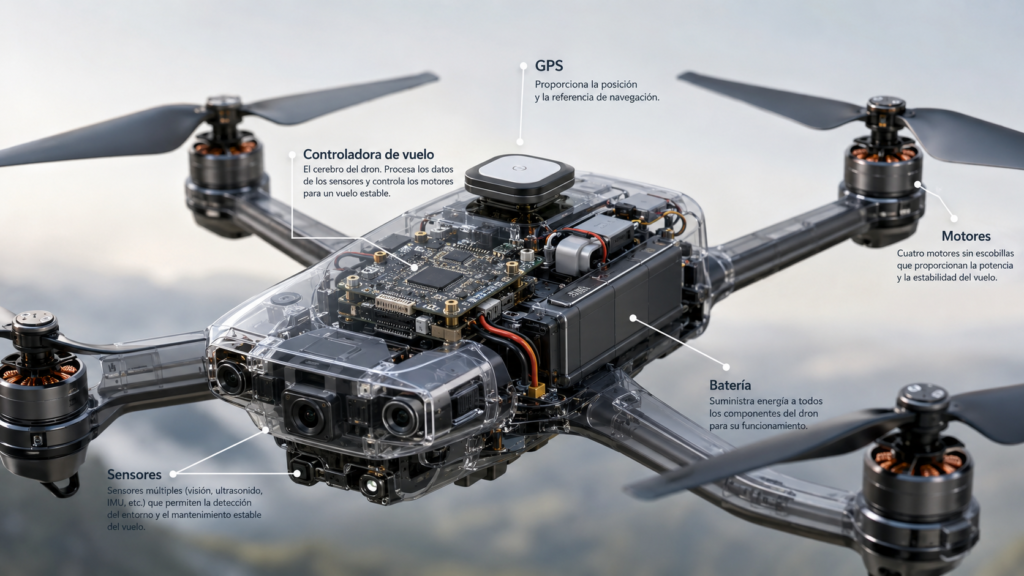
Los sistemas de seguridad reducen riesgos, pero no eliminan la responsabilidad del piloto ni garantizan que el drone pueda recuperarse ante cualquier problema.
Retorno al punto de origen
La función Return to Home o RTH intenta dirigir la aeronave hacia un punto guardado previamente.
Puede activarse manualmente o, dependiendo del modelo y la configuración, ante situaciones como:
- Pérdida prolongada de señal.
- Nivel de batería determinado.
- Orden del piloto.
Para funcionar correctamente necesita disponer de una posición válida y suficiente energía.
También debe configurarse una altura adecuada. Un drone sin sensores frontales podría iniciar el regreso y encontrar un obstáculo durante el trayecto.
Pérdida de señal
El comportamiento puede configurarse en algunos modelos para:
- Regresar.
- Mantenerse suspendido.
- Aterrizar.
La respuesta depende de la aeronave, el modo de vuelo, el posicionamiento disponible y la configuración seleccionada.
Batería baja
El sistema puede emitir advertencias, limitar determinadas funciones, recomendar el regreso o iniciar un aterrizaje.
Esperar a que la batería esté prácticamente agotada aumenta el riesgo porque el viento o la distancia pueden impedir un regreso seguro.
Detección de obstáculos
Los sensores pueden ayudar a frenar o modificar la trayectoria, pero tienen límites de distancia, ángulo, velocidad e iluminación.
Algunos modos de vuelo pueden reducir o desactivar determinadas funciones de detección.
Pérdida de GPS o interferencias
Cuando se degrada el posicionamiento, el drone puede depender de la IMU, el barómetro o el sistema visual.
Esto puede provocar que deje de mantener la posición horizontal y comience a desplazarse con el viento.
Los avisos de GPS, brújula o interferencias no deben ignorarse.
La tecnología de seguridad tampoco sustituye el cumplimiento de la normativa para drones en España.
Funciones automáticas, vuelo autónomo e inteligencia artificial
No todas las funciones automáticas utilizan inteligencia artificial.
Un drone puede seguir una ruta programada, mantener una altura o regresar al punto de origen mediante reglas, sensores y algoritmos convencionales.
Entre las funciones automáticas encontramos:
- Despegue y aterrizaje asistidos.
- Mantenimiento de posición.
- Rutas mediante puntos de paso.
- Regreso al punto de origen.
- Órbitas alrededor de un punto.
- Seguimiento de una trayectoria.
La inteligencia artificial y la visión artificial pueden utilizarse para tareas más complejas, como:
- Reconocer personas u objetos.
- Seguir un sujeto.
- Interpretar imágenes.
- Seleccionar una trayectoria.
- Analizar datos recopilados durante una misión.
Sin embargo, el grado de automatización varía mucho entre modelos. No debe asumirse que un drone puede tomar decisiones seguras por sí solo en cualquier entorno.
Conclusión
Un drone se mantiene en el aire gracias a la coordinación entre sus motores, hélices, ESC, controladora y sensores.
La controladora recibe las órdenes del piloto, calcula cómo debe responder cada motor y utiliza la información de la IMU, el barómetro, la brújula, el GNSS y los sensores visuales para corregir el movimiento.
Comprender esta cadena de funcionamiento ayuda a interpretar los avisos de la aplicación, utilizar correctamente las funciones automáticas y reaccionar mejor ante cambios de señal, batería o posicionamiento.
El siguiente paso consiste en aprender cómo volar un drone por primera vez y aplicar estos conocimientos en un entorno seguro.
Preguntas frecuentes sobre como funcionan los drones
Drone es el término común. UAV se refiere principalmente a la aeronave no tripulada y UAS incluye el conjunto completo: aeronave, control, comunicaciones y demás elementos necesarios para operar.
La controladora utiliza los datos de la IMU y otros sensores para detectar desviaciones y modificar continuamente la velocidad de los motores.
Sí, pero su comportamiento dependerá del modo de vuelo y de los sensores disponibles. Sin posicionamiento puede no mantener automáticamente la posición horizontal.
Puede estimarla combinando datos del barómetro, GNSS, sensores visuales, sistemas infrarrojos u otras tecnologías, dependiendo del modelo.
No.
La rotación opuesta ayuda a compensar el par generado por los motores y permite controlar el giro de la aeronave sobre su eje vertical.
Depende del modelo y de la configuración. Puede regresar, mantenerse suspendido o aterrizar. Estas opciones deben comprobarse antes del vuelo.
No. Algunos no tienen sensores anticolisión y otros solo detectan obstáculos en determinadas direcciones o condiciones.
No. Depende de la posición guardada, la batería, la señal, los sensores, la configuración y los obstáculos presentes en la ruta.
No. La controladora coordina la aeronave. El receptor GPS o GNSS es uno de los sistemas que le proporciona información de posición.
No. Muchas funciones automáticas utilizan algoritmos convencionales. La inteligencia artificial suele reservarse para reconocimiento, seguimiento, análisis de imágenes o planificación avanzada.