
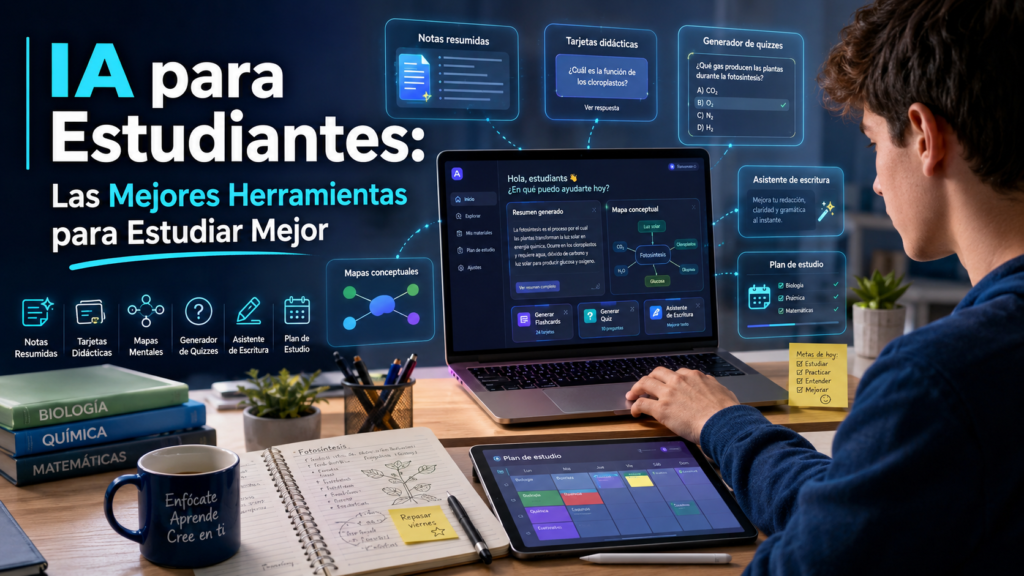
- IA para Estudiantes
- ¿Por qué la Inteligencia Artificial está revolucionando la educación?
- Beneficios de utilizar IA para estudiar
- Cómo usar la IA para estudiar correctamente
- Las mejores herramientas de IA para estudiantes
- ChatGPT para estudiantes
- Claude para resumir apuntes y documentos
- Perplexity para investigar y encontrar fuentes fiables
- Gemini para estudiantes
- Inteligencia Artificial para oposiciones
- Inteligencia Artificial para estudiantes universitarios
- IA para aprender idiomas
- Cómo usar la IA para sacar mejores notas
- Errores que los estudiantes cometen al usar IA
- El futuro de la Inteligencia Artificial en la educación
- Conclusión
- Sigue aprendiendo sobre Inteligencia Artificial
- Preguntas frecuentes sobre IA para estudiantes
IA para Estudiantes
La Inteligencia Artificial para estudiantes se ha convertido en una de las mayores revoluciones educativas de los últimos años.
Herramientas como ChatGPT, Claude, Gemini o Perplexity permiten realizar tareas que antes requerían horas de trabajo en apenas unos minutos.
Sin embargo, existe un problema.
Muchos estudiantes utilizan estas herramientas de forma incorrecta.
Piensan que la IA sirve únicamente para hacer trabajos o responder preguntas automáticamente.
La realidad es muy diferente.
Utilizada correctamente, la inteligencia artificial puede ayudarte a:
- Comprender conceptos difíciles.
- Crear resúmenes.
- Organizar apuntes.
- Preparar exámenes.
- Aprender idiomas.
- Mejorar la productividad.
- Ahorrar tiempo de estudio.
Y todo ello sin sustituir el aprendizaje real.
En esta guía descubrirás cómo utilizar la IA para estudiar, cuáles son las mejores herramientas disponibles y cómo aprovecharlas para obtener mejores resultados académicos.
¿Por qué la Inteligencia Artificial está revolucionando la educación?
La educación siempre ha tenido una limitación importante.
Los profesores deben adaptarse a grupos completos de alumnos.
Sin embargo, cada estudiante aprende de forma diferente.
Aquí es donde la inteligencia artificial aporta un enorme valor.
La IA puede actuar como un tutor personalizado disponible las 24 horas del día.
Por ejemplo:
Si no entiendes un concepto, puedes pedirle que lo explique:
- Como si tuvieras 10 años.
- Con ejemplos prácticos.
- Con nivel universitario.
- Paso a paso.
Esto permite adaptar el aprendizaje a las necesidades de cada persona.
Por ese motivo cada vez más estudiantes utilizan herramientas de inteligencia artificial para complementar sus estudios.
Beneficios de utilizar IA para estudiar
La popularidad de la inteligencia artificial para estudiantes no es casualidad.
Existen ventajas muy claras.
Aprendizaje personalizado
La IA adapta las explicaciones al nivel de cada alumno.
Algo que resulta difícil conseguir en métodos tradicionales.
Ahorro de tiempo
Tareas que antes requerían horas pueden realizarse en minutos.
Por ejemplo:
- Resumir apuntes.
- Crear esquemas.
- Organizar información.
Acceso inmediato a información
Puedes resolver dudas de forma instantánea sin necesidad de consultar múltiples fuentes.
Preparación de exámenes
La IA puede generar:
- Tests.
- Preguntas.
- Ejercicios prácticos.
- Simulacros de examen.
Mejora de la productividad
Permite dedicar más tiempo al aprendizaje y menos a tareas repetitivas.
Cómo usar la IA para estudiar correctamente
Aquí encontramos uno de los aspectos más importantes.
La IA no debe sustituir el estudio.
Debe potenciarlo.
Los mejores estudiantes suelen utilizarla para:
- Comprender mejor los temas.
- Detectar puntos débiles.
- Practicar ejercicios.
- Organizar contenidos.
- Resolver dudas.
No para copiar respuestas sin entenderlas.
Esta diferencia es fundamental para obtener resultados reales a largo plazo.
Las mejores herramientas de IA para estudiantes
Actualmente existen cientos de herramientas basadas en Inteligencia Artificial para estudiantes, pero la realidad es que sólo unas pocas ofrecen un valor realmente diferencial para el aprendizaje.
La clave no está en utilizar muchas herramientas.
La clave está en utilizar las adecuadas según el objetivo que tengas.
No es lo mismo preparar una oposición que estudiar una carrera universitaria o aprender un idioma.
Por eso vamos a analizar las mejores opciones disponibles actualmente.
ChatGPT para estudiantes
Cuando alguien busca la mejor IA para estudiantes, ChatGPT suele aparecer en la primera posición por una razón muy sencilla:
Es probablemente la herramienta más versátil del mercado.
Puede ayudarte a:
- Resolver dudas.
- Explicar conceptos difíciles.
- Crear resúmenes.
- Generar esquemas.
- Preparar exámenes.
- Aprender idiomas.
- Organizar planes de estudio.
Por ejemplo, si estás estudiando Historia y no entiendes un tema concreto, puedes escribir:
Explícame la Revolución Francesa como si fuera un profesor universitario.
O incluso:
Explícame la Revolución Francesa como si tuviera 14 años.
La capacidad de adaptar las explicaciones al nivel del alumno convierte a ChatGPT en una herramienta educativa extraordinariamente potente.
Ventajas de ChatGPT para estudiar
✅ Explicaciones personalizadas.
✅ Generación de resúmenes.
✅ Creación de ejercicios.
✅ Ayuda con trabajos académicos.
✅ Aprendizaje de idiomas.
Ideal para:
- Bachillerato.
- Universidad.
- Oposiciones.
- Formación profesional.
- Aprendizaje autodidacta.
Claude para resumir apuntes y documentos
Una de las dificultades más habituales entre los estudiantes es gestionar grandes cantidades de información.
Aquí es donde Claude destaca especialmente.
Muchos usuarios consideran que Claude es actualmente una de las mejores herramientas de IA para resumir apuntes.
Su capacidad para trabajar con documentos largos es impresionante.
Por ejemplo, puedes subir:
- Temarios.
- Apuntes.
- PDFs.
- Artículos científicos.
- Trabajos académicos.
Y solicitar:
- Resúmenes.
- Esquemas.
- Ideas principales.
- Preguntas tipo examen.
Esto resulta especialmente útil para estudiantes universitarios que manejan grandes volúmenes de contenido.
Ideal para:
- Universidad.
- Másteres.
- Investigaciones.
- Oposiciones.
Perplexity para investigar y encontrar fuentes fiables
Uno de los problemas de muchas herramientas de IA es que no siempre muestran de dónde obtienen la información.
Perplexity resuelve este problema de forma muy eficaz.
Por eso se ha convertido en una de las mejores opciones de IA para investigación académica.
A diferencia de otros asistentes, Perplexity suele mostrar:
- Fuentes.
- Referencias.
- Enlaces.
- Documentación relacionada.
Esto permite verificar fácilmente la información obtenida.
Muy útil para:
- Trabajos universitarios.
- TFG.
- TFM.
- Investigaciones.
- Búsqueda de bibliografía.
Si necesitas encontrar información fiable rápidamente, Perplexity suele ser una de las mejores alternativas.
Gemini para estudiantes
Gemini, desarrollado por Google, también ofrece ventajas muy interesantes para el ámbito educativo.
Su principal fortaleza es la integración con herramientas ampliamente utilizadas por estudiantes.
Por ejemplo:
- Google Docs.
- Google Drive.
- Gmail.
- Google Classroom.
Esto facilita enormemente la organización de materiales de estudio.
Además, Gemini destaca especialmente en:
- Investigación.
- Productividad.
- Gestión de documentos.
- Trabajo colaborativo.
Por este motivo muchos estudiantes que utilizan el ecosistema Google encuentran en Gemini un excelente compañero de estudio.
Inteligencia Artificial para oposiciones
Las oposiciones representan uno de los casos de uso más interesantes para la inteligencia artificial.
Los opositores suelen enfrentarse a:
- Temarios extensos.
- Gran volumen de información.
- Falta de tiempo.
- Necesidad de repasar constantemente.
La IA puede ayudar enormemente en estas tareas.
Por ejemplo:
Crear resúmenes automáticos
Transformar temas extensos en esquemas fáciles de repasar.
Generar preguntas tipo examen
Practicar con simulacros personalizados.
Detectar puntos débiles
Identificar áreas que necesitan más estudio.
Crear calendarios de estudio
Planificar semanas o meses completos de preparación.
Por este motivo las búsquedas relacionadas con IA para oposiciones están creciendo enormemente.
Inteligencia Artificial para estudiantes universitarios
La universidad es probablemente el entorno donde la IA aporta más ventajas.
Los estudiantes universitarios suelen utilizar estas herramientas para:
- Resumir artículos científicos.
- Analizar investigaciones.
- Preparar exposiciones.
- Comprender conceptos complejos.
- Organizar trabajos académicos.
Además, la combinación de:
- ChatGPT.
- Claude.
- Perplexity.
permite cubrir prácticamente cualquier necesidad académica.
No se trata de trabajar menos.
Se trata de trabajar mejor.
Y precisamente ahí es donde la inteligencia artificial marca la diferencia.
IA para aprender idiomas
Otra de las aplicaciones más potentes de la inteligencia artificial es el aprendizaje de idiomas.
Actualmente puedes utilizar herramientas como ChatGPT para:
- Mantener conversaciones.
- Corregir errores.
- Practicar vocabulario.
- Simular entrevistas.
- Mejorar pronunciación mediante herramientas complementarias.
Por ejemplo:
Actúa como profesor de inglés.

Mantén una conversación conmigo.

Corrige todos mis errores y explícame cómo mejorar.
Este tipo de práctica personalizada sería impensable hace apenas unos años.
Por ello muchos estudiantes utilizan ya la IA como complemento a academias, cursos y clases tradicionales.
Cómo usar la IA para sacar mejores notas
Uno de los mayores errores que cometen muchos estudiantes es pensar que la Inteligencia Artificial para estudiar sirve únicamente para obtener respuestas rápidas.
La realidad es que los alumnos que consiguen mejores resultados académicos suelen utilizar la IA de una forma completamente diferente.
No buscan que la herramienta haga el trabajo por ellos.
Buscan aprender más rápido y comprender mejor los contenidos.
Por ejemplo, puedes utilizar herramientas como ChatGPT, Claude o Gemini para:
- Identificar conceptos que no entiendes.
- Crear planes de estudio personalizados.
- Generar exámenes de práctica.
- Resumir apuntes extensos.
- Crear esquemas visuales.
- Preparar exposiciones.
- Organizar trabajos académicos.
Imagina que tienes un examen dentro de una semana.
En lugar de limitarte a leer los apuntes, podrías pedir a la IA:
Actúa como profesor universitario.

Analiza estos apuntes y crea un plan intensivo de estudio de 7 días.

Incluye repasos, ejercicios y simulacros de examen.
Este tipo de enfoque suele generar mejores resultados que simplemente memorizar información.
La IA no sustituye el esfuerzo.
Pero sí puede ayudarte a estudiar de forma mucho más eficiente.
Errores que los estudiantes cometen al usar IA
La popularidad de las herramientas de inteligencia artificial ha provocado que muchos estudiantes las utilicen incorrectamente.
Estos son algunos de los errores más frecuentes.
Copiar respuestas sin comprenderlas
Este es probablemente el peor error posible.
Si utilizas ChatGPT únicamente para generar respuestas y las copias directamente, estarás perdiendo una gran oportunidad de aprendizaje.
La IA debe ayudarte a entender.
No a evitar estudiar.
No verificar la información
Aunque las herramientas modernas son muy avanzadas, pueden cometer errores.
Por ello siempre es recomendable verificar:
- Fechas.
- Datos estadísticos.
- Referencias académicas.
- Información científica.
Especialmente cuando se trata de trabajos importantes.
Utilizar prompts demasiado simples
Muchos estudiantes escriben:
Hazme un resumen.
Y después se decepcionan con el resultado.
Sin embargo, un prompt como este suele funcionar mucho mejor:
Resume este tema destacando únicamente los conceptos más importantes para un examen universitario.

Añade ejemplos prácticos y preguntas tipo test.
La diferencia en calidad puede ser enorme.
Depender completamente de la IA
La inteligencia artificial es una herramienta extraordinaria.
Pero el pensamiento crítico, la comprensión profunda y la capacidad de análisis siguen dependiendo del estudiante.
Los mejores resultados suelen obtenerse cuando la IA complementa el estudio tradicional.
El futuro de la Inteligencia Artificial en la educación
Todo apunta a que la relación entre educación e inteligencia artificial seguirá creciendo durante los próximos años.
Ya estamos viendo herramientas capaces de:
- Adaptar explicaciones automáticamente.
- Detectar dificultades de aprendizaje.
- Personalizar contenidos educativos.
- Generar ejercicios específicos para cada alumno.
- Crear tutores virtuales inteligentes.
Probablemente veremos sistemas cada vez más personalizados que permitan a cada estudiante aprender a su propio ritmo.
Esto no significa que los profesores desaparezcan.
Significa que dispondrán de herramientas mucho más potentes para enseñar mejor.
Y los alumnos tendrán acceso a recursos educativos impensables hace apenas unos años.
Conclusión
La IA para estudiantes se ha convertido en una de las herramientas educativas más potentes de nuestra época.
Utilizada correctamente, permite aprender más rápido, organizar mejor el estudio, preparar exámenes con mayor eficacia y comprender conceptos complejos de forma mucho más sencilla.
Herramientas como ChatGPT, Claude, Gemini y Perplexity están cambiando la forma en que millones de estudiantes acceden al conocimiento.
Sin embargo, la clave no está en utilizar la inteligencia artificial para evitar estudiar.
La verdadera ventaja consiste en utilizarla para aprender mejor.
Los estudiantes que comprendan esta diferencia tendrán una ventaja enorme durante los próximos años.
Y todo indica que la inteligencia artificial seguirá transformando la educación de forma cada vez más profunda.
Sigue aprendiendo sobre Inteligencia Artificial
La IA ofrece muchísimas más posibilidades además del ámbito educativo. Si quieres seguir profundizando, te recomendamos las siguientes guías relacionadas:
👉 Todo lo que necesitas saber sobre Inteligencia Artificial
👉 Qué es la Inteligencia Artificial y cómo funciona
👉 Tipos de Inteligencia Artificial
👉 Aplicaciones de la Inteligencia Artificial
👉 Mejores herramientas de IA
👉 ChatGPT vs Gemini vs Claude
👉 Cómo usar ChatGPT paso a paso
👉 IA para empresas
👉 Automatización con IA
Estas guías te ayudarán a descubrir nuevas formas de aprovechar la inteligencia artificial para mejorar tu productividad, aprendizaje y desarrollo profesional.
Preguntas frecuentes sobre IA para estudiantes
Actualmente ChatGPT sigue siendo una de las mejores opciones para la mayoría de estudiantes gracias a su versatilidad, facilidad de uso y capacidad para explicar conceptos complejos.
Sin embargo, herramientas como Claude, Gemini y Perplexity también ofrecen ventajas muy interesantes según el tipo de tarea.
Claude y ChatGPT destacan especialmente para crear resúmenes de apuntes, documentos largos, artículos académicos y temarios extensos.
La mejor forma de estudiar con IA consiste en utilizarla para:
Resolver dudas.
Crear esquemas.
Generar preguntas tipo examen.
Organizar planes de estudio.
Comprender conceptos difíciles.
No para sustituir completamente el aprendizaje.
Sí.
De hecho, una gran parte de los usuarios universitarios utilizan ChatGPT para:
Resumir información.
Analizar textos.
Preparar trabajos.
Aprender nuevas materias.
Organizar proyectos académicos.
Sí.
Las herramientas de inteligencia artificial son especialmente útiles para opositores porque permiten resumir temarios, generar simulacros de examen, crear calendarios de estudio y detectar puntos débiles.
Perplexity suele ser una de las mejores opciones para investigación porque proporciona referencias y fuentes de información verificables.
Sí, siempre que se utilice como herramienta de apoyo.
Lo recomendable es utilizar la IA para investigar, estructurar ideas y comprender mejor los contenidos, no para copiar directamente los resultados.
Las principales ventajas son:
Ahorro de tiempo.
Aprendizaje personalizado.
Organización de apuntes.
Preparación de exámenes.
Resolución rápida de dudas.
Mayor productividad académica.
No.
La inteligencia artificial puede complementar enormemente el aprendizaje, pero sigue siendo una herramienta de apoyo y no un sustituto de la enseñanza humana.
Todo indica que la inteligencia artificial será una parte cada vez más importante del sistema educativo, ofreciendo experiencias de aprendizaje más personalizadas y eficientes.