

- IA para SEO
- Qué es la IA para SEO
- Por qué la IA está revolucionando el SEO
- Cómo se utiliza la IA en SEO actualmente
- Beneficios de utilizar inteligencia artificial para SEO
- Las mejores herramientas de IA para SEO
- ChatGPT para SEO
- Claude para análisis SEO
- Gemini para investigación y tendencias
- Semrush y Ahrefs potenciados con IA
- Search Console: la mina de oro olvidada
- Cómo utilizar IA para investigar palabras clave
- Cómo crear artículos SEO con IA
- Errores que debes evitar al usar IA para SEO
- El futuro del SEO con Inteligencia Artificial
- Conclusión
- Sigue aprendiendo sobre Inteligencia Artificial
- Preguntas frecuentes sobre IA para SEO
IA para SEO
La IA para SEO está cambiando radicalmente la forma en que los profesionales del posicionamiento web investigan palabras clave, crean contenido y optimizan páginas para aparecer en Google.
Hace apenas unos años, muchas tareas SEO requerían horas de trabajo manual.
Analizar competidores, investigar keywords, crear estructuras de contenido o realizar auditorías podía consumir gran parte de la jornada.
Hoy, gracias a la inteligencia artificial para SEO, es posible acelerar enormemente estos procesos y mejorar la productividad sin perder calidad.
Por este motivo, cada vez más especialistas utilizan herramientas como ChatGPT, Claude, Gemini y otras plataformas basadas en IA para apoyar su estrategia de posicionamiento.
Sin embargo, existe una pregunta importante:
¿Puede la inteligencia artificial posicionar una web por sí sola?
La respuesta es no.
Pero utilizada correctamente puede convertirse en una de las herramientas más potentes dentro de cualquier estrategia SEO.
En esta guía descubrirás cómo utilizar la IA para mejorar el posicionamiento web, qué herramientas son más recomendables y cuáles son las mejores prácticas para combinar inteligencia artificial y SEO de forma efectiva.
Qué es la IA para SEO
La IA para SEO consiste en utilizar herramientas basadas en inteligencia artificial para optimizar procesos relacionados con el posicionamiento en buscadores.
Estas herramientas pueden ayudarte a:
- Investigar palabras clave.
- Analizar competidores.
- Crear contenido.
- Optimizar artículos.
- Detectar oportunidades SEO.
- Automatizar tareas repetitivas.
La clave está en que la IA no sustituye el conocimiento SEO.
Lo potencia.
Por ello los profesionales que mejor resultados obtienen suelen combinar experiencia, estrategia y automatización inteligente.
Por qué la IA está revolucionando el SEO
La inteligencia artificial aporta varias ventajas muy importantes.
Mayor velocidad
Tareas que antes requerían horas pueden realizarse en minutos.
Por ejemplo:
- Generación de estructuras.
- Análisis preliminar.
- Investigación temática.
- Agrupación de keywords.
Cobertura semántica más amplia
La IA ayuda a detectar:
- Sinónimos.
- Entidades.
- Palabras clave relacionadas.
- Long tails.
Esto permite crear contenidos mucho más completos.
Escalabilidad
Resulta especialmente útil para:
- Blogs.
- Nichos SEO.
- Ecommerce.
- Medios digitales.
Donde la producción de contenido es constante.
Automatización
Muchas tareas repetitivas pueden automatizarse mediante IA.
Por ejemplo:
- Clasificación de keywords.
- Creación de briefs.
- Análisis inicial de contenidos.
- Agrupación temática.
Cómo se utiliza la IA en SEO actualmente
La inteligencia artificial ya está presente en prácticamente todas las áreas del posicionamiento web.
Investigación de palabras clave
La IA puede ayudar a generar:
- Keywords principales.
- Keywords secundarias.
- Long tails.
- Preguntas frecuentes.
- Clusters temáticos.
Esto facilita enormemente la planificación de contenidos.
Creación de contenido SEO
Uno de los usos más populares.
Actualmente puede ayudar a:
- Crear estructuras.
- Generar borradores.
- Ampliar contenidos.
- Detectar oportunidades semánticas.
Sin embargo, el contenido siempre debe revisarse y enriquecerse para aportar valor real.
Optimización on-page
La IA puede analizar:
- Encabezados.
- Cobertura temática.
- Intención de búsqueda.
- Oportunidades semánticas.
Ayudando a mejorar artículos ya publicados.
Análisis de competidores
Las herramientas modernas permiten identificar:
- Temáticas.
- Keywords.
- Estructuras.
- Oportunidades de contenido.
Mucho más rápido que mediante análisis manuales.
Beneficios de utilizar inteligencia artificial para SEO
Las ventajas son evidentes cuando se utiliza correctamente.
Ahorro de tiempo
La principal ventaja.
Permite dedicar más tiempo a estrategia y menos a tareas repetitivas.
Mayor productividad
Un especialista SEO puede analizar y producir mucho más contenido.
Mejor cobertura temática
Los artículos suelen cubrir más aspectos relacionados con la intención de búsqueda.
Generación de ideas
La IA resulta excelente para descubrir nuevas oportunidades de contenido.
Automatización de procesos
Permite escalar proyectos de forma mucho más eficiente.
Las mejores herramientas de IA para SEO
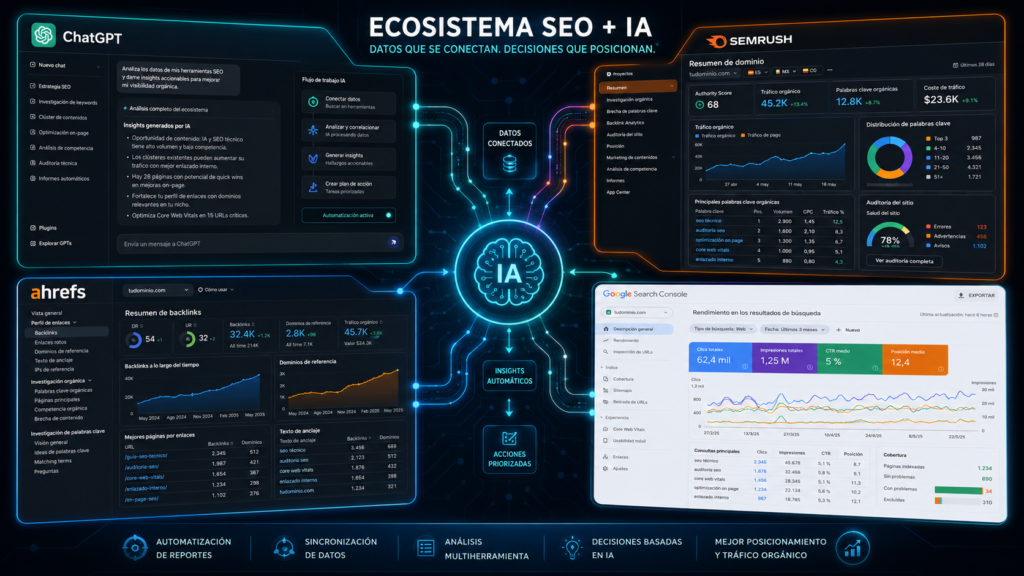
La inteligencia artificial ha dado lugar a una nueva generación de herramientas capaces de acelerar gran parte del trabajo SEO.
Sin embargo, no todas sirven para lo mismo.
Algunas destacan en la creación de contenido, otras en investigación de palabras clave y otras en análisis de datos.
Por eso, una estrategia SEO moderna suele combinar varias soluciones.
ChatGPT para SEO
Si existe una herramienta que ha cambiado el SEO durante los últimos años, esa es ChatGPT.
Su principal ventaja es la versatilidad.
Puede ayudarte a:
- Crear estructuras SEO.
- Generar ideas de contenido.
- Encontrar palabras clave relacionadas.
- Crear FAQs.
- Diseñar silos temáticos.
- Optimizar títulos y metadescripciones.
- Analizar intención de búsqueda.
Ejemplo práctico
Actúa como consultor SEO.

Analiza la keyword "IA para empresas".

Genera:

- Keywords principales.
- Keywords secundarias.
- Long tails.
- FAQs.
- Estructura H1-H3.
Este tipo de prompts permite acelerar enormemente la fase de planificación.
Claude para análisis SEO
Aunque suele ser menos conocido que ChatGPT, Claude ofrece ventajas muy interesantes para proyectos SEO.
Especialmente cuando trabajamos con:
- Artículos extensos.
- Auditorías.
- Grandes cantidades de texto.
- Análisis de documentación.
Casos de uso
- Revisar contenidos largos.
- Detectar redundancias.
- Mejorar claridad.
- Analizar documentación SEO.
Por este motivo muchos profesionales utilizan Claude como complemento de ChatGPT.
Gemini para investigación y tendencias
Gemini destaca especialmente cuando necesitamos:
- Buscar información.
- Detectar tendencias.
- Investigar sectores.
- Encontrar nuevas oportunidades temáticas.
Resulta especialmente útil durante la fase de investigación previa al contenido.
Semrush y Ahrefs potenciados con IA
Las plataformas SEO tradicionales también están incorporando inteligencia artificial.
Actualmente herramientas como:
- Semrush.
- Ahrefs.
permiten acelerar:
- Investigación de keywords.
- Análisis de competencia.
- Agrupación temática.
- Detección de oportunidades.
La combinación entre datos SEO reales e inteligencia artificial es especialmente potente.
Search Console: la mina de oro olvidada
Muchos especialistas buscan constantemente nuevas herramientas y olvidan una de las más valiosas.
Google Search Console.
Combinada con IA puede ayudarte a:
- Detectar oportunidades.
- Identificar keywords ocultas.
- Mejorar CTR.
- Actualizar contenidos.
Por ejemplo, puedes exportar consultas y pedir a ChatGPT que detecte nuevas oportunidades temáticas.
Cómo utilizar IA para investigar palabras clave
La investigación de keywords es una de las áreas donde la IA genera mejores resultados.
Descubrir keywords secundarias
A partir de una keyword principal puedes generar:
- Variantes.
- Sinónimos.
- Entidades.
- Long tails.
Esto mejora enormemente la cobertura temática.
Detectar preguntas frecuentes
La IA puede ayudarte a identificar preguntas reales relacionadas con una temática.
Esto resulta muy útil para:
- FAQs.
- Featured Snippets.
- Búsquedas conversacionales.
Construir clusters temáticos
Una de las aplicaciones más potentes.
Por ejemplo:
Keyword principal:
Inteligencia Artificial
Cluster:
- Qué es la IA.
- Tipos de IA.
- IA Generativa.
- IA para Empresas.
- IA para SEO.
- Automatización con IA.
Exactamente el tipo de estructura que estamos construyendo en Bright Technology.
Cómo crear artículos SEO con IA

La creación de contenido es probablemente el uso más popular de la inteligencia artificial dentro del SEO.
Sin embargo, existe una diferencia enorme entre:
❌ Generar texto automáticamente.
y
✅ Utilizar IA para crear contenido útil y optimizado.
Investigación
La IA puede ayudarte a recopilar:
- Conceptos clave.
- Entidades.
- Keywords.
- Preguntas frecuentes.
Estructura
Puede generar:
- H1.
- H2.
- H3.
- FAQs.
- Ideas de contenido.
Redacción asistida
Permite acelerar la producción sin renunciar a la calidad.
Especialmente cuando se combina con experiencia humana.
Optimización semántica
La IA puede detectar:
- Conceptos faltantes.
- Sinónimos.
- Variantes semánticas.
- Entidades relacionadas.
Esto suele mejorar la cobertura temática de los contenidos.
Errores que debes evitar al usar IA para SEO
La inteligencia artificial es una herramienta extraordinaria.
Pero también puede generar problemas si se utiliza incorrectamente.
Publicar contenido sin revisar
Uno de los errores más frecuentes.
Todo contenido generado mediante IA debe:
- Revisarse.
- Verificarse.
- Enriquecerse.
Crear contenido genérico
Google premia cada vez más:
- Experiencia.
- Originalidad.
- Utilidad.
Por ello es fundamental aportar valor adicional.
Ignorar la intención de búsqueda
No basta con incluir palabras clave.
Es necesario responder exactamente a lo que busca el usuario.
Obsesionarse con la automatización
La automatización es útil.
Pero la estrategia sigue siendo humana.
Los mejores proyectos combinan:
- SEO.
- IA.
- Experiencia real.
- Conocimiento del sector.
El futuro del SEO con Inteligencia Artificial
Todo indica que la relación entre SEO e inteligencia artificial seguirá estrechándose durante los próximos años.
Veremos herramientas capaces de:
- Analizar contenidos automáticamente.
- Detectar oportunidades.
- Crear estrategias temáticas.
- Optimizar páginas.
- Automatizar tareas avanzadas.
Sin embargo, cuanto más evolucione la IA, más importancia tendrán factores como:
- Experiencia.
- Autoridad.
- Credibilidad.
- Especialización.
Precisamente porque el contenido genérico será cada vez más fácil de generar.
Por eso los proyectos que combinen inteligencia artificial con experiencia real seguirán teniendo una enorme ventaja competitiva.
Conclusión
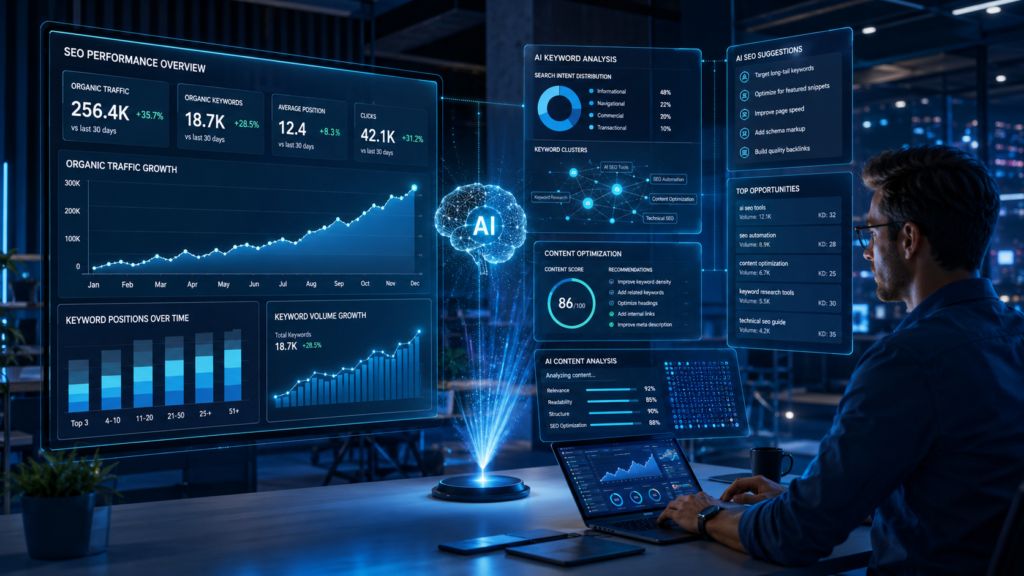
La IA para SEO se ha convertido en una de las herramientas más valiosas para cualquier profesional del posicionamiento web.
Permite acelerar procesos, descubrir nuevas oportunidades, mejorar la productividad y optimizar contenidos de una forma que hace apenas unos años parecía imposible.
Herramientas como ChatGPT, Claude, Gemini, Semrush, Ahrefs o Google Search Console están cambiando la forma en que se investiga, planifica y ejecuta una estrategia SEO.
Sin embargo, la verdadera ventaja competitiva no está en utilizar inteligencia artificial.
Está en saber utilizarla mejor que los demás.
Los proyectos que combinen automatización, análisis de datos, experiencia real y contenidos de calidad seguirán teniendo una posición privilegiada en los resultados de búsqueda.
La IA no sustituye al SEO.
Lo potencia.
Y quienes aprendan a integrar ambas disciplinas tendrán una enorme ventaja durante los próximos años.
Sigue aprendiendo sobre Inteligencia Artificial
Preguntas frecuentes sobre IA para SEO
La IA para SEO consiste en utilizar herramientas de inteligencia artificial para mejorar procesos relacionados con el posicionamiento web.
Estas herramientas pueden ayudar a:
Investigar palabras clave.
Crear contenido.
Analizar competidores.
Optimizar artículos.
Detectar oportunidades SEO.
Automatizar tareas repetitivas.
Su objetivo principal es aumentar la productividad y mejorar la calidad de las estrategias de posicionamiento.
La IA puede acelerar enormemente muchas tareas que anteriormente requerían trabajo manual.
Por ejemplo:
Investigación de keywords.
Creación de estructuras SEO.
Análisis semántico.
Optimización de contenidos.
Detección de oportunidades temáticas.
Esto permite dedicar más tiempo a la estrategia y menos a tareas operativas.
No.
La inteligencia artificial puede ayudar a crear contenido y optimizar procesos, pero el posicionamiento sigue dependiendo de muchos factores.
Entre ellos:
Calidad del contenido.
Experiencia del autor.
Autoridad del sitio.
Enlaces.
Experiencia de usuario.
Intención de búsqueda.
La IA debe entenderse como una herramienta de apoyo, no como una solución mágica.
Sí.
Actualmente es una de las herramientas más utilizadas por especialistas SEO.
Puede ayudar a:
Generar ideas.
Crear estructuras.
Encontrar palabras clave relacionadas.
Redactar borradores.
Crear FAQs.
Diseñar clusters temáticos.
Sin embargo, siempre es recomendable revisar y enriquecer el contenido generado.
Algunas de las más populares actualmente son:
ChatGPT.
Claude.
Gemini.
Semrush.
Ahrefs.
Google Search Console.
Screaming Frog.
Cada una destaca en áreas diferentes del posicionamiento web.
Sí.
La inteligencia artificial es especialmente útil para:
Encontrar keywords secundarias.
Generar long tails.
Detectar preguntas frecuentes.
Descubrir entidades relacionadas.
Crear clusters de contenido.
Esto facilita enormemente la planificación SEO.
Google no penaliza automáticamente el contenido por haber sido creado con inteligencia artificial.
Lo que evalúa es la calidad del contenido.
Si un artículo aporta valor, responde correctamente a la intención de búsqueda y ofrece una buena experiencia al usuario, puede posicionarse independientemente de cómo haya sido creado.
Los más comunes son:
Publicar contenido sin revisar.
Crear textos genéricos.
Ignorar la intención de búsqueda.
No aportar experiencia propia.
Abusar de la automatización.
Los mejores resultados suelen obtenerse combinando IA y criterio humano.
Puede ayudar enormemente.
Por ejemplo:
Analizando contenidos.
Detectando oportunidades semánticas.
Revisando estructuras.
Identificando mejoras.
Sin embargo, las auditorías técnicas siguen requiriendo herramientas especializadas y revisión profesional.
Todo apunta a que la inteligencia artificial será una parte cada vez más importante del posicionamiento web.
Sin embargo, factores como:
Experiencia.
Autoridad.
Especialización.
Credibilidad.
seguirán siendo fundamentales para destacar frente a la competencia.