
- ¿Qué es la Inteligencia Artificial?
- Diferencias entre IA, Machine Learning y Deep Learning
- Principales aplicaciones de la inteligencia artificial
- Qué es la inteligencia artificial generativa
- Herramientas de inteligencia artificial
- Cómo puede evolucionar la inteligencia artificial
- Conclusión
- Preguntas frecuentes sobre Inteligencia Artificial
La inteligencia artificial ya forma parte de numerosas herramientas y servicios que utilizamos diariamente. Los sistemas de recomendación, los asistentes conversacionales, el reconocimiento de imágenes, los traductores automáticos y las aplicaciones capaces de crear texto, vídeo o imágenes son algunos ejemplos.
Sin embargo, la IA no es una única tecnología ni funciona siempre de la misma manera. Existen sistemas diseñados para predecir resultados, clasificar información, generar contenido, recomendar productos, reconocer patrones o ejecutar determinadas tareas de forma automática.
En esta guía aprenderás qué es la inteligencia artificial, cómo funciona, qué tipos existen, dónde se utiliza, cuáles son sus principales beneficios y limitaciones y cómo puedes empezar a aprovecharla sin necesidad de ser programador.
¿Qué es la Inteligencia Artificial?
La inteligencia artificial es un campo de la informática dedicado a desarrollar sistemas capaces de producir resultados que asociamos con determinadas capacidades inteligentes.
Un sistema de IA puede utilizar la información que recibe para generar:
- Predicciones.
- Clasificaciones.
- Recomendaciones.
- Contenido.
- Respuestas.
- Decisiones.
- Acciones dentro de un entorno físico o digital.
La OCDE define un sistema de IA como un sistema basado en máquinas que infiere, a partir de las entradas recibidas y de unos objetivos explícitos o implícitos, cómo generar resultados que pueden influir en entornos físicos o virtuales. Los sistemas pueden variar en su nivel de autonomía y en su capacidad para adaptarse después de ser desplegados.
Esto no significa necesariamente que la máquina piense o comprenda como una persona. Un sistema puede realizar una tarea compleja analizando patrones y calculando resultados sin poseer conciencia, intención o comprensión humana.
En nuestra guía sobre qué es la inteligencia artificial y cómo funciona encontrarás una explicación más detallada sobre datos, algoritmos, entrenamiento, modelos y redes neuronales.
Cómo funciona la inteligencia artificial
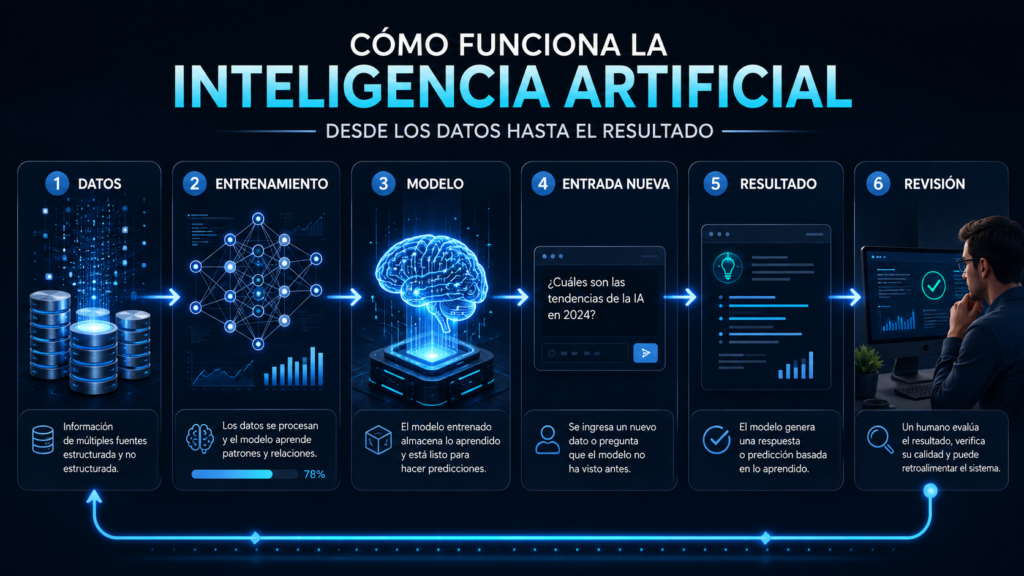
El funcionamiento depende del sistema utilizado, pero muchos proyectos de IA siguen un proceso parecido:
- Reciben información.
- Procesan o preparan los datos.
- Utilizan un modelo para encontrar patrones.
- Generan un resultado.
- Evalúan el resultado y realizan ajustes cuando corresponde.
Datos de entrada
Los datos son la información utilizada por el sistema.
Pueden consistir en:
- Textos.
- Imágenes.
- Grabaciones de audio.
- Vídeos.
- Datos numéricos.
- Historiales de comportamiento.
- Información procedente de sensores.
- Instrucciones escritas por el usuario.
La calidad, la relevancia y la representatividad de los datos influyen directamente en el comportamiento del sistema.
Disponer de una gran cantidad de información no garantiza buenos resultados. Los datos también deben estar correctamente seleccionados, organizados y revisados.
Entrenamiento del modelo
Durante el entrenamiento, el sistema ajusta sus parámetros para aprender relaciones y patrones presentes en los datos.
Por ejemplo, un modelo destinado a reconocer imágenes puede analizar numerosos ejemplos etiquetados hasta aprender qué características ayudan a diferenciar unas categorías de otras.
El proceso cambia según la técnica utilizada. Algunos modelos aprenden mediante ejemplos etiquetados, otros buscan estructuras sin etiquetas y otros mejoran mediante recompensas asociadas a sus acciones.
Generación de resultados
Una vez entrenado, el modelo puede recibir una entrada nueva y producir una salida.
Esa salida podría ser:
- Una categoría.
- Una probabilidad.
- Una previsión.
- Una recomendación.
- Una respuesta escrita.
- Una imagen.
- Una acción.
Cuando utilizas un asistente conversacional, por ejemplo, tu instrucción se procesa como una entrada y el modelo genera una respuesta basándose en los patrones aprendidos y en el contexto disponible.
Evaluación y supervisión
Los modelos deben evaluarse para comprobar su precisión, fiabilidad, seguridad y adecuación a la tarea.
También puede ser necesaria supervisión humana para:
- Revisar resultados importantes.
- Detectar errores.
- Corregir sesgos.
- Actualizar datos.
- Gestionar casos inesperados.
- Evitar que el sistema se utilice fuera de su finalidad.
Una inteligencia artificial no debe considerarse automáticamente correcta solo porque su respuesta parezca convincente.
Diferencias entre IA, Machine Learning y Deep Learning
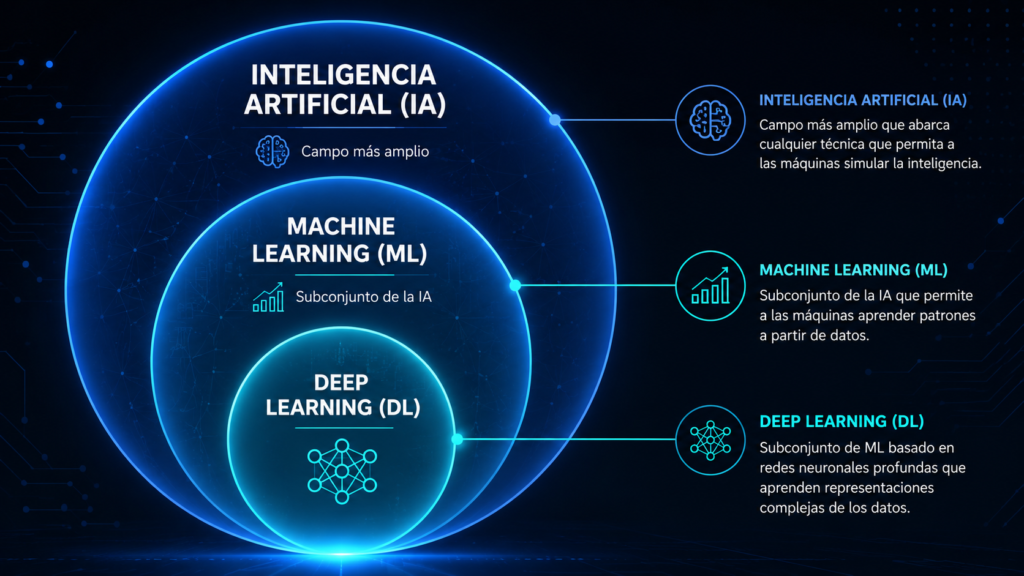
Aunque suelen utilizarse como sinónimos, representan conceptos relacionados pero diferentes.
| Concepto | Qué significa | Cómo funciona | Ejemplo |
|---|---|---|---|
| Inteligencia artificial | Campo general dedicado a crear sistemas capaces de realizar tareas inteligentes | Puede utilizar reglas, aprendizaje automático u otras técnicas | Asistentes, sistemas expertos y robots |
| Machine Learning | Rama de la IA que aprende patrones a partir de datos | Ajusta modelos utilizando ejemplos | Recomendaciones o detección de fraude |
| Deep Learning | Subcampo del Machine Learning basado en redes neuronales profundas | Utiliza múltiples capas para procesar información compleja | Reconocimiento de imágenes y modelos generativos |
La relación puede entenderse así:
Inteligencia artificial
└── Machine Learning
    └── Deep Learning
Todo sistema de Deep Learning forma parte del Machine Learning, y este se encuentra dentro del campo general de la inteligencia artificial. Sin embargo, no toda la inteligencia artificial utiliza aprendizaje automático ni redes neuronales profundas.
Qué tipos de inteligencia artificial existen
La IA puede clasificarse mediante diferentes criterios. No existe una única lista válida para todos los contextos.
IA según su capacidad
Una clasificación habitual distingue entre:
- Inteligencia artificial estrecha o ANI: diseñada para realizar determinadas tareas.
- Inteligencia artificial general o AGI: concepto de una IA capaz de desenvolverse de manera general en una amplia variedad de tareas intelectuales.
- Superinteligencia artificial o ASI: escenario hipotético en el que un sistema superaría ampliamente las capacidades humanas.
La IA que utilizamos actualmente está compuesta principalmente por sistemas especializados, aunque algunos modelos pueden realizar una variedad creciente de tareas. AGI y ASI continúan siendo conceptos de investigación y debate, y no categorías de productos claramente alcanzadas y aceptadas de manera general.
IA según la tarea que realiza
También podemos diferenciar:
- IA predictiva: calcula qué podría ocurrir.
- IA clasificadora: asigna información a categorías.
- IA de recomendación: selecciona contenido o productos.
- IA conversacional: interactúa mediante lenguaje.
- Visión artificial: analiza imágenes y vídeos.
- IA generativa: produce contenido nuevo.
- Sistemas autónomos: ejecutan acciones con determinados grados de autonomía.
- Agentes de IA: combinan modelos, instrucciones y herramientas para completar objetivos.
Nuestra guía sobre los tipos de inteligencia artificial desarrolla las diferencias entre ANI, AGI, ASI, IA predictiva, generativa, conversacional y otros enfoques.
Principales aplicaciones de la inteligencia artificial
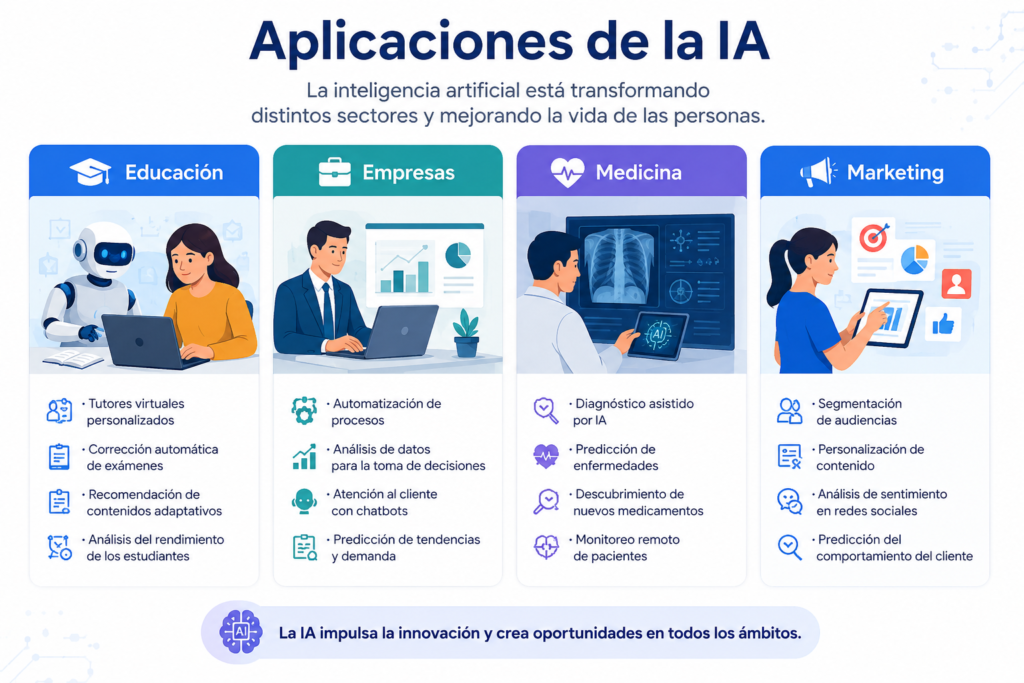
La utilidad de la IA no depende únicamente de un sector, sino del problema que se intenta resolver.
| Área | Aplicación | Ejemplo de resultado |
|---|---|---|
| Educación | Aprendizaje personalizado y tutores | Explicaciones adaptadas al alumno |
| Empresas | Automatización y análisis | Procesos más rápidos y detección de patrones |
| Medicina | Apoyo al análisis clínico | Identificación de señales en imágenes o datos |
| Marketing | Segmentación y contenido | Campañas adaptadas a diferentes audiencias |
| Programación | Generación y revisión de código | Sugerencias, documentación y detección de errores |
| Comercio electrónico | Recomendaciones | Productos ajustados a los intereses del usuario |
| Finanzas | Detección de anomalías | Alertas sobre operaciones inusuales |
| Industria | Mantenimiento predictivo | Avisos antes de que se produzca una avería |
| Transporte | Optimización de rutas | Mejor planificación de desplazamientos |
| Ciberseguridad | Detección de amenazas | Identificación de comportamientos anómalos |
La IA también se utiliza de manera cotidiana en buscadores, filtros de correo no deseado, traducción, reconocimiento facial, asistentes de voz y sistemas de recomendación.
La guía sobre aplicaciones de la inteligencia artificial analiza con mayor profundidad sus usos en educación, empresas, salud, marketing, industria y otros sectores.
También dispones de guías especializadas sobre:
- Inteligencia artificial para estudiantes.
- Inteligencia artificial para empresas.
- IA aplicada al marketing.
- Inteligencia artificial para SEO.
Qué es la inteligencia artificial generativa
La IA generativa está diseñada para producir contenido a partir de instrucciones, ejemplos u otros datos de entrada.
Puede generar:
- Texto.
- Imágenes.
- Audio.
- Música.
- Vídeo.
- Código.
- Presentaciones.
- Modelos tridimensionales.
Estos sistemas aprenden relaciones presentes en los datos utilizados durante su desarrollo y generan resultados que siguen patrones similares.
La IA generativa no recupera necesariamente una respuesta exacta almacenada. Dependiendo del sistema, construye un resultado nuevo a partir de probabilidades, representaciones aprendidas y el contexto proporcionado.
Esto explica por qué una misma instrucción puede generar respuestas diferentes y por qué el sistema también puede producir errores, detalles inexistentes o contenido que necesita revisión.
Consulta nuestra guía sobre qué es la IA generativa para conocer sus modelos, formatos, aplicaciones, ventajas y riesgos.
Herramientas de inteligencia artificial
No existe una herramienta que sea la mejor para todas las tareas. La elección depende del objetivo, el formato de trabajo, las integraciones necesarias y el nivel de control que necesitas.
| Necesidad | Tipo de herramienta | Ejemplos |
|---|---|---|
| Conversar y redactar | Asistente de IA | ChatGPT, Gemini o Claude |
| Investigar información | Buscador asistido por IA | Perplexity y herramientas con búsqueda |
| Crear imágenes | Generador visual | Midjourney, DALL·E y modelos de difusión |
| Ayudar a programar | Asistente de código | Copilot y asistentes integrados en editores |
| Automatizar procesos | Plataforma de automatización | Make, Zapier, n8n y herramientas conectadas |
| Productividad de oficina | Asistente integrado | Copilotos para documentos, correo y reuniones |
Estos nombres son ejemplos, no una clasificación definitiva. Las funciones, precios y capacidades cambian con rapidez, por lo que las comparativas deben revisarse periódicamente.
Puedes consultar:
- Las mejores herramientas de inteligencia artificial.
- La comparativa entre ChatGPT, Gemini y Claude.
- Nuestra guía para crear imágenes con inteligencia artificial.
Ventajas de la inteligencia artificial
La IA puede aportar valor cuando se aplica a un problema adecuado y se supervisa correctamente.
Automatización de tareas
Permite reducir el tiempo dedicado a trabajos repetitivos como clasificación, extracción de datos, preparación de borradores o procesamiento de consultas frecuentes.
Análisis de grandes cantidades de información
Los modelos pueden detectar relaciones y patrones en volúmenes de datos difíciles de revisar manualmente.
Personalización
La IA permite adaptar recomendaciones, explicaciones, productos o experiencias a diferentes perfiles.
Apoyo a la toma de decisiones
Puede aportar predicciones, clasificaciones o información relevante para que una persona tome una decisión mejor fundamentada.
Accesibilidad
El reconocimiento de voz, la transcripción, la traducción y la generación de descripciones pueden facilitar el acceso a información y servicios.
Creatividad y productividad
Los sistemas generativos pueden ayudar a desarrollar ideas, borradores, diseños, código y materiales iniciales que posteriormente revisará una persona.
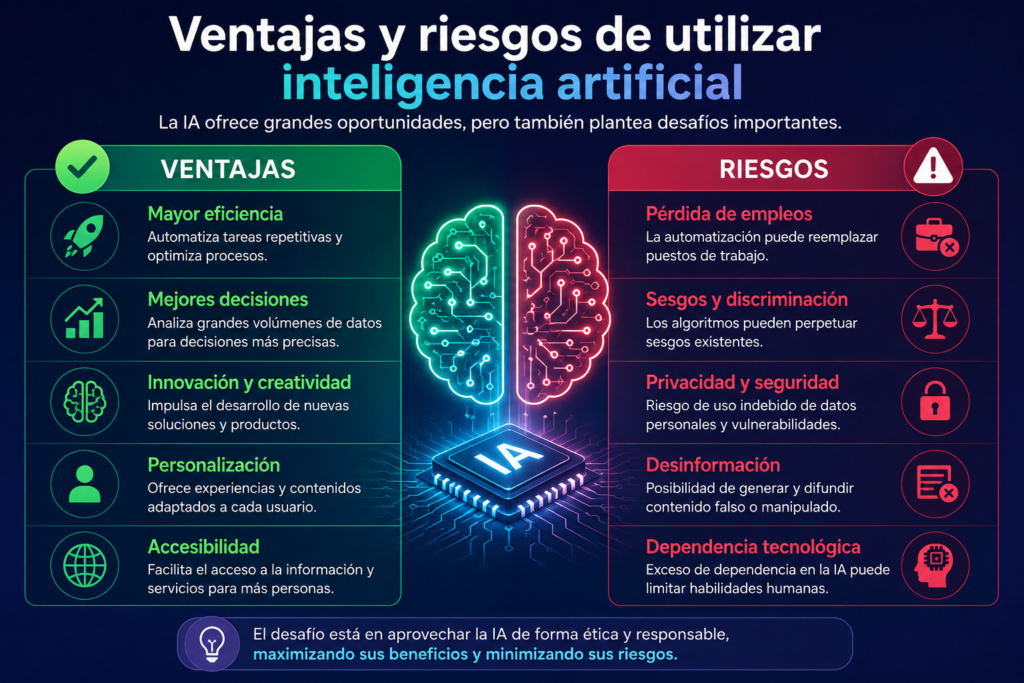
Riesgos y limitaciones de la inteligencia artificial
La IA también presenta limitaciones que deben entenderse antes de utilizarla en tareas importantes.
Información incorrecta
Un sistema puede generar una respuesta convincente pero equivocada, especialmente cuando no dispone de información suficiente o se le pide algo fuera de su capacidad.
Sesgos
Si los datos o el proceso de desarrollo contienen desequilibrios, el modelo puede reproducir resultados injustos o poco representativos.
Privacidad
Introducir información personal, empresarial o confidencial en una herramienta externa puede generar riesgos si no se conocen sus condiciones de uso y tratamiento de datos.
Falta de transparencia
Algunos modelos complejos dificultan entender exactamente por qué se ha producido un determinado resultado.
Dependencia excesiva
Delegar tareas sin revisar los resultados puede deteriorar el criterio propio y multiplicar errores.
Uso malintencionado
La IA puede utilizarse para crear desinformación, suplantaciones, contenido engañoso, ataques automatizados o manipulaciones.
NIST recomienda gestionar los riesgos de IA durante todo su ciclo de vida, teniendo en cuenta fiabilidad, seguridad, privacidad, transparencia, sesgos y supervisión.
La regla práctica es sencilla:
Cuanto mayor sea el impacto de una decisión, mayor debe ser el nivel de comprobación y supervisión humana.
Cómo empezar a utilizar inteligencia artificial
No necesitas aprender programación para comenzar. Lo importante es escoger una tarea concreta y comprobar si la herramienta realmente mejora el proceso.
Define una tarea concreta
Evita empezar con un objetivo demasiado amplio como “quiero utilizar IA”.
Escoge una tarea:
- Resumir un texto.
- Crear un borrador.
- Organizar información.
- Preparar preguntas.
- Comparar opciones.
- Generar ideas.
- Analizar un documento.
- Crear una imagen inicial.
Elige una herramienta
Selecciona una plataforma adecuada al formato:
- Asistente conversacional para texto.
- Generador visual para imágenes.
- Herramienta especializada para vídeo.
- Copiloto de programación para código.
- Plataforma de automatización para procesos.
Aprende a proporcionar contexto
Una buena instrucción debe explicar:
- Qué necesitas.
- Para qué lo necesitas.
- Quién utilizará el resultado.
- Qué información debe tener en cuenta.
- En qué formato debe responder.
- Qué limitaciones debe respetar.
La guía de prompts para ChatGPT contiene estructuras y ejemplos que puedes adaptar.
Verifica los resultados
Comprueba:
- Datos.
- Nombres.
- Fechas.
- Fuentes.
- Cálculos.
- Interpretaciones.
- Posibles omisiones.
- Información sensible.
No publiques ni utilices automáticamente un resultado importante sin revisarlo.
Integra la IA progresivamente
Cuando una tarea sencilla funcione bien, puedes incorporarla a un proceso más amplio.
Por ejemplo:
- Investigar un tema.
- Organizar los datos.
- Crear un borrador.
- Revisarlo manualmente.
- Adaptarlo al usuario.
- Publicar la versión final.
Para procesos repetitivos puedes consultar nuestra guía sobre automatización con inteligencia artificial.
Quienes estén empezando con asistentes conversacionales también pueden seguir el tutorial sobre cómo utilizar ChatGPT paso a paso.
Cómo puede evolucionar la inteligencia artificial
La capacidad de los sistemas continúa avanzando en áreas como lenguaje, programación, razonamiento, generación multimedia, ciencia y ejecución de tareas mediante agentes.
Sin embargo, no es posible predecir con certeza qué capacidades aparecerán, cuándo estarán disponibles o qué impacto producirán.
La evolución probablemente estará marcada por:
- Modelos capaces de trabajar con varios formatos.
- Agentes que utilicen herramientas y completen procesos.
- Mayor integración en dispositivos y aplicaciones.
- Sistemas especializados en sectores concretos.
- Más automatización.
- Mayor necesidad de evaluación y regulación.
- Nuevas formas de interacción entre personas y máquinas.
El AI Index 2026 de Stanford destaca tanto el rápido avance de las capacidades y la adopción como las dificultades para medir, gestionar y gobernar esa evolución al mismo ritmo.
Aprender a utilizar la IA de manera crítica será más útil que intentar adivinar exactamente cómo será dentro de varios años.
Conclusión
La inteligencia artificial reúne diferentes tecnologías capaces de generar predicciones, recomendaciones, clasificaciones, contenido o acciones a partir de los datos y objetivos recibidos.
No es una única herramienta ni una inteligencia equivalente a la humana. Existen sistemas especializados en lenguaje, imágenes, recomendación, predicción, automatización y muchas otras tareas.
Para aprovecharla correctamente debes escoger una aplicación concreta, proporcionar contexto suficiente, proteger la información sensible y comprobar siempre los resultados importantes.
Preguntas frecuentes sobre Inteligencia Artificial
La inteligencia artificial es una tecnología capaz de realizar tareas que normalmente requieren inteligencia humana, como aprender, analizar información o generar contenido.
Utiliza algoritmos y modelos matemáticos entrenados con grandes cantidades de datos para identificar patrones y generar respuestas.
No debe asumirse que comprende, razona o posee conciencia como un ser humano. Puede generar resultados complejos mediante modelos matemáticos y patrones aprendidos.
La IA es el campo general. El Machine Learning es una de sus ramas y permite construir sistemas que aprenden patrones a partir de datos.
Es un subcampo del Machine Learning que utiliza redes neuronales profundas para procesar información compleja.
Es una categoría de inteligencia artificial capaz de producir texto, imágenes, audio, vídeo, código u otros contenidos.
No. Muchas herramientas actuales disponen de interfaces conversacionales o visuales pensadas para usuarios sin conocimientos de programación.
Depende de la tarea. Un asistente conversacional puede ser adecuado para texto, mientras que una herramienta especializada resultará más útil para imágenes, vídeo, automatización o programación.
Sí. Puede producir información incorrecta, incompleta, desactualizada o sesgada. Los resultados importantes deben verificarse.
Puede automatizar tareas y transformar puestos de trabajo, pero su impacto depende del sector, del proceso y de cómo se integre. No todas las actividades pueden delegarse ni todos los resultados pueden utilizarse sin supervisión.
Depende de la herramienta, su configuración y sus condiciones de privacidad. No debes introducir datos personales, confidenciales o empresariales sin comprobar cómo serán tratados.
Comienza con una tarea concreta, prueba una herramienta accesible, aprende a proporcionar instrucciones claras y comprueba siempre la calidad del resultado.